Native Species Are Natural Choices

California lilac grows wild throughout California.

Wildflowers are only part of the story. They are happy enough with the chaparral climate here to bloom for spring or summer. A few are naturalized exotic species, though. In other words, they are not native to California. They merely behave like they are, likely because they are from similar climates. Native species are happy here because they are at home.

More than the most abundant wildflowers are native. Many trees, vines, shrubs, annuals and perennials are also. They were here long before Spanish explorers imported the first exotic plants after 1542. They were as satisfied with local soils and climates then as they are now. This is why many are more suitable for home gardens than many exotic plants.

Native plants are less popular than exotic plants only because a few are a bit too natural. Since they are from chaparral climates, some may get a bit scraggly and dry by summer. They survive arid weather by being partially dormant through some of it. Most appreciate irrigation through summer. However, some are susceptible to rot with generous irrigation.

Conversely, there are several advantages to native plant species. They naturally require less irrigation than most exotic species. Once established, some expect none at all. Only species from other chaparral or desert climates might be less demanding. Landscapes of exclusively native species therefore conserve water. Some get all they want from rainfall.

Also, native species are more compatible with natural ecosystems. Any that self sow into nearby wildlands will be where they belong. They do not compete unfairly for pollinators that other native species rely on. Nor do they compete unfairly for possibly limited space and resources. Furthermore, they contribute habitat and sustenance to wild native fauna.

California poppy and sky lupine are probably the most familiar of native annuals. Various salvias and bush lupines may be the most familiar native perennials. California lilac and flannel bush are familiar native shrubs. California sycamore, coastal redwood and coast live oak are familiar native trees. Many native species are practicable for home gardens, and landscaping.

California Native Plants

(Some of the information within this article is very outdated because the article was recycled from several years ago.

Valley oak, as well as coast live oak, were the two most common native non-riparian tree species of the Santa Clara Valley.

Bringing nature to the garden is generally very unnatural. Before urban development of the Santa Clara Valley, there were a few valley and coast live oaks spread out sporadically over open chaparral, with a few sycamores, maples and other riparian specie only in the creeks and Guadalupe River that run through it. There are vastly more trees and plant life here now than there ever have been, and specie from every region of the world. Since exotic (non native) plants are from other climates and soils, they require unnatural accommodations, such as watering and fertilizers, to keep them happy.

The most natural gardening is done with native plants, which are naturally adapted to local climates and soils. Natives are not as demanding of amendments, fertilizers or pesticides as some exotic plants are, since they know how to get they want with the local resources available. Because most are satisfied with natural rainfall, they do just fine with minimal watering (once established).

All sorts of native plants will be available at the Native Plant Sale at Hidden Villa Ranch in Los Altos Hills in only ten days on October 16, from 10:00 a.m. to 3:00 p.m.. Deergrass, monkey flower, redbud, blue-eyed grass, buckwheat, sedums and native lilies and orchids will all be there and accurately labeled. Volunteers from the California Native Plant Society will be available to talk about alternatives to law, including native perennials, shrubs, wildflowers and grasses. Books about native plants, as well as posters and note cards featuring native plants will also be available.

From 1:00 to 2:00 p.m., Stephanie Curtis of Curtis Horticulture will give a free hour lecture about tips for planting success and maintenance for natives. Admission is limited to 25 people though, first come first served. 

Hidden Villa Ranch is located at 26870 Moody Road in Los Alton Hills, two miles west of the Moody Road and El Monte Road interchange at Highway 280. Plant selection is best early in the day. All sales must be by cash or check, since credit cards are not accepted. It helps to bring boxes to carry purchased items. More information can be found at www.cnps-scv.org or cnps_scv@yahoo.com or by telephoning 650 – 260 3450. Incidentally, autumn is a good time for planting, since the warmest part of summer is over, and the rain will arrive soon to settle soil around the roots of newly planted plants.  

Weed Eater

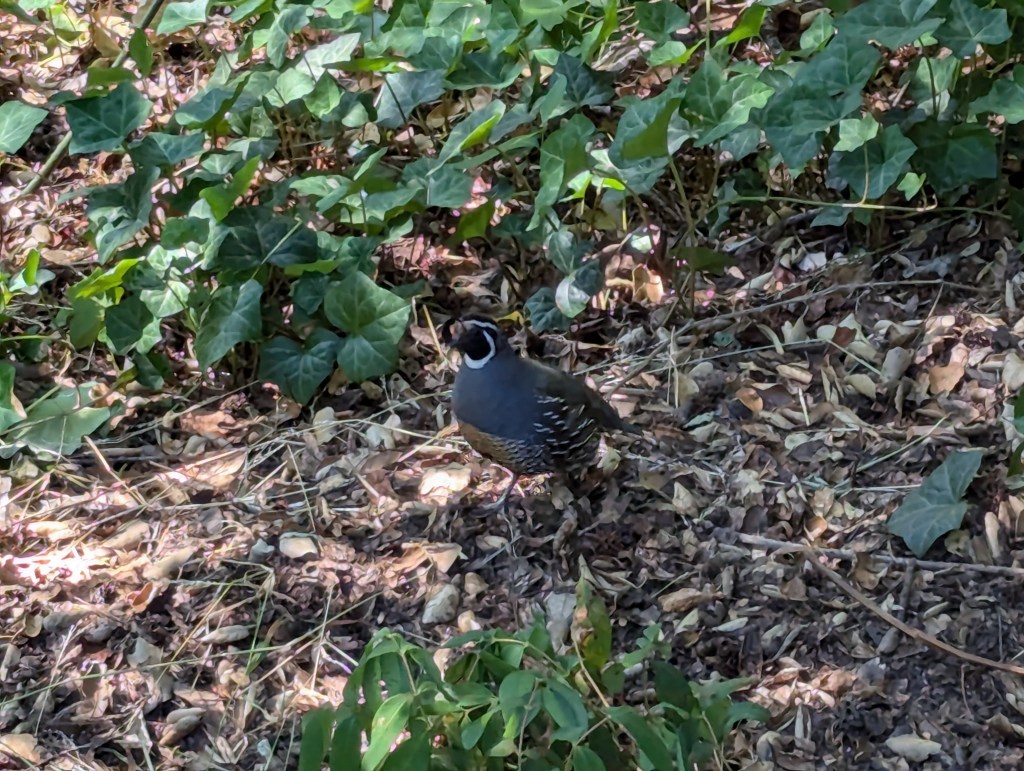
California quail are the Official State Bird of, as one might guess, California. They are delightfully plump but small game birds that are on the ground more than anywhere else. They fly only when necessary, and seem to avoid landing in trees or shrubbery. They effectively avoid predators by running into thickets of vegetation that their predators can not follow them into. Some believe that they sound like they say “Chicago” when they talk to each other. Actually though, they say “Hey Paco!”, in a politely mellow tone. They are a chaparral species that venture into adjacent forests such as the redwood forests here. Relatively colorful males, such as this, are typically followed by their visually subdued female mates after spring, and by now are likely to be followed by a herd of tiny and fuzzy chicks. Their motion on the ground is fluid, although most of a small herd can angularly and suddenly change direction, as if the Papa quail follows his silly apostrophe shaped topknot to the left or right, and the rest follow. They run about pecking at exposed soil, and often stop to scratch at forest debris where soil is not so exposed. Not only do they eat insects and mollusks, but most of their diet is seeds. Since only a negligible minority of seeds within our landscapes of desirable vegetation, such as naturalized wildflowers, almost all of the seeds that California quail eat here are those of weeds. They proactively eat weeds before they happen.

Godetia

All but one species of Clarkia are native somewhere in California.

Like California poppy, sky lupine and various other native wildflowers, godetia, Clarkia amoena, seems to prefer its own space. However, it is somewhat more adaptable than some other natives are to regular irrigation and coexisting with exotic (non-native) wildflowers that are not too overpowering. It is a common component in wildflower mixes, and is more likely than most to naturalize after the other wildflowers have died out. 

It is best to sow godetia seed in autumn, directly where the flowers are wanted, so that the seed get watered in by rain and begin to grow through winter and early spring. Bloom begins later in spring or early summer. In areas that do not get watered regularly, occasional watering prolongs bloom. Fertilizer can actually interfere with bloom though. As bloom finishes, deteriorating plants should be left to disperse seed for the following year.

The two inch wide flowers are typically pink or purplish with red blotches or veining. Some are very pale pink or nearly white with deeper pink blotches at their centers. Most godetia are only about a foot or two tall. ‘Dwarf Gem’ stays less than a foot tall. Taller types get nearly three feet tall. The lanky stems are adorned with narrow light bluish green leaves that are about half an inch to one and a half inches long.   

North & South

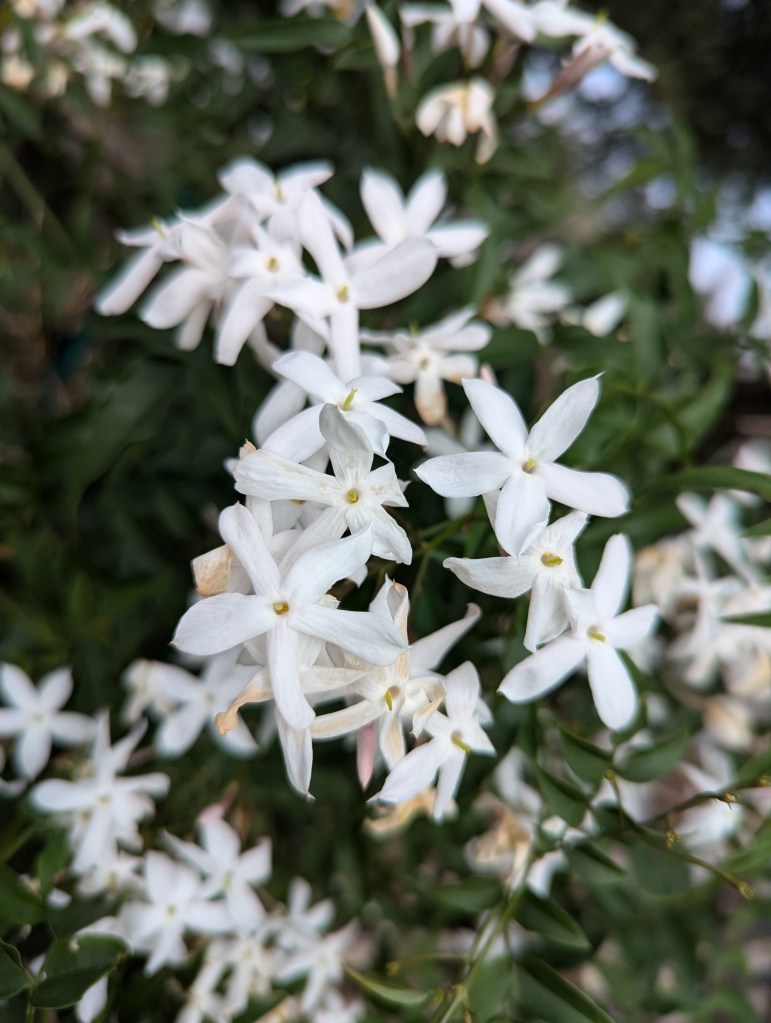
pink jasmine, Jasminum polyanthum

Brent and I studied horticulture through the second half of the 1980s at California Polytechnic State University at San Luis Obispo, which is known more simply as Cal Poly. San Luis Obispo is exactly halfway between where each of us came from. He came from the region west of Los Angeles, two hundred miles to the southeast, which is considered to be south by the standards of California. I came from the region west of San Jose, two hundred miles to the northwest, which is considered to be north by the standards of California. He considered San Luis Obispo to be within Northern California. I considered it to be within Southern California. Consequently, when either of us encountered a species with which we lacked prior experience, we assumed it to be regionally popular within the respectively unfamiliar half of California. Such assumptions were accurate for some species. For example, Brent was as fascinated with redwoods as I was with desert fan palms. He knew that redwoods are more popular here than in Southern California, and eventually went to experience them growing wild within their native range near Santa Cruz. I knew that desert fan palms are more popular in Southern California than here, and eventually went to experience them growing wild within their native range near Palm Springs. Pink jasmine, Jasminum polyanthum, was an odd one. Because Brent had never encountered it before, he assumed that it had been popular in Northern California. Because I had never encountered it before, I assumed that it had been popular in Southern California. In actuality, it only became commonly available throughout California at about the time that we encountered it, so had previously been popular neither here nor there. Nonetheless, to Brent, it is still as northern as it is southern to me.

Mojave

Joshua trees seem to be scarce near Joshua Tree.

About a quarter of California is desert. Most of that desert is part of the Mojave Desert. Much of it is very sparsely populated. All of it is fascinating to those who appreciate it.

Not many people live in the desert because the climate is so harsh, and because there is not much reason for many people to be there. Not far north of Los Angeles, which is the second most populous city in America, is one of the most sparsely populated regions of America within the Mojave Desert. It is unpleasantly hot and dry there all summer. It is certainly not the sort of place that should be appealing to horticulturists, although it is.

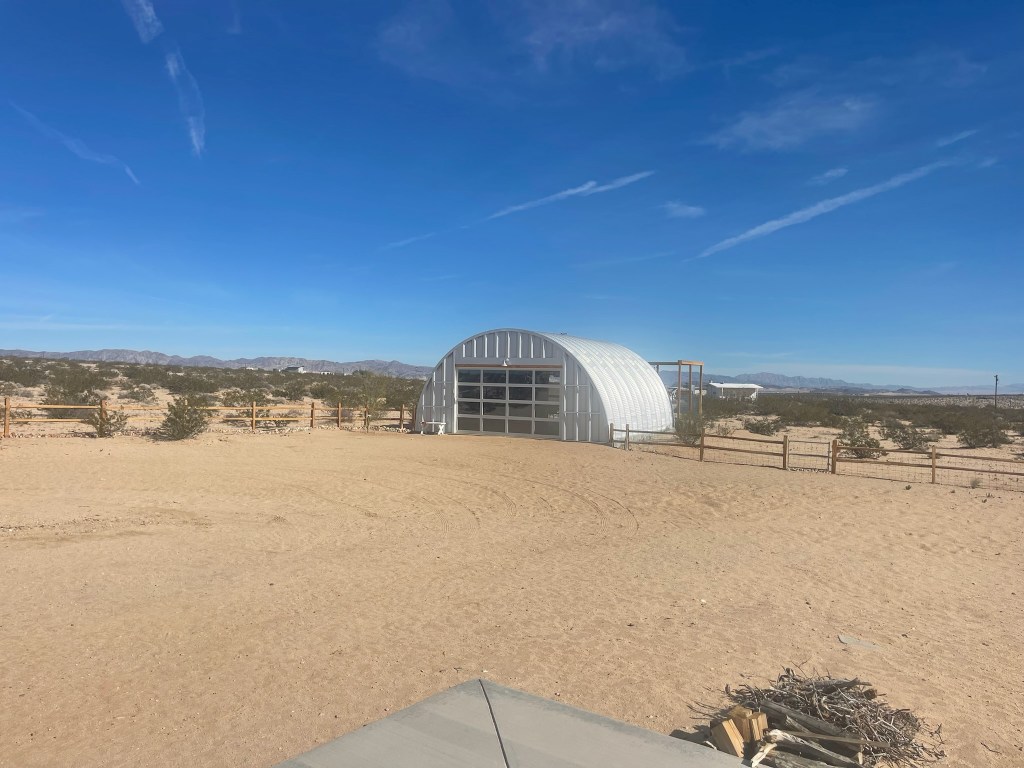
Brent sent me this picture from a place where he vacations near Joshua Tree. If there are Joshua trees near Joshua Tree, they are not visible within this picture. Actually, no trees are visible within this region where shade must be very important. The vegetation that is visible does not seem to be substantial. Vegetation is completely lacking within the fenced area. That small pile of firewood must have been brought from somewhere else. (Although nights are pleasant or warm between hot days, they can get very cold between cool days of winter.) I do not know what that building is. Without substantial vegetation, neighboring residences are visible in the distance.

Part of the allure of deserts for horticulturists is the very distinctive vegetation that lives only there. Part of the allure is the minimalism of such vegetation. Although many species live there, they are not very distinctive. Many resemble each other. In other words, much of the vegetation of the desert is easy to ignore. It is less distracting than that of other ecosystems that are more popular with those who are not horticulturists.

Yarrow

Yarrow is a popular American wildflower.

It is endemic to every Californian County except for only Imperial County. It is endemic to every American State except for only Hawaii. Yarrow, Achillea millefolium, gets around! It is also endemic to many temperate climates of Europe and Asia. Apparently, it is not very discriminating in regard to climate or soil. It is as happy at the coast as it is farther inland.

Wild yarrow mostly bloom white or with pink blush. Modern cultivars bloom various hues of yellow, orange, red, pink or pinkish lavender. A few of the most florific modern cultivars are hybrids with other species. Phases of bloom might continue from spring until autumn. Tiny flowers form dense corymbs as broad as five inches, on stems as high as three feet.

Ferny grayish or light green yarrow foliage has a softly fine texture. However, it develops compact and mounded form. Individual leaves are tomentous and as long as six inches. Foliar aroma is variable among cultivars. Some cultivars may be objectionably pungent. Propagation by division of any overgrowth is easiest prior to the end of the rainy season.

Six on Saturday: Hollywood

Vacation complicates blogging. So does spring. There is too much to get pictures of now. The pictures that I get are difficult to process while traveling without internet access. As has become typical for the past few weeks, these six pictures are already outdated. I took them prior to last Saturday, but I am only able to post them now. That is not the worst of it though. Even with so much blooming now, the only bloom within my Six for this week is scarcely visible, and half of these Six lack identifiable vegetation. The last is essentially devoid of vegetation. Heck, when it was more foliated between 1966 and 1968, the most prominent vegetation was fake. I might share six more appropriately floral pictures from the same location next week.

1. Opuntia phaeacantha or Opuntia littoralis, prickly pear grows wild in the Hollywood Hills. I got a picture closer to another herd for next week, but it may be another species.

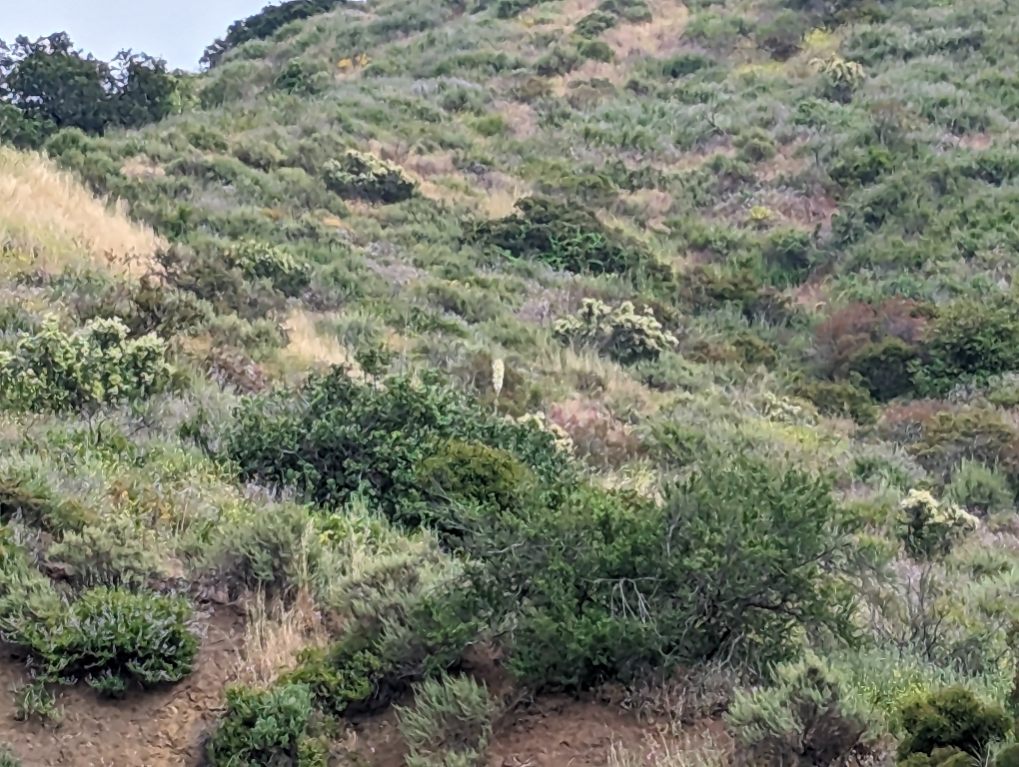
2. Hesperoyucca whipplei, our Lord’s candle blooms with an impressively tall and white floral stalk, but is barely visible at the center of this picture, taken from quite a distance.

3. Pinus pinea, Italian stone pine is obviously not native to the Hollywood Hills. I took a picture of this feral specimen because I thought it might be the legendary Wisdom Tree.

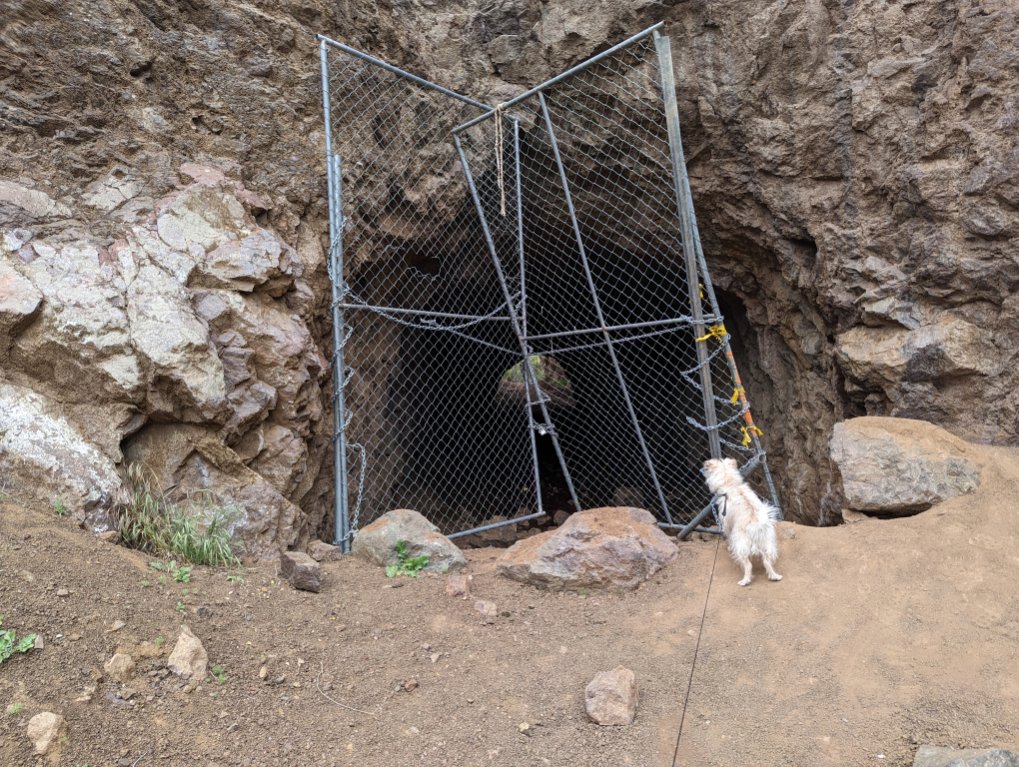
4. Not much vegetation is visible within this picture of an abandoned quarry, but Rhody directed me to this captivating scenery. Because of limited accessibility, we got no closer.

5. Zooming into the previous picture makes its scenery more captivating, and also shows a bit more vegetation within a residential landscape. Most of it is unidentifiable though.

6. Artificial English ivy with random native vegetation formerly inhabited this presently barren landscape. The busted fence is now quite uninviting. Does anyone recognize this?

This is the link for Six on Saturday, for anyone else who would like to participate: https://thepropagatorblog.wordpress.com/2017/09/18/six-on-saturday-a-participant-guide/

California Lilac

Native California lilac lacks lilac fragrance.

Almost all California lilac that inhabit refined landscapes are cultivars of native species. Ceanothus thyrsiflorus is one of such native species that grows wild near here. It is a bit less adaptable to home gardens than cultivars are. However, it can be splendid within unrefined and wildland landscapes. New plants need irrigation only until they establish their root systems. Wild plants need none.

Wild California lilac can get taller and wider than fifteen feet. That is larger than cultivars, but with more open branch structure. Their evergreen foliage is somewhat glossy. Individual leaves are only about an inch and a half long, with prominent veins. Fluffy floral trusses that bloom in spring are about two or three inches long. Tiny individual flowers are sky blue or pale blue.

Like many chaparral species, California lilac does not respond favorably to pruning. It performs best where it can grow without disruption. Wild specimens perform well for only about ten years. They might then die suddenly. Some may survive for nearly fifteen years. They grow faster with occasional irrigation, but do not survive as long.

California Native Plants Grow Wild

Some natives are difficult to domesticate.

California native plants seem like they should be very appropriate for home gardens. In the wild, they require neither irrigation nor maintenance. They are quite satisfied with local climate and soil. Of course, gardening with natives is not so simple. Home gardens are very different from wild ecosystems.

Furthermore, wild ecosystems here are very different from wild ecosystems elsewhere. California is a very big place, with many different ecosystems. Some alpine species from the Sierra Nevada would be unhappy on the coast. Some coastal species from Del Norte County would be unhappy in the Mojave Desert. California native plants should be regionally appropriate.

Therefore, chaparral species are generally most appropriate for local chaparral climates. Many riparian species perform satisfactorily here as well, but expect more irrigation. However, appropriateness to a climate is not the same as appropriateness to a garden. Actually, many chaparral species are unappealing within home gardens. Some are difficult to domesticate.

A few species of California lilac are native here. Any of them are pleased to inhabit local home gardens. However, some grow quite large, and then die after only ten years or so. They may not last even that long with typical irrigation. Few respond favorably to pruning. They prefer to grow wild. Such big, awkward and temporary plants are undesirable within many compact and refined home gardens.

Combustibility might also be a concern for chaparral plants. Some chaparral ecosystems rely on fire for periodic renovation. In the wild, some such ecosystems may burn as frequently as every few decades. After burning, fuel begins to accumulate for the next fire. Even if not copious enough to be hazardous, such accumulation can be unkempt.

Only a few specialty nurseries provide wild California native plants. Most nurseries provide cultivars of such plants that are more adaptable to home gardens. ‘Carmel Creeper’ is a densely sprawling California lilac that gets only a few feet tall. It is commonly available. The original species can get more than fifteen feet tall, with open branch structure.