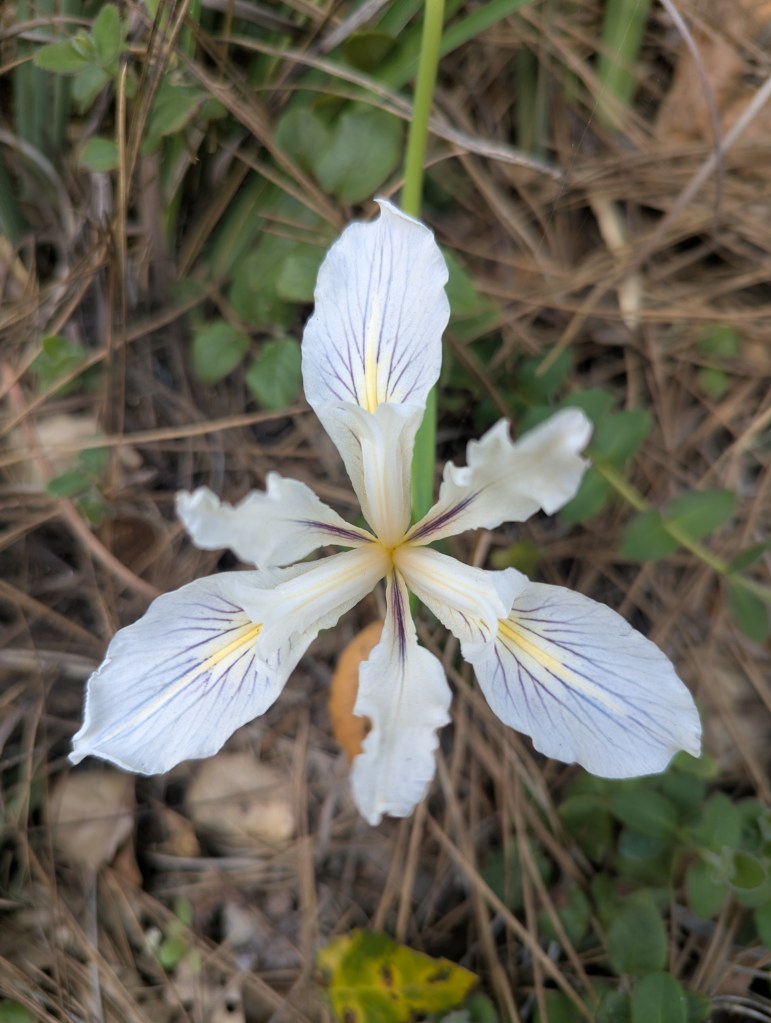
The natural range of Fernald’s iris, Iris fernaldii, is actually rather limited. It is endemic to only the Coast Ranges from Mendocino County to Santa Cruz County. Although it grows well beyond its natural range, it is quite rare in cultivation. Within chaparral climates that are warmer than its range, it prefers afternoon shade. Its foliage is greener with irrigation.
In the wild, Fernald’s iris develops sparse colonies, typically mixed with other vegetation. Colonies are more compact with cultivation and exclusion of other species. Propagation is very easy by division, or simple separation of wayward rhizomes. Fernald’s iris can be satisfied with shallow soil or soil of inferior quality. Too much fertilizer may inhibit bloom.
Fernald’s iris grows only about a foot tall, with slender, grassy and grayish green leaves. Floral stalks stand a bit more vertically and slightly above the foliage. The typically white flowers are paired on each floral stalk. Flowers might be pale or buttery yellow, or, rarely, pale lavender. Roots are thin but tough. Rhizomes, relative to those of other iris, are slim.
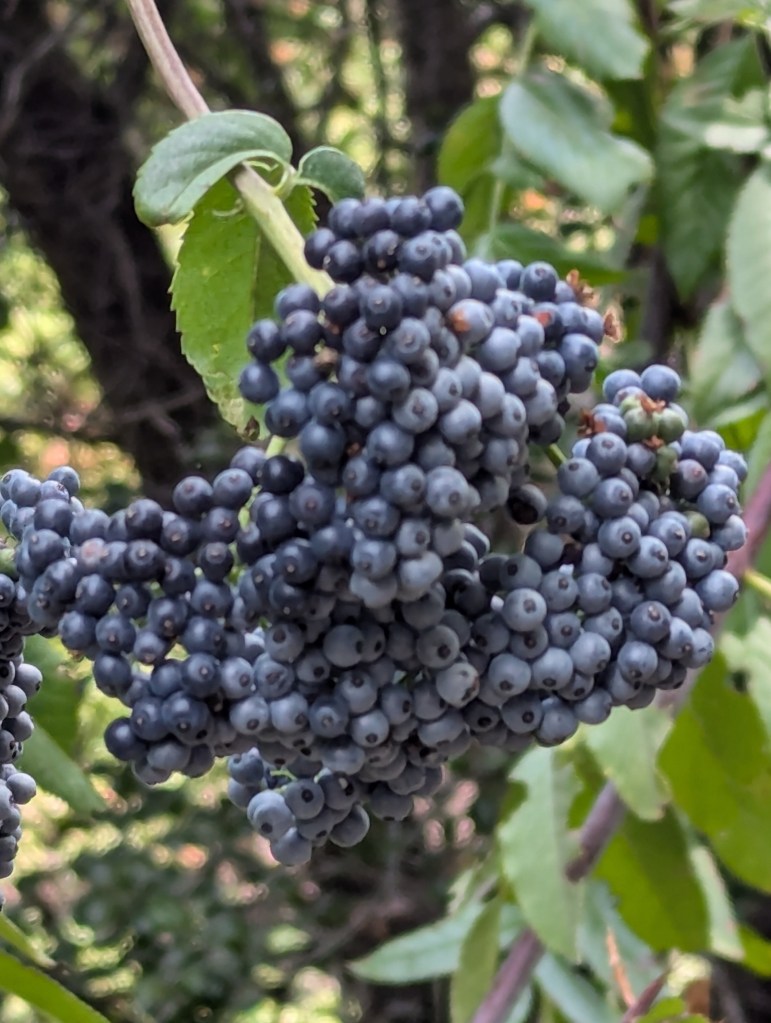
Native blue elderberry, Sambucus cerulea, can grow twenty feet tall and wide in the wild. It is rare among compact home gardens. Domestic specimens are fortunately conducive to various pruning techniques, though. They regenerate very efficiently from coppicing or pollarding. Alternating canes pruning involves more effort but promotes berry production.
Blue elderberries are toxic while fresh, but make good jelly or syrup when cooked. They are also edible dried. Although quite tiny, they grow in large clusters that are three or four inches wide or wider. They ripen through late summer. Flowers, which bloom during late spring, are useful for teas or cordials. Some find their floral fragrance to be unappealing.
Because it grows so large, blue elderberry can be a large shrub or a small tree. It usually develops several trunks. Aggressive dormant pruning enhances foliar lushness. Without much pruning, old trees can develop dense thicket growth with sparse foliage. Individual leaves are pinnately compound, with five to nine leaflets. They are as long as six inches.
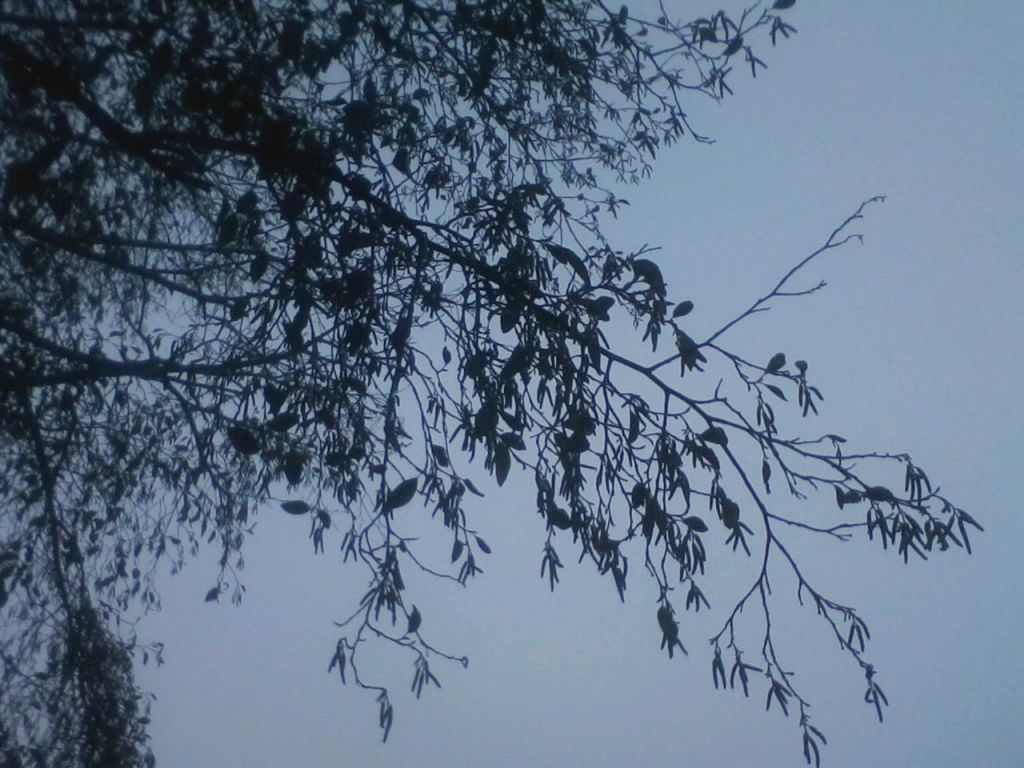
During the summer, the native white alder, Alnus rhombifolia, is a nice shade tree that looks bigger than it really is. By late winter, the bare deciduous canopy has an appealingly picturesque silhouette. This time of year is actually when white alder is typically less appealing, with dead foliage that provides no interesting fall color, but lingers until knocked down by rain or late frost. Yet, even now, it sometimes surprises with these funny looking floral structures that are interesting both in the early winter landscape, and with cut flowers.
In past decades, white alder was an ´expendable’ tree that was put into landscapes for quick gratification while slower but more desirable trees matured. By the time the desirable trees matured, the alders were removed to make more space for the desirables. This technique was practical because, like many fast growing trees, alders do not live very long, so start to deteriorate after about twenty five years anyway. However, alders often live longer than expected.
Mature alders are usually less than fifty feet tall where they are well exposed. They can get at least twice as tall where shaded by other trees or big buildings. Their plump trunks with mostly smooth silvery gray bark make them seem larger than they really are though. Too much water promotes buttressed roots which can displace pavement.
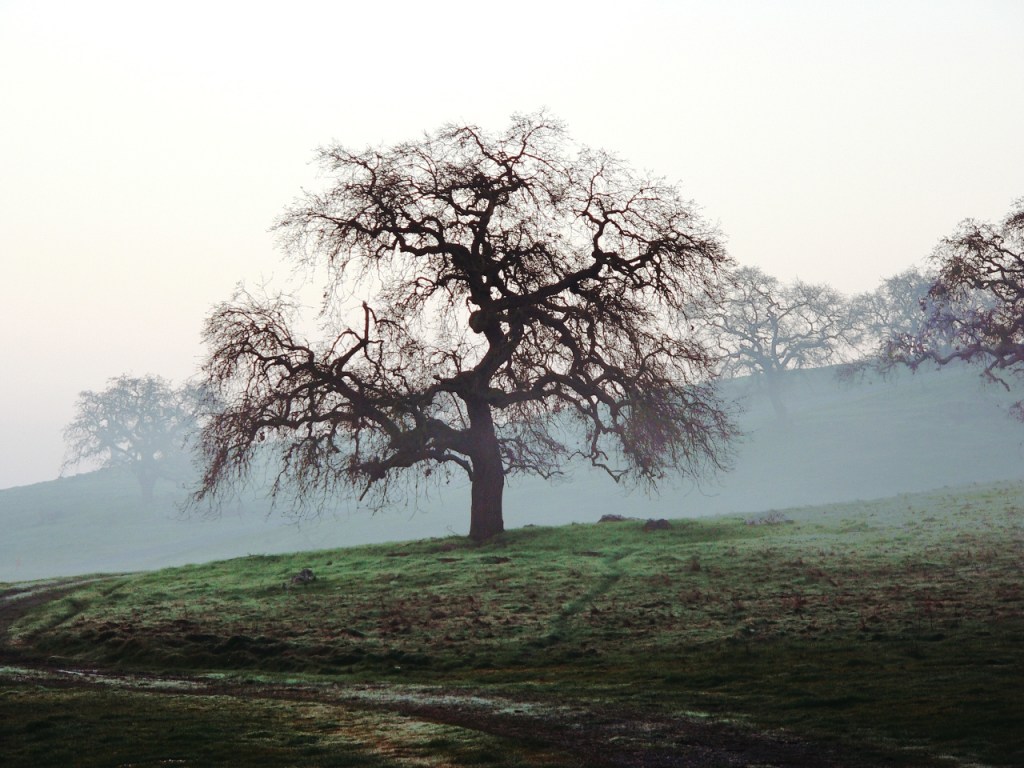
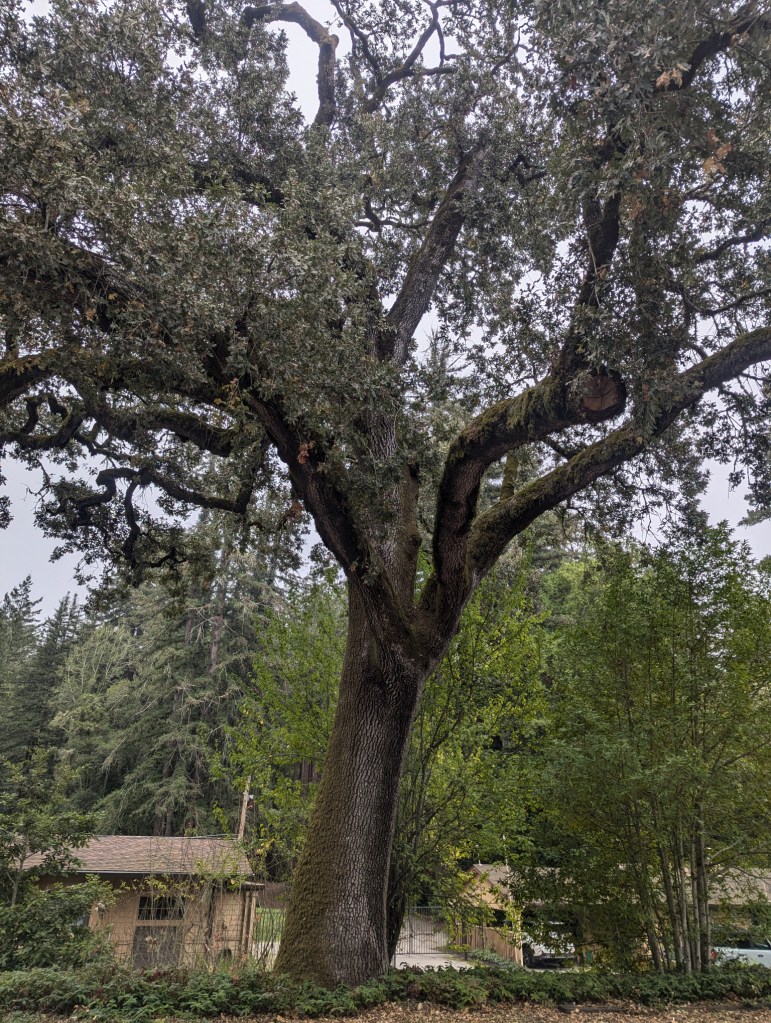
‘Foggy Oak Morning’ by Karen Asherah, is another example of the local scenery that I miss while not taking a bus or walking. I drove past this scene for years on my way to work outside of San Martin without ever bothering to take a look at it. This happy tree is a native valley oak, Quercus lobata, like those that had been common throughout the Santa Clara Valley until only about two centuries ago. It is not exactly the sort of shade tree that everyone wants in a compact suburban garden, but is grand enough for large spaces like parks.
Mature specimens may not seem to get as tall as oaks in the Appalachian Mountains, but are actually the largest oaks in North America, and live more than five centuries. The tallest trees are mostly less than seventy feet tall, but can get taller. Trunks of the oldest trees are commonly six feet wide or wider. The distinctively and uniformly furrowed bark is as classically ‘oakish’ as the rounded prominent lobes of the deciduous leaves, and the sculpturally irregular branch structure. Odd stem galls, commonly known as ‘oak apples’, are home to the larvae of tiny wasps that rely on valley oaks for everything they need. Incidentally, Paso Robles, or ‘El Paso de los Robles’ is named for the valley oaks in the area, which Spanish immigrants thought resembled the ‘robles’, the European oaks that inhabit Spain.
More information about ‘Foggy Oak Morning’ can be found at the website of Karen Asherah at karenasherah.com.
Native trees are not necessarily the best options for home gardens. Valley oak, Quercus lobata, for example, grows much too large. Old trees can grow more than a hundred feet tall. Although unpopular for new plantings, it sometimes self sows. Also, new landscapes sometimes develop around old trees. Formerly rural trees therefore become urban trees.
Old trees are unfortunately very sensitive to disruption of their surroundings. Grading can severely damage their shallow feeder roots. Irrigation to sustain new landscapes is likely to promote rot of older and larger roots. Trees that should live for centuries can succumb to such damage within decades. Younger trees are fortunately adaptable to landscapes.
Nonetheless, young valley oaks are trees for future generations. Also, they require plenty of space. Although it may take a few centuries, trunks can eventually grow ten feet wide. As they mature, such big trees can make a big mess. The deciduous foliage can shed for weeks instead of days. The pale yellowish brown autumn foliar color is rather mundane. Without excessive irrigation, roots are remarkably complaisant.
Yucca whipplei, which is now also known as Hesperoyucca whipplei, was the first species of Yucca that I met in the wild when I relocated to San Luis Obispo in 1985. Although it is too unpleasantly spiny for me to recommend it for home gardens, it is my favorite species of Yucca.
The only specimen of Yucca whipplei that inhabits our landscapes produced a few seed pods two years ago. I dried the seed and sowed them last year. I would have been pleased if a few germinated successfully. Instead, hundreds of them are now growing! Again, I grew too much of a good thing.
I can install several as a deer fence below a portion of my home garden. Although they grow only about three feet tall, deer will not try to jump over them uphill if they can not land beyond their painful foliage on the uphill side. However, if I put them three feet apart, only about twenty seedlings will be needed for approximately sixty linear feet of deer fence. That might be only about a twentieth of the hundreds that are now growing! They are still babies. I can worry about finding homes for them later.
Hybridization has produced unnaturally rich color.
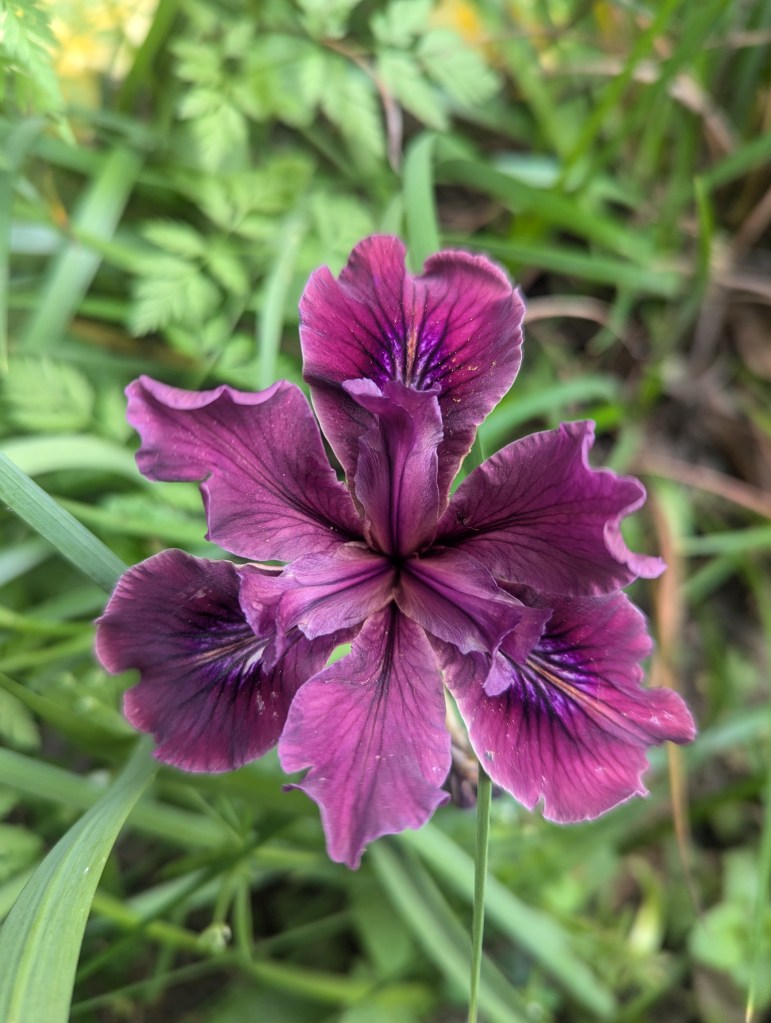
Several species of iris are native to the West Coast of North America. Iris douglasiana is probably the most colorful species. Hybridization with the others improved its floral color range and other characteristics. Several of such hybrid cultivars collectively became the Pacific Coast hybrid iris. However, the various cultivars developed from various ancestry.
Most Pacific Coast hybrid iris are finishing their bloom about now. Some bloomed earlier, at the end of last winter. Their flowers can be various shades of blue, purple, red, orange, yellow or white. This includes lavender, burgundy, rust, rose, coral, gold or creamy white. Only green colors lack. Brown pods of sterile seed are visually unappealing after bloom.
Flowers are about three or four inches wide and stand about a foot tall. Individual flowers do not last long, but bloom in succession for quite a while. Grassy and dark green foliage develops low mounds that stay lower than bloom. Propagation is simple by division from large foliar mounds during autumn. Generous watering can cause rot and patchy growth.
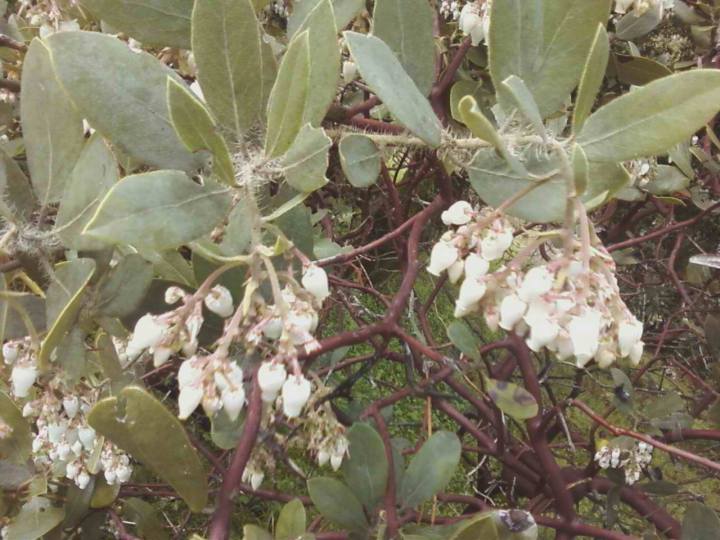
Even native manzanitas, which really are drought tolerant, need water until they disperse their roots.
Nearly every landscaper and gardener brags about using plants that do not need much water. Buzz words like ‘drought tolerant’, ‘native’, ‘sustainable’ and ‘xeriscape’ have become all too common, even though few actually spell ‘xeriscape’ properly. (It is NOT ‘zeroscape’!) Unfortunately though, most gardeners water so frequently and generously that drought tolerant and native plants are less sustainable than plants that want more water.
The difficulty is that drought tolerant plants generally need rather regular watering immediately after planting, while they are still dispersing their roots, but then want to dry out between watering once they are established. Otherwise, they are very susceptible to rot if the soil is constantly moist. Most drought tolerant plants should therefore not be mixed with plants or lawns that want regular watering.
Trees like incense cedar, beefwood, carob, silk oak, olive, California pepper tree and some eucalyptus, pine and oak can be nice shade trees in lawns that are not watered too much, but do not live as long as they would with less water. (Although many are messy in lawns anyway; and carob smells bad when it blooms.) California laurel, African sumac, Australian willow, strawberry tree and most acacia and cypress are less tolerant of lawn irrigation.
Eucalyptus, pine, oak and acacia have sensitive roots, so do better if planted while young instead of as larger specimens. For example, #5 (5 gallon) red ironbark eucalyptus get established faster and grow larger than 24” boxed red ironbark eucalyptus installed at the same time.
Bottlebrush, oleander, cotoneaster, hop bush, firethorn, grevillea, some types of wild lilac and all sorts of juniper can be happy with or without regular watering. Manzanita, coyote brush, rockrose, flannel bush and western redbud really want to dry out between watering. Like many plants from arid climates, wild lilac, coyote brush, rockrose, flannel bush and western redbud are naturally relatively short lived. Western redbud fortunately has an efficient technique of producing an abundance of seed and replacing itself with new seedlings before if finishes.
Lily-of-the-Nile is one of the most useful perennials, and can survive with annual rainfall or nearly saturated conditions. New Zealand flax is nearly as adaptable, but is more susceptible to rot if watered too much. Rosemary and several iceplants are nice ground covers with or without regular watering.
The various yuccas, aloes, agaves and their other relatives are some of the most practical perennials for arid climates, and many tolerate somewhat generous watering if necessary. However, most agaves and yuccas have nasty sharp leaves; and some agaves get too big to keep at a safe distance. Also, their bold personalities are not adaptable to every garden style.
Only four species of Iris are native here. The problem with identifying them is that three of them can be visually similar. Only Iris douglasiana is reliably and distinctively blue. Iris longipetala and Iris macrosiphon are generally pale blue, but can be as pale white with pale yellow veins as Iris fernaldii. Without keying it out, I can only guess that this particular iris is Iris fernaldii. The others seem to develop slightly larger and denser herds with slightly more upright foliage. Iris fernaldii develops relatively smaller herds and more relaxed foliage that does not stand as upright. Even what seems to be large herds are typically groups of smaller herds. Their flowers can lay almost on the ground. they shrivel too soon after cutting to work well as cut flowers. Nonetheless, they are a delightful native wildflower that is blooming as freely as it can where it grows wild. I really should relocate those that grow where they are not wanted, rather than discard them with other weeds. They might compete with weeds and other less visually appealing naturalized vegetation within areas that are not landscaped. Actually, they might be appropriate for a few areas that are casually landscaped.


 Tony Tomeo