California Poppy (not a plant profile)

Escholzia californica

California poppy is the Official State Flower of California. It is native to all but Yuba, Sierra and Imperial Counties within California. It is also native to portions of Oregon, Washington, Nevada, Utah, Arizona, New Mexico, Alaska, Sonora and Baja California.

Although rare elsewhere, a few isolated colonies inhabit several other states and Canada. It naturalizes efficiently in many other regions of other continents.

California poppy naturally blooms almost exclusively orange. Modern varieties that bloom yellow, red, lavender and creamy white were developed relatively recently. Naturally white and lavender California poppies are extremely rare in the wild. To Californian children, they are supposedly good luck, like-four leaf clovers are to Irish children. I remember finding a few of each at the Portola Monument in Montara when I was a kid. I did not see either again until I found a white California poppy at work a few years ago. Of course, modern varieties take the fun out of that tradition.

California poppies are now blooming splendidly. Unfortunately, they are neither as common nor as profuse as they were only a few decades ago. They are displaced by naturalized exotic vegetation, including naturalized forage crops and cover crops. Also, exotic vegetation, including flowers within home gardens and orchard trees, distracts the pollinators that they rely on for pollination. We dispersed California poppy seed at work while the weather was still a bit rainy, so should get more blooming later in spring. Hopefully, they will disperse a bit more seed for the following spring, although I suspect that they would already be naturally established there if it were a good situation for them.

California poppies can get somewhat unkempt within refined landscapes, particularly if they stay long enough to disperse their seed. That is why we want more within unrefined areas.

California Lilac (not a plant profile)

Ceanothus thyrsiflorus

Ceanothus of all sorts are collectively known as California lilac. A few uncommon species are also known by alternate names that might confuse those who are unfamiliar with them. Most species happen to be native to California, although most are not exclusive to California, and a few are not native to California. The species with the most extensive range is native to the eastern half of America, which does not include California. Incidentally, it is known more familiarly as New Jersey tea.

Ceanothus is not actually related to lilac. It merely blooms within the same season, with tiny flowers in floral trusses that are smaller but sort of shaped like those of lilac. The most traditional lilac bloom with lavender floral color, but a few cultivars bloom with pale blue floral color that sort of resembles that of some of the Ceanothus. Most Ceanothus bloom is richer blue, and some is pale white. The most fragrant of Ceanothus bloom is only mildly fragrant, and only in abundance. Most Ceanothus bloom lacks fragrance or smells rather dusty. Lilac, of course, is famously fragrant.

California lilac is therefore neither notably Californian nor a type of lilac. Nonetheless, during spring, we appreciate its bloom, both within refined landscapes and in the wild. It does not last for long, but it can be impressive, particularly among wild specimens that can grow larger than those within confined landscapes. The blue floral color of the majority of wild specimens and perhaps all cultivated specimens is comparable to that of native lupines, and contrasts splendidly with bright orange California poppies that bloom at about the same time. California lilac that grows wild need no maintenance, and although individual specimens do not last long enough to get old, they reliably replace themselves like so many native species do.

California Sycamore

California sycamore develops massively gnarly trunks.

The tallest, largest and oldest trees of the World are all native to California. So are the rarest pine, rarest fir and largest oak. California sycamore, Platanus racemosa, is loyal to this tradition of distinction. Although not the tallest sycamore, it might be the grandest. It develops gnarly and sculpturally irregular form. Some develop multiple massive trunks.

Because of its scale, California sycamore is uncommonly available from nurseries. It is simply not proportionate to home gardens or even big landscapes. Most old specimens are older than the landscapes around them. They are somewhat adaptable to landscape irrigation. However, increased moisture increases potential for spontaneous limb failure.

California sycamore can grow a hundred feet tall with bulky trunks and limbs. Old trees may exhibit scars from shedding limbs throughout their long lifespans. The mottled bark is gray and tan, and roughens only slowly with age. The deciduous foliage of such large trees is very copious through a long defoliation. Foliar tomentum (fuzz) is quite irritating.

California Wild Rose

Even if bloom is not much to brag about, the rosehips can be pretty and useful.

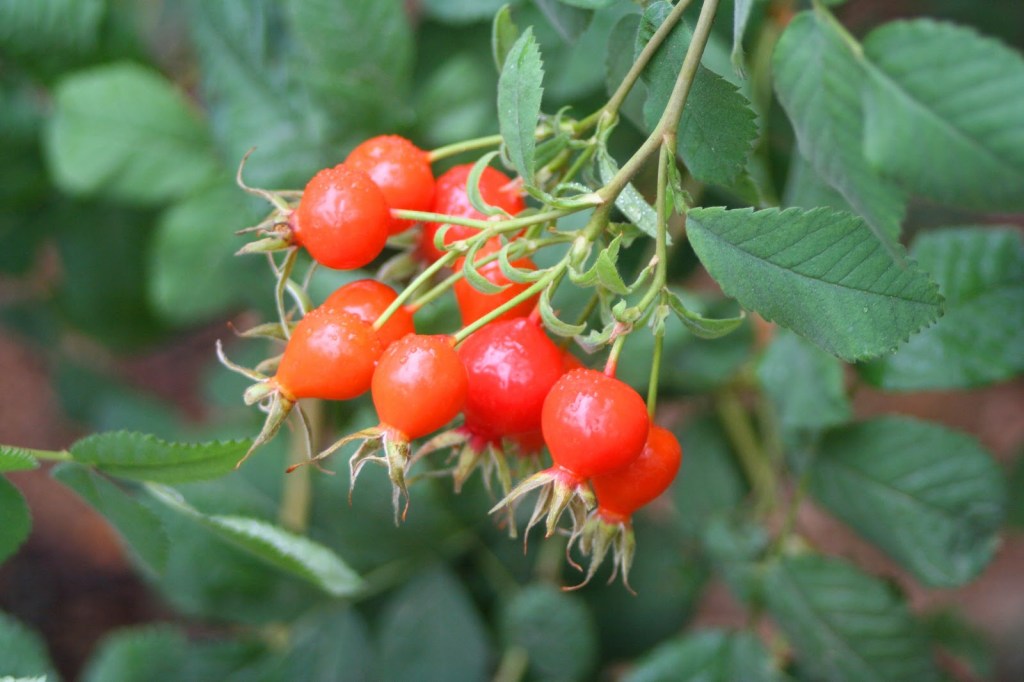
Prickly thickets of California wild rose, Rosa californica, are not often much to look at, even while adorned with small and sparse pink roses in spring and summer. The fragrant flowers can actually range in color from white to rich pink, and may have more petals, but are not abundant enough to be very impressive at any one time. In autumn though, all the flowers that bloomed in the previous few months leave bright orange or red fruiting structures known as ‘hips’, that linger on the bare canes through winter.

The rose hips of California wild roses had historically been used to make herbal tea because they contain so much vitamin C and have a pleasant flavor. (California wild rose is a ‘tea’ rose but not a hybrid ‘T’ rose.) They can also be made into jelly or sauce. The only problem is that birds like them too, so often take them before anyone else has a chance to.

White Alder

White alder is not exactly . . . white.

During the summer, the native white alder, Alnus rhombifolia, is a nice shade tree that looks bigger than it really is. By late winter, the bare deciduous canopy has an appealingly picturesque silhouette. This time of year is actually when white alder is typically less appealing, with dead foliage that provides no interesting fall color, but lingers until knocked down by rain or late frost. Yet, even now, it sometimes surprises with these funny looking floral structures that are interesting both in the early winter landscape, and with cut flowers.

In past decades, white alder was an ´expendable’ tree that was put into landscapes for quick gratification while slower but more desirable trees matured. By the time the desirable trees matured, the alders were removed to make more space for the desirables. This technique was practical because, like many fast growing trees, alders do not live very long, so start to deteriorate after about twenty five years anyway. However, alders often live longer than expected.

Mature alders are usually less than fifty feet tall where they are well exposed. They can get at least twice as tall where shaded by other trees or big buildings. Their plump trunks with mostly smooth silvery gray bark make them seem larger than they really are though. Too much water promotes buttressed roots which can displace pavement.

Stick in the Mud

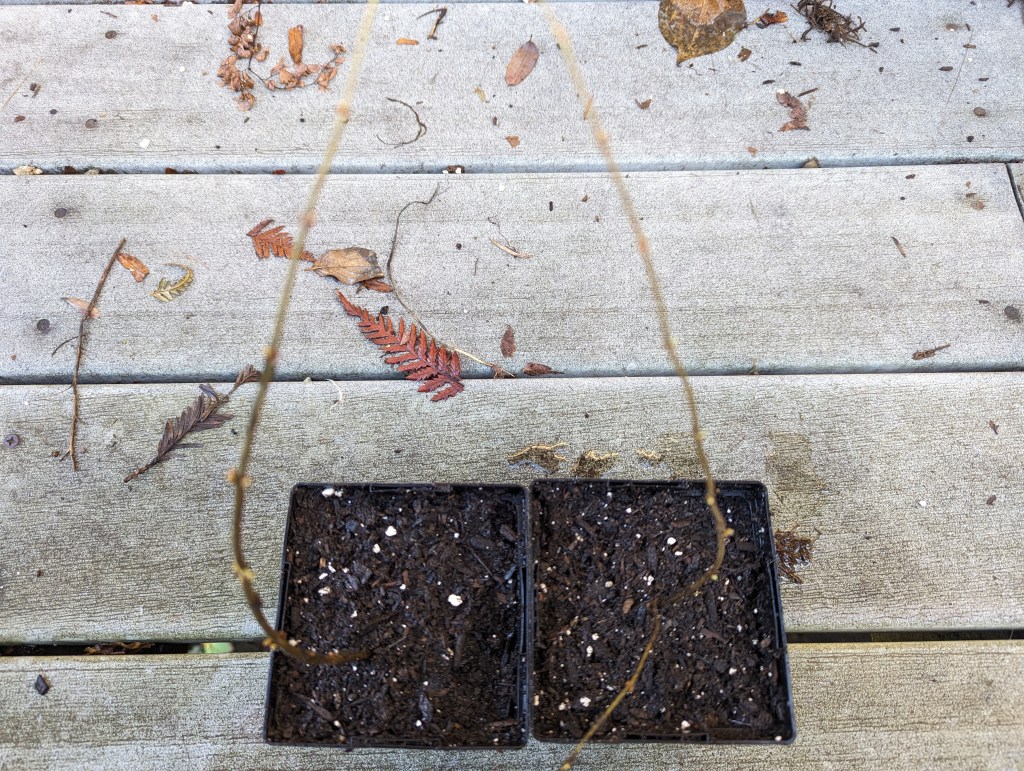
Correction: two sticks in potting medium

This is why I did not brag about my recently acquired snowberry within the context of my ‘Six on Saturday’ post this morning. They are not much to look at. Even if this illustration were more in focus, these bare twigs are indistinguishable from similar dormant twigs.

Nonetheless, I am pleased with their acquisition. I can not explain why, but I am pleased. The species, Symphoricarpos albus, is native, but not popular. I am beginning to realize why. Not only is it not much to look at in this particular condition, but it will unlikely ever become much to look at. It always looks scraggly, even while generating new foliage for spring. Its foliar color is unimpressively bland light green. Its twigs are very twiggy. Its dinky pale pink flowers are grungy and almost always infested with something or other. Its white berries, which is its primary attribute, are very scarce.

After so gleefully pulling this particular seedling from a landscape that it needed to be removed from, splitting it into two, and canning them as seen here, I realized that a rather large colony of snowberry inhabits another of the landscapes here. I could take as many rooted bits from it as I want without noticeably depleting it. For now, I am very satisfied with these. I have no plans for them, but will figure that out as they grow.

I suspect that snowberry can be more appealing in cultivation than in the wild. I intend to promote growth that is more vigorous than typical, which should enhance berry production. After this first winter, in which I dug and canned it, I will likely cut all of its growth to the ground annually during winter dormancy. I will not notice improvement this first year, but might after two years.

Valley Oak

Foggy Oak Morning by Karen Asherah

‘Foggy Oak Morning’ by Karen Asherah, is another example of the local scenery that I miss while not taking a bus or walking. I drove past this scene for years on my way to work outside of San Martin without ever bothering to take a look at it. This happy tree is a native valley oak, Quercus lobata, like those that had been common throughout the Santa Clara Valley until only about two centuries ago. It is not exactly the sort of shade tree that everyone wants in a compact suburban garden, but is grand enough for large spaces like parks.

Mature specimens may not seem to get as tall as oaks in the Appalachian Mountains, but are actually the largest oaks in North America, and live more than five centuries. The tallest trees are mostly less than seventy feet tall, but can get taller. Trunks of the oldest trees are commonly six feet wide or wider. The distinctively and uniformly furrowed bark is as classically ‘oakish’ as the rounded prominent lobes of the deciduous leaves, and the sculpturally irregular branch structure. Odd stem galls, commonly known as ‘oak apples’, are home to the larvae of tiny wasps that rely on valley oaks for everything they need. Incidentally, Paso Robles, or ‘El Paso de los Robles’ is named for the valley oaks in the area, which Spanish immigrants thought resembled the ‘robles’, the European oaks that inhabit Spain.

More information about ‘Foggy Oak Morning’ can be found at the website of Karen Asherah at karenasherah.com.

Sacred Datura

Native sacred datura is extremely toxic.

Georgia O’Keeffe made jimson weed flowers famous. Within the context of her paintings, they seem to be angel’s trumpet flowers. Californians know its species as sacred datura, Datura wrightii. It is as native here as where Georgia O’Keeffe observed and painted it in New Mexico. For refined gardens, though, it is rare. It lives almost exclusively in the wild.

There are a few reasons for this. Sacred datura is a sloppily sprawling perennial that can quickly grow eight feet wide. It is not reliably perennial though. It might perform for only a single season, and then suddenly die. The spectacular flowers close through the middle of the day. Seed capsules are annoyingly bristly. Worst of all, sacred datura is very toxic.

Otherwise, sacred datura is as appealing as Georgia O’Keeffe depicted it to be. Its grand flowers resemble those of angel’s trumpet. They stay open longer during cool and damp weather. Foliar color is creamy white, perhaps with a slight lavender blush. Fragrance is mild only because bloom is so close to the ground. Big specimens can get three feet tall. The foliage has a velvety texture.

Six on Saturday: Hollywood II

These ‘Six on Saturday’ are even more outdated than my ‘Six’ that were outdated for last Saturday. They were taken at the same time, but are presently a week later. I really want to post them anyway though. I do not get to Southern California often, although some of these species also happen to be native here. All of this vegetation is native to, and grows wild within the Hollywood Hills, and specifically at the Bronson Caves, where I got these pictures. I brought back a few exotic species from the region, but did not take pictures of them. I can get pictures of them at any time, and they are not distinctive to Hollywood.

1. Clarkia bottae, punchbowl godetia was featured in my garden column. Now that I see it in bloom, I sort of wonder if it is what I thought, back in school, was evening primrose.

2. Eriophyllum confertiflorum, golder yarrow is merely my guess for the identity of this bright yellow wildflower. The floral trusses are smaller and rounder than they should be.

3. Eriophyllum confertiflorum, golden yarrow sort of looks like this. Well, I sort of think it does. I really can not remember. This is a bit farther back from the same bloom above.

4. Opuntia phaeacantha or Opuntia littoralis, prickly pear is probably the same species as the big herd that I got a picture of for last week. This is a closeup, but of another herd.

5. Romneya coulteri, matilija poppy is also known as fried egg poppy because the floppy white flowers with big yellow centers look like fried eggs. These were at least six feet tall.

6. Salvia mellifera, black sage is one of my favorite wildflowers here because I recognize it and its alluringly pungent foliar aroma from almost everywhere that I have ever lived.

This is the link for Six on Saturday, for anyone else who would like to participate: https://thepropagatorblog.wordpress.com/2017/09/18/six-on-saturday-a-participant-guide/

Punchbowl Godetia

Bloom is brief for wild godetia.

All forty-one species of Clarkia that are native to North America are native to California. Punchbowl godetia, Clarkia bottae, inhabits almost all counties of Southern California. It is absent only from Imperial County. It also inhabits Monterey and San Benito Counties. Its name may allude to its floral shape, or its bloom in Devil’s Punchbowl near Valyermo.

Punchbowl godetia is an ephemeral annual that blooms briefly for spring. Bloom is early in some regions but late in other regions. Also, its schedule is variably from year to year. Because it does not transplant easily, it is rarely available from nurseries. It grows better from seed, which is available online. Within favorable situations, it self sows after bloom.

Bloom is delicate and airy, on limber and lightly foliated stems less than three feet high. Individual flowers are barely an inch wide. Floral color is slightly purplish pink with white centers and tiny red spots. It is variable though, so might be a bit more purplish or lighter pink. Leaves are very narrow. New seedlings do not compete well with other vegetation.