Black Oak

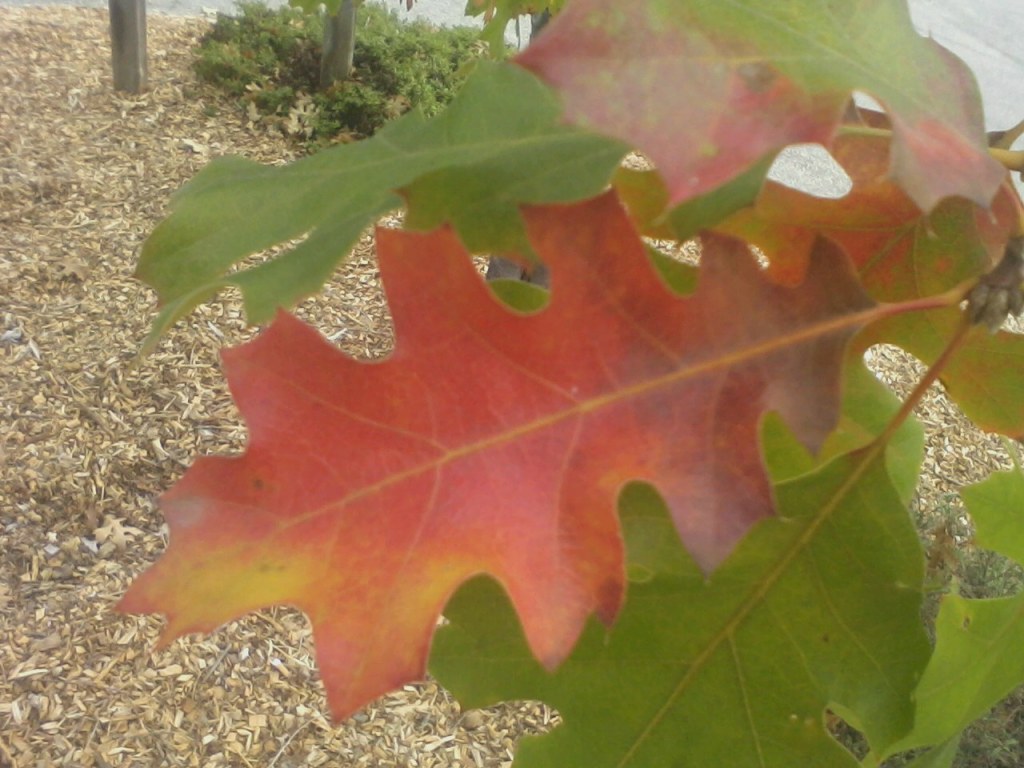
Not many native deciduous trees turn orange or brownish red in autumn like California black oak can.

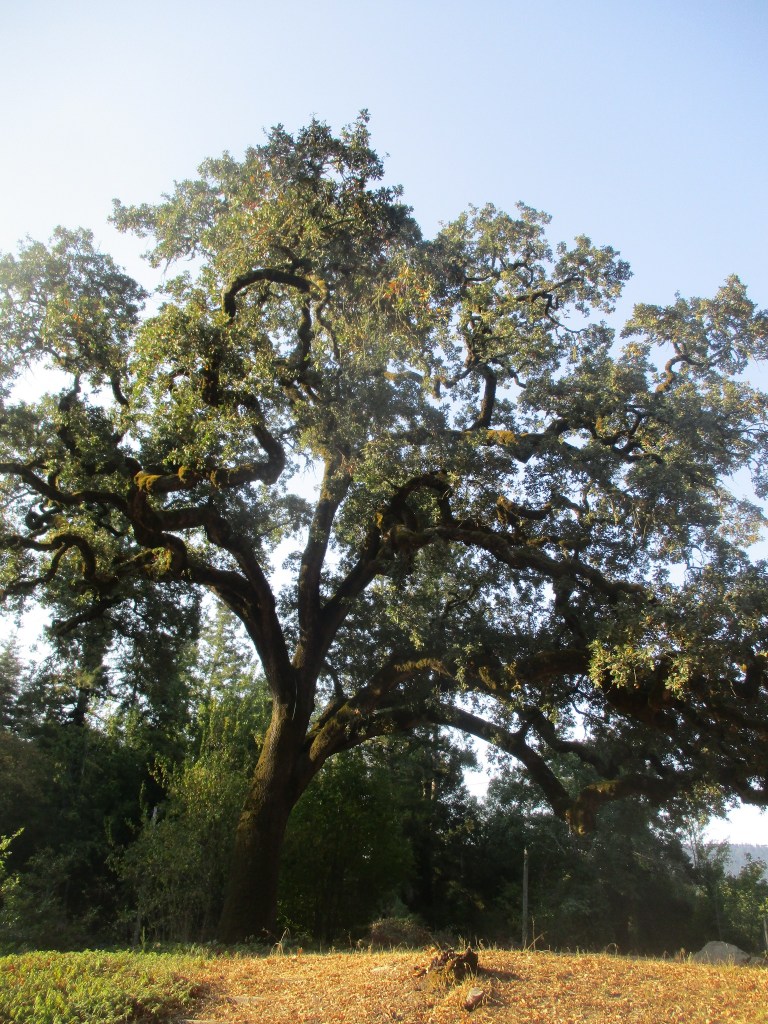
Though native mostly to the Sierra Nevada and Coast Ranges between San Francisco and Oregon, California black oak, Quercus kelloggii, also inhabits isolated colonies in lower mountains as far north as the southern half of the Oregon Coast, and as far south as San Diego County. It actually occupies more area than any other hardwood tree in California. Wild trees competing in forests can get more than a hundred feet tall and live for five centuries. Well exposed urban trees may take their first century to eventually get about half as tall with trunks as wide as four feet.

Even while young, California black oak is a distinguished tree, with a broadly rounded canopy and elegantly arching limbs. The smooth silvery bark of young trees eventually becomes dark and uniformly checked with maturity. The distinctive deeply lobed leaves are about five inches long, and turn gold, soft orange or even brownish red before falling in autumn.
Flannel Bush

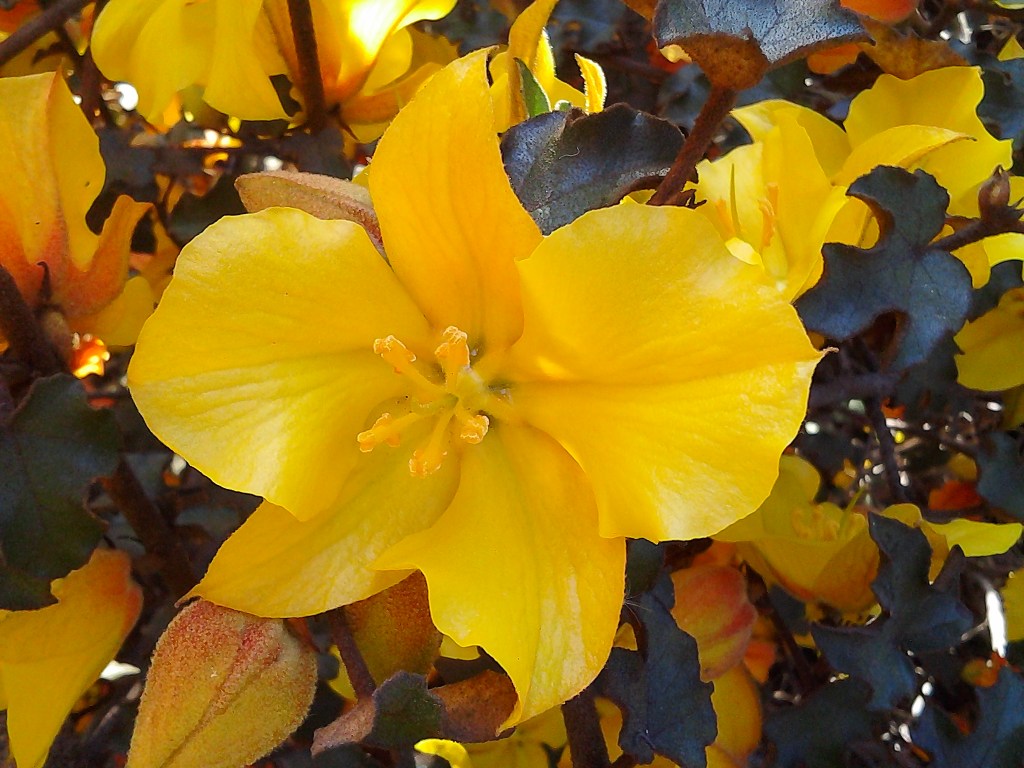
Abundant golden blooms are really spectacular, but because of irritating foliar fuzz, flannel bush should be enjoyed from a distance.

There is no way to say it delicately. Flannel bush, Fremontodendron californicum, is not easy to work with. It grows rapidly and rampantly with awkward form to about ten feet high and broad, but then starts to deteriorate when only about twelve years old. It can deteriorate even sooner if well irrigated. The fuzz on the foliage and young stems is irritating to the skin, especially during warm weather, so is very uncomfortable to handle. Otherwise, for out of the way spots, flannel bush is a striking native plant with impressively abundant bright golden yellow bloom this time of year. Neglected plants that do not get pruned or watered seem to be happier and more colorful, and can get older and much larger.

Osier Dogwood

The soft yellow or rusty red bare stems of osier dogwood have better color where exposed to cold and sunlight.

New spring foliage will soon be obscuring the rusty red or light yellow stems of osier dogwood, Cornus sericea (or Cornus stolonifera). Because this odd dogwood is grown for these distinctively colorful stems instead of blooms, it can be pruned harshly before foliation, to promote more twiggy growth for next winter. Unpruned plants form thickets five to ten feet high and ten or more feet broad. The flowers are actually rather pathetic relative to those of other dogwoods, since they lack colorful bracts. Where exposed to frost, the opposing two or three inch long and one or two inch wide leaves can provide nice reddish autumn color.

Six on Saturday: No Theme

There was a theme when I assembled these six pictures. I just can not remember what it was now. I am very happy with the three species from Del Norte County, #3, #4 and #5. #6 is my favorite though. It was so unfortunately necessary to remove the venerable old trees. It was necessary to remove their suckers too. I combined the two unpleasant tasks in a rather satisfying manner. There was absolutely no indications that the original trees were grafted. I looked for unions. I was informed that the suckers were visually identical to the original trees. I hope that the suckers that I transplanted within the centers of the decayed trunks will grow into trees that are new copies of the original trees!

1. Brugmansia X candida ‘Double White’, angel’s trumpet is a copy of the specimen at el Catedral de Santa Clara de Los Gatos. It somehow got frosted! Frost happens even here.

2. Yucca recurvifolia or Yucca gloriosa var.(iety) tristis, pendulous yucca is blooming at an unoccupied residence where only a few neighbors see it. It tastes like iceberg lettuce.

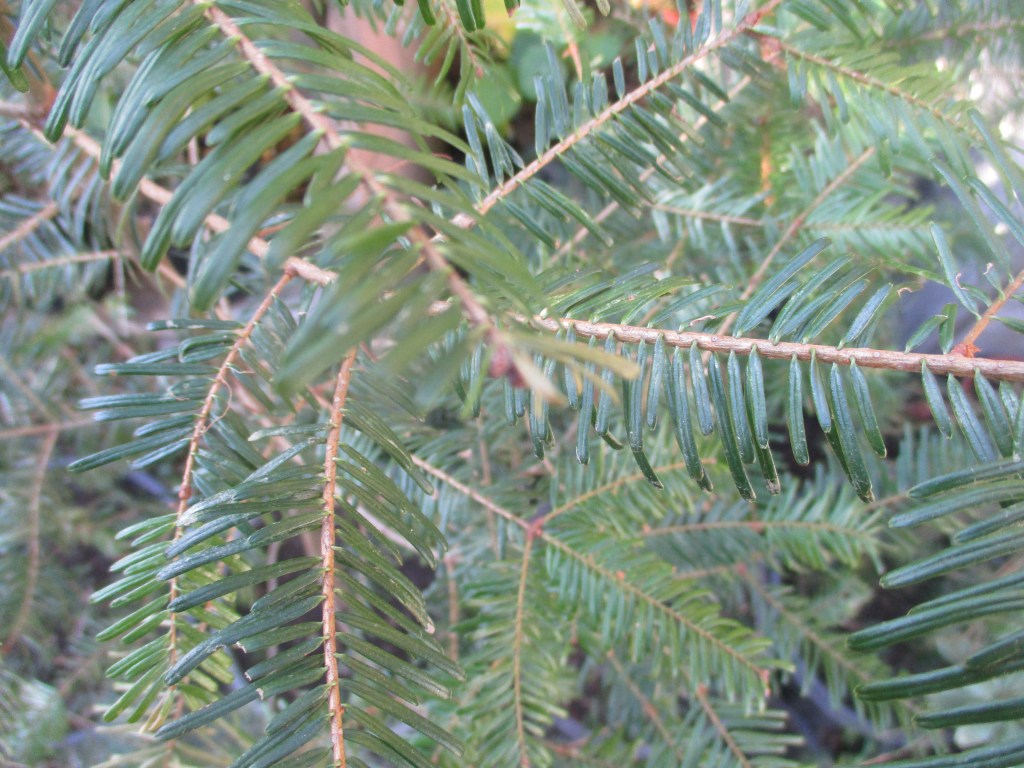
3. Abies grandis, grand fir was brought by another horticulturist here, from the extreme northwest corner of California, literally on the coast, barely south of the Oregon border.

4. Picea sitchensis, Sitka spruce got collected with the grand fir above and the bear grass below. I am very pleased with these species, but do not know where to plant more trees.

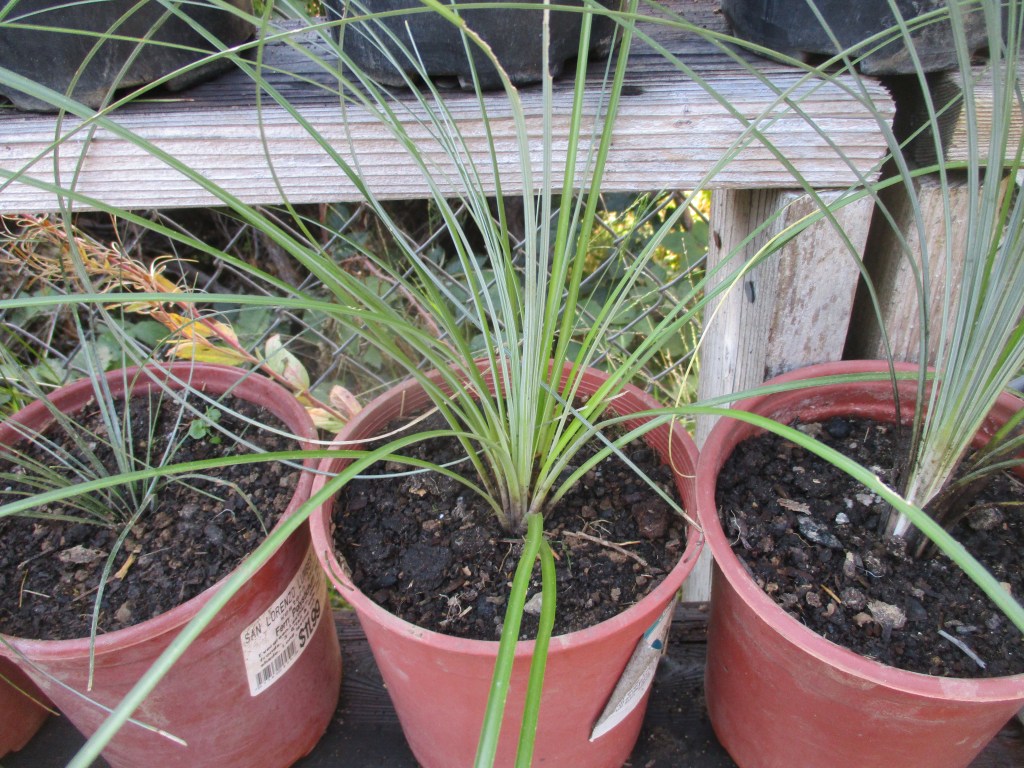
5. Xerophyllum tenax, bear grass came with the two tree species above, but will be easily incorporated into landscapes here. I am unfamiliar with it, and intent to get acquainted.

6. Prunus serrulata ‘Beni Hoshi’, flowering cherry was so severely decayed that only the outer shell of its stumped trunk remains. The twig in the center is its own rooted sucker! 

This is the link for Six on Saturday, for anyone else who would like to participate:

Coral Bells

Most coral bells are grown for their colorful foliage.

From Santa Barbara to Vancouver, and also in central Idaho, the humble native coral bells, Heuchera micrantha, is not much to look at, with compact rosettes of relatively small and bronzy rounded leaves with weird tomentum (hairs). In spring and early summer, and sometimes again in autumn, sparse trusses of minute brick red flowers hover about a foot above on wiry and slightly fuzzy stems. Old plants that get bare in the middle can be divided into several small plants in spring or autumn.

Modern cultivars are considerably more interesting, with more substantial foliage in various shades of green, gold, tan, brown, bronze and purplish bronze. The larger and variably lobed leaves can be two inches wide or slightly wider. The flowers stand as much as two feet high, but lack color. Most are pale greenish white. ‘Palace Purple’ has deep bronze or almost purplish foliage. ‘Ruffles’ has deeply lobed and ruffled green leaves. Unlike undemanding wild plants that can grow in cracks in exposed stone, modern cultivars like rich soil. Harsh exposure can scorch foliage, so a bit of partial shade is preferred.

Many coral bells have delightful bloom as an added bonus to their foliage.

Valley Oak

Valley oak is the grandest of oaks.

From the north end of the Sacramento Valley to the San Fernando Valley, the valley oak, Quercus lobata, is among the most familiar and distinctive of native oaks. It is the largest oak of North America, reaching more than a hundred feet tall with trunks as wide as ten feet, which is why it is rare in urban gardens. The hundred fifty foot tall ‘Henley Oak’ of Covelo is the tallest hardwood tree in North America. The oldest trees are about six centuries old.

The two or three inch long leaves have deep and round lobes. The foliage turns only dingy yellow and then brown in autumn, and can be messy as it continues to fall through early winter, particularly since the trees have such big canopies. The gnarly limbs are strikingly sculptural while bare through the rest of winter. The gray bark is evenly furrowed.

Incidentally, Oakland, Thousand Oaks, Paso Robles and various other communities within their range are named for valley oaks. (‘Roble’ is the Spanish name.)

White Alder

White alder is a sporadic native.

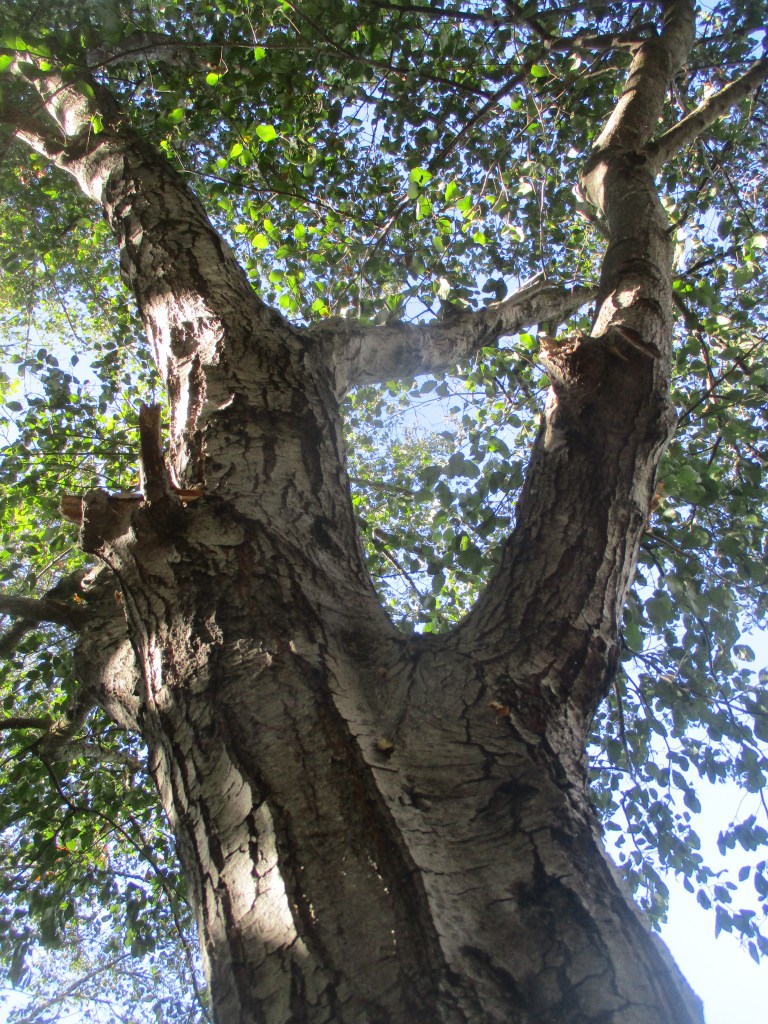
After a forest fire, white alder, Alnus rhombifolia, might be the first trees to regenerate into freshly deforested riparian situations. It grows quickly to exploit such an opportunity, and temporarily dominate a recovering ecosystem. Individual trees do not live for much more than half a century though. Then, they relinquish area to slower but more enduring trees.

Years ago, white alders did the same in new landscapes that needed shade. They grew fast to provide shade while preferable trees matured slowly. They subordinated and then vacated their landscapes as the preferred trees grew. Unfortunately, this technique is not so practical within municipalities that require but rarely grant permits for removal of trees. 

Although native, white alder is not prominent everywhere within its natural range. It might seem to be rare in Southern California, with only a few sporadic trees to provide seed for regeneration after a fire. Farther north, large and sustained colonies resist encroachment of other trees. Mature white alders can get forty to eighty feet tall, or taller where crowded by taller trees.

Beard Tongue

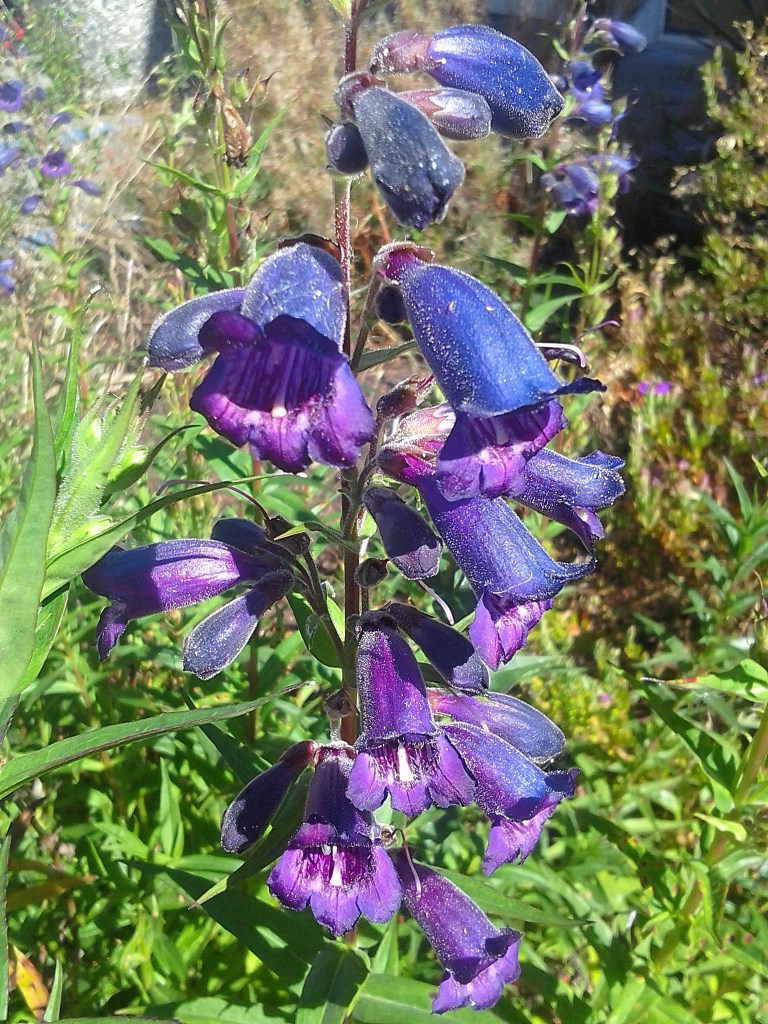
Beard Tongue does purple well.

With such a weird name, beard tongue is probably less commonly known by its common name than by the Latin name of Penstemon. Of the thousands of cultivars (cultivated varieties) that have been developed over the decades, most of those that are popular for home gardens are known as cultivars of Penstemon gloxinioides, even though their actual lineage is generally unknown. In recent years, other species have become more available.

Spikes of red, pink, purple or white flowers stand vertically above the foliage. Yellow flowers are still rather rare. Individual flowers are bisymmetrically tubular, with two conspicuous lips and a fuzzy tongue. Some beard tongue have relatively wide leaves and plump flowers, like really big snapdragons. Others have narrow leaves and thin flowers. Mature plants get only 1 to 2½ feet high and a bit wider, although some of the rare specie can get significantly larger.

California Buckeye

California buckeye resembles related horse chestnut.

Chaparral climates are not easy without irrigation. The long summers are warm and arid. California buckeye, Aesculus californica, knows what to do if it can not stay hydrated out in the wild. It simply defoliates. Yes, it goes bare right in the middle of summer. If it does it early enough, it refoliates after rain resumes in autumn, only to defoliate again for winter.

This ‘twice deciduous’ characteristic is likely why California buckeye is not more popular for unirrigated landscapes of other natives. Shade is an asset through warm summers. In coastal, riparian or irrigated landscapes, the original spring foliage lasts through summer to defoliate in autumn, like that of most other deciduous plants. It may get shabby though. 

Nonetheless, California buckeye is a delightful small tree, typically with a broad and low canopy suspended by a sculptural branch structure. Not many get more than twenty feet tall, although some get twice as tall. Bark is strikingly pallid gray. The elegant leaves are palmately compound. Six inch long trusses of tiny white flowers are sweetly fragrant in spring.

California Poppy

Wild California poppies are bright orange.

Even after so many pretty shades of yellow, red, pink and and white have been been developed, the natural orange of the native California poppy, Eschscholzia californica, is still the best. That is probably why they all eventually revert to orange after reseeding. Although native, they do not reseed everywhere, and actually seem to be more reliable in unrefined and unamended areas of the garden than in rich soil with generous irrigation. However, a bit of watering can prolong sporadic bloom until autumn. Bloom otherwise ends before warm summer weather.

California poppy is grown as an annual because the perennial plants get tired rather quickly. They fortunately self sow prolifically. Flowers are typically about two inches wide, with four petals. The intricately lobed leaves are slightly bluish. Foliage is not much more than half a foot deep.