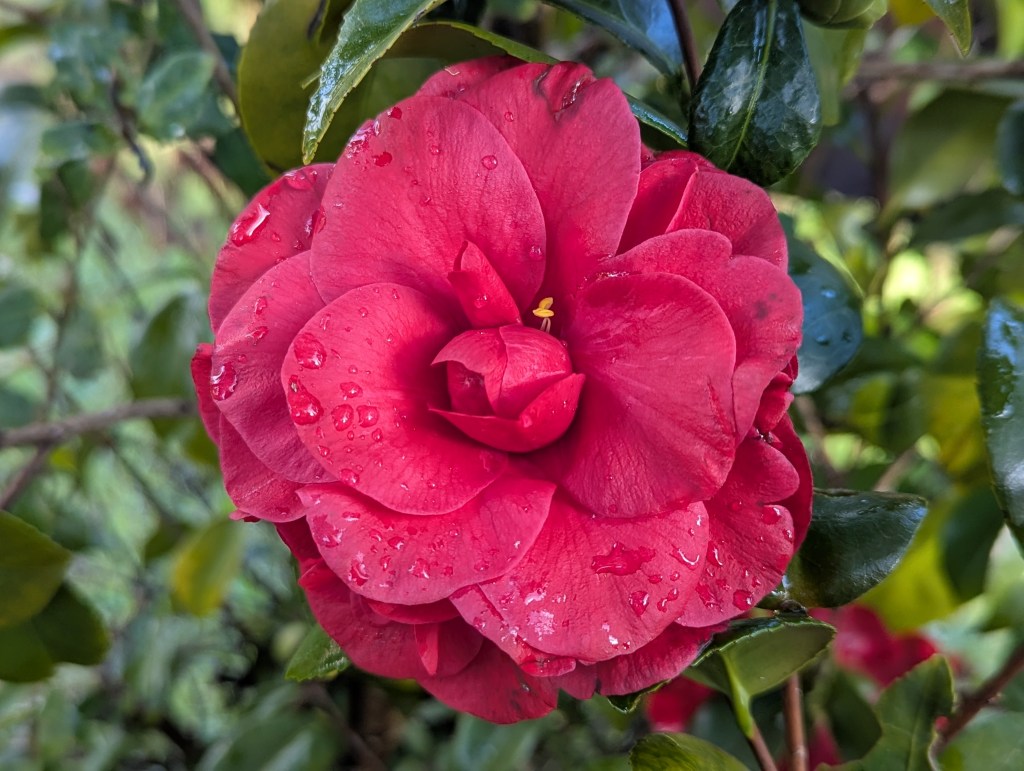
Sunday Best – Camellia
An old deck at work is presently being replaced. Potted cannas that resided on it needed to be moved. Camellias below it are in the way, but safe for now. It is quite a big project.
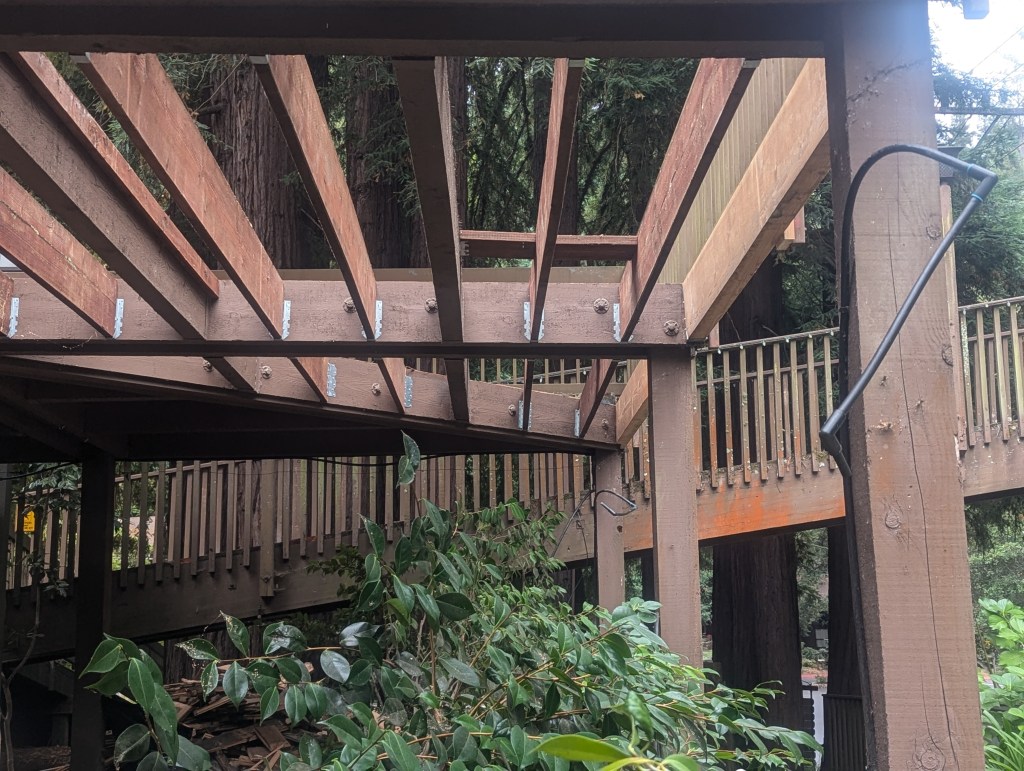
1. Camellia japonica, camellia under the old deck are temporarily getting more sunlight than they are accustomed to. There are about eight. This will not last long, though, until the new deck replaces the old. The disheveled irrigation tubing was for pots on the deck.
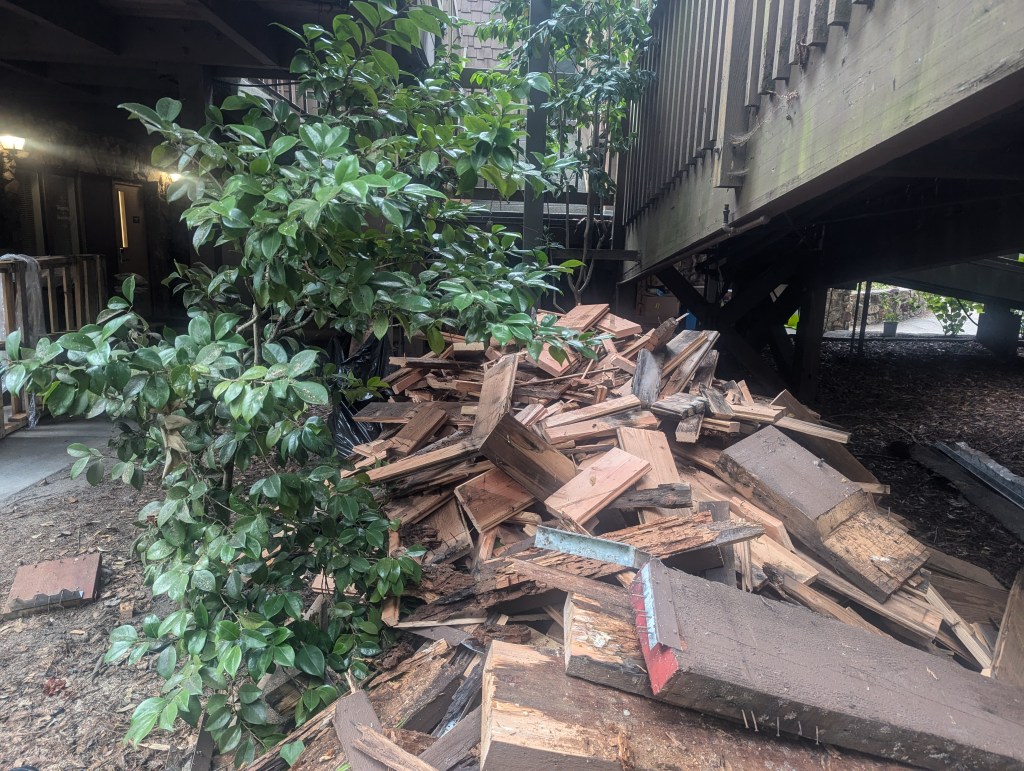
2. Camellia japonica, camellia at the far end of this row is somehow undamaged by this accumulation of debris from the dismantled deck above. I am impressed. Some extent of damage is expected from such a project, particularly with so many camellias in the way.
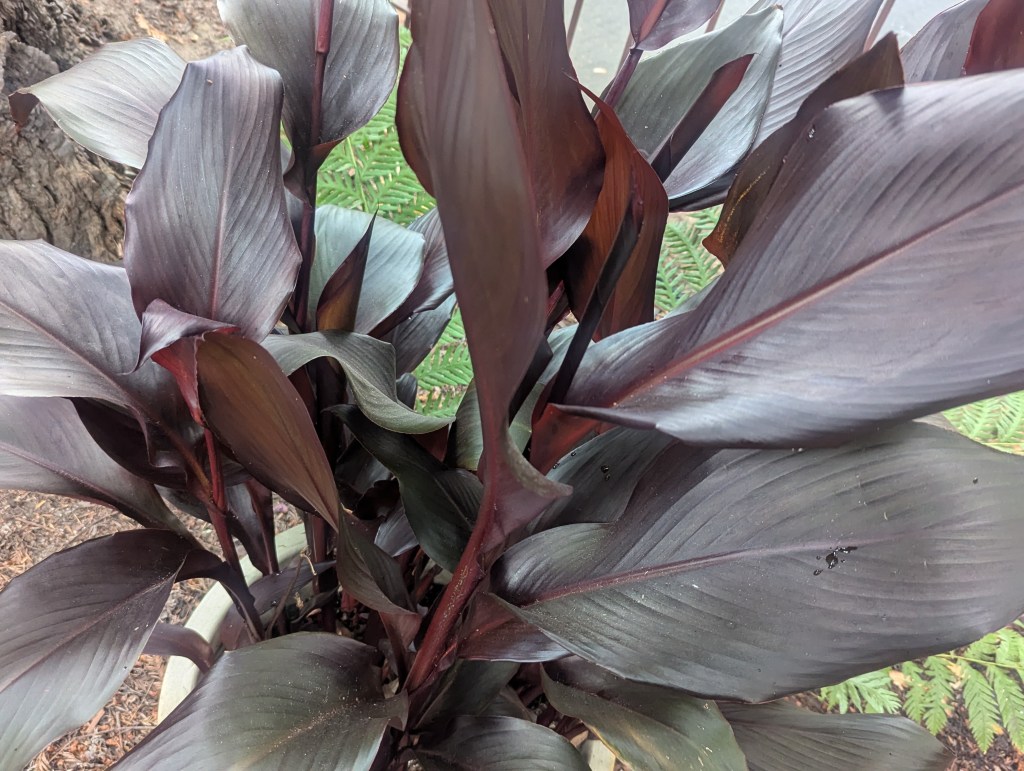
3. Canna indica, canna was looking good on the deck across the road in the background. Not only were they removed, but because of a realistic concern that they promote decay, they will not return to the new deck. For now, they were straightened into position here.
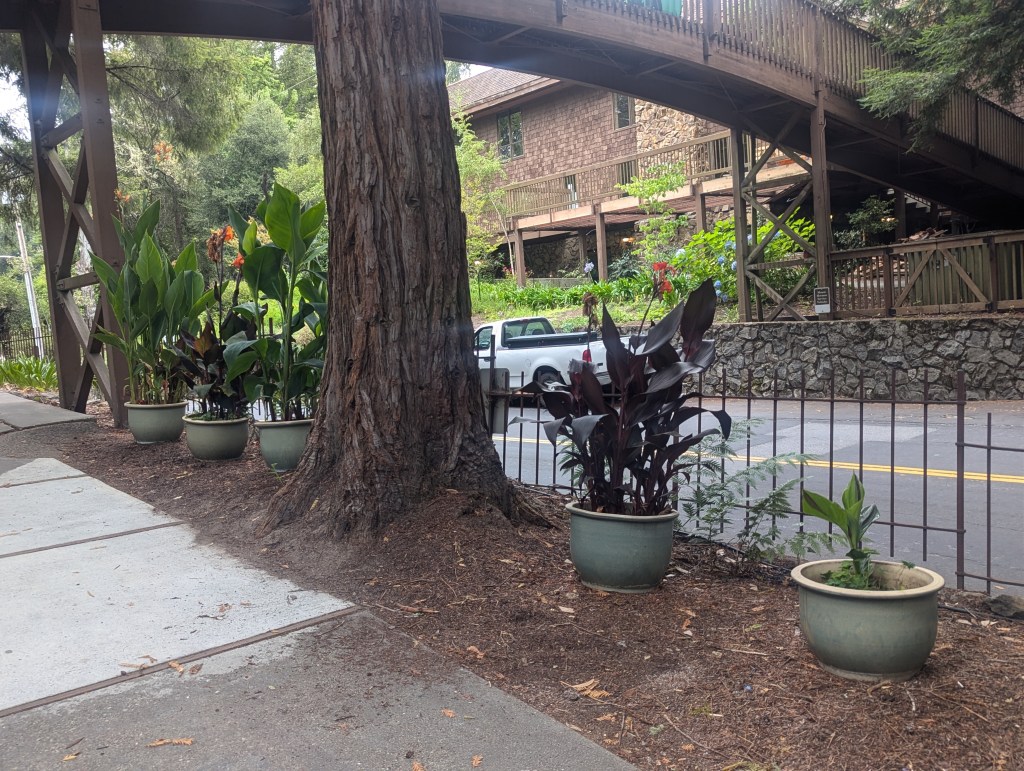
4. Canna indica ‘Australia’ canna is probably the boldest of the five even without bloom. The others are ‘Wyoming’, ‘Cleopatra’, ‘Stuttgart’ with an unidentified cultivar with large red bloom, and ‘Inferno’ with a notably tall but unidentified cultivar of Canna musifolia.
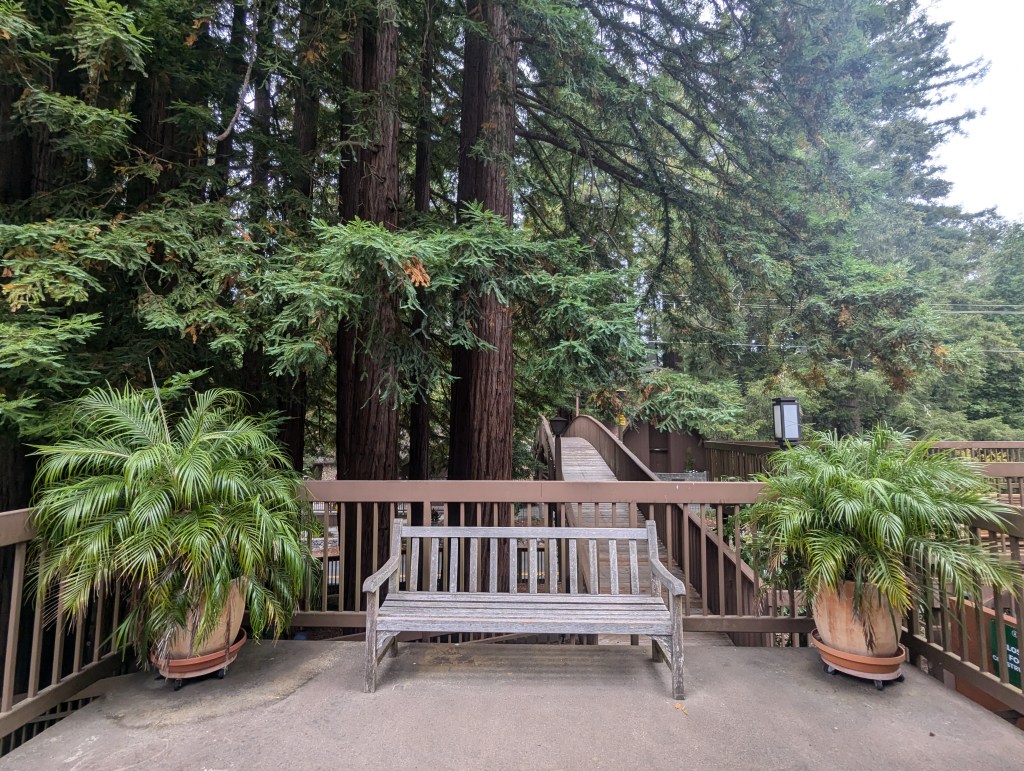
5. Phoenix roebelenii, pygmy date palm paired on another area of the deck will also need to be removed prior to a second phase of reconstruction. Unfortunately, I do not know if these big old pots can be moved intact. Both are deteriorated, fractured, and very heavy.
6. Pelargonium X hortorum, zonal geranium should also be removed, but from another situation. They were originally installed to hold posts for the signs that are now attached to the fence behind them. Now they just get bashed by parking cars. One is already gone.

This is the link for Six on Saturday, for anyone else who would like to participate: https://thepropagatorblog.wordpress.com/2017/09/18/six-on-saturday-a-participant-guide/

‘Yuletide’ Camellia sasanqua should bloom for Christmas, as the name implies. It typically does. However, it sometimes blooms early or late. It might be slightly late this year, but has been blooming for quite a while, and was beginning to bloom by Christmas.
It certainly is a delightful red. It seems to me that it can be slightly more reddish, with less of a pink influence, in some situations. Perhaps the bright yellow of the staminate centers cause it to appear as such within certain weather conditions or sunlight exposures. This particular flower may seem to be slightly pinkish as a result of distress. The hedge that it bloomed on had been infested with red spider mite earlier.
This particular cultivar of Camellia sasanqua develops distinctly upright and perhaps ovoid form, and can get quite tall. Most other cultivars develop more irregular or sprawling form, with long and limber stems, and relatively short stature.
I am impressed that this bloom is so resilient to wintry weather. Although much of the foliage is under a wide eave, most of the bloom is not under the eave, so has been exposed to both rain and frost. Apparently, Camellia sasanqua bloom is resilient to frost that is colder than it gets here. Camellia flower blight is common regionally, but mysteriously does not damage many flowers within the landscapes here. White and light pink Camellia japonica flowers are more vulnerable, but even they bloom quite nicely here, with only a few flowers succumbing before they finish bloom, and generally as their cumulative bloom cycle is finishing anyway.
Deer eat any cultivar of any species of Camellia, but avoid camellias here more mysteriously than camellia flower blight. I do not remember ever encountering damage that was caused by deer; and there are many camellias here.
All but the first of these six are Camellia japonica. They bloomed late this year, likely as a result of the exceptionally wintry winter. Also, these pictures are more than two weeks old. They likely finished blooming by now. I do not know because I am not there. Rhody, Carson and I are still on vacation in the Pacific Northwest. As these Six on Saturday post at midnight, we will begin our trip home. Pictures of our vacation would be appropriate, but are not processed yet. Besides, I do not take many pictures. Also, although these few pictures are now outdated, I did not want to waste them. These five camellias and single flowering cherry demonstrated commendable diligence by blooming after such a wintry winter.
1. Double white flowering cherry is obviously not a Camellia japonica, but happens to be my favorite of our several flowering cherries here. The tree is in rough condition though.

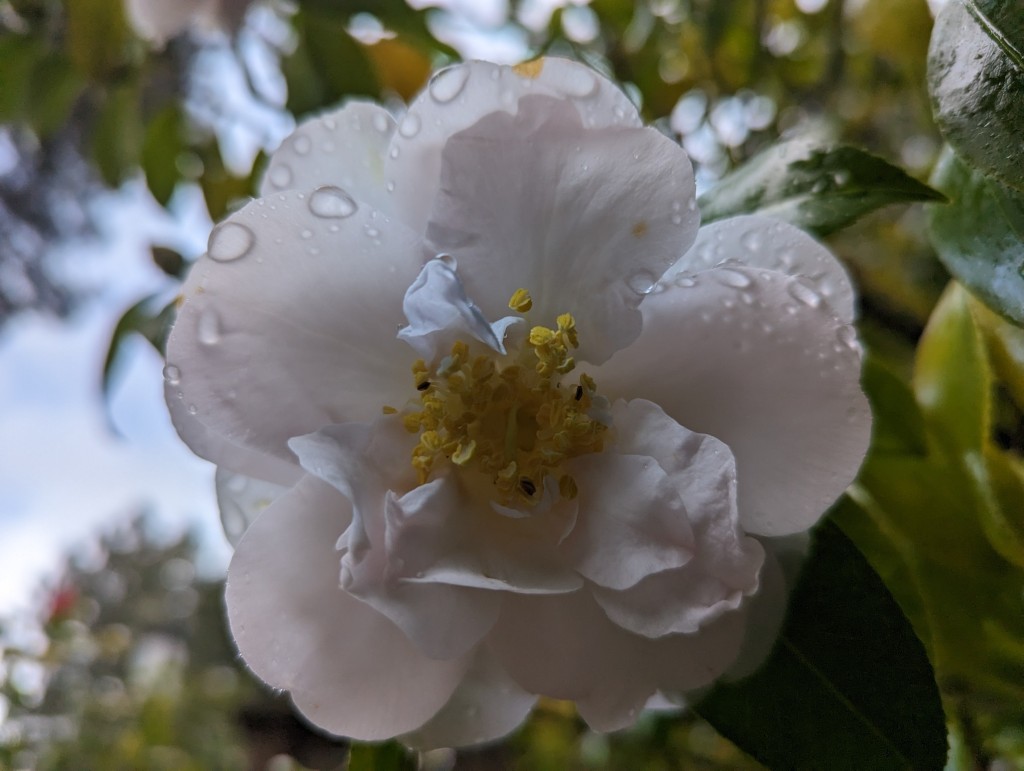
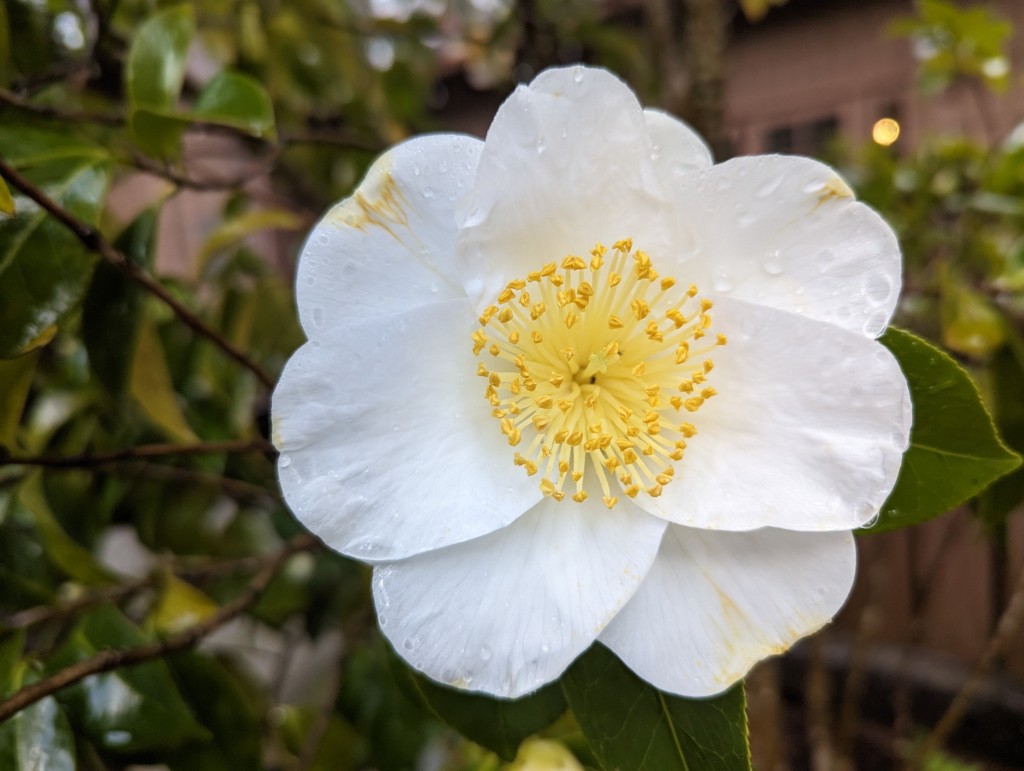
2. Frilly white camellia with a relatively modest staminate center may be the prettiest of the white camellias here, but does not look so pretty in this shaded picture after the rain.
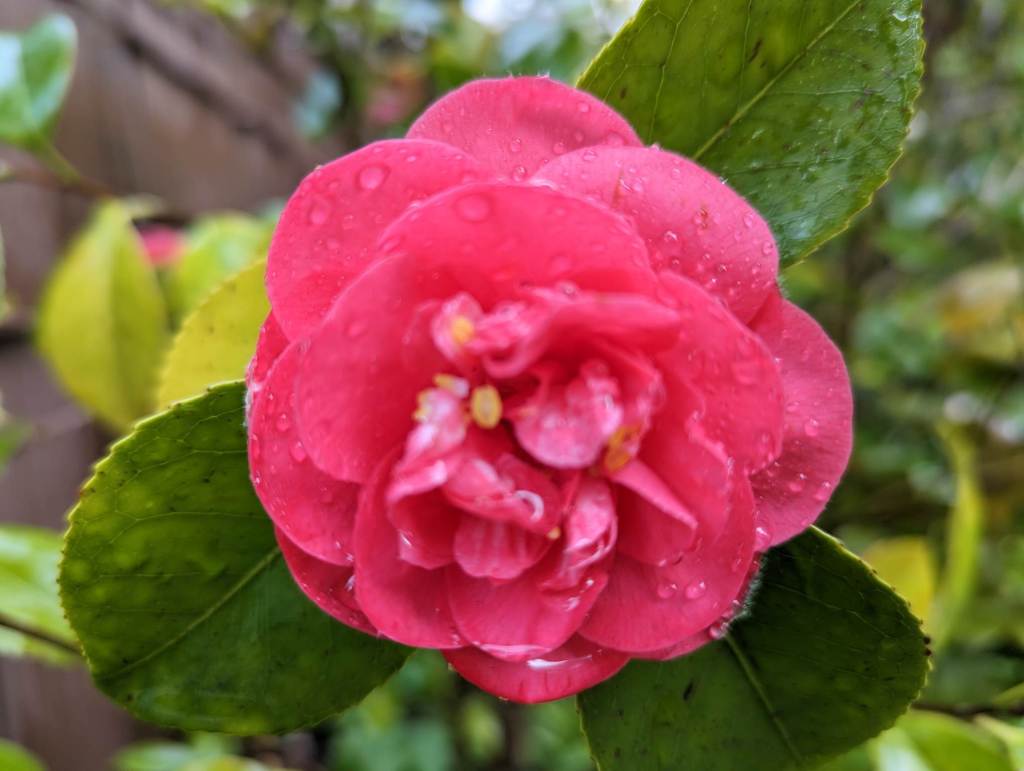
3. Pinkish watermelon red camellia blooms with variable floral form. Some flowers seem to be of peony form. Some seem to be of anemone form. I have no idea what form this is.
4. Very pallid pink camellia seems to be almost white. Whiter white or pinker pink could be prettier, but its pastel color seems to be very appropriate to its distinctive floral form.

5. Pinkish watermelon red camellia resembles the color of #3 now, but normally blooms deeper red. Perhaps the unusually harsh weather last winter somehow altered the color.
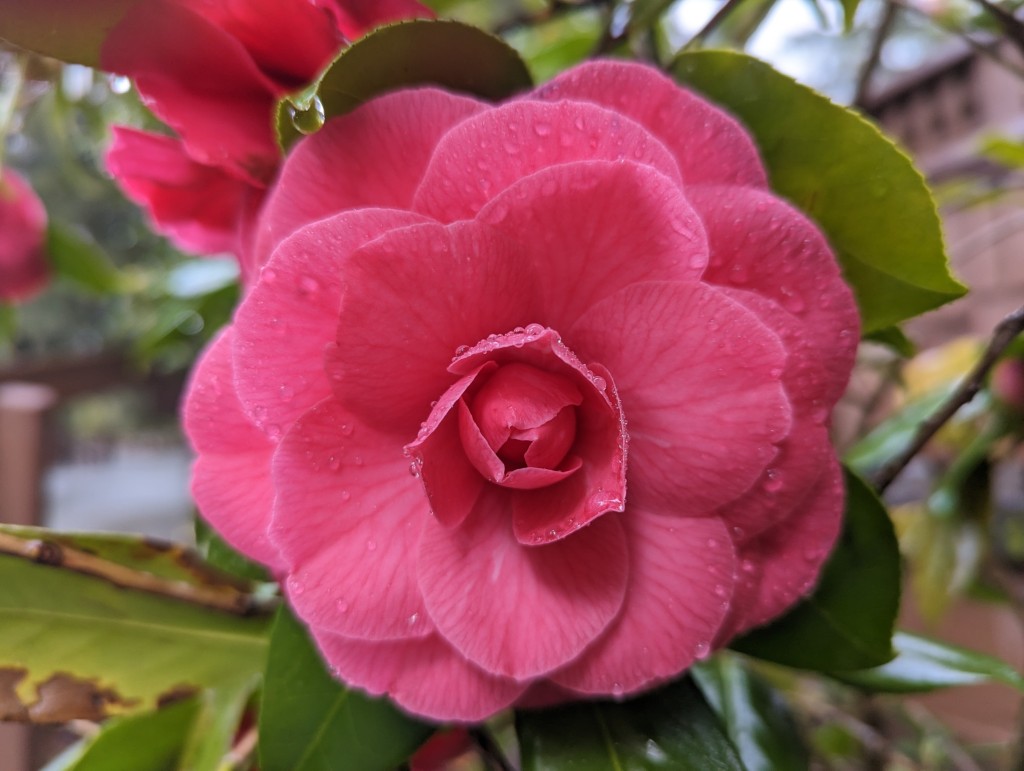
6. Single white camellia with a prominently staminate center looks like a sunny-side-up egg. Camellia blight around the edges proliferated during the exceptionally rainy winter.
This is the link for Six on Saturday, for anyone else who would like to participate: https://thepropagatorblog.wordpress.com/2017/09/18/six-on-saturday-a-participant-guide/

While other bloom might be lacking through late winter, camellia, Camellia japonica, can help compensate. Although generally not as profuse as spring and summer bloomers, its individual flowers display elegantly against luxuriantly glossy evergreen foliage. Lack of sturdy stems for cutting is no problem for a few flowers simply floating in a shallow bowl.
Centuries of breeding has produced more than two thousand cultivars of camellia. Floral form can be single, semi-double, double, formal double, paeony, anemone or rose, so is quite variable. Floral color ranges from pure white to deep red, with many hues of pink in between. Stripes, speckles, blotches or picotee margins are within the same color range.
Camellia generally develops as nicely dense shrubbery that stays lower than the eaves. Some cultivars stay even lower. A few slowly mature as small and perhaps sparse trees. Individual flowers are about three inches wide. Some are smaller. A few are comparably bulky. Camellia sasanqua is a separate species with smaller but more abundant flowers.
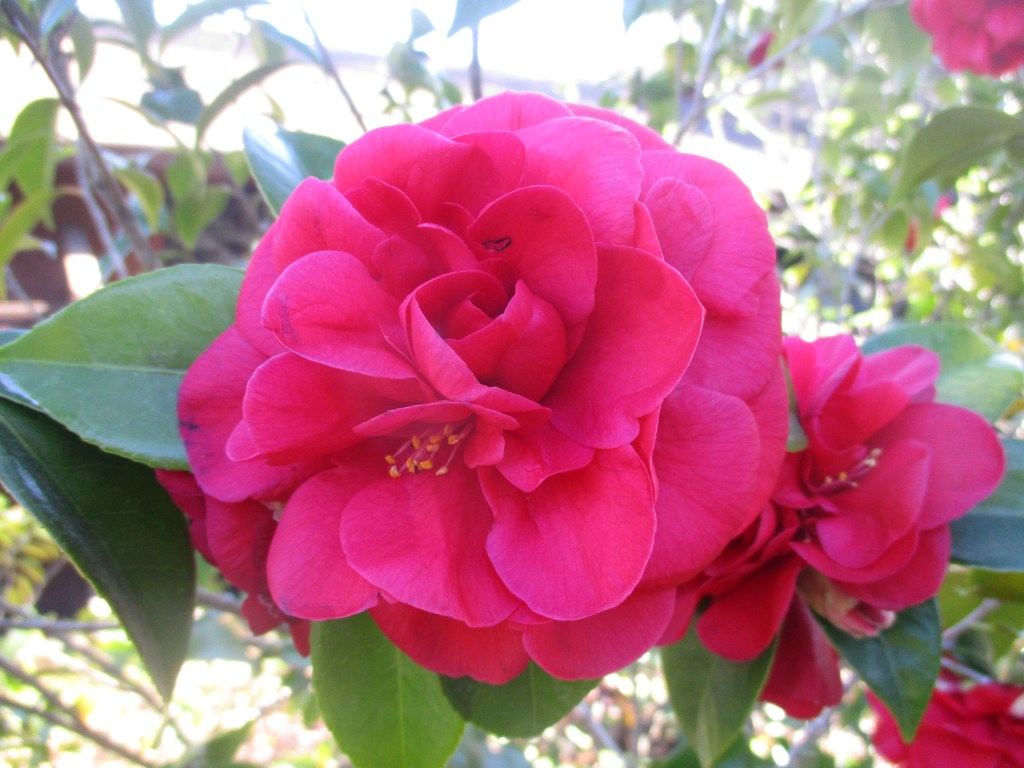
After centuries of breeding, there are more than two thousand cultivars of Camellia japonica! Additionally, there are more than a thousand cultivars of both Camellia sasanqua, with smaller but more profuse flowers, and comparably rare Camellia reticulata, with fewer but garishly big flowers. This does not even include the more than a hundred other specie of camellia found in the wild throughout East Asia.
It is obviously difficult to generalize about so many different personalities. Actually though, the glossy and slightly serrate leaves of almost all Camellia japonica are surprisingly similar. Also, most grow into rounded shrubs that are happy to stay below first floor eaves. Only a few grow into small trees, and only after many years. All prefer rich soil and regular watering.
The flowers that bloom late in winter are the most distinguishing characteristics of the many cultivars. The largest can get more than four inches wide. Flower form is remarkably variable (and can be described as single, semi-double, double, formal double, paeony, anemone or rose). Many have prominent yellow stamens. Color ranges from pure white to red, with every shade of pink in between. Picoteed, striped and blotched flowers are not uncommon.

‘Foundation planting’, which most of us think of as vegetation intended to merely obscure a foundation behind lower and prettier plants, has a simple utilitarian origin. Before homes were so commonly outfitted with rain gutters like they are now, densely shrubby foundation plantings diffused water that fell from eaves, and limited splattering of mud onto foundations and walls.
Nowadays, foundation planting only needs to look good, and maybe obscure crawlspace vents or exposed undersides of decks. They might be allowed to get as high as window sills, or higher.
These camellias got more than a bit too high. They had not obscured the cinder block foundation in a very long time, and did not contribute much to the shingled wall above. What was worse was that all of their best foliage and bloom obscured the view from the window above, and obstructed sunlight to the interior. They were impressive specimens, but were not doing their job.
We tried to prune their canopies lower and thinner, in order to promote more lower growth that we could prune down to later. They responded by merely replacing what was pruned away, exactly where it was pruned away from. We considered relocating the camellias to where such big and lanky camellia trees would be desirable, but they are too old and firmly rooted in place.

The only option was to coppice them. It was quick and easy. We cut them to the ground with the expectation that they will either regenerate from their stumps or die. If they die, we will not miss them. (Okay, I might.) The new growth will obscure the foundation well, and after a few years, should resume blooming. They will be patchy if some but not all do survive, but we tried.
The remaining sculptural specimen obscures no windows.

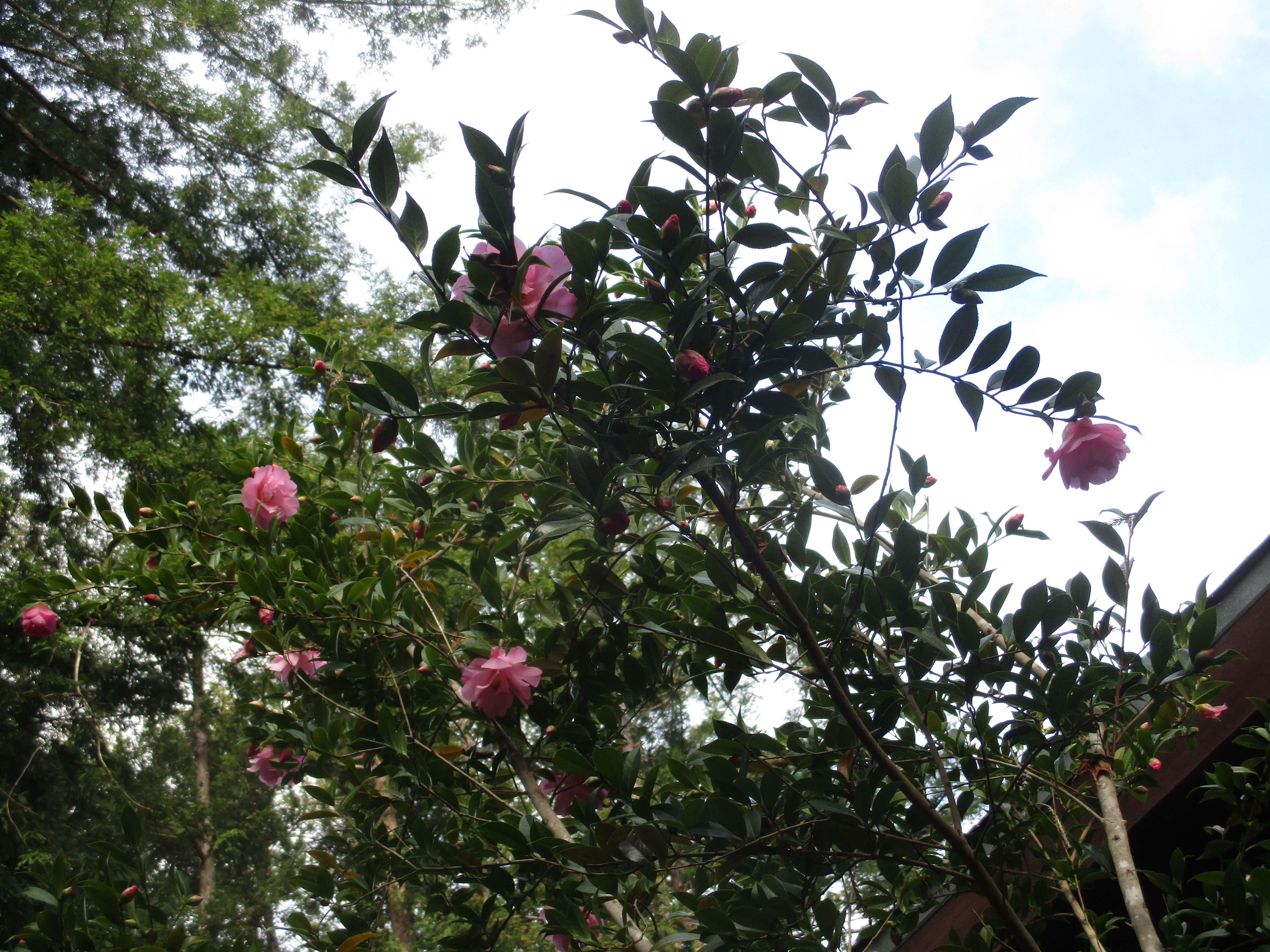
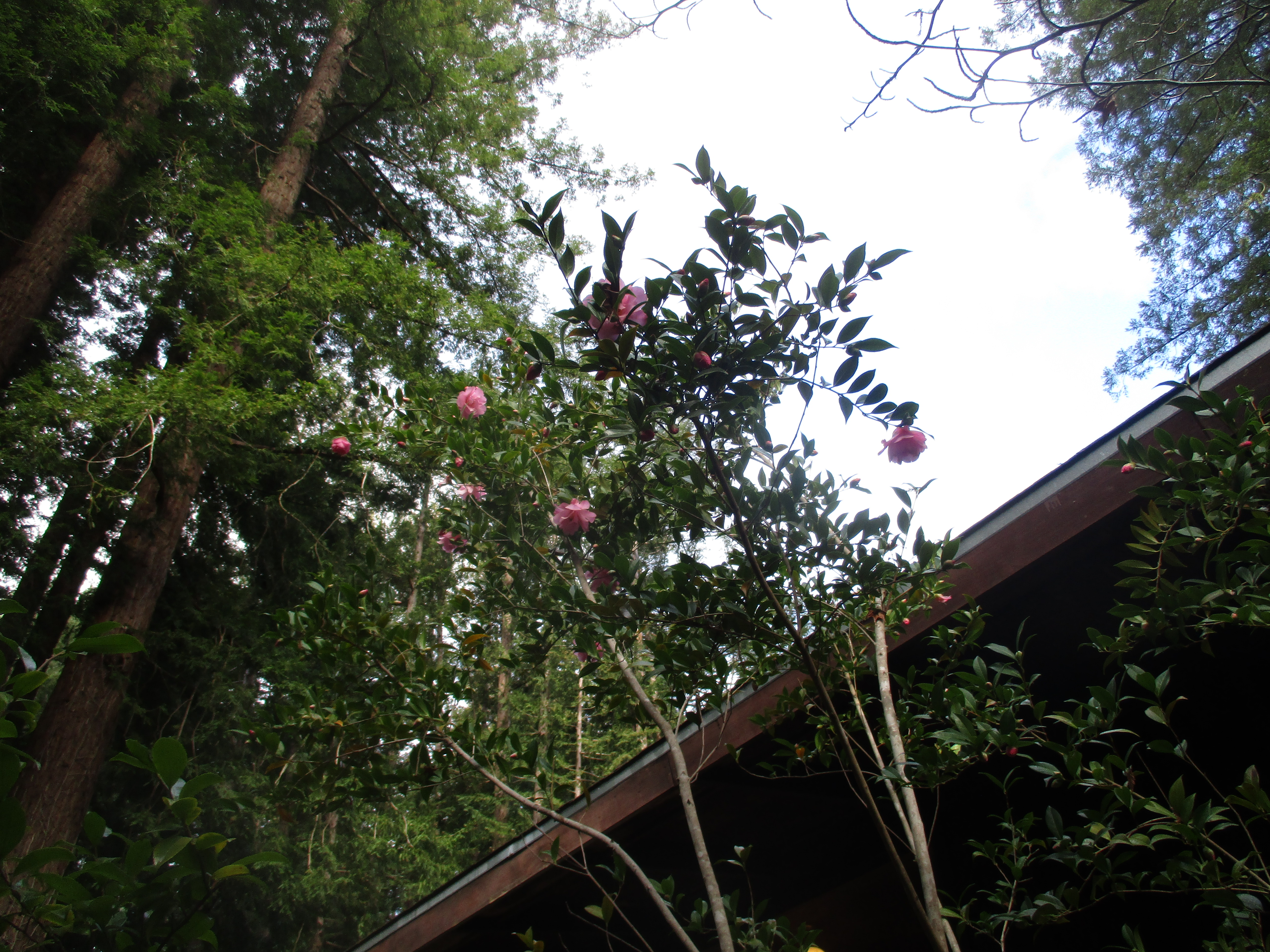
Camellias have been blooming for a while now. I typically get rather good pictures of them. The pictures are nothing too artistic, of course, and are intended to merely exhibit the floral color and form. A bit of the glossy foliage in the background is nice.
The picture above is not so useful for exhibiting much of the floral characteristics. Even the pink color is muted by the sloppy background and gray sky above. Zooming in would not have corrected the positioning of the flowers. I simply could not get close enough to do any better.
That eave in the lower right corner of the picture is above a two story building. That is where all the blooms of this particular camellia shrub are located. With so much of the lower growth shaded out and gone, this shrub is more like a small tree. The bloom is too high up to be appreciated. The picture below demonstrates what it all looks like without zooming in.
If there were windows facing this big camellia shrub or tree, I would likely prune it only a bit lower, just to keep it below the eave and within view of the windows. Without windows, I know that I really should prune the tall trunks back to what little lower growth remains, in order to promote more growth and bloom closer to ground level where it can be appreciated.
The difficulty I have with pruning it back is that this big camellia shrub or tree is so impressively big and sculptural, and all the glossy foliage looks so good in the foreground of the rich dark brown wall. I do not know what is more important here, the sculptural limbs and rich green foliage that lasts throughout the year, or the colorful but seasonal bloom.
As I mentioned in the immediately previous post, this is the sequel to that same previous post, and the second ‘Six on Saturday’ for today. These five bad pictures of good camellias, and the sixth . . . picture, would make sense only after reading the previous post: https://tonytomeo.com/2019/03/30/six-on-saturday-vanity/
These pictures are somewhat better than the previous six, . . . although black vinyl nursery cans and the gravel on the ground below are a bit too prominent in the first four. The flowers are centered better within the pictures, . . . although the first three are not facing the camera.
1. R. L. Wheeler
2. Variegated Guilio Nuccio
3. Nuccio’s Gem
4. Valentine’s Day
5. Unidentified camellia in the home garden
6. ME! As mentioned above, the previous post makes a bit more sense about these pictures.
Now, in case you do not read the previous post or know who Brent is, I will explain briefly that he is a renowned but extremely vain landscape designer in the Los Angeles region, and has been my colleague since we were college roommates in 1986. I posted my selfie here for comparison with Brent’s selfie in the previous post. Together they demonstrate that, although I am not nearly as proficient with taking good selfies as Brent is, I look much better in my selfies. Ironically, Brent Green, the renowned landscape designer, got his selfie in a nursery; and I am a nurseryman, but got my selfie in a landscape.
There are some more pictures of Brent’s home garden that I will likely share next week. They are much more interesting than the sorts of landscapes that I work in.
This is the link for Six on Saturday, for anyone else who would like to participate:
https://thepropagatorblog.wordpress.com/2017/09/18/six-on-saturday-a-participant-guide/
These are five of the pictures of camellias from Nuccio’s Nursery in Altadena that I said last week I would share this week. I will share five more immediately afterward in a second ‘Six on Saturday’ post. I am not certain if there is a rule against doing so, but no one seemed to mind when I did the same to share an over abundance of autumn foliar color last autumn. You can find the second post here: https://tonytomeo.com/2019/03/30/six-on-saturday-vanity-ii/
Brent Green, my colleague who I sometimes mention within the context of my articles, typically in a rather unflattering manner, took these pictures nearly two weeks ago. He lives and works nearby, in the Los Angeles region.
Brent takes horrible pictures. He always has. He was wasting my film on bad pictures such as these in 1986. I told him just before he took these pictures that I really wanted GOOD pictures. These are what I got.
Also, Brent is VERY vain. Back in 1986, when we were roommates in Fremont Hall at Cal Poly in San Luis Obispo, he often had me go get the car to meet him at the bottom of the stairs because he was in that much of a hurry to do whatever he happened to be doing at the time. It might have been getting close to a week since he last got his Grace Jones flat top do done. Perhaps his clothes were getting close to three months old, so he needed a new batch. It was always a rush. The problem was that there was a mirror in our dorm room. I would wait in the red zone at the bottom of the stairs with the engine running for several minutes before going back up to the top floor and most of the way down the long hall to our room to find him staring at himself in that mirror. When I told him that we needed to leave NOW before the car got ticketed, he would still need to add some more Sta-Sof-Fro to his do . . . and stare some more. He had hair back then.
Yes, this is relevant here. Anyway, these are the camellias:
1. Chandleri Elegans or Francine – What do they see off to the right? Why is one cowering behind the other? This picture should have been centered, and wider than tall, or horizontal rather than vertical.
2. Rosette – What is so interesting off to the left that the flower can not look at the camera? Is this supposed to be a picture of the flower low in the picture, or the gravel beyond it?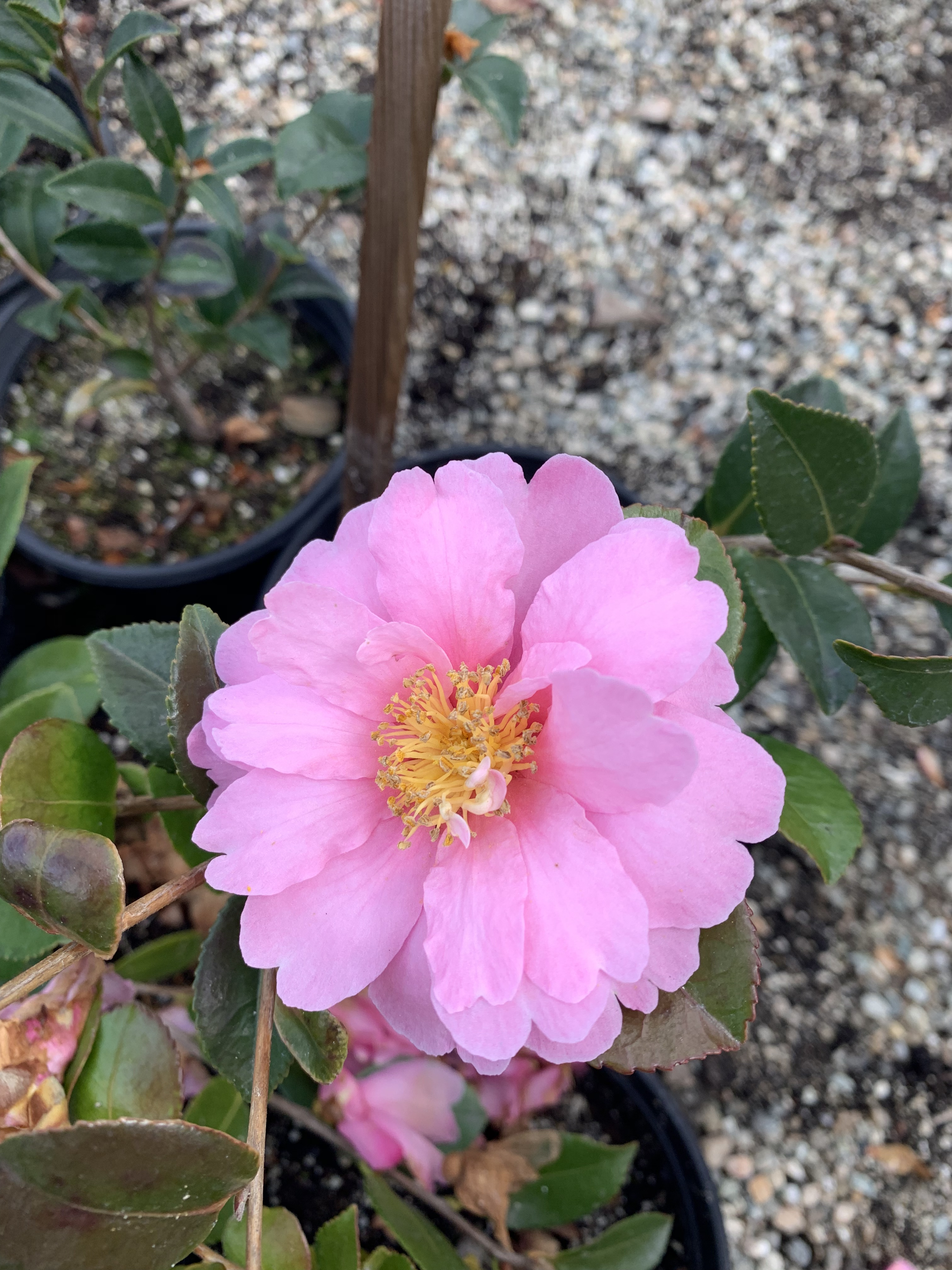
3. Red Devil – There are a lot of distracted flowers here. What is this one looking at on the ground? Is the gravel that interesting? Perhaps the vinyl cans are. This one should be centered too.
4. Demure – This one looks like an album cover from the 1970s; pale, distracted, and off center against an industrial background. It could be a bad picture, or it could be artistic.
5. Tata – This one looks like a teenager with bad acne looking down before jumping off the high dive.
6. Brent Green – The only good picture of the bunch.
Now . . . how did Brent take such bad pictures of flowers that he could so easily aim the camera at properly, AND take such a perfect selfie without being able to see the picture as he took it? Could it be VANITY?!?
This is the link for Six on Saturday, for anyone else who would like to participate:
https://thepropagatorblog.wordpress.com/2017/09/18/six-on-saturday-a-participant-guide/
 Tony Tomeo