Cane Berries

Cane berries are certainly not ‘low maintenance’.

Given the opportunity, blackberry and raspberry canes become rampant thickets. The trick is to keep them contained and controlled so that they can produce berries without conquering the garden. Besides, proper pruning promotes production. Properly maintained canes are therefore both better behaved and more productive.

Berry canes are certainly not low maintenance, and should be selectively pruned a few times through the year. The type of pruning needed is determined by the type of growth that the canes exhibit in particular seasons. Spent canes or upper portions of everbearing raspberry canes that produced berries through summer and early autumn will need to be removed by the end of winter while new canes that grew through this year get trained to replace them.

Pruning and thinning of new canes should be delayed until the end of winter; but removal or pruning of spent canes can begin as soon as their fruit gets depleted. Spent canes of traditional summer bearing raspberries like ‘Willamette’, ‘Tulameen’ and ‘Canby’ can be pruned to the ground. ‘September’, ‘Heritage’, ‘Summit’, ‘Fallgold’ and other everbearing raspberry canes should be pruned only as low as their fruit was produced. Lower portions that did not produce fruit should be left to bloom and produce berries next spring.

Just like raspberry canes, new blackberry canes that grew this year do not need to be pruned until late winter. However, the canes that grew last year and are finishing berry production this year can be pruned to the ground as their last berries get taken. There is no rush for this procedure, but getting it done early makes later pruning of new canes for next year a bit easier.

Of course, every different cultivar (cultivated variety) of raspberry and blackberry behaves differently. Some finish producing and are ready to be pruned sooner than others. Their behavior is also affected by climate and environmental conditions, so that the same variety may be earlier or later in different areas, or even different parts of the same garden.

Favorite berry canes are very easy to propagate by division of superfluous new shoots during winter. Alternatively, spent canes that should be removed can be ‘layered’ instead. They simply need to be bent down and partially buried, and can be dug and separated as they develop roots.

The top few inches of cane should extend above the soil. At least a few inches of cane below the top should be buried a few inches below the surface of the soil. The length of cane between the buried portion and the base of the parent plant can remain exposed.

Layering can be done at any time of year if the layer (buried section of cane) gets watered while developing roots. Layering this time of year is easiest though, because layers get plenty of water from rain through winter, and develop roots most efficiently as they come out of dormancy late in winter or early in spring. If layers are buried where new plants are desired, they do not need to be dug and moved next year.

Pruning Cane Berries

Their habit of overwhelming untended gardens gives blackberry canes a bad reputation. Their thicket like growth in their native habitats does not help. They are certainly not ‘low maintenance’ and need intensive specialized pruning later in the year. Yet, they become available with other bare-root plants this time of year for a reason. They make great blackberries!

New bare-root blackberry plants do not look like much when they are first planted, and do not produce berries in their first year. They will instead be busy dispersing roots and producing biennial canes that will produce berries the following year. Root barriers can prevent their aggressive roots from getting into neighbors’ gardens, particularly since south or west facing fences are just as practical for supporting trailing canes as trellises are.

‘Trailing’ types like ‘Marion’, ‘Boysen’ and ‘Olallie’ blackberries, which are also known as ‘boysenberry’, ‘marionberry’ and ‘olallieberry, are the most popular locally. ‘Erect’ types, like ‘Arapaho’, ‘Choctaw’ and ‘Navaho’ are more tolerant to frost, so are more popular where winters are colder. ‘Semierect’ types are hybrids of trailing and erect blackberries. 

In their second year, trailing and semierect canes that grew during the first year should be trained onto trellises, fences or wires. As their fruit gets depleted later in summer, these canes can be cut to the ground. Some of the new canes that developed through the season need to be trained onto the same supports to replace the older canes as they get removed.

There should be more than enough new canes. About ten to fifteen of the best canes of trailing types should be selected and pruned to about six or seven feet long. Semierect types need about half as many canes, and can be pruned about a foot shorter. Extra canes should be cut to the ground. A few of the smaller extra canes can be left through summer to be separated with roots as new plants during the following winter.

Side branches that grow from the pruned canes through late summer and early autumn should get pruned to about a foot long at the end of the following winter. New growth from these stubs will produce fruit during the following summer. The process of replacing the old canes with new canes can be repeated as the fruit gets depleted.         The process is similar for erect blackberries, but no support is needed. During the second year, canes should be cut to about two and a half feet tall in the middle of summer. Secondary branches from these canes should be cut to about a foot long in winter. As fruit gets depleted and replacement canes develop during the following summer, these mature canes can get cut to the ground. New canes then get pruned just like the older canes were.

Cane Berries

Thorny stems complicate pruning.

The fruits of summer are still a few month away. The work necessary to produce them needs to get done now though. Just like bare root trees, bare root raspberry canes get planted while dormant in winter, and later require intensive specialized pruning to keep them in control and to promote abundant production. Canes that are already established need to get pruned now and every winter.

New plants should be planted about two or three feet apart, and then cut back so that only a single bud is visible above ground. Root barriers should keep them from venturing under fences and into neighbor’s gardens, particularly since south or west facing fences are ideal spots to grow raspberries. Alternatively, raspberries can be planted in sunken #15 cans (15 gallon nursery pots), with or without the bottoms cut off. Cans should be buried up to their rims because any exposed black vinyl collects warmth from the sun, which is uncomfortable for the roots within. Mulch should insulate the soil until new foliage provides shade.

The few new canes that should develop during the next few months should be able to support their own weight, but may be easier to work with if tied to a fence or trellis. The popular everbearing types, like ‘September’, ‘Heritage’, ‘Summit’, ‘Golden Summit’ and ‘Fallgold’ may produce fruit on top of their new canes by autumn. The tops of these canes should get cut down as low as fruit developed during the following winter. The remaining lower portions of canes that did not produce fruit in the first year should produce fruit by the second summer, and should be pruned to the ground as the fruit finishes.  

As the spent canes get removed, about five to ten of the best new canes should be selected and tied in place if desired. All other canes should be cut to the ground. Like the canes of the previous year, the selected canes should develop fruit on top in autumn and get pruned as they finish in winter, and then develop more fruit down low before getting pruned out during the following summer. This process should be repeated annually.

‘Willamette’, ‘Tulameen’ and ‘Canby’ are traditional summer bearing raspberries. They do not produce in their first year, and will need to be pruned to about five feet tall during the following winter. As these canes develop fruit, many new canes emerge below. Every winter afterward, about five to ten of the new canes should be selected and pruned to about five feet as spent canes and unneeded canes get cut to the ground.

Installing Bare Root Cane Berries

Blackberry canes are not at all “low maintenance”!

The fruits of summer are still a few month away. The work necessary to produce them needs to get done now though. Just like bare root trees, bare root raspberry canes get planted while dormant in winter, and later require intensive specialized pruning to keep them in control and to promote abundant production. Canes that are already established need to get pruned now and every winter.

New plants should be planted about two or three feet apart, and then cut back so that only a single bud is visible above ground. Root barriers should keep them from venturing under fences and into neighbor’s gardens, particularly since south or west facing fences are ideal spots to grow raspberries. Alternatively, raspberries can be planted in sunken #15 cans (15 gallon nursery pots), with or without the bottoms cut off. Cans should be buried up to their rims because any exposed black vinyl collects warmth from the sun, which is uncomfortable for the roots within. Mulch should insulate the soil until new foliage provides shade.

The few new canes that should develop during the next few months should be able to support their own weight, but may be easier to work with if tied to a fence or trellis. The popular everbearing types, like ‘September’, ‘Heritage’, ‘Summit’, ‘Golden Summit’ and ‘Fallgold’ may produce fruit on top of their new canes by autumn. The tops of these canes should get cut down as low as fruit developed during the following winter. The remaining lower portions of canes that did not produce fruit in the first year should produce fruit by the second summer, and should be pruned to the ground as the fruit finishes.  

As the spent canes get removed, about five to ten of the best new canes should be selected and tied in place if desired. All other canes should be cut to the ground. Like the canes of the previous year, the selected canes should develop fruit on top in autumn and get pruned as they finish in winter, and then develop more fruit down low before getting pruned out during the following summer. This process should be repeated annually.

‘Willamette’, ‘Tulameen’ and ‘Canby’ are traditional summer bearing raspberries. They do not produce in their first year, and will need to be pruned to about five feet tall during the following winter. As these canes develop fruit, many new canes emerge below. Every winter afterward, about five to ten of the new canes should be selected and pruned to about five feet as spent canes and unneeded canes get cut to the ground.

Horridculture – Mail Order Glitch

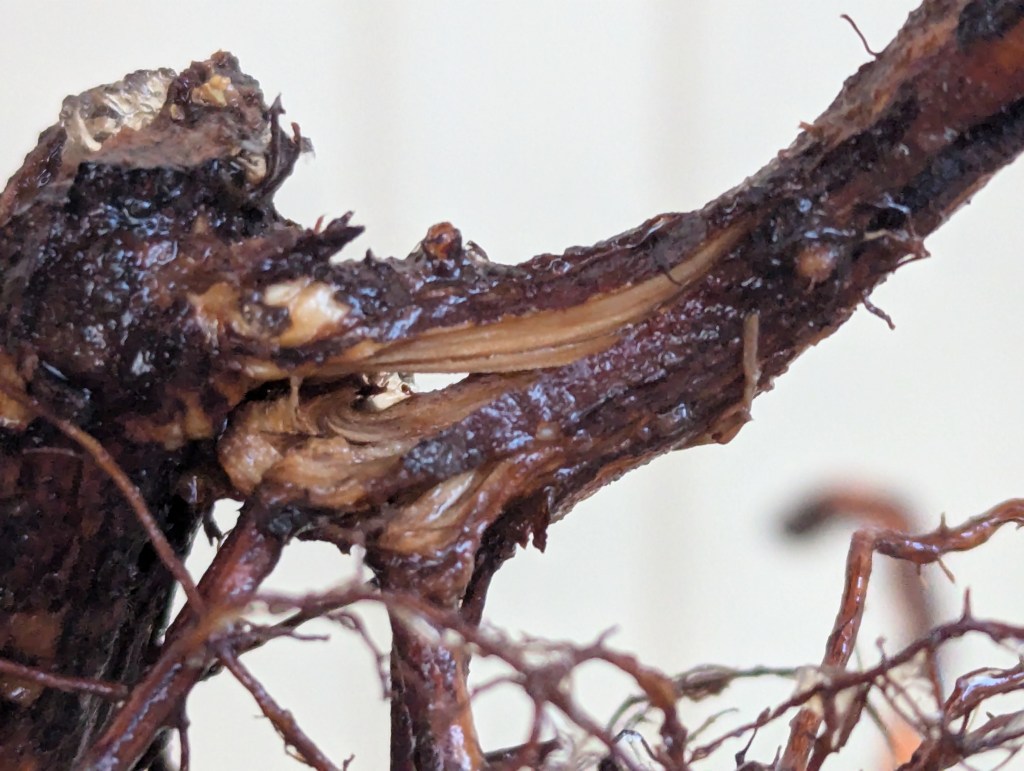
Of a dozen or so items of a mail order purchase that included various cane berries, mulberries, grapes and mayhaws, only a ‘Cumberland Black’ raspberry was less than exemplary. Unfortunately, it was majorly less than exemplary. It was broken at the base of its newest cane, just above where it extended from the older cane that the cutting was made from. If only it had not been broken, it would have been an excellent bare root specimen, with more roots than typical, and a substantial cane with several plump and turgid buds. I realize that it could either extend new canes from latent buds just below where it broke, or extend new roots from the base of the younger cane just above where it broke; so I should simply wait to see what it does. It could even do both, to provide me with two specimens for the price of one. However, I also realize that it could potentially do neither, but instead succumb to its damage. Regardless, its recovery from such damage should not be my concern. It is not in a condition that I intended to purchase it as. The provider should either provide a replacement, or refund what was paid for this particular item. Instead, I was instructed to wait to see if this damaged raspberry cane recovers. Well, at least I got a response. Perhaps that is all that is necessary. I am now more intent on keeping this raspberry cane alive, partly because I doubt that its purchase would be refunded if it succumbs to its damage, and partly because I would likely be to embarrassed to request such a refund if it becomes justifiable. Besides, as I mentioned, all other items of the purchase are of exemplary quality. I should be satisfied with that.

Raspberries Are Similar To Blackberries . . . But Different.

Like these dormant fruit trees, raspberry canes should go into the garden during bare root season.

            My grandmother would have gotten better results by sending me out to the garden for zucchini. She should have known better than to send me out for raspberries. I could have brought in as many zucchini as she wanted in a short while. With raspberries though, I was gone too long, and returned with meager spoils and diminished appetite.

            Neither raspberries nor zucchini will be exploitable for a few more months. Raspberries though, can get planted about now. Also, established raspberry canes should be pruned about now to promote abundant production later. Just like most deciduous fruit trees and blackberries, raspberries are not ‘low maintenance’, and require intensive specialized pruning.   

            New bare root plants should be spaced about two to three feet apart and mulched to insulate the soil until they develop enough foliage to shade their own roots. Their canes can then be cut back so that only a single bud is visible above ground. Because raspberries spread, root barriers are sometimes useful to keep them out of neighbors’ gardens.  

            Through summer, new plants should produce three or more new canes. These canes should be able to support themselves, but are less rampant if tied to a trellis or wire. I like to train them onto a fence like grapevines, because there are not many other uses for a fence.

            The more popular everbearing cultivars like Heritage, September, Summit, Golden Summit and Fallgold may develop fruit on the tops of their new canes during their first autumn. During the following winter, the tops of the canes should be cut back as far down as fruit developed. The remaining lower portions of their canes that did not develop fruit in the first year will do so during their second summer, and should get pruned out as they finish producing.

            At about the same time, about five to ten of the best new canes should be selected, and trained if desired. Superfluous canes should be cut to the ground. Like their predecessors, the remaining selected canes should fruit on top during autumn, get pruned in winter, and fruit again during the following summer before getting pruned out. This process should be repeated annually.

            Summer bearing cultivars like Willamette, Canby and Tulameen should not fruit in their first year, and should be pruned to about five feet tall during the following winter. Every subsequent summer, many new canes emerge as the older canes bloom and fruit. Every subsequent winter, about five to ten of these new canes should be selected, tied to support if desired, and pruned to about five feet tall, as all spent canes and superfluous new canes get cut to the ground.

            Black and purple raspberries are shrubbier, so get pruned differently than the more traditional red and yellow raspberries do.  During their first summer, canes should be pruned back to about two feet to promote branching. All except about six or seven of the best of these canes should be removed over winter. The side branches of the selected canes of black raspberries should then get pruned to about half a foot long. Side branches of purple raspberries can be twice as long. After these canes finish fruiting during the following summer, they should be cut to the ground. New canes can then be pruned like during the first summer so that the process can be repeated annually.  

Blackberry Canes Need Specialized Maintenance

Dormant blackberry canes are now available with other bare root stock.

            One of my favorite modern California impressionistic paintings depicts suburban gardening of the post agricultural period in the Santa Clara Valley. It is a finger painting that I made in kindergarten at Bucknall School in about 1972 or 3, to illustrate some of my favorite features of my grandparents’ garden in Santa Clara. To the left is a vertical brown stripe below green squiggles with black spots; the avocado tree. To the right is a similar image with red instead of black spots; the cherry tree. Between and below these, and lacking a vertical stripe, is a flurry of green squiggles with more black spots. These are blackberry canes.

            Blackberries are not at all ‘low maintenance’ since they require rather intensive specialized pruning. Most of the work that they need gets done during summer; but bare-root blackberry plants become available and get planted this time of year with other bare-root plants. Blackberries produce fruit on biennial canes which grow during their first year, and then bloom and fruit during their second year before dieing out.

            Once the tough roots are established, there is no shortage of fresh new canes to replace the old canes. In fact, surplus young canes can be dug and divided with roots to propagate new plants during winter. Because they have a way of spreading outward, blackberries should not be planted too near to neighbors’ fences without root barriers to keep them contained.  

            The most popular blackberries locally are ‘trailing’ types such as ‘Boysen’, ‘Marion’ and ‘Olallie’, which are also known as ‘Boysenberry’, ‘Marionberry’ and ‘Olallieberry’.  Less common ‘erect’ types, such as ‘Arapaho’, ‘Chickasaw’, ‘Choctaw’ and ‘Navaho’, are more tolerant to cold winter weather, so are more popular where winters are more severe. Hybrids of trailing and erect blackberries are ‘semierect’, and are generally treated like trailing types.

            After they get planted in winter, trailing and semierect blackberry canes can do whatever they want to through their first year. In their second year, canes should be trained onto trellises or wires until they have finished fruiting in summer. When the fruit is finished, these canes should be cut to the ground.

            Some of the canes that were growing on the ground below the trellises while all this was going on should now be trained like the canes that were just removed. For trailing types, about ten to fifteen of the best canes should be selected, trained and pruned to about six or seven feet long. About half as many canes of semierect types should be selected and pruned about a foot shorter. All remaining canes should be cut to the ground. (A few of the smallest remaining canes may be left intact through summer to be divided for propagation in winter.)     

            Side branches grow from the pruned canes through late summer and early autumn. At the end of the following winter, these side branches should be pruned to about a foot long. New growth from these stems blooms and fruits during the following summer. Again, when fruit is gone, the spent canes get cut to the ground so that the process can be repeated.

            Erect blackberries do not need to be trained onto support. Canes that develop during their first year can be cut to about two and a half feet tall in the middle of summer. Resulting branches should be cut about a foot long in winter. During the following summer, these fruiting canes should be cut to the ground as fruit is depleted. New canes can then be pruned like the previous canes were.

Bareroot Season Begins With January

Bare roots are dormant for winter.

Christmas trees and associated items are no imposition for nurseries. They are seasonal while not much else is appealing to a retail market. They occupy retail area that summer and autumn commodities relinquished earlier. Then, they relinquish their same space as bareroot stock becomes seasonable. The chronology is very coincidentally very efficient.

Bareroot season is not actually contingent on the end of Christmas tree season. It begins with winter dormancy of bareroot stock. This dormancy merely and fortuitously coincides with Christmas. It is as effective as anesthesia for surgery. Basically, dormant stock goes to sleep on a farm, and awakens in a new home garden. Timing of the process is critical.

Bareroot stock initially grows in the ground rather than within nursery cans. Separation of its roots from the soil they grew is harmless during dormancy. Both roots and stems need simultaneous pruning. Then, stock is ready for transport without soil. Some gets packing of moist sawdust in plastic bags. Most awaits resale from bins of moist sand at nurseries.

Bareroot stock has several advantages to more familiar canned nursery stock. It is much less expensive. It is also much less cumbersome. So, not only are more items affordable, but also, more fit into a car at the nursery. Their relatively small roots systems are easy to install. More importantly, without binding, their new roots disperse much more efficiently.

Deciduous fruit trees are the most popular bareroot stock. This includes stone fruits such as apricot, cherry, plum, prune, peach and nectarine. Also, it includes pomme fruits such as apple, pear and quince. Roses and cane berries are likely the second most popular of bareroot stock. Persimmon, pomegranate, fig, mulberry, and nut trees are also available.

Some of the more unusual bareroot stock is available only from online catalogues. More variety seems to become available locally though. Elderberry has only been available in California for the past several years. Currant and gooseberry are variably available here. Artichoke, asparagus, rhubarb and strawberry are perennials that are available bareroot. Cultivars of blueberry and grapevines are available.

Cane Berries Require Diligent Maintenance

Without proper pruning, cane berries become wicked thickets.

Given the opportunity, blackberry and raspberry canes become rampant thickets. The trick is to keep them contained and controlled so that they can produce berries without conquering the garden. Besides, proper pruning promotes production. Properly maintained canes are therefore both better behaved and more productive

Berry canes are certainly not low maintenance, and should be selectively pruned a few times through the year. The type of pruning needed is determined by the type of growth that the canes exhibit in particular seasons. Spent canes or upper portions of everbearing raspberry canes that produced berries through summer and early autumn will need to be removed by the end of winter while new canes that grew through this year get trained to replace them.

Pruning and thinning of new canes should be delayed until the end of winter; but removal or pruning of spent canes can begin as soon as their fruit gets depleted. Spent canes of traditional summer bearing raspberries like ‘Willamette’, ‘Tulameen’ and ‘Canby’ can be pruned to the ground. ‘September’, ‘Heritage’, ‘Summit’, ‘Fallgold’ and other everbearing raspberry canes should be pruned only as low as their fruit was produced. Lower portions that did not produce fruit should be left to bloom and produce berries next spring.

Just like raspberry canes, new blackberry canes that grew this year do not need to be pruned until late winter. However, the canes that grew last year and are finishing berry production this year can be pruned to the ground as their last berries get taken. There is no rush for this procedure, but getting it done early makes later pruning of new canes for next year a bit easier.

Of course, every different cultivar (cultivated variety) of raspberry and blackberry behaves differently. Some finish producing and are ready to be pruned sooner than others. Their behavior is also affected by climate and environmental conditions, so that the same variety may be earlier or later in different areas, or even different parts of the same garden.

Favorite berry canes are very easy to propagate by division of superfluous new shoots during winter. Alternatively, spent canes that should be removed can be ‘layered’ instead. They simply need to be bent down and partially buried, and can be dug and separated as they develop roots.

The top few inches of cane should extend above the soil. At least a few inches of cane below the top should be buried a few inches below the surface of the soil. The length of cane between the buried portion and the base of the parent plant can remain exposed.

Layering can be done at any time of year if the layer (buried section of cane) gets watered while developing roots. Layering this time of year is easiest though, because layers get plenty of water from rain through winter, and develop roots most efficiently as they come out of dormancy late in winter or early in spring. If layers are buried where new plants are desired, they do not need to be dug and moved next year.

Blackberry

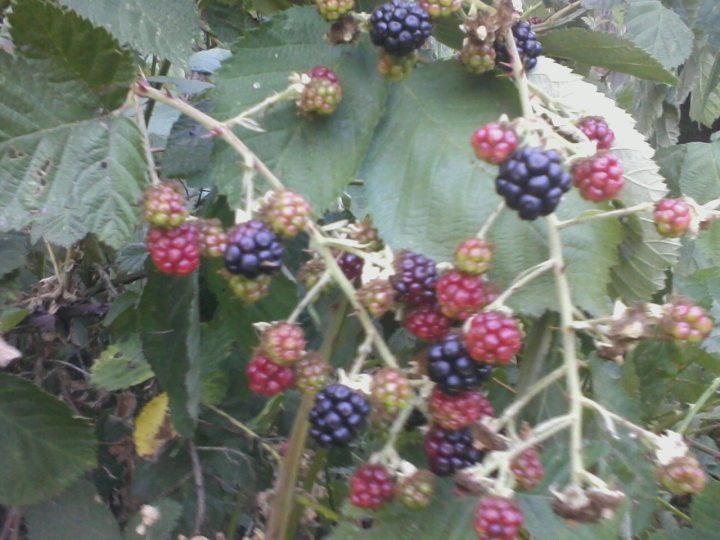
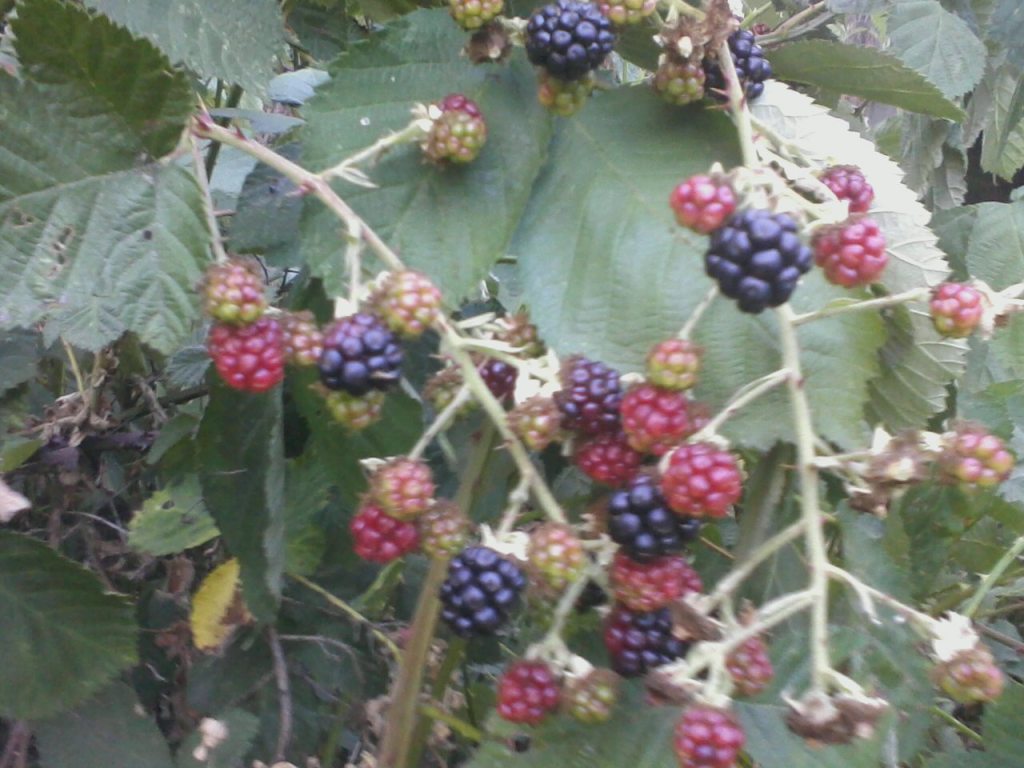
Blackberries are ripening slowly this year because of the mild weather.

Rampant brambles of feral blackberry, Rubus fruticosus, canes are much too common and give blackberries a bad reputation. Yet, with regular selective grooming and pruning, their biennial stems that emerge from woody perennial roots are both more productive and easier to contain than one would guess. ‘Primocanes’ grow rapidly to six to sixteen feet in the first year. In the second year, they become ‘floricanes’, which do not grow longer, but instead develop lateral stems that bloom and fruit. Only a few modern ‘fall bearing’ or ‘everbearing’ cultivars fruit on primocanes.

Canes are trailing, semi-trailing or erect. As the names imply, trailing types like ‘Marion’, ‘Boysen’ and ‘Olallie’, need support. They are the most popular locally because they are more productive. Erect types that need no support, like ‘Navaho’, ‘Choctaw’ and ‘Arapaho’, are less productive, but because they are more tolerant to frost, are more popular where winters are colder. Old classic blackberry varieties are quite prickly. Modern thornless varieties are becoming more popular as more varieties are developed. All have palmately compound leaves with five or seven leaflets. Simple small white or pale pink flowers that bloom late in spring are followed by the familiar blackberries that are ripening now.