Yucca whipplei, which is now also known as Hesperoyucca whipplei, was the first species of Yucca that I met in the wild when I relocated to San Luis Obispo in 1985. Although it is too unpleasantly spiny for me to recommend it for home gardens, it is my favorite species of Yucca.
The only specimen of Yucca whipplei that inhabits our landscapes produced a few seed pods two years ago. I dried the seed and sowed them last year. I would have been pleased if a few germinated successfully. Instead, hundreds of them are now growing! Again, I grew too much of a good thing.
I can install several as a deer fence below a portion of my home garden. Although they grow only about three feet tall, deer will not try to jump over them uphill if they can not land beyond their painful foliage on the uphill side. However, if I put them three feet apart, only about twenty seedlings will be needed for approximately sixty linear feet of deer fence. That might be only about a twentieth of the hundreds that are now growing! They are still babies. I can worry about finding homes for them later.
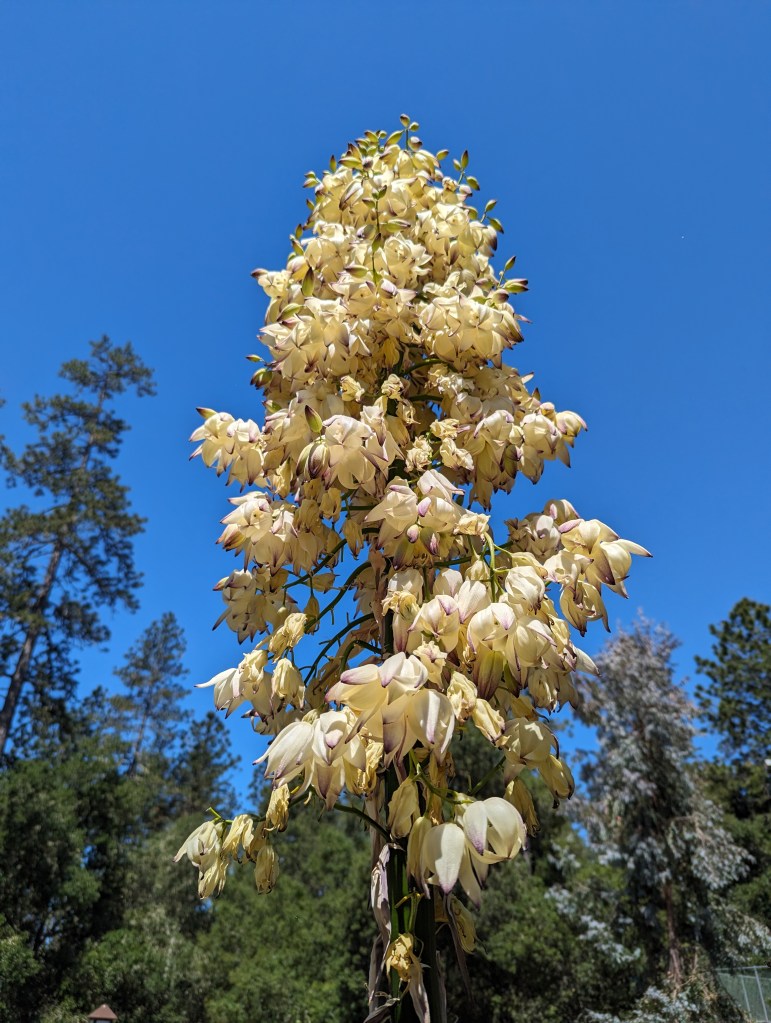
Our Lord’s candle blooms with very tall floral stalks.
The one or two foot long and nearly inch wide leaves of our Lord’s candle, Yucca whipplei, certainly do not look as painful as they really are. The ridiculously sharp terminal spines can penetrate boot leather and administer a whole new experience of lingering pain! It is no wonder that, although native south of Big Sur, they are uncommon in home gardens.
Their three foot tall and six foot wide stemless clumps of dense foliage would be a very efficient barrier that does not obstruct view, but is not always permanent. Within only a few years, mature plants die after summer bloom. Their big flower stalks emerge like asparagus and grow nearly twelve feet tall, with the upper half of their height branching into hefty spikes of pale white bell shaped flowers one or two inches wide.
California lilac grows wild throughout California.
Wildflowers are only part of the story. They are happy enough with the chaparral climate here to bloom for spring or summer. A few are naturalized exotic species, though. In other words, they are not native to California. They merely behave like they are, likely because they are from similar climates. Native species are happy here because they are at home.
More than the most abundant wildflowers are native. Many trees, vines, shrubs, annuals and perennials are also. They were here long before Spanish explorers imported the first exotic plants after 1542. They were as satisfied with local soils and climates then as they are now. This is why many are more suitable for home gardens than many exotic plants.
Native plants are less popular than exotic plants only because a few are a bit too natural. Since they are from chaparral climates, some may get a bit scraggly and dry by summer. They survive arid weather by being partially dormant through some of it. Most appreciate irrigation through summer. However, some are susceptible to rot with generous irrigation.
Conversely, there are several advantages to native plant species. They naturally require less irrigation than most exotic species. Once established, some expect none at all. Only species from other chaparral or desert climates might be less demanding. Landscapes of exclusively native species therefore conserve water. Some get all they want from rainfall.
Also, native species are more compatible with natural ecosystems. Any that self sow into nearby wildlands will be where they belong. They do not compete unfairly for pollinators that other native species rely on. Nor do they compete unfairly for possibly limited space and resources. Furthermore, they contribute habitat and sustenance to wild native fauna.
California poppy and sky lupine are probably the most familiar of native annuals. Various salvias and bush lupines may be the most familiar native perennials. California lilac and flannel bush are familiar native shrubs. California sycamore, coastal redwood and coast live oak are familiar native trees. Many native species are practicable for home gardens, and landscaping.
(Hespero)Yucca whipplei has an identity crisis. My contemporaries and I learned it as Yucca whipplei. Botanists now insist that it identifies as Hesperoyucca whipplei, although, like any and all other species of Yucca, it can hybridize with any and all other species of Yucca. (If it is a different species of the same genus, such hybrids would be interspecific hybrids. If it is a different genus, such hybrids would be intergeneric hybrids, which is even weirder.) Also, my contemporaries and I learned its common name as Spanish bayonet. Botanists prefer to designate it as chaparral yucca. It is alternately known as foothill yucca, Quixote yucca or our Lord’s candle. Because it was the only species of the genus that was locally native, we typically referred to it merely as yucca. Later, I learned that Spanish bayonet is a general designation for a few arboriform species of Yucca, which develop trunks and perhaps limbs, such as Yucca aloifolia, and that Spanish dagger is actually more commonly a generic designation for a few species that lack significant trunks or limbs, such as this particular species. Anyway, regardless of all this nonsense, I had been wanting to grow this species since encountering it while studying horticulture at California Polytechnic State University in San Luis Obispo, but could not find an appropriate situation in which to do so. It is too wickedly spiny for most landscapes. I was told that a specimen inhabited one of the landscapes at work, but because it did not look familiar, I was sceptical. It adapts so efficiently to whatever situation that it grows into, that its foliage here is somewhat different from how it develops in the wild around San Luis Obispo. Its impressively tall bloom is very familiar though, and is very distinctive of the species.
So many similar cultivars of low shrubby grevilleas come and go that it is hard to know what is what. All prefer sunny exposure and good drainage. They really do not like too much watering or fertilizer, particularly fertilizer with phosphorus. Pruning after bloom promotes more bloom, which keeps hummingbirds happy. Some people who are allergic to grevilleas can get a rash from handling the foliage.
Grevillea ‘Canberra’ was probably the most popular grevillea in the early 1990s, but can be hard to find now that other similar grevilleas are more common. It is a mid-sized shrub with dark green foliage that resembles pine needles on arching branches about six feet tall and broad. Small clusters of rosy red flowers bloom along the branches in winter and spring.
Several of the fifty or so species of Yucca are difficult to distinguish from similar species. Some are varieties of species, rather than distinct species. Some are naturally occurring hybrids. Curve leaf yucca, Yucca recurvifolia, is supposedly a naturally occurring variety of mound lily, Yucca gloriosa var. recurvifolia (or tristis). Alternatively, it could be a hybrid.
As if that is not confusing enough, its physical characteristics are variable. Foliar color is typically grayish, but might be simple olive drab like that of many other species of Yucca. Its typically pliable evergreen leaves that curve downward as they mature can be almost as rigid as those of common mound lily. Stout but upright trunks may or may not develop.
Curve leaf yucca is remarkably resilient. Actually, unwanted specimens can be difficult to eradicate. Small bits of rhizome can generate pups for many years after the removal of a primary plant. Occasional watering is appreciated through the warmest summer weather, but may not be necessary. Old colonies can get ten feet tall, and occupy significant area, but quite slowly.
The first bloom is the best. At least it is purported to be. Many of us who are familiar with any cultivar of rockrose, Cistus, might disagree. Bloom begins in spring and continues through summer. The most profuse bloom can be anytime within that range. Some cultivars bloom sporadically but continually. Others bloom in more distinct phases. Cultivars that start later can bloom into autumn.
Bloom is white, pale pink, rich pink or purplish pink. Individual flowers have five petals and fuzzy centers. Flowers of some of the older cultivars have a prominent rusty red spot at the base of each petal. Smaller flowers are more profuse than larger flowers. The small evergreen leaves of most rockrose are somewhat grayish, with a matte finish. Foliage is aromatic when disturbed or warm.
Most rockrose are appreciated for their low and mounding form. If arranged in a row, they can grow into an artificial berm. Most get at least three times broader than tall. Few get taller than three feet. They all appreciate warm exposure. Once established they do not need much watering. Unfortunately, most rockrose do not live much longer than five years. Few survive more than ten years.
What a silly name this is! Sticky monkey flower, Diplacus aurantiacus (or Mimulus aurantiacus), is native to a broad range of ecosystems of California and the Northern Coast of Baja California. It is famously happy in situations that are too rocky or sandy for most other species. The resinous foliage really can be rather sticky during warm weather. The relevance to a monkey is a mystery.
Sticky monkey flower is more popular among hummingbirds and insects than anyone else. Those who welcome hummingbirds and insects into their garden happen to like it too. Honestly though, it might a bit too casual for refined landscapes. It works better in or on the outskirts of rustic gardens. If not already growing wild, cultivars and the straight species are available in some nurseries.
Bloom begins late in winter or early in spring, and might continue through summer, but is rarely impressively prolific. The bisymmetrical and tubular flowers are about three quarters of an inch long. Almost all are pastel orange, sort of like circus peanuts. Gold and yellow are uncommon. Supposedly, there are rare cultivars that bloom in red or white. Mature plants get more than three feet tall.
Most other specie of ceanothus are more colorful and tame than Ceanothus cuneatus is. It is known as ‘buckbrush’ because the abundant round trusses of minute flowers are typically dingy white instead of the more familiar shades of blue that have earned other ceanothus the common name of ‘California lilac’. However, a few wild plants and some garden varieties bloom blue.
Mature plants are at least six feet high and wide, but typically less than ten feet high and twelve feet wide. They are pleasantly fragrant as they bloom between March and April or May. Roots seem to tolerate almost any soil that drains well and does not get watered too much. Once established, no watering is needed. The scrubby evergreen foliage likes full sun exposure.
Although it is a bit unrefined, and does not want to be pruned for confinement, buckbrush works nicely as screening shrubbery on the perimeter of a landscaped area, or in unlandscaped areas. Newly installed small plants only need to be watered occasionally as they disperse their roots through their first year. Since they are native, established plants are satisfied with rainfall.




 Tony Tomeo