
There is not as much difference between the seasons here like there is in other climates. It might seem like we get only summer, with a briefly cooler and slightly rainy time of ‘not summer’. I can recognize the changing of the seasons because I am familiar with them. Those acquainted with more normal climate mind find our subdued seasons to be rather boring, and restrictive.
People from climates with more extreme weather and more pronounced seasons might not expect mild weather and mild climate to be restrictive or limiting. They tend to notice what grows here that would not survive out in gardens through colder winters, such as bougainvilleas, tropical hibiscus and so many of the popular succulents. Even more tropicals survive farther south.
What they do not notice are what does not do so well here. Although stone fruit does remarkably well here, and many apples and pears are more than adequately productive, there are many cultivars of apple and pear that prefer more chill than they could get here. Lilac gets sufficient chill to bloom well here, but not enough to bloom as splendidly as it does in the Upper Midwest.
For example, some might be impressed by the perennial daisies that bloom sporadically whenever they want to throughout the year here. These daisies take no time off for winter, and are rarely damaged by frost every few years or so. They are so rarely without bloom that it is not often possible to shear off deteriorating bloom without removing some of the unbloomed buds.
What goes unnoticed is the potentially subdued bloom of the forsythias, which are so reliably prolific where winters are cooler. Some are real duds this year, and all are blooming notably late. This is one of the consequences of a mild climate.

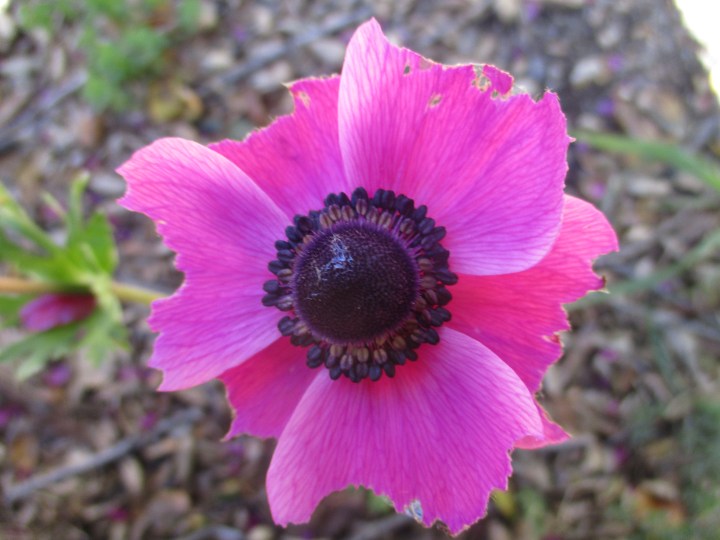 This really is something that I did not expect to see. It may not look like much. It is just a raspy anemone with bites taken out of it, blooming later than it should. What is so impressive about it is that it was not planted here last year. It was planted during the previous year, then bloomed on time last year, and then died back like anemones normally do. I did not plant it, of course. It is in a planter where volunteers contribute whatever they like.
 We do not get much frost here. This picture of the view through the windshield of one of the work vehicles was taken more than a week ago, while the humidity and the temperatures were still quite low. The sparse and angular pattern of the frost on the windshield is a result of the minimal humidity. There will be more frost later in winter, although there will not be nearly as much as most other climates get.
 Where winters are cooler, the deteriorating stems of flowers that bloomed last year either got pruned away already or got knocked down by the weather, and are now rotting on the ground. Around here, where the weather is milder, and some flowers only recently finished blooming, used up flower stalks still stand in stasis. Most but not necessarily all should get pruned out and raked away.
 Tony Tomeo