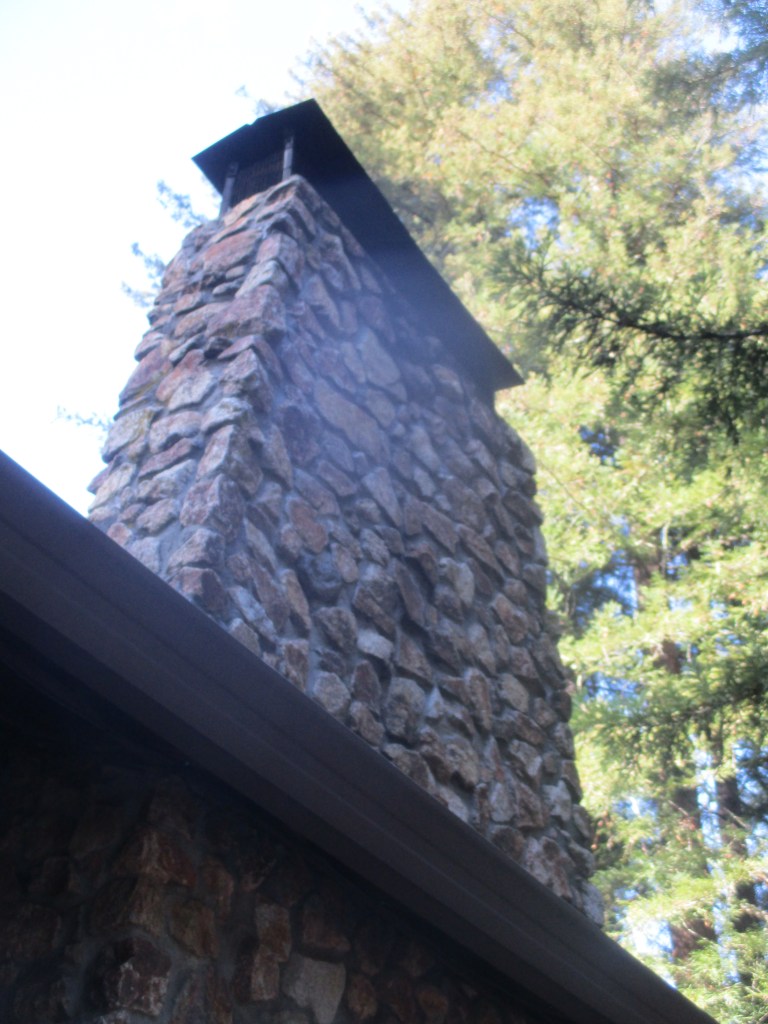
Chimney Clearance Must Be Maintained

Chimneys do not get enough consideration.

Chimneys are easy to neglect. Some are external to the homes they serve. They occupy visible but minor garden space. Others are internal. Only portions that extend above their respective roofs are visible. Besides the use of accompanying fireplaces or woodstoves, they do not change with the seasons. Nonetheless, chimney clearance is very important.

Trees and vines often extend growth over the tops of chimneys. They grow most actively while chimneys are least active through spring and summer. Such growth is hazardously combustible within the exhaust of chimneys below. Essential chimney clearance pruning eliminates hazardous vegetation prior to the use of associated fireplaces or woodstoves.

Various eucalyptus, cypress, pine, cedar, juniper, fir, spruce, oak and bearded fan palms are very combustible. Deciduous oaks become less combustible as they defoliate during cooling weather though. Other deciduous vegetation is likewise less combustible by the time chimneys are most in use. Vines can accumulate debris directly on top of chimneys.

Vegetation within ten feet of a chimney should generally be two feet below the top of the chimney or fifteen feet above it. More combustible vegetation justifies more clearance or more vigorous grooming. Accumulated dry detritus is more hazardous than fresh foliage. Burning vegetation drops burning debris onto other combustible vegetation and material.

Of course, fireplaces, woodstoves and their associated chimneys are not as common as they were in the past. Most municipalities banned them from new construction during the past many years. Removal of chimneys that incur damage from earthquakes is generally more practical than repair. Chimney clearance becomes unnecessary without chimneys.

Furthermore, few surviving chimneys experience as much use as they did decades ago. Modern heating systems are much more practical and efficient. They generate no smoke to offend neighbors. They are unregulated by ‘no-burn’ alerts. Now that urbanization has replaced orchards and woodlands, firewood might be expensive from local tree services.
Vegetation Needs Clearance From Infrastructure

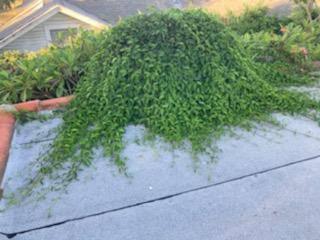
There is a chimney under this overgrown vine.

It may not seem like it is so now, but evergreen trees really are messier than most deciduous trees. They probably do not produce any more debris, but they drop their debris over much longer periods of time, or at various times, or simply ALL the time. Yet, at this time of year, it seems like the deciduous trees that mostly have dropped nothing or very little since last year, are making most of the mess in the garden as they defoliate for winter.

Defoliation is only beginning, and will continue for a while. Ironically, the most impressively colorful deciduous trees happen to be those that hold their foliage for a long time, making their defoliation process linger over a few months. Even the most efficiently neat trees that defoliate in a few days tend to do so during windy or rainy weather, when we are not so motivated to go out into the garden to clean up their mess.

As the rainy season begins in a few weeks or so, the gutters on the eaves should be cleaned of debris that has accumulated since last year. This can sometimes be delayed until all deciduous trees that contribute to the accumulation of debris are completely defoliated. Generally though, homes with many or big trees (or many big trees) may need their gutters cleaned more than once as they continue to collect debris through autumn and perhaps into winter.

Any debris that collects behind chimneys, in valleys (where roof slope changes direction) or anywhere else on the roof, should also be removed. Even without gutters to collect debris, flat roofs collect whatever debris that does not get blown off by wind. Only parapet roofs that are common on so many homes of Spanish architecture collect more debris, since they are sheltered from wind.

Trees and vines should never be allowed to lean onto roofs. Vines and some densely foliated trees tend to accumulate all sorts of debris that rots and then damages the roof below. Trees that touch roofing material are abrasive as they move in any breeze.

Obtrusive trees and vines are also a serious problem for chimneys. Cypress, cedar, pine and the beards (accumulations of dead foliage) of fan palms are particularly combustible. Even after they get soaked by rain, they can quickly dry if heated by the exhaust from a chimney. Maple, ash and other trees with open canopies may not be as combustible, especially while defoliated, but can get roasted by chimney exhaust, and can interfere with ventilation.

Chimney Clearance Must Be Maintained

Modern homes lack old fashioned fireplaces.

Even as autumn weather cools, smoke rising from a simple old fashioned brick chimney is a rare sight nowadays. A smoking stovepipe is rarer. Modern building codes forbid the installation of new fireplaces or wood stoves within most municipalities here. Modern air quality ordinances severely limit the use of existing fireplaces and wood burning stoves.

Furthermore, existing fireplaces and wood stoves are neither as popular nor as common as they had been. After an earthquake, a faulty chimney is likely to justify removal rather than repair. An unused wood stove wastes too much space. Old orchards that generated inexpensive firewood as they relinquished their space to urban development are extinct.

There are a few advantages to these modern trends though. Modern homes consume so much less energy for heating than older homes because of efficient insulation. Insulation of older homes retains heat that fireplaces generate, so that less wood is needed. Almost every surviving chimney has a spark arrestor. Modern roof materials are noncombustible.

Nonetheless, vegetation that gets too near to a chimney that is in use can be hazardous. Even if clearance was adequate last winter, trees, vines and large shrubbery grew since then. It does not take long for such vegetation to overwhelm a chimney, or encroach a bit more than it should. It does not take too much vegetation to be hazardously combustible.

Clinging vines like English ivy and Boston ivy sometimes climb up and then over the top of a chimney. Although not especially combustible, they will burn directly over a fireplace or wood stove. Just like gutters do, vines can accumulate leaves that fall from deciduous trees to become more combustible. Birds or rodents can build combustible nests in them.

Evergreen trees and big shrubbery are similarly combustible over a chimney. Deciduous trees are generally not as hazardous. Conversely, cypress, pine, cedar, eucalyptus, large junipers, and ungroomed palms are very combustible. Eucalyptus foliage will burn while fresh, if it gets hot enough. The other trees tend to accumulate very combustible detritus.