Live Christmas Trees

Most live Christmas trees grow too big for home gardens.

One of the problems with driving my favorite vehicles that were old long before I learned to drive them is that I spend considerable time waiting for a bus or walking. The cool thing about that is that I get to seem so much scenery that I would otherwise drive past. While waiting nearly an hour for a bus at the Cavallero Bus Terminal in Scott’s Valley, I went across the street to see the landscape of the somewhat new Post Office, which has actually been there for many years now.

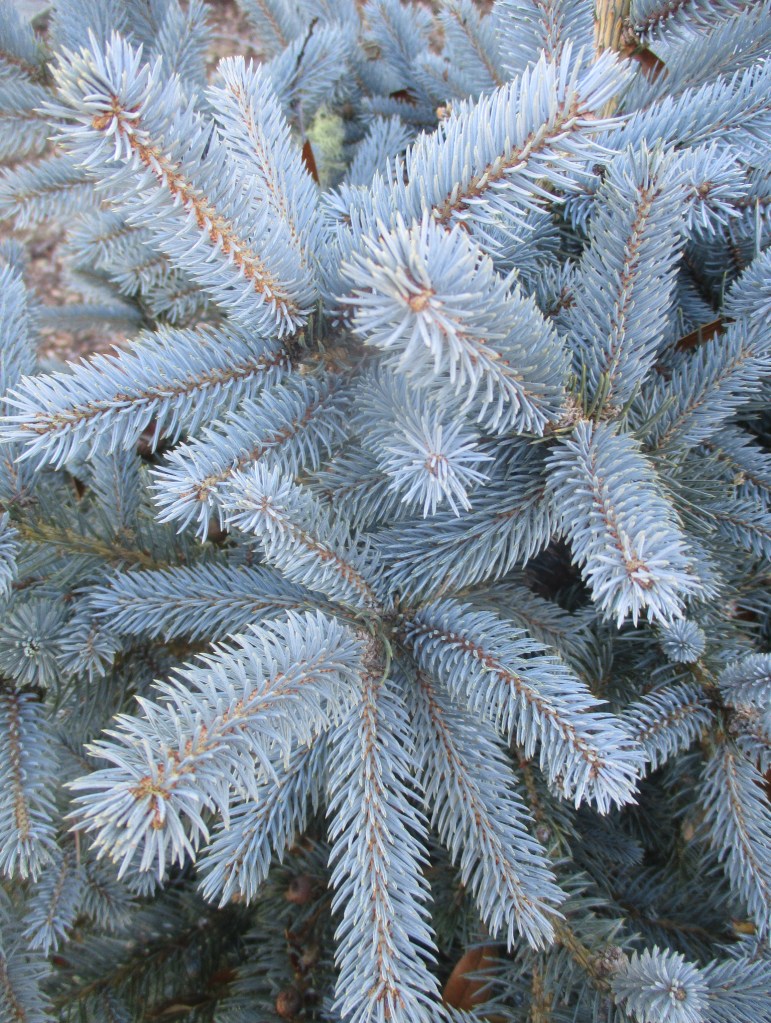
The landscape is a bit sparse in front (I think because of architectural modifications after the landscape was designed), so was outfitted with recycled live Christmas trees. Although none of these particular trees seem happy in the local climate or sandy soil, I had wanted to get better acquainted with them for some time. They are an odd assortment of spruce and fir that are rare here.

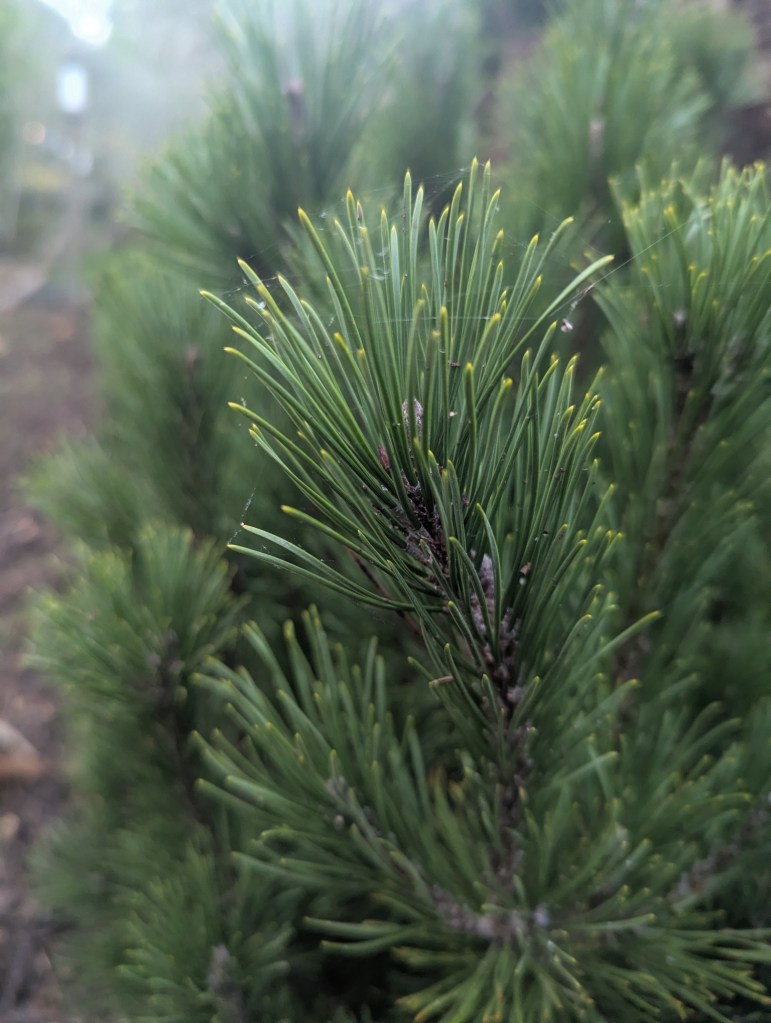
The more typical concern with the more common live Christmas trees is not that they are not well suited to local climates and soils, but that they actually do too well and grow much larger than expected. Except for the small rosemary, holly and English ivy ‘trees’, most coniferous evergreen live Christmas trees are young pines that get remarkably large; and some waste no time doing it! The most common live Christmas trees are Italian stone pines, which happen to be the two very large and broad trees in Blaney Plaza in downtown Saratoga!

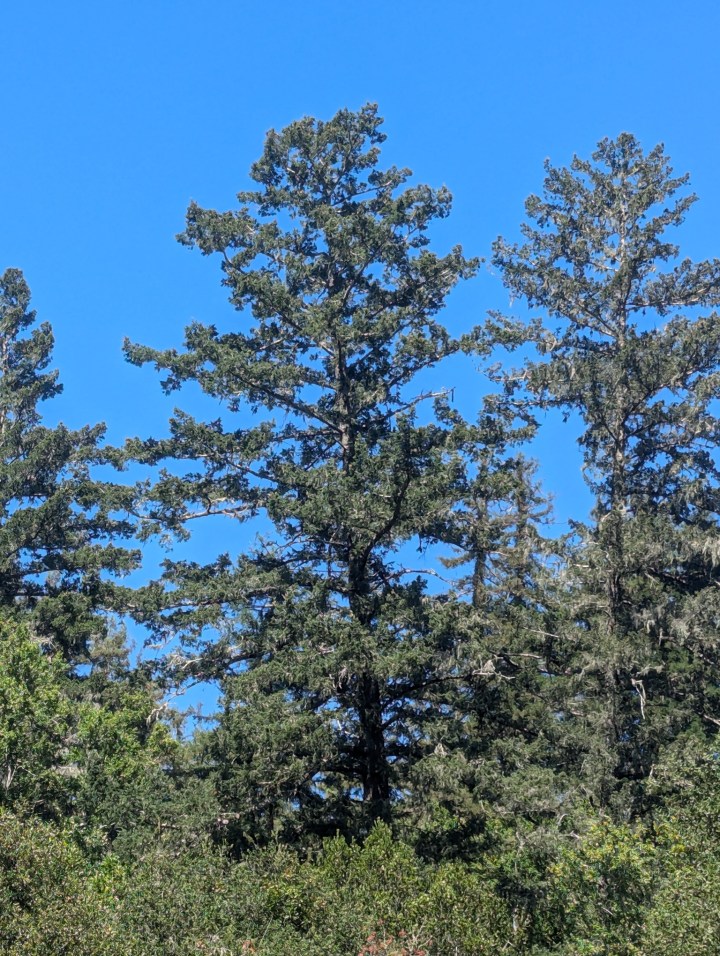
Canary Island pines, which had been more common than they are now, do not get quite as broad, but do get very tall and messy. Years ago, Aleppo, Eldarica and Monterey pines all took their turns being popular live Christmas trees. Each of them grows large enough to require significant garden space.

This is of course not a problem for the few live Christmas trees that happen to get planted where they have plenty of space. However, those that get planted where they do not have room to grow can cause serious problems. Because they seem so cute and innocent while they are young, and are so often expected to stay cute and innocent, many often get planted dangerously close to houses, where they can displace porches, walkways and even foundations! Large pines, particularly Italian stone pines, are also too messy and potentially combustible (if not pruned and groomed regularly) to be too close to houses.

Sadly, large pines do not like to stay in containers too long. They can be pruned for a few years, but eventually get congested roots. (Bonsai techniques of root pruning can maintain even the largest types of pines in containers indefinitely, but not many of us know these techniques.) Small pines, like Austrian black, Japanese black and Scott’s pine (which has no relation to Scott’s Valley), as well as other small coniferous evergreens, like certain junipers, can stay in containers much longer, but these are the sort that are small enough to get planted in the garden, so do not necessarily need to stay in containers anyway.

If space is not sufficient, pines and other live Christmas trees that eventually get too large really should be given to friends and neighbors who have space to accommodate them. Fortunately, most do not require much attention once they get established after two years or so.

Potted Christmas Trees Grow Up

Dwarf Alberta spruce stays very compact.

There should be no stigma associated with cut Christmas trees. They grow on farms, not within natural ecosystems, as some believe. Like cut foliage, cut flowers and vegetables, they are an agricultural commodity. They generate no more greenwaste than an average lawn. Yet, potted Christmas trees are popular as an ‘environmentally responsible’ option.

Potted Christmas trees, however, can be more of an environmental detriment. Only those that perform for a few years consume less resources than cut Christmas trees. Almost all deteriorate too much during their first summer for a second Christmas. Therefore, they do not perform any more perpetually than cut trees. They are, however, costlier and smaller.

The expense of potted Christmas trees is proportionate to the resources which they use. Proportionately, they require more fertilizers, pesticides and infrastructure than cut trees. This is also relevant environmentally. So is their synthetic growing medium, plastic pots, and for some, mylar wrapping. Transportation is more efficient only for the smallest sorts.

Regardless, for many households, potted Christmas trees remain after Christmas. Some of the most expensive sorts are fortunately more likely to be practical sorts. They may be compact types that are conducive to confinement within big pots. If so, they may function as Christmas trees for a few years. Afterward, they might fit nicely into their home garden.

This includes a few cultivars of spruce as well as fir and even pine. Dwarf Alberta spruce is easy to accommodate in both pots and gardens. Large specimens are expensive and rare though, so few need accommodation now. Blue spruce is more practical as a potted Christmas tree, but grows larger. Eastern redcedar can stay in a large pot for a few years.

The most common potted Christmas trees are Italian stone pine and Canary Island pine. These are the small sorts with cheap ornaments and mylar wrapping. They too often lack identification or description of how large they grow. Consequently, those who plant them too often provide inadequate space. Such big trees can be very destructive as they grow.

Live Christmas Trees

Some live Christmas trees grow too big for home gardens.

They appear to be so simple and innocent now, shorn strictly into conical form and perhaps adorned with any remnants of their Christmas time employment, but living Christmas trees can potentially become big problems. Italian stone pine, which is one of the most popular living Christmas trees, can get nearly eighty feet tall and sixty feet wide, with massive trunks and limbs! Regardless, they often get planted in small gardens and tight situations after Christmas because they do not seem like they would do any harm.

Most living Christmas trees can eventually become large trees. Canary Island pine, Aleppo pine, Monterey pine and Afghan pine are the most notorious since they are the most common, and also because they are not so easily recognized while they are young Christmas trees. Their juvenile foliage is more softly textured and often lighter colored than their more substantial adult foliage.

These most common living Christmas trees do not like to stay potted for very long, and are not very conducive to subsequent shearing. Consequently, many do not survive through their first summer, and those that do often get planted in the garden without much thought. Until recent years, they were seldom labeled; so few people knew how big they could get.

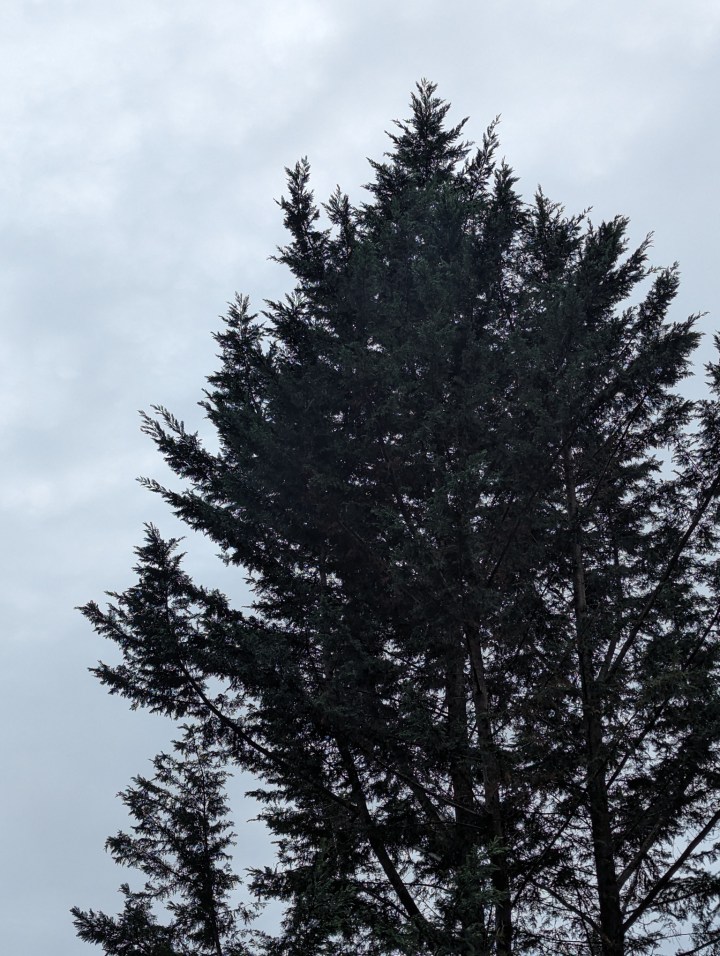
Coastal redwood, giant redwood, deodar cedar and Arizona cypress as living Christmas trees are neither as common, nor as likely to not get recognized as trees that eventually get quite large. They need their space nonetheless. Fortunately, they are generally somewhat more practical for some spacious gardens than the large pines are.

Scotts pine, Austrian black pine (rare), Japanese black pine, Eastern red cedar (juniper), Rocky Mountain juniper, some arborvitae and the various spruce are some of the best living Christmas trees. They grow somewhat slowly, are more cooperative with pruning and can live in tubs long enough to function as Christmas trees for a few years. When they eventually get too large for their pots, they are not so likely to get too large for the garden.

Whether a Colorado blue spruce being retired after ten years of service or an Italian stone pine being retired after only a single Christmas, a living Christmas tree needs some help with the transition from pot to garden. Any circling roots should be severed when the pot gets removed. Otherwise, roots become constricted as the circling roots grow and expand.

Much of the dense foliar canopy should be thinned out to compensate for confinement of roots. Besides, much of the shorn growth is actually disfigured and will eventually get replaced and shed as new growth develops above the original canopy. Formerly pruned spruce, redwood, deodar cedar and most pines may need minor trimming of the upper new growth to promote a single leader (that will develop into the main trunk).

It is best to plant living Christmas trees rather soon after Christmas so that they can loiter in the garden through winter. Rain and cool temperatures keep them from desiccating as their roots start to disperse before new foliage starts to emerge in spring. Newly planted living Christmas trees should be watered somewhat regularly during their first year because their roots take some time to disperse adequately.

Foliage Surpasses Flowers For Christmas

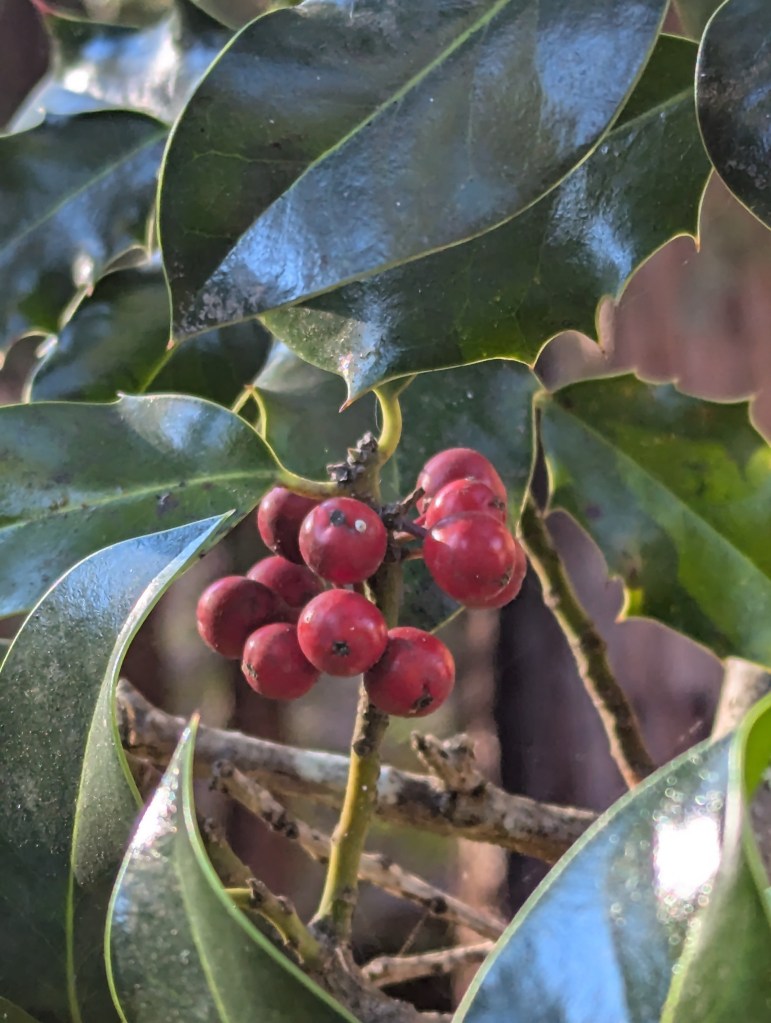
Hollies contribute more foliage than berries.

Winter bloom might be limited. Wintry berries, dried flowers and the remains of summery bloom can be more abundant. Evergreen foliage is as abundant as it always is. After all, it is evergreen. That is most likely why it is so popular for home decor through Christmas. It is the primary component of wreaths and garlands, and, technically, of Christmas trees.

Flowers are more scarce where winters are cooler. They are also more desirable indoors while the weather is too cool to be outdoors. Evergreen foliage effectively compensates. While flowers are less scarce here, the most traditional evergreen foliage is more scarce. It is simply less popular within home gardens locally. Also, less of it grows wild in forests.

Most cut evergreen foliage consequently grows on farms like certain popular cut flowers. Many of such farms are in the Pacific Northwest, where such foliage grows most readily. Many types of fir, spruce and pine that are popular for wreaths are naturally happy there. Western red cedar, which is the primary component of garland, is a native species there.

However, locally available cut evergreen foliage can be as delightful as traditional types. A few types are native species that grow wild beyond cultivated home gardens. More are exotic species within refined landscapes. Douglas fir is both traditional as well as native to many regions of California. A few native pines can substitute for more traditional types.

Redwood, cypress and juniper are likewise alternatives for traditional evergreen foliage. Some are natives or relatives of native species. Deodar and Atlas cedars resemble blue spruce. Arborvitae may substitute for Western red cedar, and is actually the same genus. English holly, although rare, and more rarely produces berries, is occasionally available.

Christmas trees are the ultimate form of cut foliage. Unlike other foliar decor, they almost exclusively grow on farms. Their cultivation is very impractical for refined home gardens. Collection of other cut foliage should not damage its source. Some may be from pruning scraps. Christmas trees, though, are much more than a few stems. They are entire trees, containing all their stems.

Living Christmas Trees Eventually Mature

Living Christmas trees are real trees.

Christmas trees are extreme cut foliage. They stand alone, rather than as accessories to cut flowers. Most are a few feet tall, and some are much grander. Ultimately though, they are as disposable as cut flowers. Because they are so expensive, their disposal seems to be wasteful. Realistically though, they are more practical than living Christmas trees.

Now that living Christmas trees remain after Christmas, they require attention. They are otherwise as disposable as cut trees are. Large specimens are too expensive to discard. They might also be difficult to maintain. Because almost all were field grown, they are in very dense and heavy soil. Such soil can retain either insufficient or excessive moisture.

Many initially healthy living Christmas trees can deteriorate through summer. Some get too shabby to function as a Christmas tree before their second Christmas. They adapt to local climates slowly after leaving the climates in which they grew. Some do not survive. They are happier in the ground than in a tub, but as such, can not come in for Christmas.

Living Christmas trees are less expensive than cut trees only after a few years of service. Several of the more compact types can actually survive containment for several years. A few can survive in tubs indefinitely with occasional pruning. Otherwise, most eventually need to graduate from containment to a garden. This is not as simple as it seems to be.

Visual appeal and price limit selection of living Christmas trees. Physical characteristics of such trees should be more of a consideration. Some are more tolerant of confinement within large pots than others are. Some will eventually be quite adaptable to landscapes. The unfortunate reality is that many become very large trees that need substantial space.

Small pre-decorated trees in mylar wrap are the most common of living Christmas trees. Unfortunately, most are either Italian stone pine or Canary Island pine. Both grow too big for compact gardens. Planting living Christmas trees in the wild is not a practical option. Without irrigation, formerly confined trees can not survive long enough to disperse roots. If they could, they can damage local ecology.

Living Christmas Trees Eventually Grow Up

Although relatively compact, even spruce trees eventually grow up.

One of the problems with driving my favorite vehicles that were old long before I learned to drive them is that I spend considerable time waiting for a bus or walking. The cool thing about that is that I get to seem so much scenery that I would otherwise drive past. While waiting nearly an hour for a bus at the Cavallero Bus Terminal in Scott’s Valley, I went across the street to see the landscape of the somewhat new Post Office, which has actually been there for many years now.

The landscape is a bit sparse in front (I think because of architectural modifications after the landscape was designed), so was outfitted with recycled live Christmas trees. Although none of these particular trees seem happy in the local climate or sandy soil, I had wanted to get better acquainted with them for some time. They are an odd assortment of spruce and fir that are rare here.

The more typical concern with the more common live Christmas trees is not that they are not well suited to local climates and soils, but that they actually do too well and grow much larger than expected. Except for the small rosemary, holly and English ivy ‘trees’, most coniferous evergreen live Christmas trees are young pines that get remarkably large; and some waste no time doing it! The most common live Christmas trees are Italian stone pines, which happen to be the two very large and broad trees in Blaney Plaza in downtown Saratoga!

Canary Island pines, which had been more common than they are now, do not get quite as broad, but do get very tall and messy. Years ago, Aleppo, Eldarica and Monterey pines all took their turns being popular live Christmas trees. Each of them grows large enough to require significant garden space.

This is of course not a problem for the few live Christmas trees that happen to get planted where they have plenty of space. However, those that get planted where they do not have room to grow can cause serious problems. Because they seem so cute and innocent while they are young, and are so often expected to stay cute and innocent, many often get planted dangerously close to houses, where they can displace porches, walkways and even foundations! Large pines, particularly Italian stone pines, are also too messy and potentially combustible (if not pruned and groomed regularly) to be too close to houses.

Sadly, large pines do not like to stay in containers too long. They can be pruned for a few years, but eventually get congested roots. (Bonsai techniques of root pruning can maintain even the largest types of pines in containers indefinitely, but not many of us know these techniques.) Small pines, like Austrian black, Japanese black and Scott’s pine (which has no relation to Scott’s Valley), as well as other small coniferous evergreens, like certain junipers, can stay in containers much longer, but these are the sort that are small enough to get planted in the garden, so do not necessarily need to stay in containers anyway.

If space is not sufficient, pines and other live Christmas trees that eventually get too large really should be given to friends and neighbors who have space to accommodate them. Fortunately, most do not require much attention once they get established after two years or so.

Cut Foliage For Christmas Decor

Coniferous evergreens are popular Christmas decor.

Christmas trees are extreme cut foliage. They grow on farms like cut foliage that florists use, but are entire trees! Although most fit under household ceilings, some within public venues are famously grand. Nonetheless, they are ultimately as disposable as any other cut foliage. Eventually, after their Christmas season, they become common greenwaste.

Other cut foliage is also popular as home decor through the Christmas season. Much of it is from the same sorts of coniferous trees that become Christmas trees. Almost all of it is evergreen, since deciduous vegetation is already defoliating. A few deciduous stems with colorful bark, such as red twig dogwood, are nice too. So are colorful winter berries.

Cut foliage is more practical as wintry decor within climates with cooler winter weather. Not much blooms during such weather. However, because of this same wintry weather, people prefer to be inside. While inside, they appreciate the color, texture, and perhaps aroma of cut foliage. Locally, such foliar decor for winter is more traditional than practical.

Actually, the most traditional cut foliage of Christmas is uncommon within local gardens. Scraps from the lowest branches of Christmas trees are a good source of minor bits of it. Premade wreaths and garland include a few types that are otherwise unobtainable here. Improvisation is necessary to create wreaths and garlands from locally available foliage.

Only a few of the few blue spruce that live here grow large enough to share many stems. Their best foliar growth is also their most important structural growth. Removal of it might cause minor disfigurement. Other spruce, as well as various fir, are very rare within home gardens. So is Eastern white pine, although a few other pines are notably common here.

Atlas cedar, Deodar cedar, various cypress and various juniper are also rather common. A few sorts of holly are uncommon but not rare, but they produce only a few berries here. Holly olive may be more common, and resembles English holly, but produces no berries. Southern magnolia is a strikingly untraditional cut foliage, but becomes fragile as it dries.

Christmas Trees Grow On Farms (2011)

Christmas trees grow on farms rather than forests, but some farms are in forests.

(This is an old article from 2011, so much of the information within is no longer relevant.)

Douglas, grand, white and Noble firs, as well as sierra redwoods, Monterey pines and at least fourteen other varieties of Christmas trees can be found and cut at Santa’s Tree Farm and Village near Half Moon Bay. Certainly, no one needs that many Christmas trees; and most select only one. Yet it is good to know that somewhere within such a vast selection, there is the perfect Christmas tree. Santa’s Tree Farm and Village also provides wreathes, garlands, tree stands, flocking, fire retardant and delivery.

On weekends, Sleighbells Gift Shop is open from 9:00 a.m. to 4:00 p.m.; and through December 18, Santa Visits between 9:30 a.m. and 4:30 pm.. For $2, children from two to ninety-two and older can ride the train from 9:30 a.m. to 4:00 p.m., as weather allows. Younger children ride for free. Santa’s Tree Farm is open between 8:00 a.m. and 5:00 p.m. on weekends (except for closing at 1:00 p.m. on Christmas Eve), and from 9:00 a.m. to 5:00 p.m. on weekdays.

Except for trees on the Diamond lot and pre-cut trees, prices range from $46 to $69. VISA and Mastercard and leashed dogs are welcome. Santa’s Tree Farm and Village is at 78 Pilarcitos Creek Road at Highway 92, six and a half miles from Highway 280 on the way to Half Moon Bay. Coupons, showtimes (yes, ‘showtimes’) and more information can be found at the website http://www.santastreefarm.com, or by telephoning 650 – 726 2246.

Atlantic cedar, Austrian pine, Arizona cypress, Leyland cypress Scott’s pine, sugar pine, white fir, as well as many other varieties of Christmas trees can also be obtained from Crest Ranch Christmas Tree Farm, located in the Santa Cruz Mountains west of the San Lorenzo Valley. Douglas firs, pines, cedars and cypress are $37 up to five feet tall, and $7.40 for each additional foot. White and Greek fir varieties are $42 up to five feet tall, and $8.40 for each additional foot. All sales are cash or check. An ATM is available.

The beautifully scenic picnic area is a good excuse to bring lunch, or at least get something at the snack bar. Leashed dogs are welcome. More information can be found at the website http://www.crestranch.com or by telephoning 831 – 426 1522. Crest Ranch Christmas Tree Farm is open from 8:00 a.m. to 5:00 p.m. until December 20, and is located at 12200 Empire Grade outside of Felton.

Live Christmas Trees Eventually Grow Up

Small coniferous trees do not stay small for long.

One of the problems with driving my favorite vehicles that were old long before I learned to drive them is that I spend considerable time waiting for a bus or walking. The cool thing about that is that I get to seem so much scenery that I would otherwise drive past. While waiting nearly an hour for a bus at the Cavallero Bus Terminal in Scott’s Valley, I went across the street to see the landscape of the somewhat new Post Office, which has actually been there for many years now.

The landscape is a bit sparse in front (I think because of architectural modifications after the landscape was designed), so was outfitted with recycled live Christmas trees. Although none of these particular trees seem happy in the local climate or sandy soil, I had wanted to get better acquainted with them for some time. They are an odd assortment of spruce and fir that are rare here.

The more typical concern with the more common live Christmas trees is not that they are not well suited to local climates and soils, but that they actually do too well and grow much larger than expected. Except for the small rosemary, holly and English ivy ‘trees’, most coniferous evergreen live Christmas trees are young pines that get remarkably large; and some waste no time doing it! The most common live Christmas trees are Italian stone pines, which happen to be the two very large and broad trees in Blaney Plaza in downtown Saratoga!

Canary Island pines, which had been more common than they are now, do not get quite as broad, but do get very tall and messy. Years ago, Aleppo, Eldarica and Monterey pines all took their turns being popular live Christmas trees. Each of them grows large enough to require significant garden space.

This is of course not a problem for the few live Christmas trees that happen to get planted where they have plenty of space. However, those that get planted where they do not have room to grow can cause serious problems. Because they seem so cute and innocent while they are young, and are so often expected to stay cute and innocent, many often get planted dangerously close to houses, where they can displace porches, walkways and even foundations! Large pines, particularly Italian stone pines, are also too messy and potentially combustible (if not pruned and groomed regularly) to be too close to houses.

Sadly, large pines do not like to stay in containers too long. They can be pruned for a few years, but eventually get congested roots. (Bonsai techniques of root pruning can maintain even the largest types of pines in containers indefinitely, but not many of us know these techniques.) Small pines, like Austrian black, Japanese black and Scott’s pine (which has no relation to Scott’s Valley), as well as other small coniferous evergreens, like certain junipers, can stay in containers much longer, but these are the sort that are small enough to get planted in the garden, so do not necessarily need to stay in containers anyway.

If space is not sufficient, pines and other live Christmas trees that eventually get too large really should be given to friends and neighbors who have space to accommodate them. Fortunately, most do not require much attention once they get established after two years or so.

Live Christmas Trees Eventually Mature

Most conifers are not so compact.

Christmas trees grow on farms. They are an agricultural commodity. Their unnatural and intensive cultivation is no asset to any associated natural ecosystem. Their harvest does not deprive ecosystems of natural components. Live Christmas trees are at least equally as unnatural. Their cultivation involves more synthetic materials and unnatural irrigation.

There should be no shame associated with the procurement of cut Christmas trees. They are merely cut foliage that is significantly more substantial than that which accompanies cut flowers. Furthermore, live Christmas trees are not an ecologically responsible option. They are merely potted plants that can be difficult to accommodate within home gardens.

That certainly should not invalidate the appeal and potential practicality of live Christmas trees. With proper maintenance, other potted plants, such as houseplants, can grow and perform for many years. Since live Christmas trees are coniferous species that get rather large, they demand more attention. All are not necessarily totally unmanageable though.

Some compact conifers, such as dwarf Alberta spruce and compact cultivars of Colorado blue spruce, can remain within pots for many years. They need either larger pots as they grow, or occasional root trimming if they stay within their same pots for a few years. Their roots outgrow pots as slowly as their canopies grow. They also require diligent watering.

Unfortunately, the most common of decorated live Christmas trees that are available from supermarkets are also the most problematic. Most are either Canary Island pine or Italian stone pine, which grow surprisingly large for such seemingly innocent small evergreens. They very often go into compact gardens, where their bulky roots displace infrastructure, such as pavement and turf grass.

Contrary to popular belief, planting live Christmas trees in the wild after Christmas is not a practical option. Because their roots were confined to pots, they rely on irrigation while they disperse roots into the ground. They can not survive without irrigation after the rainy season. Besides, trees that are not native could be detrimental to the native ecosystems.