Street Trees Must Be Adaptable

Pavement necessitates trees with complaisant roots.

Trees of substantial size are not as popular as they had been among old home gardens. Modern landscapes of bigger homes on smaller parcels can not accommodate as many. Clearance from various infrastructure is now more of a concern than shade. Within many modern urban gardens, most available space is in front. Such is the realm of street trees.

This is not because of a lack of obstacles, such as infrastructure that requires clearance. It is more because such obstacles are closer to the ground with more open space above. Many street trees must actually be more adaptable to certain constraints than other trees. Selection of such trees, if allowable by their municipalities, necessitates diligent scrutiny.

Street trees are, most simply, trees between curbs and sidewalks. Some inhabit medians while others are adjacent to curbside sidewalks. Many municipalities prescribe particular trees for particular situations. Anyone who is uncertain of such limitations should inquire. Many municipalities permit property owners to install any trees they prefer, or none at all.

For those who can select street trees, such trees must be appropriate to their application. They must grow high enough to not obstruct sidewalks or roadways. Both sidewalks and roadways require minimal clearances. So do street signs, streetlamps and traffic signals. However, street trees should not grow too large for the confined spaces that they inhabit.

This includes their roots. Aggressive roots of willows, poplars and sweetgum are likely to displace pavement. Oaks, although too big for confined situations, are more docile. Their roots are less likely to displace adjacent infrastructures. Crape myrtle has become overly common because it is too small to cause damage. It does not make much shade, though.

Crape myrtle might also get rather messy, which is another consideration for street trees. It drops flowers during summer, and can get infested with scale, which exude honeydew. Magnolias drop flowers that can be a slipping hazard. Whether deciduous or evergreen, street trees should be reasonably tidy. Over roads, they should not need much attention.

Taking Sides

This is what taking sides looks like. The right side was taken completely off, leaving only the left. The view from the other side would show that the left side was taken completely off, leaving only the right. It is not such a good picture because it is difficult to distinguish the extent of the damage from what is going on in the background. Realistically though, a better picture would be even worse, since the extent of the damage would be more obvious. The justification for such damage here is more obvious, since, obviously, this is a bad situation, with no room for balanced growth. Although survival is possible, this is not what nature intended. Natural growth should be an asset, and efficiently directed to where it can be useful, which would most likely be much more balanced than this. Incidentally, this is a coastal redwood, which is the Official State Tree of California. This sort of pruning would be just as damaging to Western hemlock, Douglas fir or blue spruce. For that matter, it would be just as damaging to longleaf pine, Western white pine or Ponderosa pine. Ultimately, it is bad technique for any tree in any situation.

Clearance Pruning Directs Obtrusive Vegetation

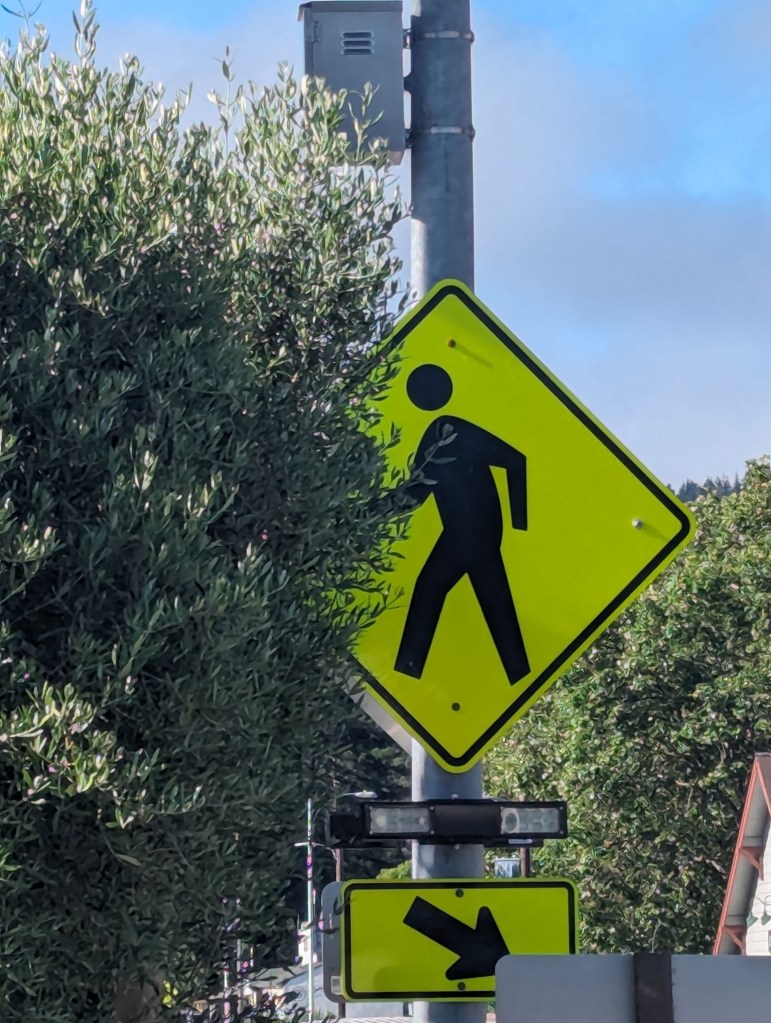
Traffic signs must always remain visible.

Pruning techniques are very diverse to serve various purposes. Dormant pruning during winter concentrates resources for spring or summer growth. Hedging or shearing merely contains growth. Thinning or grooming removes superfluous growth to enhance sunlight diffusion. Clearance pruning directs new growth that might otherwise become obtrusive.

There are too many distinct pruning techniques to mention. Some, such as shearing and thinning, are mutually exclusive. Shearing actually initiates the sort of congested growth that thinning eliminates. Techniques such as dormant pruning and clearance pruning are mutually compatible. After all, almost all pruning is less stressful with winter dormancy.

Clearance pruning merely becomes a concern now as spring growth becomes obtrusive. Much of the worst require professional assistance. Only arboricultural professionals can safely prune trees away from high voltage cables. Such cables are extremely hazardous! Utility services generally try to arrange such procedures before major problems develop.

However, arboricultural professionals are necessary for other clearance pruning as well. Many trees are simply too large or hazardous for anyone but professionals. Some extend over roadways that need clearance for the largest of trucks. Some extend over chimneys that could ignite vegetation that gets too close. Many simply extend beyond a safe reach.

Street trees seem to require the most clearance pruning. They must be a specified height over any roadway, as well as over any sidewalk. Also, they must not obstruct street signs or views for cars backing out of driveways. Ideally, their interference with light from street lamps should be minimal. Vegetation that is closer to buildings presents other concerns.

Besides chimneys and exhaust vents, roofs also need clearance. Stems and foliage are abrasive as they move in any wind. They collect debris that causes rot and clogs gutters. Furthermore, walkways and navigable areas are more efficient with adequate clearance. Clearance pruning should direct growth away from any obstruction, rather than contain it.

Utility Clearance Can Disfigure Trees

Utility cables need clearance from trees.

Last winter was a doozy! It involved historic frost, snow, rain, wind, floods and mudslides. A few roads remain closed in some regions. Major electrical outages were too numerous for prompt repair. Weather alone did not cause such outages though. It merely dislodged vegetation that did so. This demonstrates the necessity for utility clearance maintenance.

Utility pruning is a specialized but very often unpleasant sort of arboriculture. It maintains necessary clearance between vegetation and utility cables. Its unpleasantry derives from its harsh efficiency. Clearance is the priority. Proper arboricultural technique is not. There is no compromise. Trees that encroach too closely to cables are likely to regret doing so.

Proper arboricultural procedures are too expensive to justify for utility clearance pruning. Otherwise, electricity and other utilities that utilize cable would be much more expensive. Besides, for many trees within utility easements, proper arboriculture is impossible. They can not accommodate necessary pruning without disfigurement. Several can not survive such disfigurement.

Palms, for example, can not survive without their single terminal buds. They lack limbs to divert growth to. Removal of a terminal bud that encroaches too closely to utility cables is lethal. Palms generally grow only upward. Those that grow tall rapidly can not live below utility cables for long. Very few palms remain low enough to maintain minimal clearance.

Excurrent trees are generally more vulnerable to disfigurement than decurrent trees. The single central trunks of excurrent redwoods and spruces do not adapt to redirection. The several main limbs of decurrent oaks and elms are more cooperative. Compact trees that are unlikely to reach cables are least problematic. Of course, many trees are unplanned.

Arborists can repair some minor clearance pruning damage or disfigurement. They might prevent some damage by timely pruning for containment. Unfortunately, some damage is neither repairable nor preventable. Also, such procedures are too dangerous for anyone who lacks qualification for them. Typical garden enthusiasts must avoid electrical cables!

Simplicity Is Best For Parkstrips

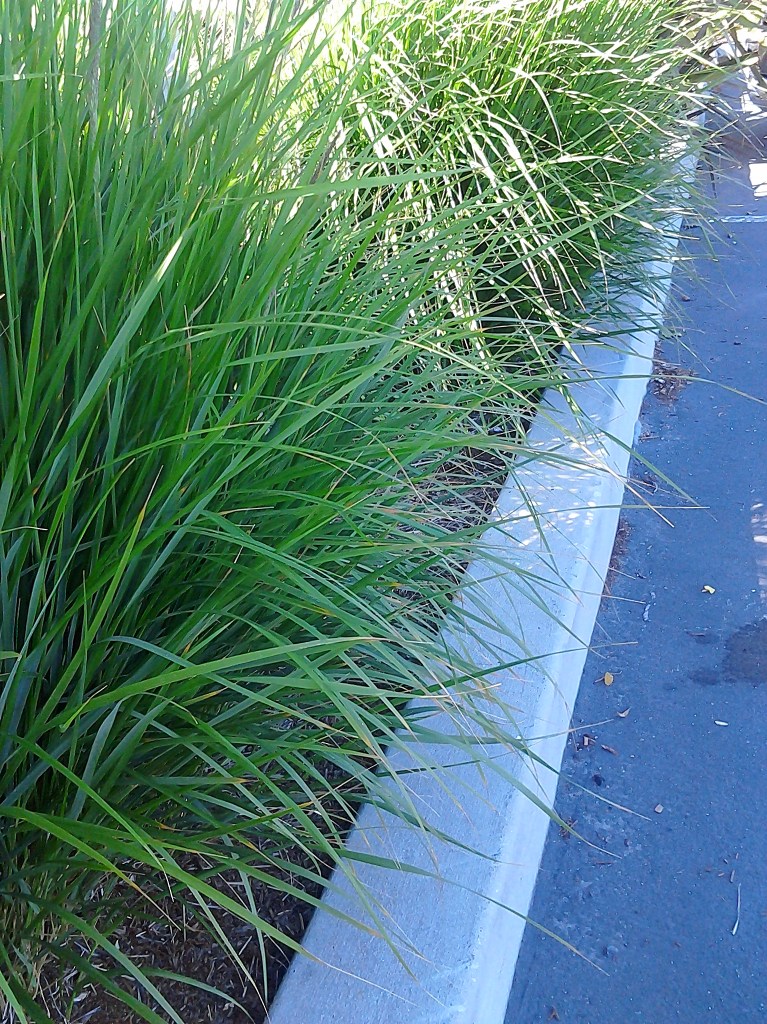
Clumping grasses hang out over curbs.

Parkstrips, those narrow spaces between curbs and sidewalks, are among the most awkward spaces in the garden. In urban areas with significant traffic, they are commonly paved over. Some neighborhoods, especially downtown neighborhoods, do not have parkstrips at all. Suburban neighborhoods though, often have wider parkstrips.

The difficulty with parkstrips is that there is so much happening around them. Cars get parked on one side. Pedestrians pass by on the other side. Driveways need to be kept clear at each end. Water meters and perhaps other subterranean utilities must be accessible.

Street trees are common features in parkstrips. They should have complaisant roots that will be less likely to displace the surrounding pavement and curbs, and high branch structure for adequate clearance above truck traffic on the roadways below. Ideally, street trees should conform with the neighborhood, and are often quite uniform. Selection of street trees should be a community effort where practical.

All other plants that go into parkstrips should be adaptable to confinement within the limited space available. They should not extend over curbs or sidewalks where they can scratch parking cars or be obtrusive to pedestrians. Parkstrip landscapes must also stay low enough so that they do not obstruct the view from cars backing out of driveways.

Because people regularly walk past or through parkstrips, thorny plants like cacti and roses should be kept back from the edges, or preferable not put into parkstrips at all. Large agaves and yuccas (with rigid leaves) are simply too big and dangerous for narrow parkstrips.

Contrary to the trend of planting vegetables in weird places, parkstrips are not good places for them either. The main problem is what dogs like to do in parkstrips. The second problem is that the good produce that might be out reach of dogs is within reach of everyone else walking or driving by. Reflected glare from all the surrounding pavement is a problem for plants that do not like harsh exposure.

Really, there are far more limitations on parkstrip landscaping than there are options. Turf grasses or tough ground cover that tolerates traffic, like trailing gazania, may seem to be a mundane, but they are practical. At least ground cover can be punctuated with clumping perennials like African iris, lily-of-the-Nile or blanket flower.

Pots are overrated, especially for curbsides.

UTILITY CABLES NEED SPACE

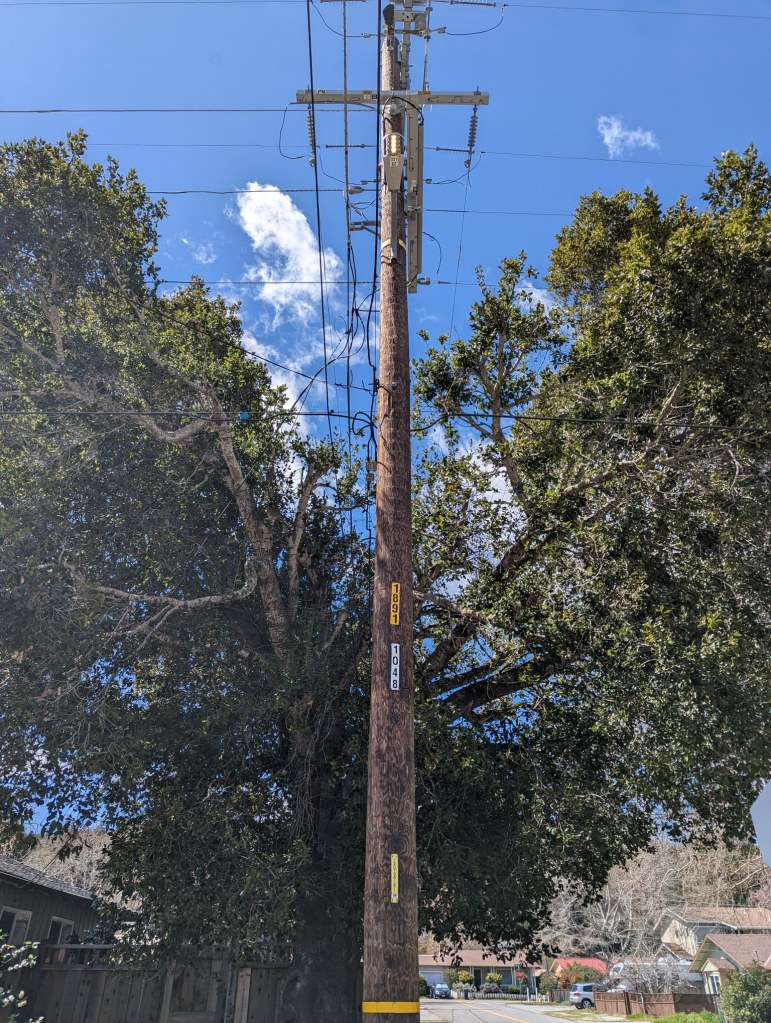
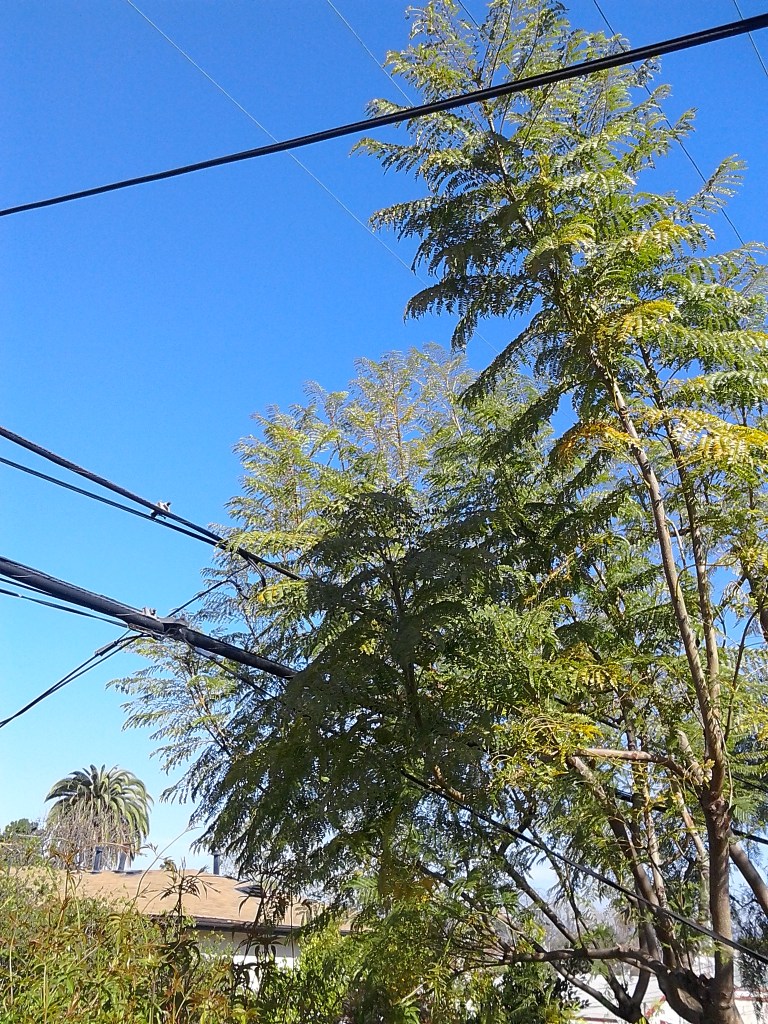
With all the cables coming and going, this unfortunate tree does not have much room to grow without causing trouble.

Since I did not make the drive up or down the coast very often, the rare silvery-gray Bismarck palm that I could see slowly climbing into the skyline near the edge of Highway 101 through Santa Barbara seemed to be slightly taller every time I saw it. It grew slowly, but enough to notice since I only saw it less than annually. Then, when I drove by about a month ago, it was gone.

This exemplary specimen had been quite healthy and happy (even though Bismarck palms are not supposed to be happy on the coast). There was only one problem. It was under high voltage utility cables. As it grew, it got too close to the cables, so needed to be removed in order to maintain the minimal clearance required for high voltage.

Unlike other trees, palms have only single terminal buds that grow upward. They can not develop branches to grow around cables, so only die if the single bud needs to be pruned away. Complete removal is therefore the only option when palms begin to grow into high voltage cables.

Sadly, palms often get planted under utility cables. Many Mexican fan palms grow under cables because birds that eat their fruit drop the seed there. Queen palms are popularly planted around the perimeters of back yards, and along the back fence lines that are very often directly below and parallel to high voltage cables.

Trees that are not palms can get disfigured by pruning for clearance around high voltage cables, but generally survive. Trees with central leaders (single trunks) and strict form, such as spruces and redwoods, can get be so disfigured that removal may be more practical than pruning. Trees with more irregular form, like sycamores and elms, are somewhat easier to salvage. Unfortunately, crews hired to maintain clearance are unable to prioritize the health and structure of trees that get too close to high voltage cables.

Lower cables for telephone, television and house-drops (lower voltage cables that extend from utility poles to homes and other buildings) do not often justify pruning for clearance like upper high voltage cables do. However, these lower priority cables can still be damaged if too many limbs sag onto them or become abrasive as they blow in the wind. Really, it is best to avoid problems with utility cables by selecting and planting trees that are not likely to become too obtrusive. Palms, large trees and trees that are likely to be severely disfigured by pruning to maintain clearance should be kept at safe distances.

Chimney Clearance Must Be Maintained

Modern homes lack old fashioned fireplaces.

Even as autumn weather cools, smoke rising from a simple old fashioned brick chimney is a rare sight nowadays. A smoking stovepipe is rarer. Modern building codes forbid the installation of new fireplaces or wood stoves within most municipalities here. Modern air quality ordinances severely limit the use of existing fireplaces and wood burning stoves.

Furthermore, existing fireplaces and wood stoves are neither as popular nor as common as they had been. After an earthquake, a faulty chimney is likely to justify removal rather than repair. An unused wood stove wastes too much space. Old orchards that generated inexpensive firewood as they relinquished their space to urban development are extinct.

There are a few advantages to these modern trends though. Modern homes consume so much less energy for heating than older homes because of efficient insulation. Insulation of older homes retains heat that fireplaces generate, so that less wood is needed. Almost every surviving chimney has a spark arrestor. Modern roof materials are noncombustible.

Nonetheless, vegetation that gets too near to a chimney that is in use can be hazardous. Even if clearance was adequate last winter, trees, vines and large shrubbery grew since then. It does not take long for such vegetation to overwhelm a chimney, or encroach a bit more than it should. It does not take too much vegetation to be hazardously combustible.

Clinging vines like English ivy and Boston ivy sometimes climb up and then over the top of a chimney. Although not especially combustible, they will burn directly over a fireplace or wood stove. Just like gutters do, vines can accumulate leaves that fall from deciduous trees to become more combustible. Birds or rodents can build combustible nests in them.

Evergreen trees and big shrubbery are similarly combustible over a chimney. Deciduous trees are generally not as hazardous. Conversely, cypress, pine, cedar, eucalyptus, large junipers, and ungroomed palms are very combustible. Eucalyptus foliage will burn while fresh, if it gets hot enough. The other trees tend to accumulate very combustible detritus.