Frost Is Not An Enemy

Among canna, frost damage is harmless.

Rain was one clue. Cooler weather is another. It is now so late into autumn that it will be winter soon. Every regional climate experiences some degree of chill. Some, particularly to the north, experience frost. This limits gardening in two ways. Several species prefer a bit less cool weather. Several prefer a bit more. Every species prefers a particular range.

Apple trees, for example, require vernalization, which is a specific duration of chill. Some cultivars require more than others. Without it, they can not distinguish seasons, so do not know when to bloom for spring. Consequently, few cultivars of apple perform adequately within Los Angeles. However, many perform very well in the cooler climates of San Jose.

Banana trees, conversely, need no chill, and are instead set back by frost. Some tolerate a bit more chill than others; but ultimately, they are all tropical species. They produce fruit only within the months between frosts. Consequently, not many banana trees are notably productive within San Jose. However, they perform better in the climates of Los Angeles.

Banana trees stop growing when the weather is cooler than fifty degrees or so. That is a bit too much chill for them. However, frost does not occur until the weather is cooler than thirty-two degrees. Banana foliage can therefore be safely dormant during chilly weather. That is a range of twenty-two degrees. Different tropical species survive different ranges.

The simplest form of frost protection is to not cultivate species that are vulnerable to frost. This is, of course, a bit too restrictive for many who enjoy gardening. Instead, some grow vulnerable species in pots to move to shelter prior to frost. Some simply grow vulnerable species below the shelter of eaves or big trees. Tenting may also be effective protection.

Alternatively, some species can endure frost damage to recover during warmer weather. If possible, outer foliage that succumbs to frost should remain through winter. It insulates inner growth from subsequent damage. Besides, premature grooming can stimulate new growth that is more vulnerable. Many perennials prefer cutting back after winter anyway.

Mild Summer

Weather has been somewhat atypical.

(This article is recycled from a few years ago.)

Now that it is half way through September, it is impossible to ignore that tomatoes did not have a good season. Most of us who grow tomatoes were embarrassed by their performance until we realized that everyone else who grows them was also experiencing similar disappointing results. It was not because we did not water them properly. Nor was it because they lacked particular nutrients. They simply wanted warmer weather.

Plants that were put out early before the warm weather last spring did much better at first, but then decelerated as the weather became milder instead of warmer. Cool nights certainly did not help. Mildew, which typically slows a bit as weather becomes drier (less humid) though summer, instead continued to proliferate so that new foliage became infected almost as soon as it developed.

Earlier predictions that the weather would eventually get warm were not accurate enough for many of us who are only now getting enough tomatoes for fresh use, but not an abundance for canning, drying or freezing. There is still some time for most of the tomatoes that are on the vines now to ripen; but many will probably remain green by autumn. Some but not all of the last green tomatoes can ripen off the vine. Perhaps the only good news about all this is that there should be plenty of green tomatoes for pickling.

Sadly, tomatoes were not the only warm season vegetables to be dissatisfied with the weather. Green bean vines and bushes were generally healthy and made good beans, but did not produce very abundantly. Corn was likewise of adequate quality, but on smaller ears and less abundant. Even zucchini, which typically produces too much, was a bit subdued. Marginal vegetables that really prefer warmth, like eggplant and bell pepper, were downright disappointing.

Even if the weather gets warmer in the last days of summer, languishing tomato plants can not ketchup on production. They can be left to make a few more tomatoes, but will eventually need to get out of the way of cool season vegetables. Cabbage, kale, turnip greens, beets, radishes and all the slower growing vegetables that take their time through autumn, winter and early spring will want their space back soon. They will hopefully have a better season.

If possible, cabbage, broccoli, cauliflower and some of the larger cool season vegetable plants can be plugged in amongst the finishing warm season vegetable plants. Then, by the time the finishing warm season vegetable plants need to be removed, the next phase of cool season vegetable plants is already somewhat rooted and has a head start. This process works well in small spaces with good quality soil.

The main problem with this procedure is that it prevents potentially depleted soil from getting amended and well mixed between planting. It can also be a bit awkward to get the spacing of rows, furrows or mounds of the next phase of vegetable plants to match up with the previous phase. Smaller vegetable plants that get sown directly from seed into rows, like turnip greens, carrots, beets and radishes, really prefer customized bed preparation, after the warm season vegetables have been removed.

Warming Summer Weather

Dog Days!

My great grandfather could remember more summers in Sunnyvale than anyone else. He knew how unique every summer was and continues to be. Some summers are uncomfortably hot from beginning to end. Last summer though, was the coolest in recorded history!

Warm summers are of course best for the fruits and vegetables that like warmth. Peaches, grapes, tomatoes and rhubarb in my great grandfather’s garden always got the best flavor during warm weather. Warm but not too hot weather early in summer made the best ‘Bing’ cherries on my grandmother’s tree in Santa Clara.

Although cool summers are more comfortable for dogs, cats and people, they are not quite as conducive to growing fruits and vegetables. It is still too early to know what this summer will be like, but even though it is now getting warm, the warmth is developing late. The past spring was remarkably mild, with rain lingering later than it typically does.

Consequently, some fruits and vegetables, as well as some flowers and trees, are developing slowly. Peaches may be a bit smaller than they typically are, with slightly milder flavor. Rhubarb should have good flavor because of recent warm weather, but may develop a bit late because it got a late start.

Tomatoes are perhaps expressing the most dissatisfaction with the mild weather. Even tomato plants that were put out in the garden early in spring have grown slowly, and are not nearly as productive as they typically are by the beginning of summer. Some are not yet producing!

Fortunately and unfortunately, the weather has gotten significantly warmer. This may be uncomfortable for us; but is a party for the formerly bored tomato plants. Warmth of course promotes bloom and fruit production, and enhances flavor. If they get what they need, tomato plants that seemed sickly in the past may suddenly grow like weeds.

They should waste no time making up for lost time. Even if mild weather continues into summer like it did last summer, it will still get warmer than it has been. Maturing tomato plants will want more water and fertilizer (if used) as they get larger, and the weather gets warmer.

Native Species Are Natural Choices

California lilac grows wild throughout California.

Wildflowers are only part of the story. They are happy enough with the chaparral climate here to bloom for spring or summer. A few are naturalized exotic species, though. In other words, they are not native to California. They merely behave like they are, likely because they are from similar climates. Native species are happy here because they are at home.

More than the most abundant wildflowers are native. Many trees, vines, shrubs, annuals and perennials are also. They were here long before Spanish explorers imported the first exotic plants after 1542. They were as satisfied with local soils and climates then as they are now. This is why many are more suitable for home gardens than many exotic plants.

Native plants are less popular than exotic plants only because a few are a bit too natural. Since they are from chaparral climates, some may get a bit scraggly and dry by summer. They survive arid weather by being partially dormant through some of it. Most appreciate irrigation through summer. However, some are susceptible to rot with generous irrigation.

Conversely, there are several advantages to native plant species. They naturally require less irrigation than most exotic species. Once established, some expect none at all. Only species from other chaparral or desert climates might be less demanding. Landscapes of exclusively native species therefore conserve water. Some get all they want from rainfall.

Also, native species are more compatible with natural ecosystems. Any that self sow into nearby wildlands will be where they belong. They do not compete unfairly for pollinators that other native species rely on. Nor do they compete unfairly for possibly limited space and resources. Furthermore, they contribute habitat and sustenance to wild native fauna.

California poppy and sky lupine are probably the most familiar of native annuals. Various salvias and bush lupines may be the most familiar native perennials. California lilac and flannel bush are familiar native shrubs. California sycamore, coastal redwood and coast live oak are familiar native trees. Many native species are practicable for home gardens, and landscaping.

Tornado

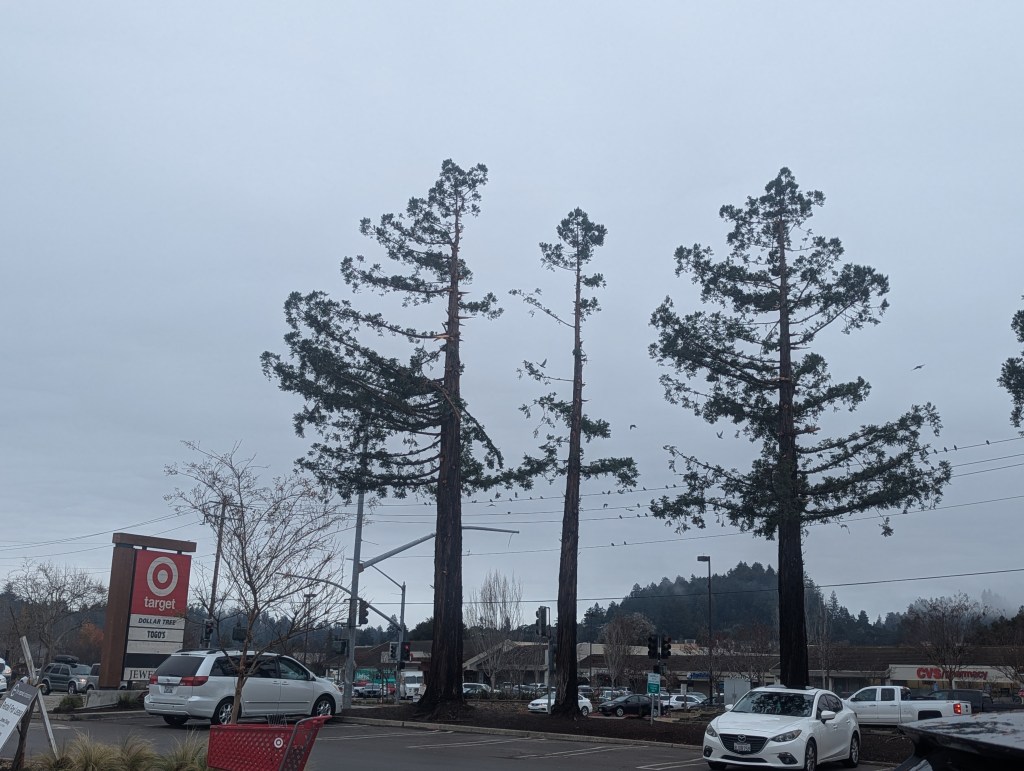
The tornado that stripped these redwoods landed right on Target. Notice the sign to the lower left.

The weather here may seem boring to those who are acquainted with other climates. It gets neither too warm nor too cold. Rain is limited to the relatively short rainy season. Humidity is minimal. Snow is so extremely rare that I can remember it only once in the Santa Clara Valley during my lifetime, and it was only half an inch deep. Tornadoes are about as rare, or at least they were. I can now remember two here, which is twice as many occurrences of snow that I can remember. Shortly after half past one last Saturday, rain, which had been falling for a while, suddenly became torrential, then instantly stopped, then instantly became torrential again. I stepped outside with Rhody to observe, and noticed Heather, Rhody’s feline ‘associate’ who prefers to stay inside during such stormy weather, had also come outside to observe, and was staring to the south. When I looked to see what she was looking at, I saw that not only were dark clouds speeding to the east, but that a portion of them was backtracking, as if swirling. My comment to Rhody and Heather was something like, “Well, at least tornadoes do not happen here.”. A few minutes later, a tornado did happen, right on Target, literally. It landed right on the Target store in Scotts Valley, less than two miles away. It was rated as an EF1 tornado, which apparently means that it was rather minor. It lasted for five minutes, though, while travelling only about a quarter of a mile. That is much slower than the clouds that we observed only a few minutes earlier. Fortunately, injuries were minimal, although a few cars were tossed. Utility cables, streetlamps and traffic signals were thrashed. So was much of the vegetation of the urban landscape.

Nurseries Sell Some Marginal Species.

Heliotrope is available from nurseries in climates that get too frosty for it.

            Limiting selection of plants to those that are appropriate to the local climate is not as easy as it seems. Even in mild climates, plants that should be grown in even milder climates are just too tempting, and have sneaky ways of getting from nurseries into the garden. Consequently, when the weather gets cold, at least a few plants get damaged by frost.

            Geraniums, angel’s trumpet, daisies and many other perennials that are so reliable throughout the rest of the year were likely damaged when the weather recently got harshly cold so suddenly after being so mild. Sensitive plants that got some protection prior to the frost may have avoided damage this time, but will likely need protection again before the end of winter. The only sensitive plants that are reasonably safe are those that are located in sheltered spots or in pots that got moved to shelter.

            Now that the damage has been done, it is important to not rush corrective procedures. Even though frost damaged foliage is unsightly as it deteriorates, it insulates undamaged tissue below. Early removal of the damaged foliage exposes interior stems to frost later in the season. On rare occasion, exposed stems of some plants can be damaged by desiccating cold wind or sun scald. (Sun scald typically happens during summer, while sunlight is most intense.)        

            Early pruning of frost damage can also stimulate premature development of new growth, which is much more sensitive to later frost. Most moderately sensitive plants have no problem recovering from minor frost damage once annually. However, recovery is so stressful and takes so much effort that secondary frost damage to new growth can be much more damaging and even fatal to some plants.

            It is best to delay removal of frost damage until late winter when subsequent frost is unlikely. Large plants that are too unsightly to wait that long should be pruned as minimally as possible, and then pruned as necessary later. Minor distal damage known as ‘tip burn’ of avocado and lemon trees may not need to be pruned out at all if it first gets obscured by new growth that develops after winter.

            This may seem contrary to the importance of pruning most other plants while they are dormant during winter. The difference is that, unlike most plants that stay dormant while the weather is cold, plants that get damaged by frost are not so well adapted to cold winter weather, so do not know that they need to stay dormant until the weather is safe for new growth.      

            Burlap, plastic sheeting or any other coverings used to protect sensitive plants from frost should be removed when it is not needed. These protective coverings hold warmth within, which can stimulate premature development of sensitive new growth. Opaque materials shade the plants below and can eventually cause etiolation (stretching of the stems), which likewise makes plants even more susceptible to frost damage.

Frosty Weather Can Limit Gardening

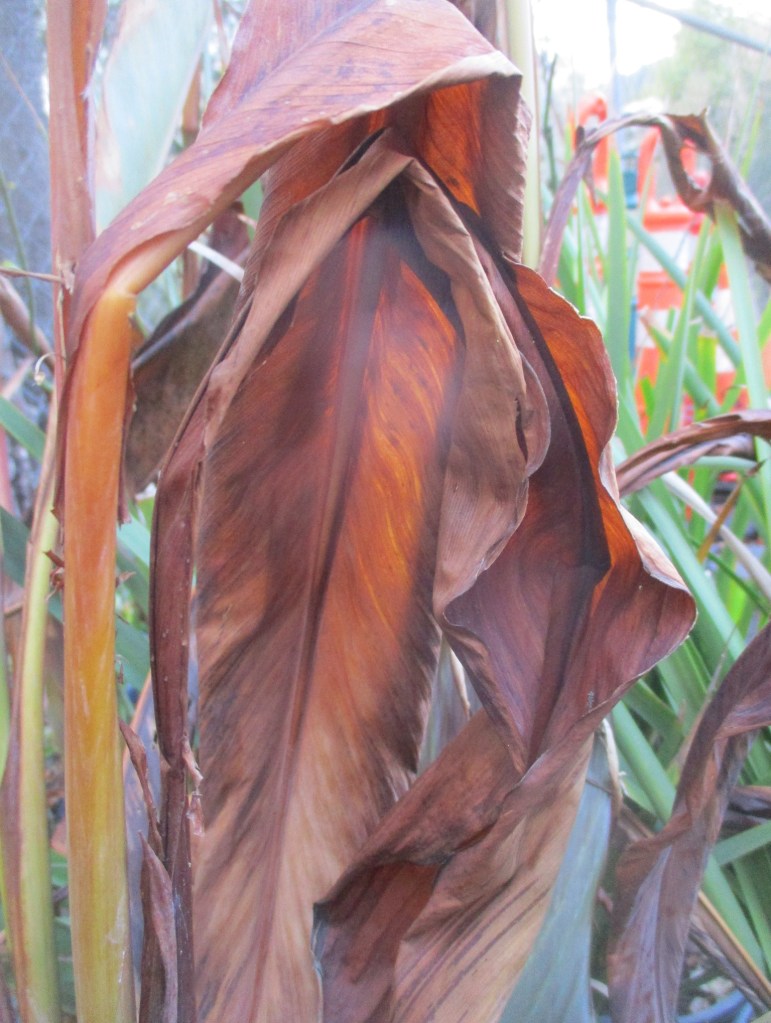
Foliar frost damage can be unsightly.

Even here, climate is not perfect. It may sometimes seem to be too warm during summer. However, it might not be consistently warm and humid enough for some tropical species. Winter chill may be inadequate to vernalize some species or certain cultivars of species. However, recently frosty weather has already damaged some vegetation in some areas.

Frost limits what performs well in home gardens in two extremes. Some species prefer a bit more than they experience here. Others prefer less. For example, peony prefers more, while vanilla orchid prefers none. Peony is only marginal where weather is exceptionally frosty by local standards. Vanilla orchid can be offended by minor chill even without frost.

Climates and microclimates limit frost just as frost limits what performs in home gardens. Some coastal climates here only very rarely or perhaps never experience frosty weather. Other climates farther inland or at higher elevations experience frost almost every winter. Within such climates, eaves or canopies of big trees can provide shelter from minor frost.

Vegetation within home gardens should be appropriate to its particular climate. Varieties that are vulnerable to frosty weather are likely safe where frost never occurs. Conversely, they will obviously be susceptible to damage where frost does occur. The best means to avoid such damage is appropriate selection. Climate will not accommodate bad choices.

Gardening could be slightly less interesting without a few bad choices, though. Besides, some of such choices are justifiable with the right perspective. Canna, for example, dies back harmlessly to dormant rhizomes after frosty weather. It wastes no time regenerating as weather warms. Some tropical species may grow in pots to move to shelter from frost.

Tenting can shelter some specimens that are too big to move, or are in the ground. Outer foliage that already succumbed to frosty weather can shelter inner growth. Therefore, if it is not too unsightly, it should remain through winter. Besides, premature pruning is likely to stimulate new growth. Such growth would innately be vulnerable to subsequent frosts.

Late Summer Heat Confuses Some Vegetation

(This article is recycled from several years ago, so some of its information is irrelevant to current conditions. Also, it posted more than half a day late.)

Weather should but does not always get cooler at this time of year.

After the coolest July in a century, and one of the mildest summers in memory, the recent warm weather at the end of August seemed unseasonable, even though it is actually not unusual for this time of year. Predictions of an Indian summer for this year were made shortly after predictions for this past El Nino winter materialized. The ash blasted into the atmosphere by a volcano in Iceland may have changed all that. No one really knows. The weather continues to change like the weather.

For right now though, the damage caused by the sudden warmth is becoming evident. Fortunately, most of the damage is harmless and should be gone by winter. Some is a bit unsightly. The desiccation of small or potted plants may unfortunately be as serious as it looks. The most severely damaged plants may not recover.

The yellowing inner foliage that eventually turns reddish brown in redwood trees is actually a normal response to foliar desiccation that results from warm or dry weather. As long as the outer foliage remains healthy, this discoloration is harmless. Inner foliage that is more expendable is merely being shed to conserve moisture for the more important outer foliage. This shedding foliage will deteriorate and get cleaned out by wind and rain in autumn.

This older foliage typically sheds naturally throughout summer. However, because the summer was so mild, much of the foliage that should have been shed was not shed. As the weather only recently but suddenly became warm, all the foliage that should have been shed earlier became discolored and began to shed at the same time, which is why it is now so much more noticeable.

A few other trees are also shedding some of their foliage. Trees in areas that are not landscaped or watered may drop dried leaves in even slight breezes. Leaves of deciduous trees that would be colorful and pliable if they fell on schedule in autumn are instead crispy and brown. Maple, oak, ash, sycamore (including plane), willow, poplar, eucalyptus and madrone are among the most affected. Fortunately, this is a harmless response to the warm weather after such a mild summer.

Some Japanese maples are damaged more significantly, but should recover. Because they are naturally understory trees (which prefer to grow in the partial shade and ambient humidity of larger trees), they are not well adapted to warm and dry weather, particularly if it becomes warm as suddenly as it recently did. Some got roasted so quickly that the foliage stays attached to the stems as it shrivels and dries. Foliage that is still partially viable (and hopefully functional) should fall in autumn and winter. Foliage that is necrotic (dead) may linger until it is forced to fall by new foliage that emerges next spring.

Potted plants that were desiccated by the heat may not be so fortunate. Even though they can be unsightly, roasted plants that may be rooted into the ground through their drainage holes should not be moved right away, since the roots that are in the ground are the least damaged and the best hope for recovery. Similarly, roasted plants that hang over the edges of their pots should not be pruned back too severely until later, since exposing the pots to more sunlight will cause more heat to be absorbed if the weather gets warm again.

Summer Warmth Continues Into Autumn

Dog days of summer are over.

The locally mild climate might be rather boring. Winter weather is not very cold. Summer weather is only sometimes very hot. Then, warmth does not often last for very long. Such climate might seem to be deficient in seasons. Summer seems to be the primary season, with just a few cool weeks of winter. Spring and autumn seem to be only brief transitions.

According to the position of Sirius, the Dog Star, the dog days of summer are done. They are the hottest days of the year for several climates of the Northern Hemisphere. The last was the eleventh of August. The final day of summer is the twenty-second of September. Such dates are less relevant here than elsewhere, though. Warm weather may continue.

Indian summer is more typical here than not. In some other climates, it is unusually warm and dry weather that continues into autumn. In this particular climate, it is not so unusual. Another difference is that it does not occur after earlier frost, as it might elsewhere. Some climates here lack frost anyway. Locally, warm weather is more lingering than fluctuating.

Some vegetation knows how to exploit such weather. Indeterminate tomato varieties can continue to be productive until a first frost. If they started soon after a last frost, they could get sloppy with rampant growth. That should not be a problem if production is the priority. With phasing as late as August, determinate tomato varieties can also produce until frost.

Most popular canna cultivars are hybrids of tropical and montane species. Because they are tropical, they are not accustomed to distinctly cool winter seasons. Because they are montane, they survive mild frost. Therefore, they grow until frost, and then resume growth as soon as they can afterward. Dahlia is similar, but maintains dormancy through winter.

Photoperiod also influences growth. Days gradually shorten through summer regardless of the duration of warmth. Some species are more responsive to this than others. Later in summer, crape myrtle can slowly begin to develop autumn foliar color. It does not require much chill to become strikingly colorful for autumn. It can do so while cannas still bloom and tomato plants still produce fruit.

In The Zone

Climate is regional.

We all know how excellent the local climate is for gardening. As we travel around the area though, we also realize that there is more than one climate. Locally, there are at least three of the standardized ‘Sunset’ garden zones, with several more within only a few miles. There are countless microclimates too.

Elevation, terrain, latitude and the proximity of the ocean or large bodies of water all influence the climate. Even though the Santa Cruz Mountains are not very high, they sometimes get snow on top because higher elevations are a bit cooler. When the Summit and Santa Clara Valley floor are cold in winter, the slopes in between are not quite as cold because cold air drains away downhill. The areas closest to the San Francisco Bay stay much cooler through summer because of the insulating quality of the water. 

More localized variables like forests, lakes, direction of slopes and infrastructure affect microclimates. Older neighborhoods with mature trees are shadier and cooler than newer neighborhoods with smaller trees. The west facing slopes to the east get warmer than the east facing slopes to the west. In Downtown San Jose, tall buildings create cool and shady microclimates to the north; and some reflect enough solar radiation to significantly warm areas to the south and west.

It is important to know what climate zone any particular garden is in to be able to select appropriate plants. Besides that, it is important to know the microclimates within the garden to know where each plant will be happiest. Tropical plants that would be happy in Los Angeles might succumb to even mild local frosts. However, plants that might succumb to frost if too exposed may be safe in sheltered microclimates.

Generally, Campbell, most of San Jose, southern Sunnyvale, northeastern Cupertino, northeastern Los Gatos and Union City are all within Sunset Zone 15. Most of Saratoga, southwestern Los Gatos, southwestern Cupertino and Mission San Jose are in Zone 16. Santa Clara, Alviso, Milpitas, northern Sunnyvale and western Fremont are in Zone 17.

None of these zones are too severe. Because of the marine influence of the San Francisco Bay, Zone 17 can actually be relatively boring and not so great for plants that want winter chill or summer warmth. Zone 16 is very similar to Zone 15, but comprises hillside thermal belts where cold air drains away in winter, and also gets a bit warmer in summer. Above and below Zone 16, Zone 15 gets cool enough for plants that want winter chill, but may not get warm enough in summer for plants that crave heat. The Sunset Western Garden Book not only describes the climate zones in detail, but also specifies what zones every plant is adaptable to.