There’s No Place Like Home.

Desert ecosystems are fascinating, but so are local ecosystems.

Vacation was excellent! I do not get out much, but when I do, I feel as if I enjoy it more than those who travel regularly. The simplicity of my travel allows me to enjoy it more intimately than those who travel more elaborately and put more effort into enjoying what they should probably just enjoy more effortlessly. Anyway, I went to the Pacific Northwest for two weeks, returned for two weeks, and went to the Southwest for two weeks. Actually though, my trip to the Pacific Northwest was limited to Western Oregon and Western Washington, and my trip to the Southwest was limited to the area between Los Angeles and Phoenix. Regardless, it was excellent, and I encountered several climates and ecosystems that are very different from what I am accustomed to. I drove through dense rainforests dominated by massive Douglas firs as well as sparsely forested deserts dominated by sporadic saguaro cacti. Winters are much cooler in some regions than here. Summers are much warmer in some regions than here. It was all so fascinating. I encountered so much vegetation that I would like to grow here, and brought a bit of it back, but can not grow everything that I find intriguing within other regions. However, as excellent as it all was, it also reminds me that I prefer to be here, within the climates and ecosystems that I am most comfortable with. Winters do not get too cool. Summers do not get too warm. I may not be able to grow all the cultivars of apples that prefer a bit more chill in Washington, or all the cacti that prefer more arid warmth in Arizona, but realistically, even if I could work in the garden constantly, I could not possibly grow everything that performs well here.

Mediterranean Climate Is Quite Californian

New Zealand natives perform well here.

“Mediterranean” translates from Latin to “middle of land”. The Mediterranean Sea is in the middle of the land of those who named it. Other regions were either unimportant or unknown to them until the Sixteenth Century. Nowadays, most people of the World are aware of many other regions. A few of such regions also enjoy a Mediterranean climate.

Such climates are obviously not confined to the regions of the Mediterranean Sea. They merely resemble such climates. Some extend eastward into Western Asia. Others are in eastern and southern Africa, southwestern South America and Columbia. Larger regions of such climate are in southern Australia. The closest are here in western North America.

Even these limiting regional designations are debatable. Many horticulturists consider climates of New Zealand to be typical Mediterranean. Such climates are mostly between thirty and forty five degrees north and south. However, some might exist within northern India and southern China. Ultimately, climate is meteorological rather than geographical.

Mediterranean climates receive almost all of their rain during winter. Rain is very minimal through summer. Even if it is twice as abundant in other similar climates, it conforms to a similar schedule. Although winter chill is adequate for many species that need it, frost is mostly minor. Locally, summer weather does not often become too uncomfortably warm.

Native species know what to expect from local climate. So do exotic species from similar climates. Some may prefer more or less winter rain, summer heat or winter chill. Almost all can tolerate warm summers without rain, though. Such weather conditions are normal for them. Therefore, the most adaptable exotic species locally are from similar climates.

This includes species of Eucalyptus, Pittosporum and Callistemon from Australia. Aloe, Agapanthus and Morea are from South Africa. Phormium and Leptospermum are from New Zealand. Oleander and the various species of Lavandula are truly Mediterranean. In the past, a few exotic species adapted too efficiently to become invasively naturalized. Horticulturists are now careful to not import such potentially aggressive species.

Irrigation Resumes With Drier Weather

Spring gets progressively drier and warmer.

Spring, in several regards, is like autumn in reverse, or vice versa. Bloom increases for spring but decreases for autumn. Foliage increases for spring but decreases for autumn. The two seasons are in opposition. In this chaparral climate, the rainy season that began last autumn ends now. Irrigation that became redundant then becomes necessary now.

Diminishing rain is not the only reason that irrigation becomes more important for spring. Spring weather also becomes warmer and more arid, or less humid. Warmth and aridity increase evaporation of moisture that rain deposited not long ago. Increasing day length, intensifying sunlight and warmth accelerate plant growth. Such growth consumes water.

This need for moisture is progressive, though. Vegetation certainly requires more water as the weather becomes warmer and drier. However, it does not yet require as much as it will require later during summer. By then, the weather will be even warmer and drier, and the days will be even longer. Irrigation should increase accordingly in regard to weather.

Unfortunately, there are no simple formulas to determine how much irrigation is needed. Some vegetation with shallow roots may require frequent but moderate irrigation. Some vegetation with deep roots may prefer less frequent but more copious irrigation. Rain is possible at any time. It can briefly interfere with the most efficient of irrigation schedules.

Soil also affects irrigation. Sandy soils drain efficiently, but do not retain much moisture. This may not be a problem for some species that tolerate occasionally dry soil. It may be more of a concern for species that prefer more regularly moist soil, though. Dense soils retain more moisture, but do not drain as efficiently. Soil amendments can improve soils.

Manual irrigation is easier to monitor than automated irrigation, but can be tedious. That is why most irrigation is automated nowadays. Automation is more likely to be excessive than insufficient. Desiccation, wilting and other symptoms of insufficiency of irrigation are obvious. Symptoms of saturation may not become obvious until too late for remediation.

Mojave

Joshua trees seem to be scarce near Joshua Tree.

About a quarter of California is desert. Most of that desert is part of the Mojave Desert. Much of it is very sparsely populated. All of it is fascinating to those who appreciate it.

Not many people live in the desert because the climate is so harsh, and because there is not much reason for many people to be there. Not far north of Los Angeles, which is the second most populous city in America, is one of the most sparsely populated regions of America within the Mojave Desert. It is unpleasantly hot and dry there all summer. It is certainly not the sort of place that should be appealing to horticulturists, although it is.

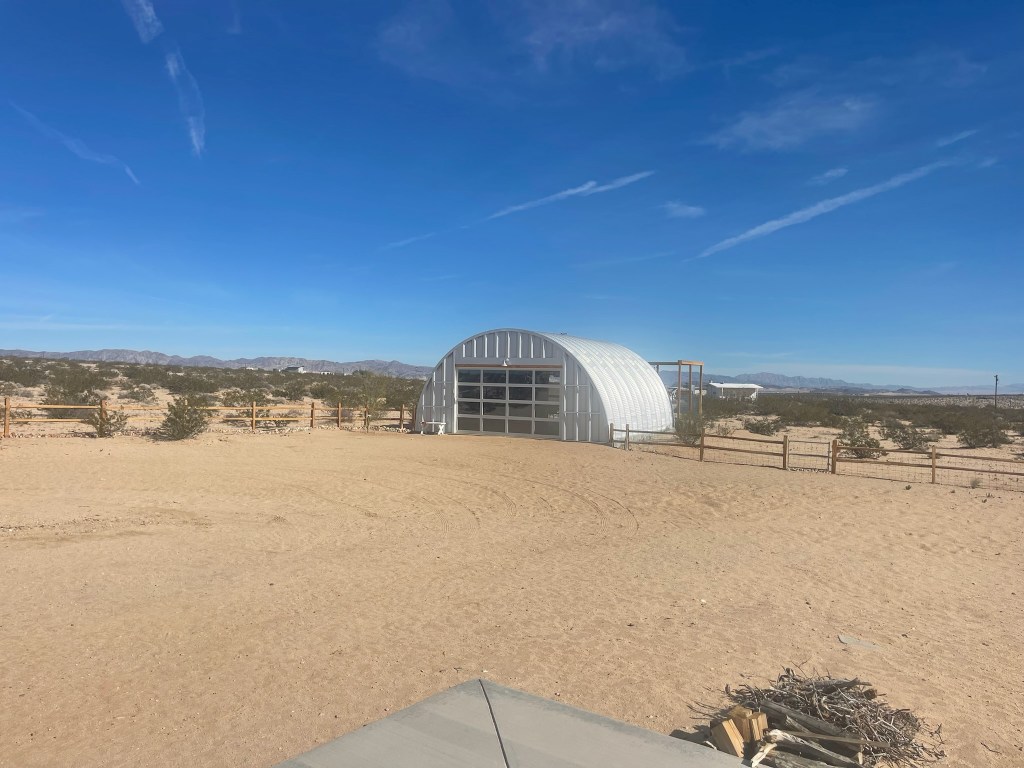
Brent sent me this picture from a place where he vacations near Joshua Tree. If there are Joshua trees near Joshua Tree, they are not visible within this picture. Actually, no trees are visible within this region where shade must be very important. The vegetation that is visible does not seem to be substantial. Vegetation is completely lacking within the fenced area. That small pile of firewood must have been brought from somewhere else. (Although nights are pleasant or warm between hot days, they can get very cold between cool days of winter.) I do not know what that building is. Without substantial vegetation, neighboring residences are visible in the distance.

Part of the allure of deserts for horticulturists is the very distinctive vegetation that lives only there. Part of the allure is the minimalism of such vegetation. Although many species live there, they are not very distinctive. Many resemble each other. In other words, much of the vegetation of the desert is easy to ignore. It is less distracting than that of other ecosystems that are more popular with those who are not horticulturists.

Proof of Seasons

Daffodil bloom here as if they were in the Pacific Northwest.

Narcissus make me wonder. Both paperwhite and common daffodil, as well as a few fancier daffodil, bloom here as if they were in a climate that is more conducive to such performance. The happiest naturalize and slowly multiply. Not many bulbs do so where winter weather is so mild. That is why I do not bother with tulip or hyacinth, although a few hyacinth have also been performing reliably here for many years.

Peony is very marginal here. I know that they perform inexplicably well for some neighbors, but none have ever done well for me. I really do believe that they prefer more chill than they experience here. Realistically, winter weather is relatively mild here.

Yet, I am not convinced that it is as mild as I have always believed it to be. Some who are unfamiliar with California believe that we experience only two seasons, which are summer, and a few days annually that are not summer. I know better. No one argues that the warm and dry summers here last longer than elsewhere. Prior to summer though, spring is likely comparably to spring within other climates. After summer, autumn, although mild, is cool enough to initiate autumn foliar color. Then, winter is cool. Really, it is cool enough for deciduous species to defoliate, and for mild frost. It may not get as cold as it does in other climates, but how cold does it need to be to qualify as winter?

I am satisfied with the winters here. I can grow all of the deciduous fruit trees that I want to grow. This is one of the best climates in the World for roses. These daffodils seem to be quite satisfied as well. In fact, they sometimes stay dormant later here than in climates with cooler winters!

Six on Saturday: Bad Botany II

Botany is bad this week for a different reason than it was last week. It is lacking. I mean, there is none. Only common names are mentioned. The first picture, which is not mine, includes too many different species to cite. Even if I wanted to, I could not identify all of them from this picture, and I can not remember what all of them are. The other pictures conversely show only a few common species that need no introduction.

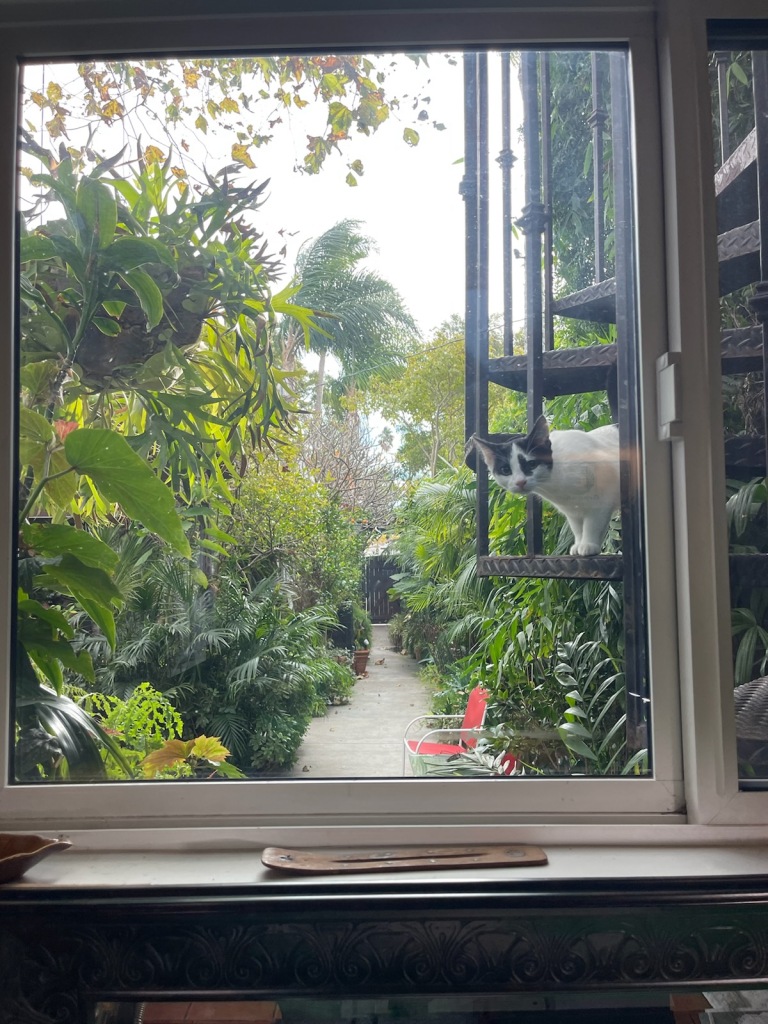
1. Brent sent this picture of a view from his primary landscape design studio west of Los Angeles. The Jungalow is obscured by overgrown vegetation on the left. More species of flora inhabit this compact garden than all the combined acreage that I work and live on.

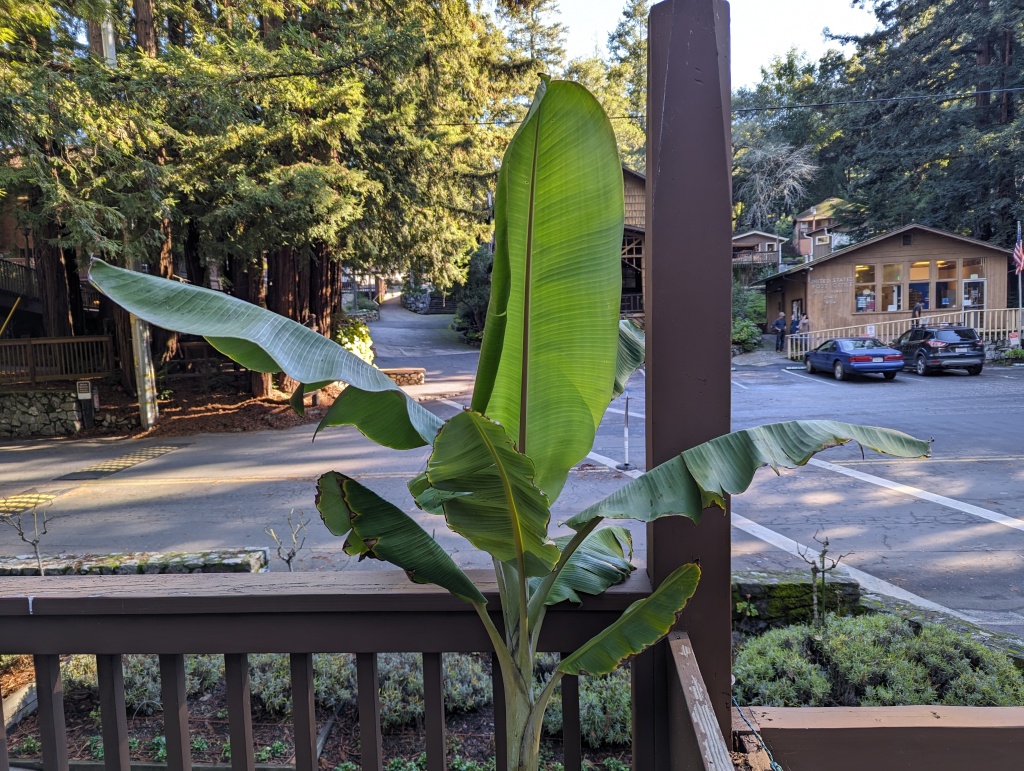
2. Scenery from my work is very different. Redwoods are the primary species. The bland foliage to the left is tanoak. Only a few species of trees grow wild here. The scenery from my writing studio is embarrassingly less interesting, but that is a topic for another time.

3. Banana trees live at work because I like a few species that, to me, seem to be the sort of vegetation that is more common in the Los Angeles region. They got frosted at home.

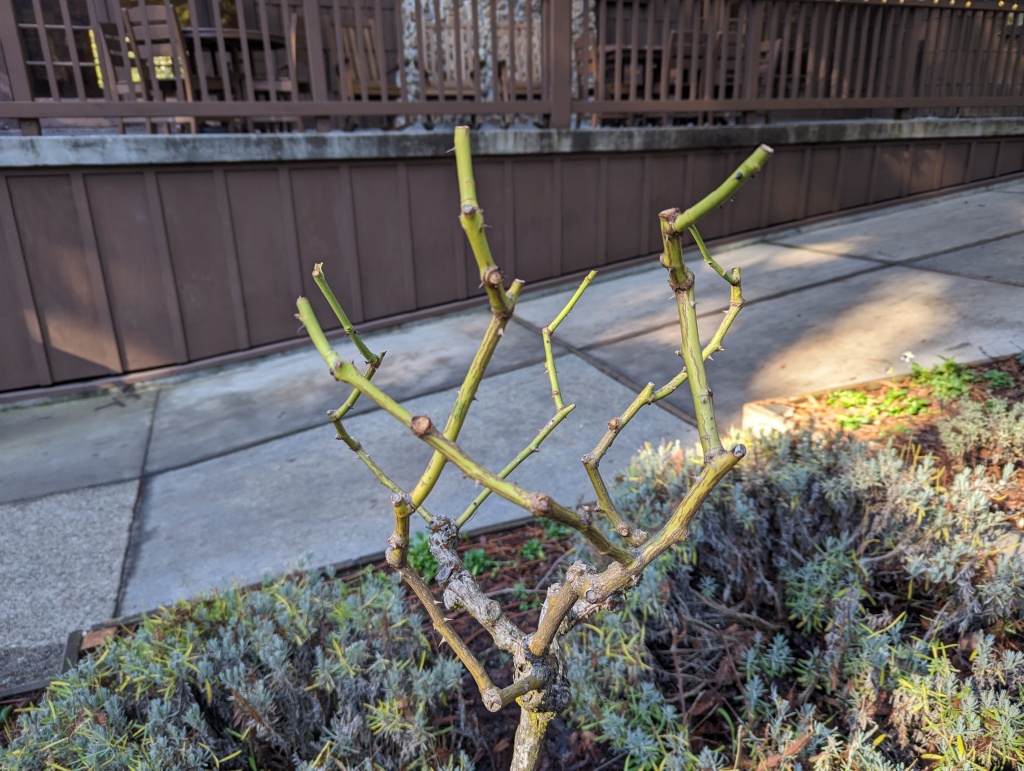
4. Roses, which are in the background of the banana tree, are more popular here than in the Los Angeles region, and are actually dormant for winter. This one does not generate new canes from its base though, which is why it is now so gnarly after dormant pruning.

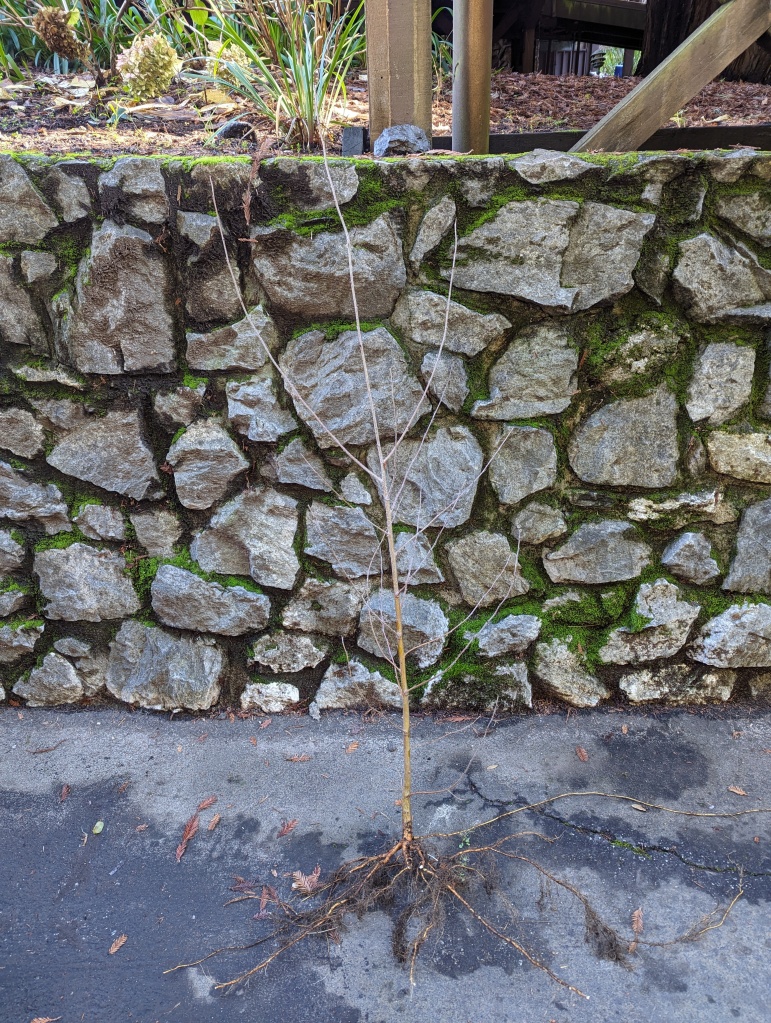
5. European white birch are also dormant during the slightly cooler wintry weather here. I can easily relocate feral specimens like bare root stock. Cooler weather has advantages.

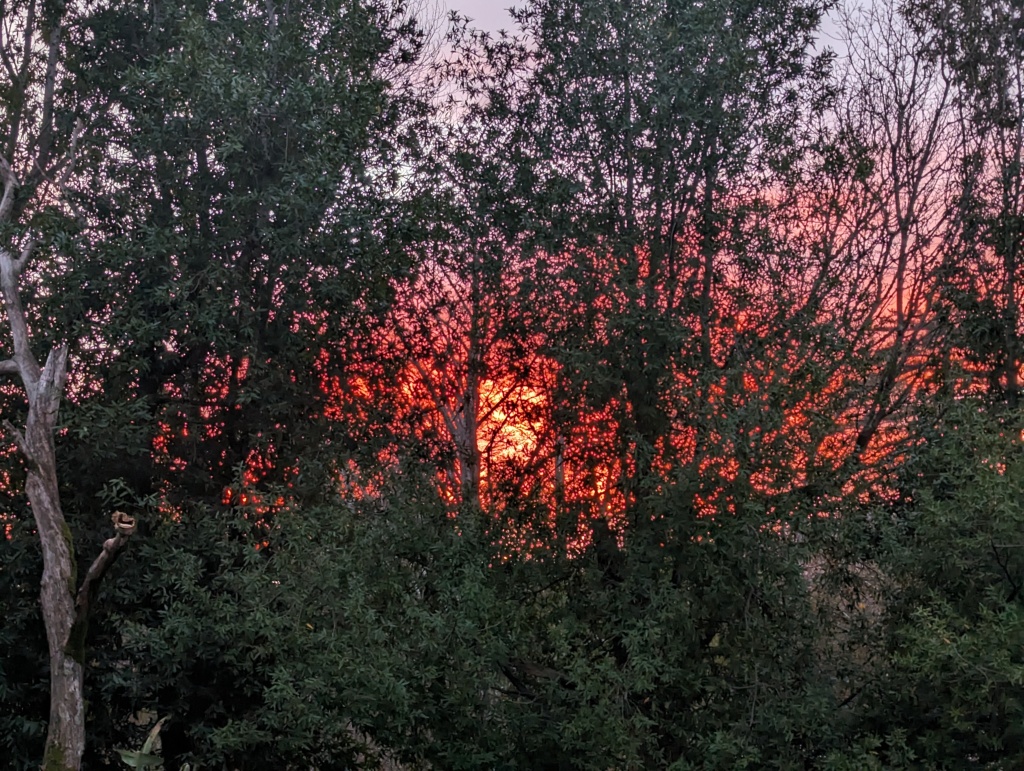
6. Bay and box elder obscure this local sunset that looks like it should be in Los Angeles.

This is the link for Six on Saturday, for anyone else who would like to participate: https://thepropagatorblog.wordpress.com/2017/09/18/six-on-saturday-a-participant-guide/

Frost Is Simply Too Chill

Some minor frost damage is acceptable.

Chill can be good. Frost can be bad. The difference is thirteen degrees Fahrenheit. Chill is at or less than forty-five degrees. Frost is at or less than thirty-two degrees. Chill helps some flora to maintain its seasonal schedule. Frost causes some flora to freeze. Both are limiting factors of home gardening. Both are weather patterns that are limited by climate.

Many species from climates with more pronounced seasons rely on chill. They know that it occurs only during winter, and that they should bloom afterwards. Duration of such chill is more important than temperature. Any temperature at or less than forty-five degrees is equally sufficient. Within that, different species require different durations, or ‘chill hours’.

This limits the selection of many species, like various fruit trees. Citrus orchards formerly grew within the San Fernando Valley. They require no chill. Stone fruit orchards formerly grew within the Santa Clara Valley. They require a bit of chill. Pomme fruit orchards grow in the Willamette Valley. Many cultivars of pomme fruit perform best with significant chill.

Frost also limits the selection of many species. Pomme fruits do not mind it. However, if it happens late, it can ruin stone fruit bloom or developing fruit. It might damage citrus trees whenever it happens. Some climates here experience frost annually. Some experience it only rarely or mildly. Several coastal climates experience merely minor chill without frost.

Many garden enthusiasts grow a few species that are vulnerable to frost. Of course, such species are safe within frostless climates. Elsewhere, they may need shelter during cold weather. Potted vegetation may benefit from seasonal relocation. Temporary tenting can shelter imobile vegetation in the ground. Some vegetation is too large to shelter, though.

Vegetation that sustains frost damage is unsightly. However, it is best to delay pruning or grooming until subsequent frost is unlikely. Damaged outer growth insulates undamaged inner growth. Besides, pruning stimulates new and more vulnerable growth. Some types of vegetation should want only superficial grooming. Others might require major pruning.

Frost

Before

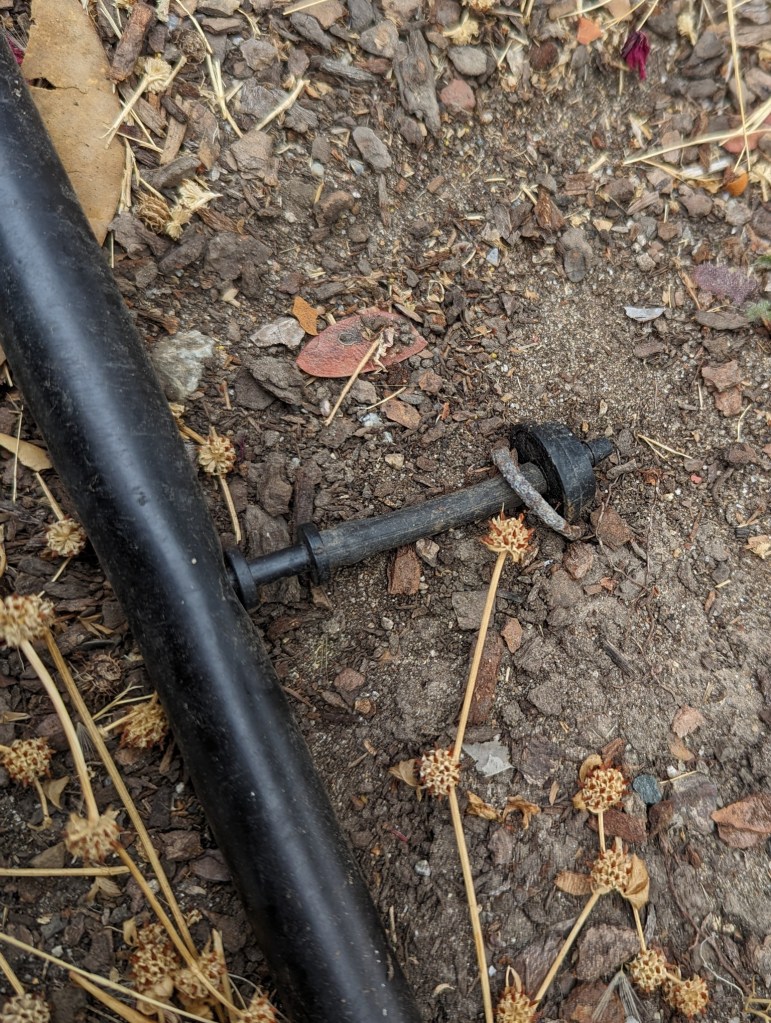
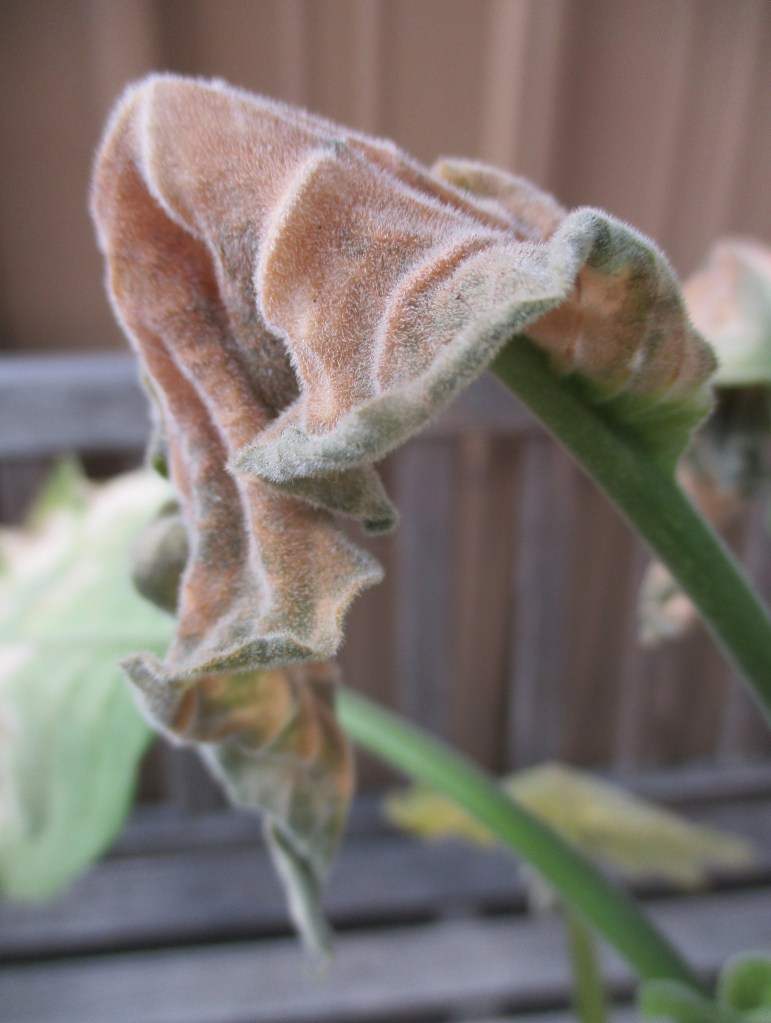
This elephant ear was happy and healthy as the sun set last night. As the sun rose this morning, it was sagging from frost damage. The picture that was taken prior to damage posted here (at my previous ‘Six on Saturday’ post) at midnight. Frost likely occurred shortly afterward. The picture that was taken after damage was taken only a few hours later.

Frost does not happen frequently enough to get much consideration here. When it does happen, it is not severe. This particular frost was only thirty- two degrees. Nonetheless, I should have sheltered the elephant ear. It would not have taken much effort to do so. I could have simply moved it over a few feet, so that it would have been under an eave. A few other species were likewise worthy of shelter. A few, though, should not even be grown here. The most practical means with which to avoid frost damage is to refrain from growing species that are vulnerable to it.

Fortunately, the elephant ear and all other species that were slightly damaged by frost early this morning should recover efficiently. Elephant ear typically loses its foliage through winter, and regenerates foliage for spring anyway. No more frost is predicted for the next week.

I am glad that I do not need to contend with the sort of frost that kills vulnerable species completely. The possibility of such weather would be much more limiting.

A pair of bougainvillea that I planted last autumn actually succumbed to frost last winter. Although bougainvillea commonly loses foliage and perhaps a few small stems to frost, basal stems should not have succumbed. I wanted to get them into their landscape during autumn, so that they could benefit from cool rain through winter, and be ready to grow in spring. Their replacements will get planted in spring.

After

Rainy Weather Begins With Autumn

Weather changes with the changing seasons.

Rain is at least as relevant as temperature is to the seasons here. Temperature does not change as much. The warmest of summer weather does not seem to be terribly hot. Low humidity helps. The coolest of winter weather is not too terribly cold. Some local climates lack frost. The difference between dry weather and rainy weather is much more obvious.

After all, rainy weather ends during spring, and does not resume until about now. Almost no rain occurs during the extensively arid summer season. This includes late spring and early autumn. Summer thundershowers are uncommon. Therefore, almost all rain occurs during winter. Some also occurs somewhat variably during late autumn and early spring.

This is quite normal for local chaparral climates. Comparatively to other climates, it might be both an advantage and a disadvantage. It is why most landscapes, particularly lawns, rely on irrigation. It is also why the growing season is so long here. This climate provides more pleasant weather to facilitate more gardening. It also necessitates more gardening.

Recent rainy weather is likely the beginning of the rainy season. If so, it is obviously also the end of the dry season. Transition from one season to the next is not on a very precise schedule, though. Dry weather could potentially resume for a while. Conversely, El Nino has potential to promote rainy weather. This winter could be even rainier than last winter!

Even if rainy weather does not resume for a while, irrigation requires seasonal reduction. This includes frequency and duration of automatic irrigation. Vegetation consumes much less moisture while dormant through winter. Less moisture evaporates from soil while the weather is cool. Rain may provide most of the garden with more moisture than it can use.

Unfortunately though, rain is also potentially messy. It makes soil muddy, and can cause erosion. It dislodges deteriorating deciduous foliage, especially in conjunction with wind. Colorful deciduous foliage is much less appealing on pavement or lawn than in its trees. Raking fallen leaves, and all other gardening, is less pleasurable during rainy weather of autumn.

Autumn Foliar Color Appreciates Chill

Maples perform better in cooler climates.

Indian Summer complicates autumn. It is an imposition of pleasant weather that delays inevitable chill. Gardening is a bit more enjoyable while the weather remains summery. However, late warmth confuses a few species that should decelerate growth for autumn. Deciduous species delay dormancy. This delays the development of autumn foliar color.

Consequently, autumn foliar color is somewhat late this autumn. It is only beginning to develop. Some species that eventually become spectacularly colorful remain very green. Only the most sensitive species, such as Boston ivy, are beginning to exhibit their color. Unfortunately, because of this delay, some may defoliate unusually soon after coloring.

Autumn foliar color is underrated here, for various reasons. It is less common in the wild than in other regions. The color range of native deciduous species is almost exclusively simple yellow. Orange or red are uncommon. This is not much incentive for incorporation of such species within home gardens. Nor does it promote more colorful exotic species.

Besides, deciduous trees are innately less popular here than within other regions. Local culture seems to promote a preponderance of broadleaf evergreen species. Penetration of warming sunlight through defoliated trees is not such a priority. Winter weather does not get very cold here. Concealment of undesirable suburban scenery is more important.

Also, the misbelief that chill is inadequate here for much autumn foliar color is common. Technically, many of the most colorful species of cooler climates lack such color locally. This unfortunately includes famously colorful North American maples. Several species, however, do not need much chill for spectacular color. They compensate for what lacks.

Sweetgum develops the most vivid autumn foliar color, including yellow, orange and red. It defoliates slowly to retain its color until winter. PIstache is about as colorful, although it defoliates a bit earlier. Flowering pear provides more orange, red and dark burgundy red. Crape myrtle is a smaller tree with comparable foliar color. Ginkgo becomes vivid yellow. Of course, physical traits of each species are also important.