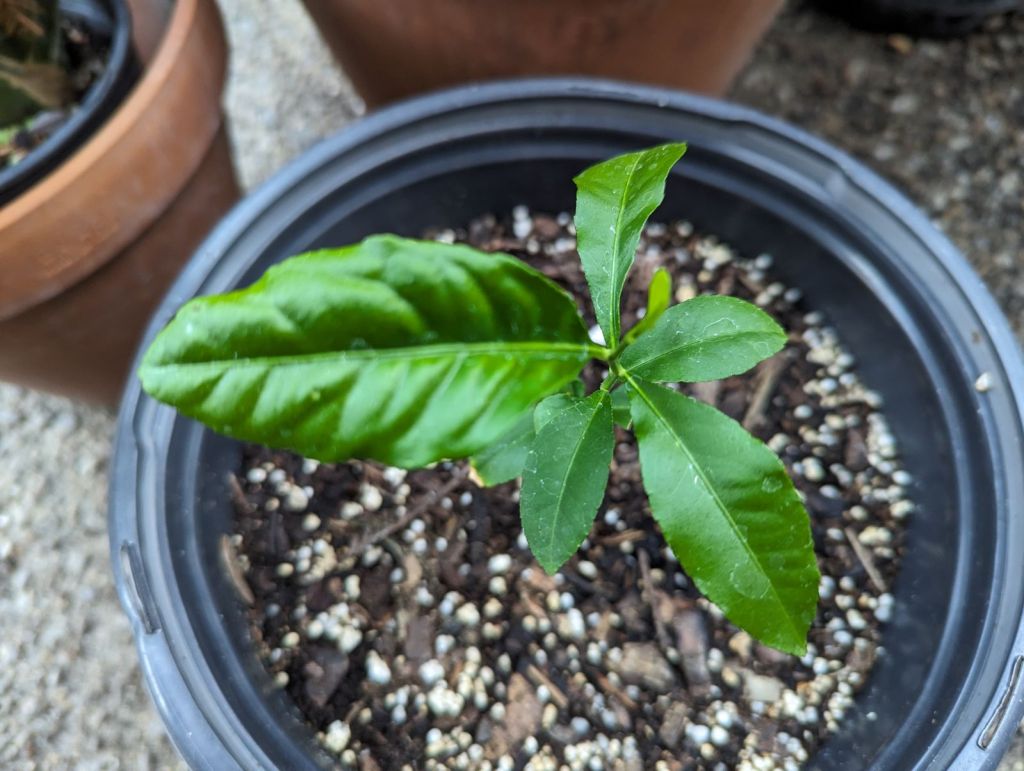
Prior to the identification of Hibbertia scandens last week, another mystery arrived. I probably should have mentioned it earlier, but as with the previous mystery, I thought that I would have identified it before I felt compelled to mention it here. Unlike the previous mystery though, I did not recognize it as something that I had encountered in the past.
Someone with whom I work, who is not so horticulturally oriented, brought it from one of the homes that he was working at. It had been left by a former tenant. Initially, I thought that it was merely a can of otherwise unused media in which a common bay laurel seed had germinated. However, it is not a bay laurel seedling. Also, contrary to how it appears in the picture, it is remarkably centered within the can, as if intentionally plugged there.
Initially, I thought that it resembled coffee, Coffea arabica. However, coffee exhibits opposite leaf arrangement, and these leaves are alternately arranged. Besides, viable unroasted coffee seed is not exactly common. Now, I sort of suspect that it could be lychee, Litchi chinensis. Although uncommon, seeded lychee fruit are not as rare as unroasted coffee. Although their leaves are so closely paired among mature specimens that they seem to be oppositely arranged, they are technically alternately arranged, and more obviously so among juvenile growth. If this is lychee, it will not produce identifying bloom for a few years.
Realistically, immediate identification of this seedling is unimportant. I could have put less effort into discarding it than I put into writing about it. Therefore, I will merely give it what it needs until it grows enough for identification. I will not mind discarding it if I identify it as something that is useless. Otherwise, I can find it a home.
 There are certain things that we expect to find in a coffee shoppe. Mainly, we expect to find . . . coffee. Yes, coffee, . . . duh. We can get all sorts of coffee beverages; hot, chilled, steamed, infused with things that have no business going into coffee. They have all sorts of cool sounding but strangely irrelevant Italian names that white people enjoy telling people of Italian descent how to pronounce. Yes, my name is Tony Tomeo; and I don’t want twenty cups of coffee with bread. Well, besides the coffee beverages, there are plenty of coffee beans; all sorts of roasts. I do not know of any coffee shoppe that grows any of the beans that it sells, but there is nice coffee shoppe in Felton, The Mountain Roasting Company, that grows coffee trees.
 Tony Tomeo