Dyckia

91023It is easy to mistake various cultivars of Dyckia for diminutive relatives of Agave or Yucca. They form stout rosettes of rigid leaves with wickedly sharp terminal spines. Their comparably nasty but incurved marginal teeth resemble those of most species of Agave, but are generally more abundant. Surprisingly though, Dyckia are instead related to bromeliads. They just happen to be xeric.

Dyckia do not bloom much, but when they do, the tall and arching floral stalks really are more typical of bromeliads. As they bloom late in spring or in summer, the many small individual flowers on each stalk are collectively colorful enough to be delightfully popular with hummingbirds, butterflies and bees. Bloom is most commonly rich reddish orange, but some cultivars bloom red or yellow.

No one seems to mind that Dyckia does not often bloom. The foliage is remarkably striking alone. Many cultivars form dense mounding colonies of pups that, although unpleasant to handle, can be divided for propagation. A few toothless cultivars, armed only with terminal spines, are easier to handle. Individual rosettes can be as tall and broad as a foot. Dyckia do not need much water.

Silver

P90713KThese are two pictures that did not make the grade for my ‘Six on Saturday‘ post this morning. That post featured bronze and gold foliage. Actually, of the six, only two were bronze, and only one was truly gold. One that I passed off as bronze was more purplish. Two that I thought were gold were just variegated with yellowish green and white.
I am none too keen on bronze or gold foliage anyway. The only exception that I can think of is the old fashioned bronzed ‘Schwedleri’ Norway maple. It was planted as a street trees on a few streets in the Santa Clara Valley in the 1950s.

Bronzed cultivars are less vigorous than their greener counterpart.

Gold cultivars are even less vigorous, and susceptible to scorch.

The best quality about bronze and gold is that they make silver look so good.

Olympic medal designations really should be reconsidered.

I only featured bronze and gold foliage earlier because I liked the contrasts between two different cultivars of each of the three species that were featured. Ironically, none of the three pairs compared bronze to gold directly. One compared purple to gold. The other two compared bronze to variegation that was barely yellow. Oh well.

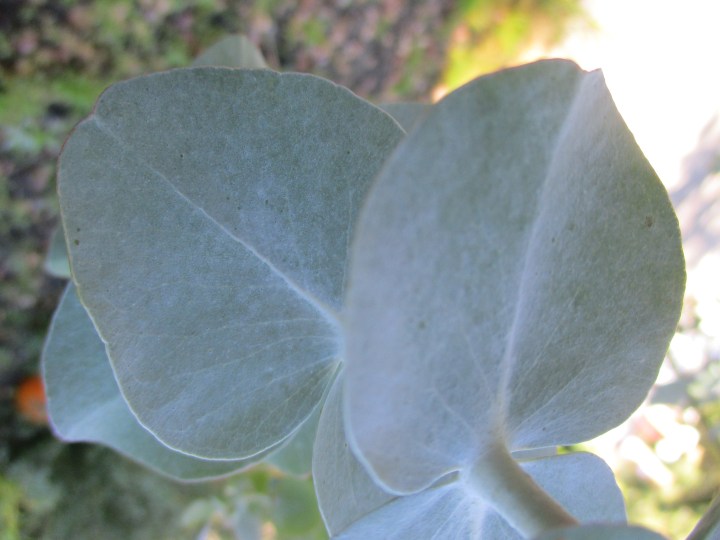
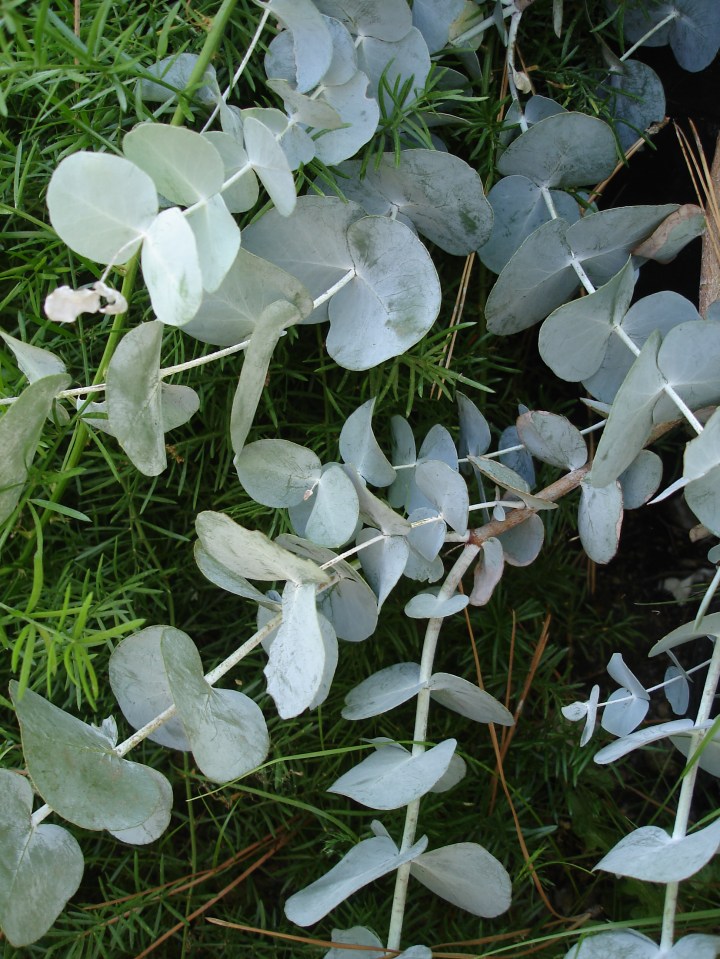
There are neither bronze nor gold cultivars to compare to the silver foliage of the two species shown here.

I do not know what species of agave this is. There are not many distinguishable features visible in the picture above. The color and texture of the foliar surface might be identifiable to an expert. The little snail does not seem to be at all concerned.

The Eucalyptus cinerea in the picture below was pruned aggressively last autumn, both to contain the disfigured canopy, and also to stimulate more vigorous new juvenile growth. It is now strikingly silver.P90713K+

Hinoki Cypress

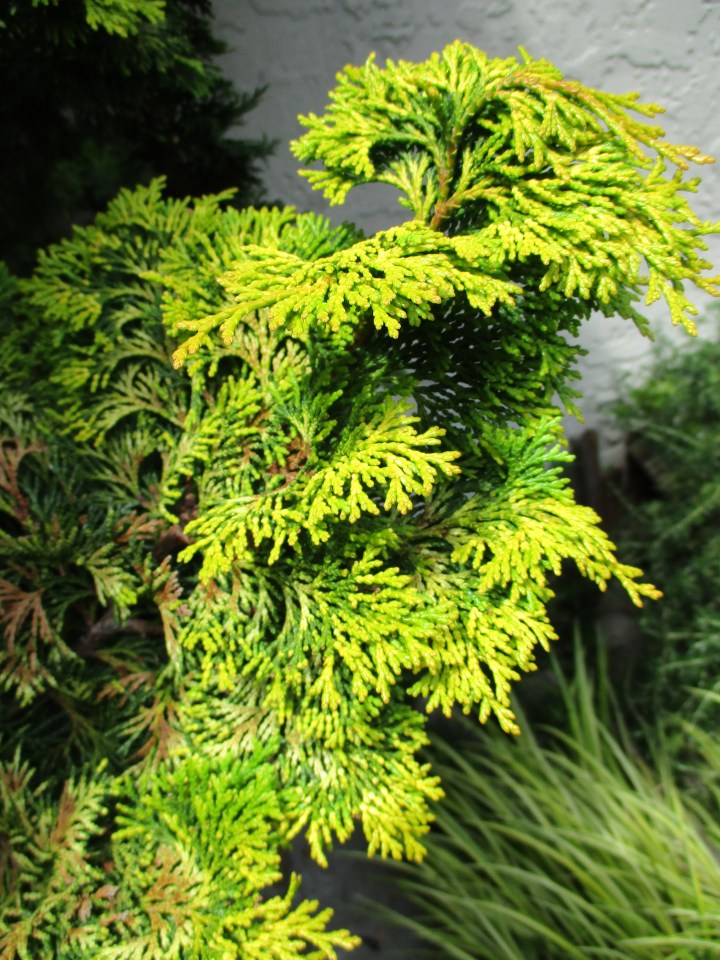
60615In California, it is hard to imagine that hinoki cypress, Chamaecyparis obtusa, gets big enough to be harvested for lumber in Japan. Almost all of the local garden varieties stay quite short. The largest rarely get up to second story eaves. The most compact types that are grown for bonsai, do not get much more than a few inches tall. Most are somewhere in between, to about ten feet tall.
The ruffled sprays of evergreen foliage are surprisingly dense relative to the soft texture and often irregularly loose branch structure. Mature trees often shed branches to reveal sculptural reddish trunks and limbs within, while maintaining the distinct density of their foliar tufts. The minute leaf scales have rounded tips. (Other specie have pointed leaves.) Tiny round cones are rarely seen.

Because of slow growth and irregular form, hinoki cypress is an excellent specimen ‘trophy’ tree, but not so useful as hedging shrubbery. It prefers a bit of shade, and will tolerate considerable shade. However, varieties with yellow new growth are more colorful with good (but not harsh) exposure. It does not take much pruning and grooming to enhance form and expose branch structure.

Foliar Color Long Before Autumn

51104The best and brightest color in the garden is obviously still provided by flowers. Autumn color can be spectacular, but only amongst relatively few deciduous trees, shrubs and vines that turn color reliably in mild climates, and only if the weather is conducive to coloration. The next best option for color beyond green is the sort of colored foliage that does not wait for autumn to materialize.
Foliage can be shaded with varying degrees of yellow, red, pink, purple, bronze, grayish blue or gray, or variegated with white, yellow or silvery gray. Plants that display such colorful foliage can be as small as flowering annuals, or as substantial as shade trees. Many are deciduous plants that also turn color in autumn. Most of the best are actually evergreen, so hold their color through winter.

Color tends to be richest as new foliage emerges in spring, and fades more or less through summer. Gold junipers only start out gold, but then fade to green within only a few months. The purplish foliage of ‘Forest Pansy’ redbud fades to coffee stained green. Yet, bronze New Zealand flax is always bronze. Dusty miller is always gray. Some plants are more reliably colorful than others are.

Exposure is important too. Most blue or gray foliage, whether juniper, agave, spruce, eucalyptus, olive or silver Mediterranean fan palm foliage, will be significantly greener if shaded. However, white variegation of English holly, hydrangea, ivy, hosta and pittosporum have better contrast if partly shaded. Colorful Japanese maples color better with good exposure, but roast if too exposed.

Many plants with colorful foliage are notorious for developing greener mutant growth known as ‘sports’. Because sports have more chlorophyll, they grow more vigorously than more colorful growth does, and can overwhelm and replace the more desirable colorful foliage if not pruned out. Many types of white or yellow variegated euonymus, as well as the more intricately variegated New Zealand flax, can revert to monochromatic green within only a few years.

Heavenly Bamboo

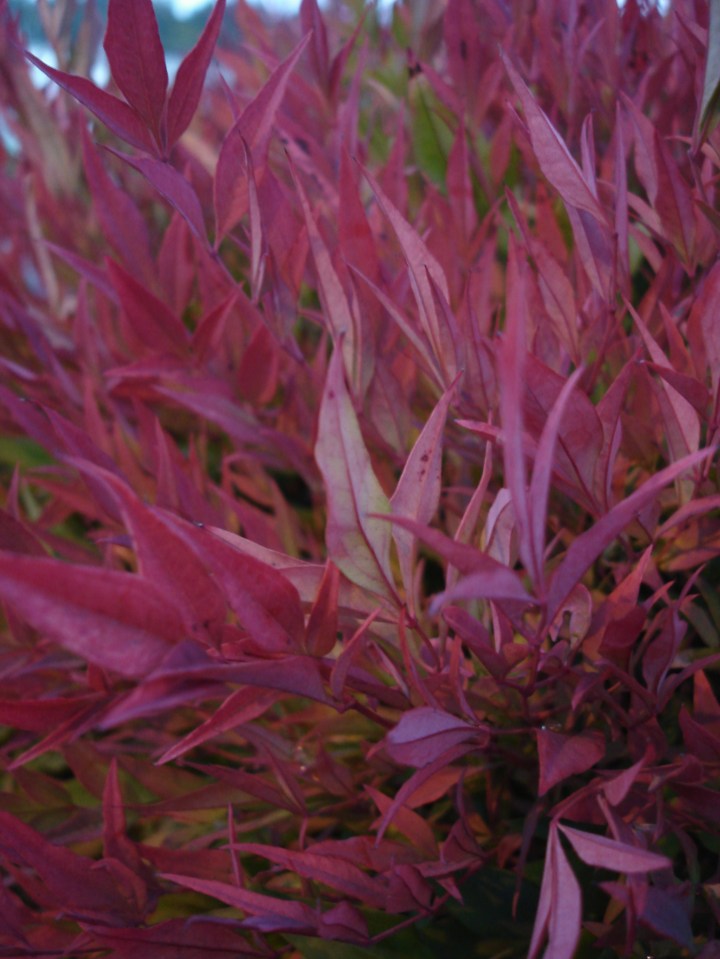
51111Good old-fashioned Heavenly bamboo, Nandina domestica, which can almost reach the eaves, can be difficult to obtain nowadays. More compact modern cultivars do not get much more than six feet tall, and some stay less than three feet tall. Foliage is airier in partial shade, but more colorful where more exposed.
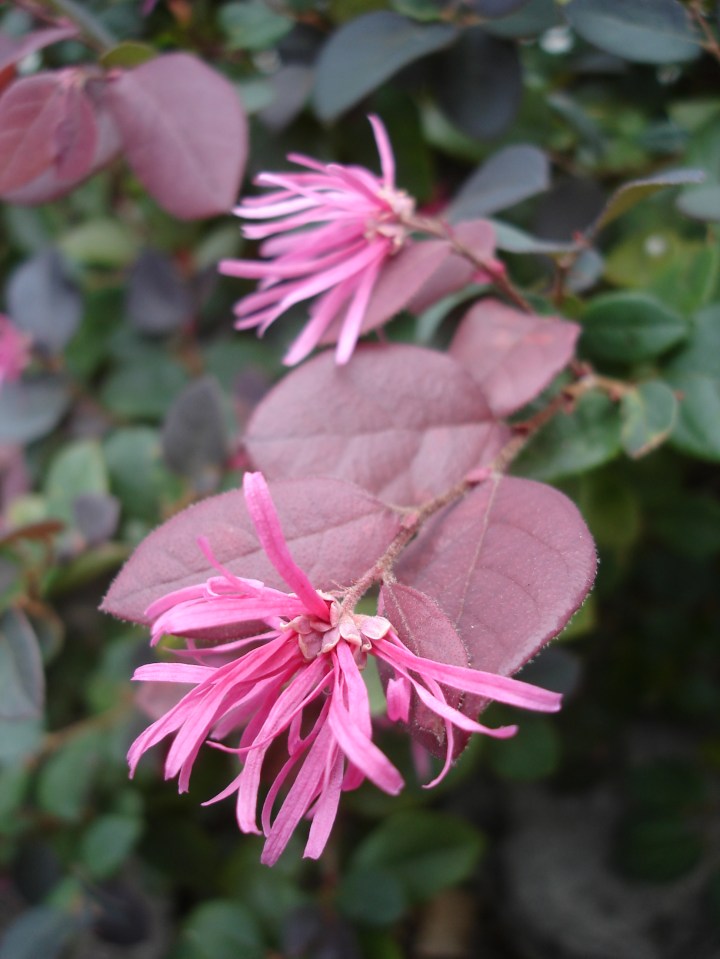
As it begins to emerge in spring, new foliage is pinkish or reddish before greening. It slowly bronzes by autumn. Some cultivars turn ruddy or orangish, or even burgundy. Individual leaves are actually quite large, but are divided into many small, diamond shaped leaflets. Some cultivars have very narrow leaflets. Tiny white flowers bloom through summer. Bright red berries ripen through autumn.

Although unrelated, Heavenly bamboo grows like bamboo, with vertical canes developing from creeping rhizomes. Overgrown or deteriorating canes should be cut to the ground as they get replaced by newer canes. Otherwise, they become top-heavy and inhibit development of new canes. Foliage should not be shorn, since it is not much to look at without its naturally intricate texture.

Fringe Flower

51007Since modern cultivars became trendy several years ago, the old fashioned ‘common’ fringe flower, Loropetalum chinense, has become even more uncommon than it already was. It does not grow fast enough to function as large scale shrubbery, but slowly gets too big to work as small shrubbery. Without pruning, old plants take many years to get to fifteen feet tall.
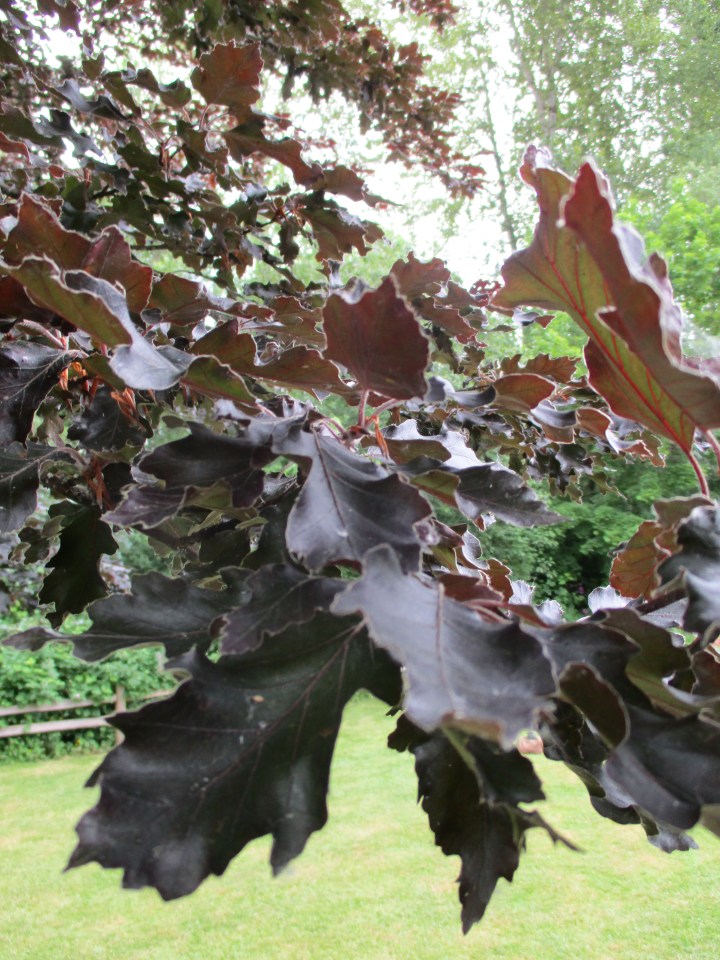
The gracefully arching stems are outfitted with light green evergreen foliage. The simple leaves are about an inch or two long. The small white blooms have very narrow petals that hang downward like limp bits of ramen. Each bloom is actually a tuft of a few individual flowers. Bloom is most abundant in spring, and then continues sporadically through most of the year.

Modern cultivars of fringe flower are more compact, so rarely get more than five feet tall. Flowers can be white, pink, red or rosy pink. The most popular cultivars have purplish bronze foliage. Fringe flower does well as an understory plant, in the partial shade of trees. It should not be shorn, so should instead be pruned selectively to maintain its natural form.

Beech

70628Compared to crape myrtle, sycamore (London plane) and many other more popular trees, the beech, Fagus sylvatica, is much less problematic, and really deserves more respect. Although it can eventually get almost as big as sycamore, it has remarkably complaisant roots. It is neatly deciduous, defoliating only in autumn, without noticeable floral mess. Disease and pests are rare.
Beech is probably unpopular with landscapers because new trees are a bit more demanding than other tree specie are. (Landscapers prefer easier trees.) Until they disperse their roots, they are more likely to desiccate if they do not get watered regularly enough, and more likely to rot if watered too much. They grow somewhat slowly, so need to be pruned more carefully for a high canopy.

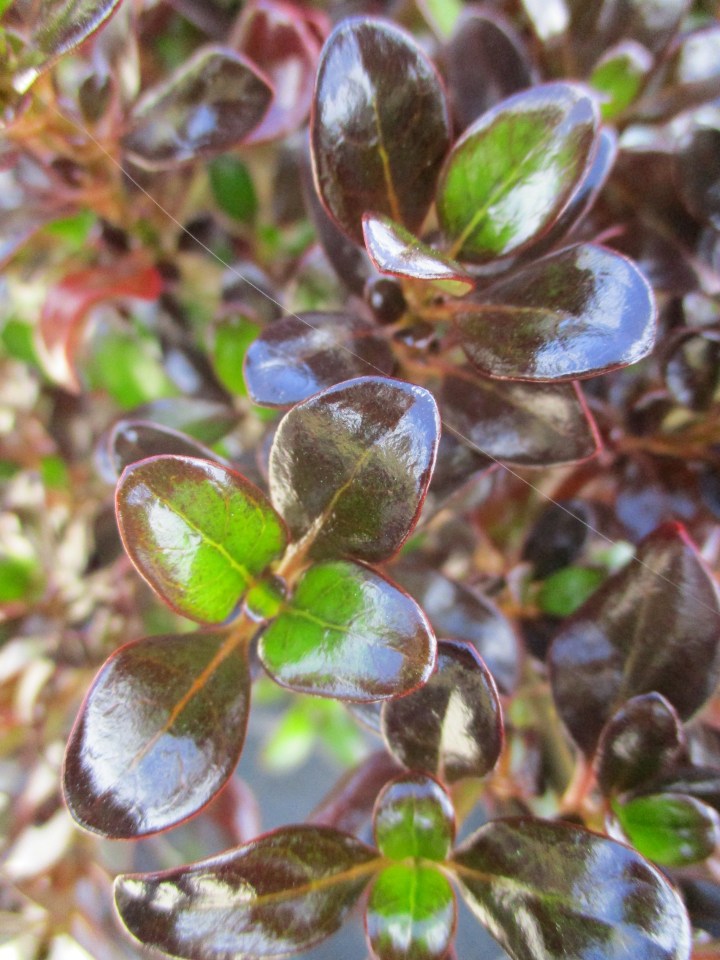
Those of us who tend our own gardens do not mind the extra effort for such a distinctive tree. The handsome foliage can be rich green, coppery bronze, darkly purplish or variegated with white or pink that fades to white. A cultivar with sunny yellow new foliage fades to green by summer. Most beeches have spreading branch structure, but some are strictly vertical or sculpturally pendulous.

Mirror Plant

70510As the old fashioned larger mirror plant, Coprosma repens, fell out of favor through the 1990s, several more colorful varieties of a more compact species of mirror plant, Coprosma X kirkii, became popular. (The ‘X’ in the name indicates that it is actually a hybrid of two specie.) Without getting much more than two feet deep, it spreads out laterally like dense evergreen groundcover.
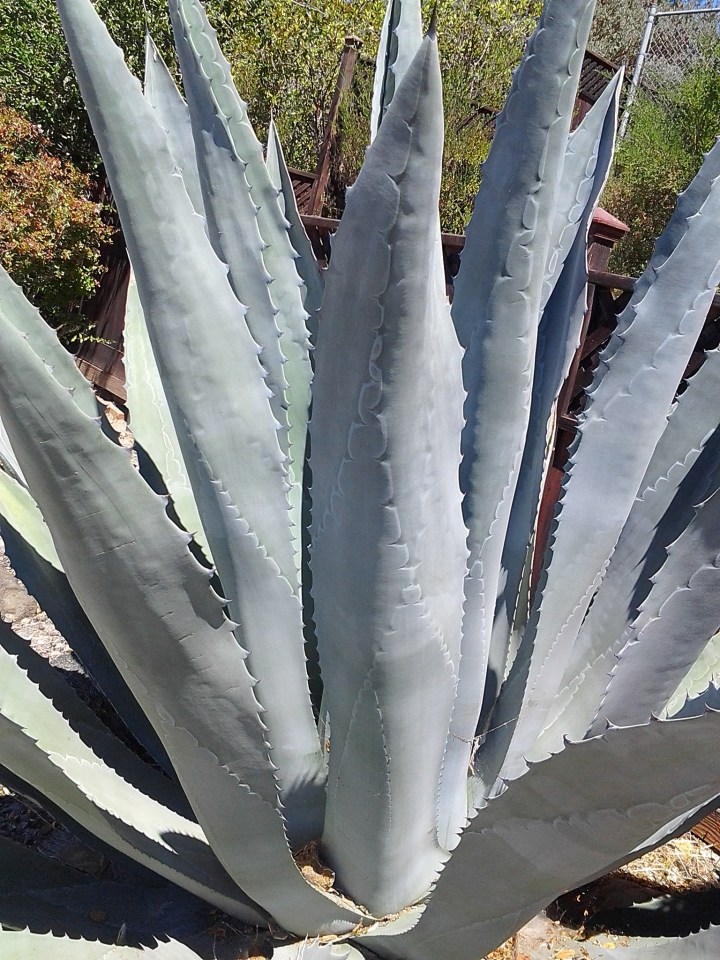
The color is not from bloom, but from the very glossy foliage. It can be variegated with white, gold, red, pink or bronze, or completely brownish bronze. Some varieties stay very shallow. Others can be shorn into low hedges like Japanese boxwood, only shorter. Although mirror plant does not mind partial shade, foliar density and color is best with full sun exposure and occasional watering.

Most modern varieties are known by their cultivar names, without their specie names. For example, Coprosma ‘Tequila Sunrise’ lacks the species name of ‘X kirkii‘. Such omissions might be the result of confusing hybridization with Coprosma repens, for rounder leaves. In other words, some cultivars may be of ‘questionable parentage’. Some are just dwarf cultivars of coprosma repens.

Foliage Shows Its True Colors

70510thumbFlowers were originally colorful only to attract pollinators. Breeding has improved the color and quality of many garden varieties of flowers, to make them more appealing to the people who grow them. Some have been bred so extensively that they are sterile, which defeats the original function of flowers. Now their function is merely to look good in the garden. Improvements are relative.
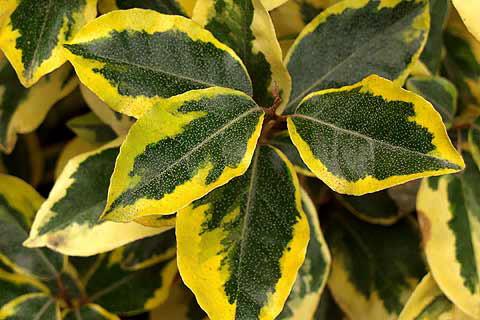
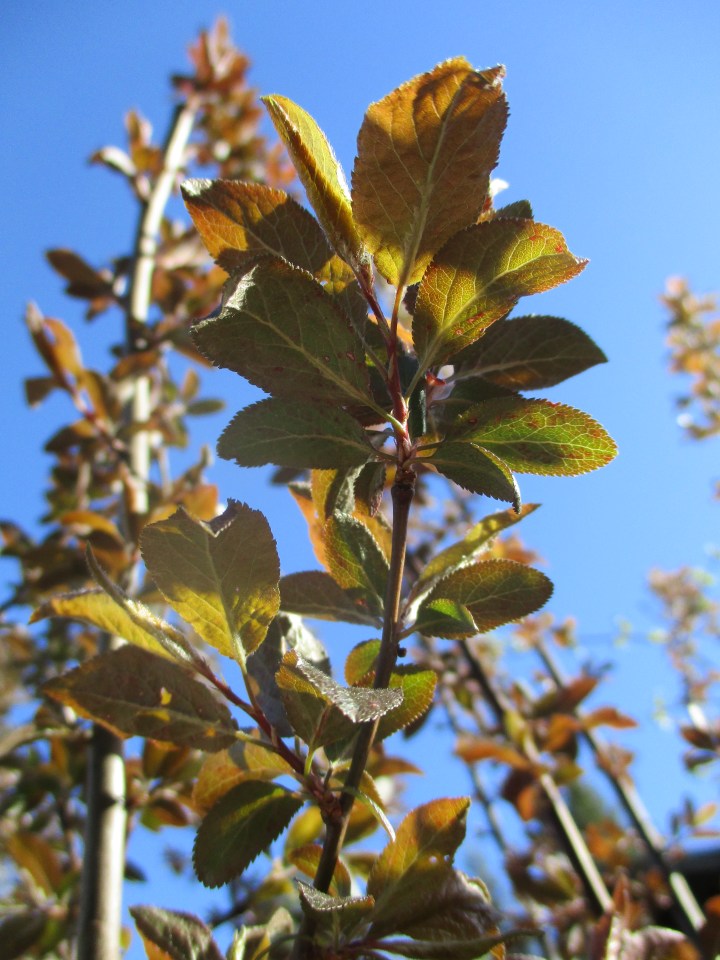
Foliage is green because it is photosynthetic. Chlorophyll, which is necessary for photosynthesis, happens to be green. Yellow, red, blue, purple, bronze, gray and variegated foliage might not be as efficient at photosynthesis as green foliage, but can be appealing in home gardens. Many plants with colored foliage are inferior to their greener counterparts, but are somehow more popular.

Gray and blue foliage absorbs less sunlight, which can be an advantage in harsh environments. Blue hesper palm and the various blue agaves are from arid deserts. Colorado blue spruce is from high elevations of the Rocky Mountains. Arizona cypress, silver mountain gum, artemesia, lambs’ ears, lavenders, dusty millers and blue junipers all provide distinctively gray or blue foliage.

Golden arborvitaes and junipers can be strikingly gold as new foliage develops in spring, even if the color does not last long. Most plants with gold foliage fade to yellowish green through summer. Golden honeylocusts do not fade as much, so are still mostly yellow by the time they defoliate in winter. Purplish or reddish foliage of purple leaf plum and red Japanese maple holds color better.

Euonymous, English holly, osmanthus, silverberry, hosta and various pittosporums can be variegated with white or yellow. Ivy, and hydrangea can be variegated with white. New Zealand flax and mirror plant can be variegated with gold or bronze, . . . or red or pink. Any unvariegated mutant growth (known as ‘sports’) that appears on variegated plants should be pruned away. Because it has more chlorophyl, it grows more vigorously, so can overwhelm and replace the more desirable variegated foliage.70510thumb+

Dingo

P80407K

Dogs and humans have been in a symbiotic relationship longer than history can document. Dogs naturally became more domesticated as humans did, and have been more or less selectively bred for a few thousand years.

Dingos are different. No one knows for certain how domesticated they were when they first came to Australia. They probably had been domesticated enough to come on boats with the first humans to migrate to Australia. After arriving in Australia, they became feral, although still symbiotically migrating with humans. They are now considered a native species of Australia.

Many species of plants have lived symbiotically with humans as well. As long as humans have been living with dogs, they have been domesticating and breeding plants. As plants were more extensively bred, they became more dependent on humans for their perpetuation. Some are so overly bred that they are sterile and unable to perpetuate without human intervention to propagate them vegetatively. Others, although unnaturally productive in regard to what humans want from them, are too weak or otherwise inferior to survive in the wild.

However, there are some extensively bred plants that escape their domestic lifestyles, and perpetuate feral descendants who retain some of the domestic characteristics of their extensively bred ancestors. They are not quite like naturalized plants that were merely imported in a more or less natural state from other regions, or those that naturalize and revert to a natural state. Characteristically, they are between wild plants and extensively bred and selected domestic plants. They have developed their own stable but feral lineage that can perpetuate in the wild.

For example, the purple leaf plum has been developed as an ornamental tree for a very long time. Several vegetatively propagated cultivars are now available. The ancestors were likely discovered as mutants with darker bronzed foliage. These primitive mutants were more or less genetically stable, and were likely able to perpetuate naturally. It is difficult to say for certain. From these ancestors, seedlings with even darker foliage were selected, and bred to find more seedlings with even darker foliage, and so on. Because of this selective breeding, purple leaf plum trees grown as domesticated ornamental trees now have darker foliage they would naturally in the wild. They are propagated vegetatively because some are so overly bred that they are sterile, and seedlings from those that can produce viable seed would be likely be more genetically stable, and therefore less genetically ‘developed’. This is why feral seedlings from purple leaf plums that can produce viable seed are not as dark purplish bronze as their parents. Seedlings from the seedling trees are even lighter bronze. They may never be completely green, but they will not be dark purplish bronze either. They are feral purple leaf plums, like dingoes.