Sticks on Fire

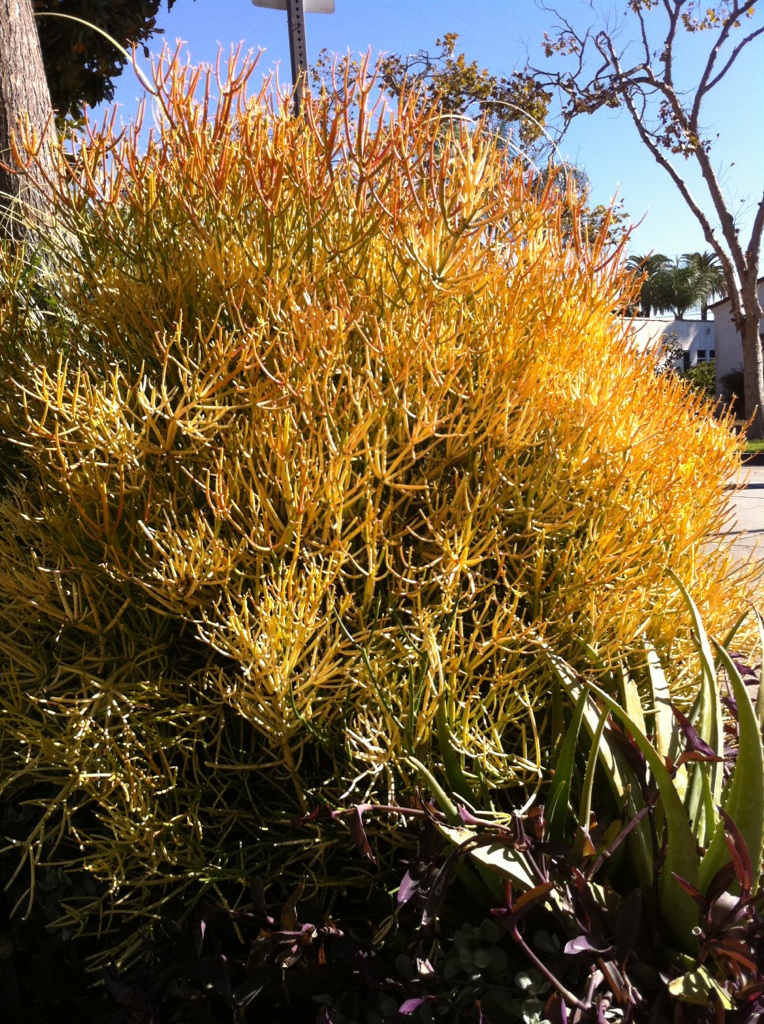
Sticks on fire is a more colorful and more compact version of pencil tree.

The old fashioned pencil tree, with leafless, succulent stems is a strikingly strange plant already. In mild climates of coastal Southern California, it can get quite large, nearly ten feet broad and twice as high. Sticks on Fire, Euphorbia tirucalli ‘Sticks on Fire’, stays less than half as large, but is even weirder because the stems are so oddly colored.

The inconspicuous leaves drop almost as soon as they develop, leaving distended fleshy stems that are either reddish or yellowish orange. Stems fade to softer yellow through summer, and then turn red in winter. Size and growth rate are limited by a lack of chlorophyll. Although related to poinsettia, the flowers of sticks on fire are not significant.

Sticks on fire prefers full sun exposure and warmth, but unfortunately needs protection from frost during winter. It can be happy under an eave on a south or west facing wall, or in a large tub that can be moved to shelter during winter. Plants in tubs are a bit more sensitive to rot if watered too frequently. The sap of sticks on fire is very caustic to skin and can be dangerous if it gets in the eyes.
Aeonium arboreum

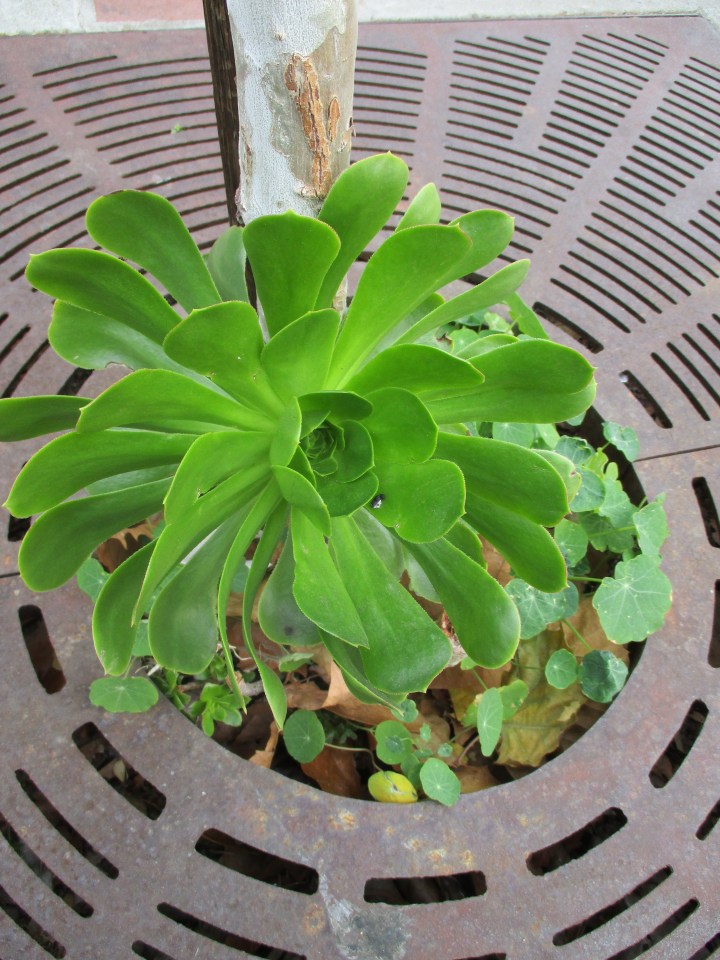
Aeonium arboreum will grow about anywhere.

The once traditional Aeonium arboreum, with round, dense rosettes of slightly serrate, olive green leaves has become less popular than its more colorful varieties that have become more available over the years. ‘Atropurpureum’ has rich purplish brown foliage. ‘Zwartkop’ is even darker and stays more compact. Long and sometimes unkempt clusters of tiny yellow flowers that bloom in spring or summer are not much to look at against green foliage, but contrast nicely against dark foliage. Larger plants can get to three feet tall and wide, with foliar rosettes wider than six inches.

Like many succulents, Aeonium arboreum is so easy to propagate from cuttings, that small pieces that need to be pruned from established plants can be plugged into the garden wherever more of the same plants are desired. New cuttings like to be watered until they develop roots. Established plants are a bit happier with occasional watering, but can survive neglect just fine. After all, they are native to similar climates in the Mediterranean and northern Africa.

Lavender Cotton

Neither lavender nor cotton, but a member of the Compositae Family.

The name is somewhat of a mystery. It is related to neither lavender nor cotton, but Santolina chamaecyparissus is known as lavender cotton nonetheless. The small, silvery gray leaves have a finely wrinkly texture, and are remarkably aromatic, like lavender. Though, the small and round bright yellow flowers look like daisies with the outer petals plucked off.

Unlike lavender and most other similar evergreen semiherbaceous shrubs, lavender cotton is adaptable to shearing, and is actually a classic component of traditional ‘knot gardens’, usually with another species of Santolina with green foliage to provide contrasting color. (Knot gardens feature small hedges with various foliar colors shorn into geometric and sometimes intricate patterns.) If regularly shorn, it is appreciated for its strikingly gray evergreen foliage, since it will not bloom.

Unshorn plants get about two feet tall and a bit broader, and will eventually need seasonal light shearing to remove fading flowers after bloom. Annual pruning at the end of winter keeps plants compact and neat without depriving them of their bloom. They otherwise eventually get bald in the middle and sloppy around the edges. (Some of us know about that.)

Good warm exposure and well drained soil is best. After their first year, lavender cotton does not need much water.

Atemisia ‘Powis Castle’

Artemisia ‘Powis Castle’ is more foliar than floral.

The pleasantly aromatic and lacy silvery gray foliage of Artemisia ‘Powis Castle’ can either mix well with pink, lavender or light blue flowers, or contrast against bright red or orange. The dark angular leaves of bronze New Zealand flax or bronze cannas are striking against its low and softly mounding form, which stays less than two feet tall and not much more than twice as wide. Contrary to how Artemisia ‘Powis Castle’ enhances the color of other flowers and foliage, its own flowers are not much to look at, if they get noticed at all.

Foliage is fluffiest if mature plants get pruned down at the end of winter. New plants can be propagated by division in spring or autumn. As plants get established, good drainage becomes more important than frequent watering.

Purple Leaf Plum

Spring bloom is spectacular prior to foliation.

There are actually several different purple leaf plums, Prunus cerasifera, to provide colorful white or pink bloom sometime between the middle of winter and the middle of spring, followed by colorful bronzy or purplish foliage through summer. Some also provide good fruit, which can unfortunately be messy if it is not harvested. Most stay quite compact, less than twenty feet tall and broad, so are proportionate to small garden spaces. ‘Hollywood’ is the largest, but rarely gets more than thirty feet tall, and not quite as broad. Prunus X cistena does not get much more than six feet tall and broad.

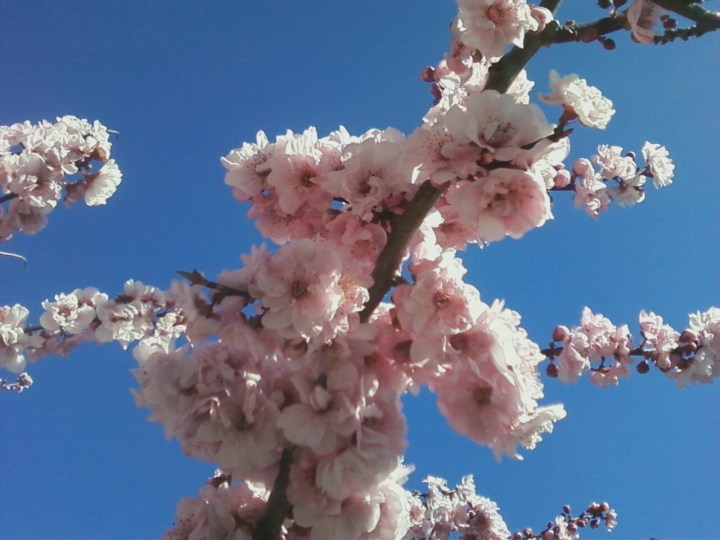
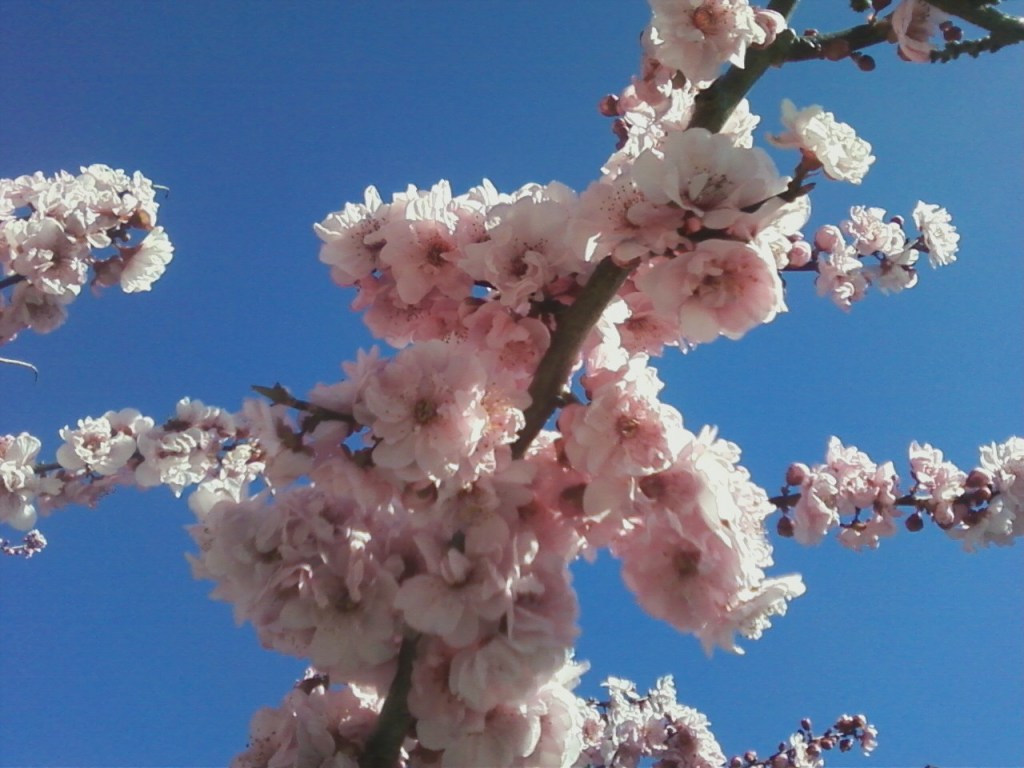
Because each cultivar has a distinct personality, it is important to match trees when adding or replacing trees in a grove. The fruitful ‘Atropurpurea’ has single white flowers in spring, followed by bronzy red new growth that turns purplish in summer and reddish brown in autumn. ‘Krauter Vesuvius’ has single pale pink flowers and the darkest foliage, but lacks fruit. ‘Thundercloud’ has similar or paler flowers, lighter or more bronzy foliage, and sometimes produces tangy red fruit about an inch wide. Prunus X blireiana (illustrated) fades to bronzy green by summer, but has handsome branch structure and double pink flowers that are slightly fragrant. Unlike plums that are grown for larger and more abundant fruit, purple leaf plums do not need much pruning.

Purple Leaf Plum

Purple leaf plum bloom is more colorful than its purplish foliage.

There are actually several different purple leaf plums, Prunus cerasifera, to provide colorful white or pink bloom sometime between the middle of winter and the middle of spring, followed by colorful bronzy or purplish foliage through summer. Some also provide good fruit, which can unfortunately be messy if it is not harvested. Most stay quite compact, less than twenty feet tall and broad, so are proportionate to small garden spaces. ‘Hollywood’ is the largest, but rarely gets more than thirty feet tall, and not quite as broad. Prunus X cistena does not get much more than six feet tall and broad.

Because each cultivar has a distinct personality, it is important to match trees when adding or replacing trees in a grove. The fruitful ‘Atropurpurea’ has single white flowers in spring, followed by bronzy red new growth that turns purplish in summer and reddish brown in autumn. ‘Krauter Vesuvius’ has single pale pink flowers and the darkest foliage, but lacks fruit. ‘Thundercloud’ has similar or paler flowers, lighter or more bronzy foliage, and sometimes produces tangy red fruit about an inch wide. Prunus X blireiana (illustrated) fades to bronzy green by summer, but has handsome branch structure and double pink flowers that are slightly fragrant. Unlike plums that are grown for larger and more abundant fruit, purple leaf plums do not need much pruning.

Dusty Miller

Such silvery foliage contrasts exquisitely with bronze foliage.

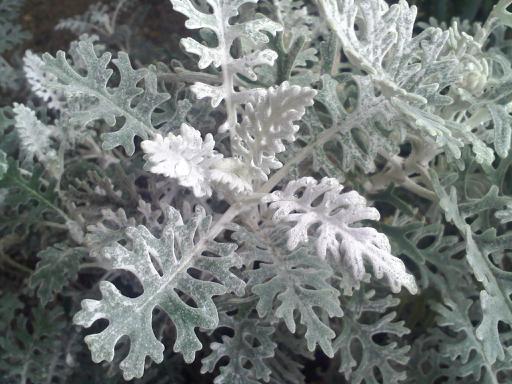
The relaxed trusses of small yellow composite (daisy-like) flowers of dusty miller, Senecio cineraria, can bloom at any time except when winter gets too cold. They are still blooming now. Yet, who cares? Dusty miller is grown more for its fuzzy white foliage than for bloom. It actually looks best and fluffier if occasionally shorn and pruned to remove blooming stems before they bloom. Individual leaves are intricately lobed. Mature plants get taller and wider than two feet. Dusty miller likes full sun exposure, good drainage and moderate water. Too much water causes rot and discoloration.

Madonna & Black Lace

Sambucus nigra ‘Black Lace’ European black elderberry

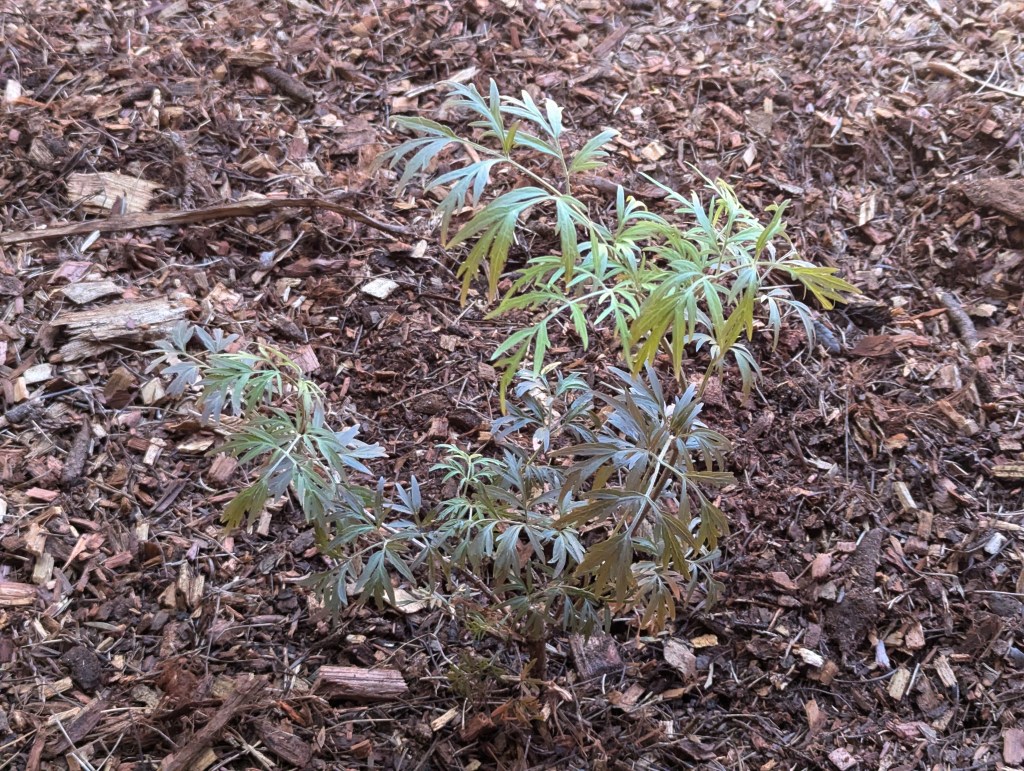
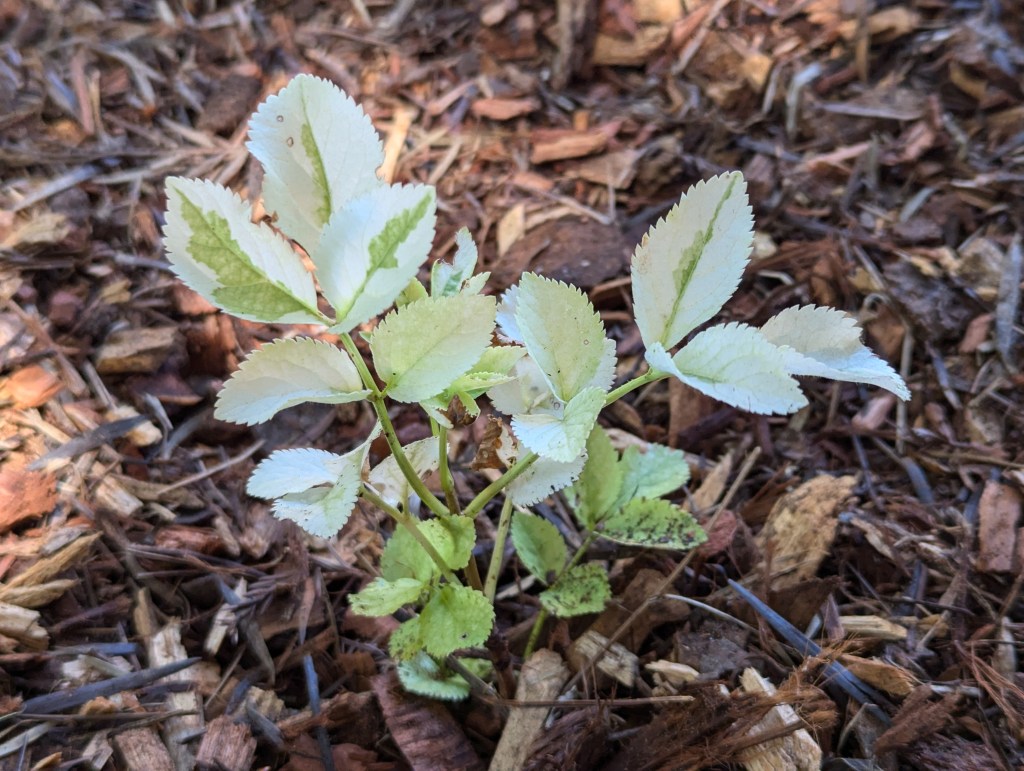
1984 was four decades ago. This is happening right now. Sambucus nigra ‘Black Lace’ European black elderberry, with intricately lacy and richly bronzed foliage, and flaring upright form, has inhabited one of the landscapes here for a few years. I was initially not so keen on it, but eventually learned to appreciate it as others who saw it expressed fondness for its distinctive texture and color. It was so popular that I grew a few too many copies from pruning scraps two winters ago, with the intention of adding a few more to other landscapes. I plugged a few more last winter, as if I did not know better. Several were shared with neighbors, but so far, only one was added to another landscape here, and only a few days ago. It may not look like much in the picture above, but should be a bit bigger and more richly bronzed next year. Sambucus nigra ‘Madonna’ European black elderberry, with simpler and yellowish variegated foliage, and somewhat more rounded form, was a more recent acquisition. Although I am not so keen on its yellowish color, it happened to become available while I was considering acquisition of a pollinator for ‘Black Lace’, which has not produced berries yet. Although each can self pollinate somewhat, different cultivars pollinate each other more effectively. Doves enjoy the resulting berries; and people enjoy seeing happy doves. The original specimen of ‘Madonna’ was thrashed when I acquired it, but provided more than sixteen rooted side shoot copies before going to live in a colleague’s garden. The first of these copies was installed adjacent to and in conjunction with the first copy of ‘Black Lace’. It may not look like much in the picture below, but it is just a dinky copy from a four inch pot.

Sambucus nigra ‘Madonna’ European black elderberry

Smokebush

Smokebush bloom is not particularly flowery.

Mundane floral color and a lack of floral fragrance are no problems. Smokebush, Cotinus coggygria, compensates. Its uninteresting bloom reveals strikingly fluffy floral trusses for summer. These trusses eventually deteriorate to reveal exquisitely vibrant foliar color for autumn. This foliar color eventually deteriorates to reveal sculptural trunk form for winter.

Foliar color through spring and summer is likely the most striking attribute of smokebush. Most are boldly rich purplish bronze. Some are strikingly vivid yellowish chartreuse. The two extremes contrast splendidly. Old fashioned olive drab is now rare. Foliar color does not fade much. However, it suddenly transitions to fiery orange and red color for autumn.

Old fashioned olive drab smokebush can grow a bit more than fifteen feet high and wide. Because it does not grow fast, only old specimens are so large. Most bronze cultivars do not get much higher than first floor eaves here. Chartreuse cultivars are likely to stay a bit shorter. Healthy young specimens might get wobbly if their canopies outgrow their roots. Aggressive pruning improves form and stability, and can also enhance foliar color.