Horridculture – Pave Paradise

pavement within pavement within pavement

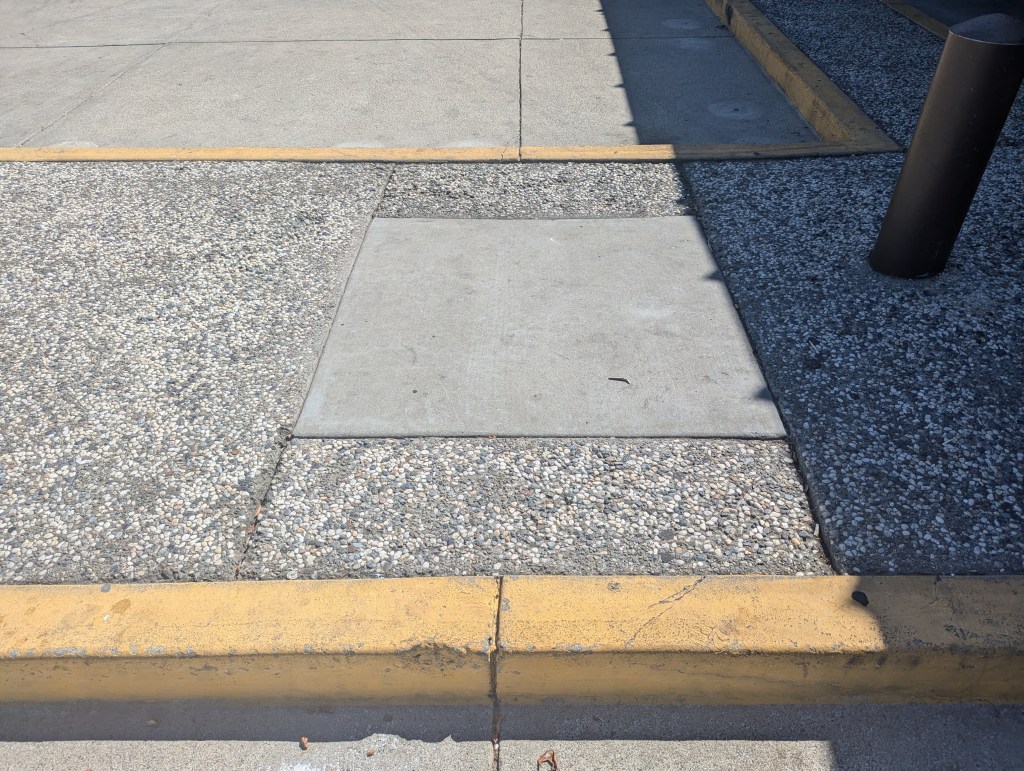
The Santa Clara Valley really is, as it was formerly known, the Valley of Heart’s Delight. A long time ago, it was famous for vast orchards that thrived in its exemplary climate and soil. The climate is still here, but so are nearly two million people who now live where orchards formerly were. Not so much of the formerly productive soil remains exposed, and almost none is appreciated for its potential. Urban development continues to expand to occupy more of it. At a strip mall in the Berryessa District of San Jose, I noticed what appeared to be gravesites of small patches of once exposed soil that died slow deaths after all other soil around them was developed. The concrete pavement outside of and below the yellow curbs was likely the original parking area, walkway and paved patio, which were separated from each other by what was likely small landscaped patches of exposed soil within and at the same level as the yellow curbs. Sometime after the area outside of the curbs were paved, most of what was likely exposed soil within was also paved with exposed aggregate concrete, leaving only what was likely three smaller square patches of exposed soil, perhaps for trees to survive in. Eventually, even these three smaller square patches of exposed soil were also paved with simpler concrete. It is impossible to say why all this concrete pavement was necessary, or why exposed soil was so objectionable. Perhaps the dirt was dirty. Perhaps it was infested with weeds. Perhaps all this concrete is some sort of Brutalistic art. Regardless, the good soil below is now useless. The patio now lacks shade from trees. A little bit more of the Santa Clara Valley can not sustain any vegetation. A little bit more of Paradise is paved.

Brutalism?

Ancient Ruins

Eight columns arranged in a semicircle behind the High Place garden at Filoli were found by excavation for the foundation of a skyscraper in San Francisco. The stone from which they were carved is European, but no one knows how or why they were buried under San Francisco. They could have been recycled into one of many buildings that were destroyed by the Great Earthquake and associated fire of 1906, and subsequently buried within landfill with tons of other debis. They were more likely recycled as ballast for a European ship that, as it deteriorated or became obsolete, was dismantled and buried within landfill in San Francisco. It is a mystery. They are in a formal landscape at Filoli now, and will likely remain there for a very long time.

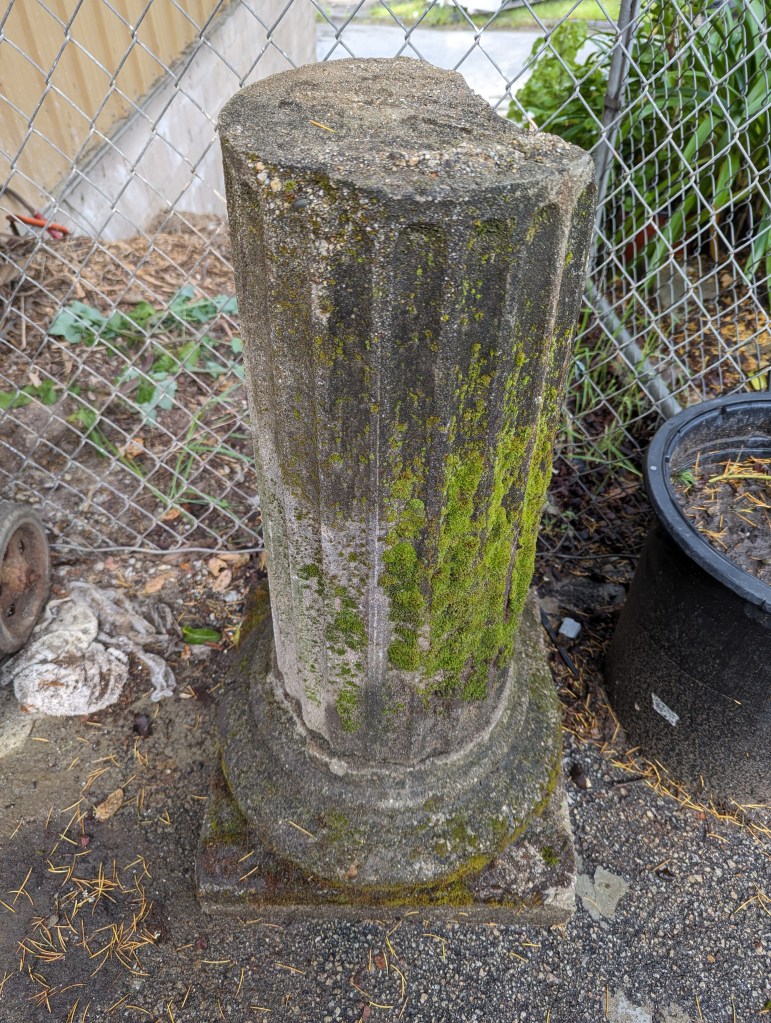
Within a dumpster of recyclable broken concrete, I noticed this old concrete column. With a bit of investigation, I also found the base. Each component is very heavy. I have no idea what they were, but I suspect that they were the base of an elaborate birdbath. I did not find any associate basin within the dumpster. In order to identify their origin, I inquired about these items with those who disposed of them. At the location, I found a small portion of the column that fits between the base and the larger portion of the column, as well as another column that is identical to the original with the smaller portion attached, but no other base. Nor did I find any basin or other features that might have been supported by the columns. They are either already disposed of, or buried by earlier excavation. It is such a waste. Regardless, these items are here now, and will hopefully be incorporated into the landscapes, although I have no idea how.

Monogram

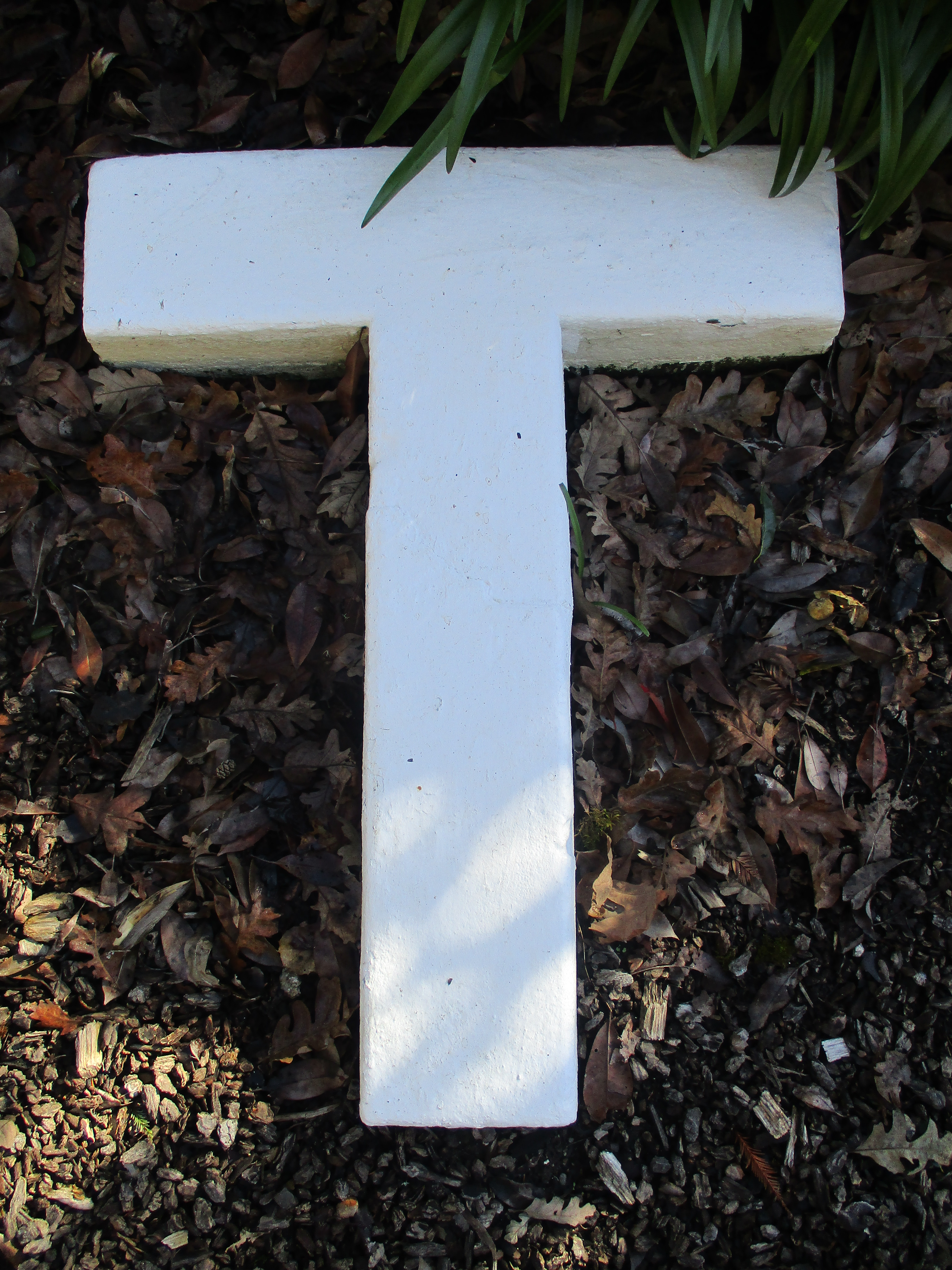
P90216KToday’s episode is brought to you by the letter ‘T’.
This is not Sesame Street.
Nor is this freshly painted concrete ‘T’ a monogram that designates the garden as mine. Even I am not ‘that’ vain.
It is part of a sign at the train depot. There happen to be enough of the right letters for my last name. I suppose that with a pry bar and a shovel, I could be ‘that’ vain.
There is no ‘Y’, so my first name would not work, particularly in conjunction with my last name, which would take the only ‘T’ and ‘O’ available. Am I really vain enough to be putting this much thought into this? Oh my!
For right now, I should only be concerned with keeping the vegetation clear of the sign. The amaryllis foliage above barely flops into it. The overgrown photinia hedge behind the amaryllis was just removed. The arborvitaes that will be installed to replace the photinia hedge will not likely get wide enough to ever reach the sign. They will be set several feet back. We are still trying to decide what to install between the arborvitaes, which will be far enough from each other so that they will not become a continuous hedge like the photinia were.
You would not believe how many bay trees and valley oak trees were trying to grow amongst the photinia! They ranged in size from fresh seedlings all the way up to a nearly six inch wide coppiced stump of a valley tree that was cut down a few years ago. There are still a few small oaks that must be removed nearby. We want to remove them while we are working on the site, and before they get big enough to displace the concrete letters with their roots.

Time Travel

P81124KOne never knows what strange artifacts might be found out in public landscapes. It is amusing enough to find items discarded or simply misplaced long ago by former occupants of a home out in a private home garden. Public landscapes are even more interesting, since they collect debris and artifacts from many more people. Some landscapes have been doing so for a long time.
Besides litter, the most commonly found artifacts are sporting equipment. Frisbees, baseballs, tennis balls, soccer balls, volleyballs and such are commonly lost in dense vegetation. Golf clubs, baseball bats and tennis rackets sort of make one wonder. Chew toys are sometimes left by dogs who go after them, but then return with something they perceive to be more interesting.
Landscapes that are near roadways often feature car parts that might have fallen out of cars as they drove by, as well as a few that cars could not have driven by without. Obviously stolen items, such as purses and wallets, often surrounded by a few credit cards that they likely contained sometimes appear. Stolen mail might fit into that category.
I have yet to find anything as interesting as tickets to a San Jose Sharks game, a big bag of money, Elvis, a purple dinosaur from another plant or a flying saucer that brought it here. However, I have found evidence of time travel!
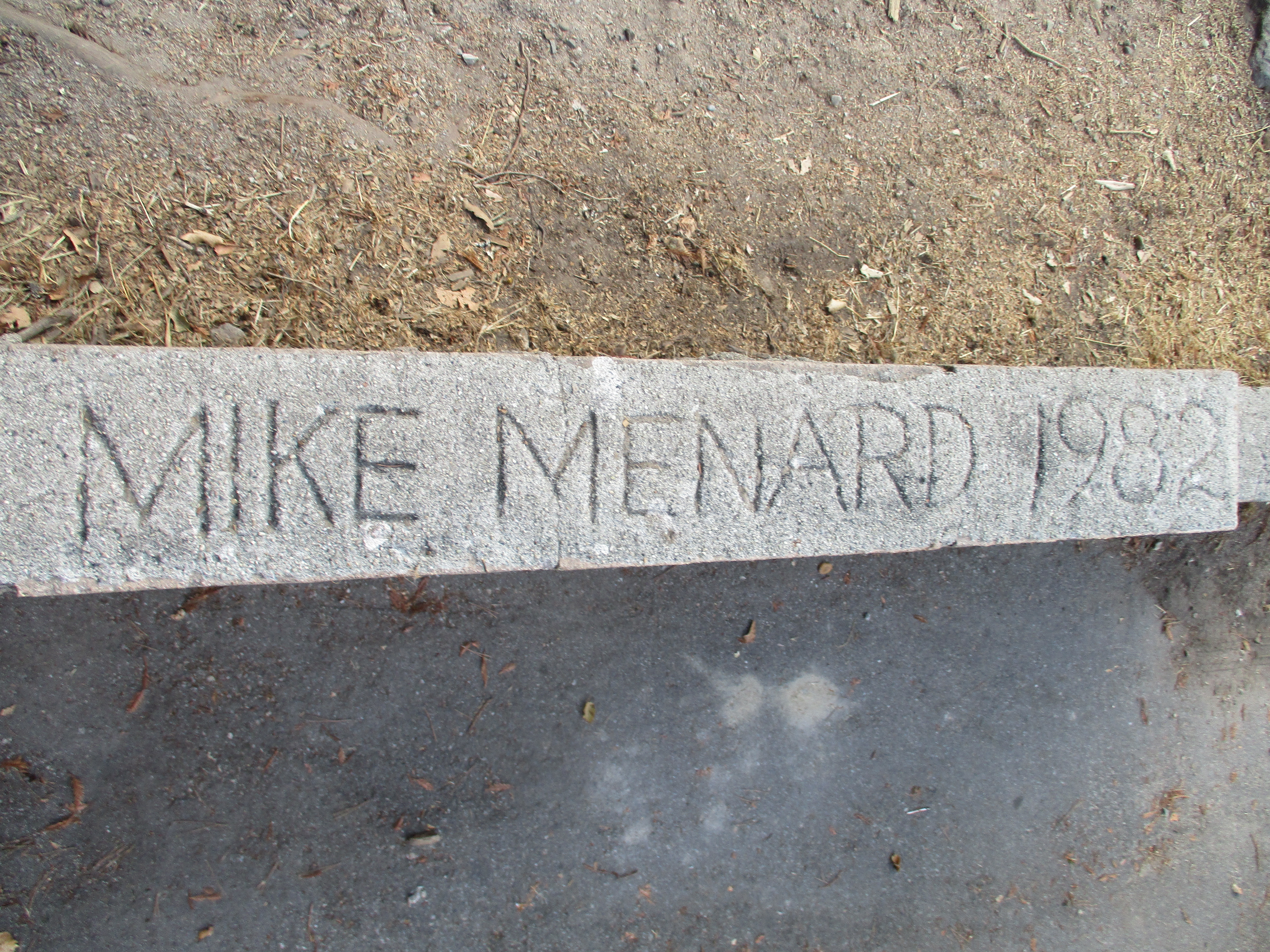
A retaining wall that holds back an embankment above a parking lot at work was apparently constructed by Mike Menard in 1982, who left his name and the date inscribed into the concrete on top of the wall. That by itself is nothing too remarkable. What IS remarkable is that an adjacent retaining wall was constructed four hundred years later, and three hundred and sixty-four years from now, in 2382!P81124K+

Good Roots Are Seldom Seen

70628thumbWhen a tree falls in the forest, and there is no one around to hear it, does it make a sound? Of course it does! There is just no one to hear it. Why should that be such a profound question? A falling tree makes a mess too. Anyone who does not see or hear it in action can witness it afterward. Sometimes, roots that were inadequate to support the fallen tree become exposed as well.

There is certainly nothing unnatural about trees falling in forests. Otherwise, forests would be too crowded for new trees or anything else to inhabit. The roots of fallen trees might have been adequate for many decades or centuries, but eventually succumbed to decay and the weight of the canopies they supported and sustained. Trees falling in home gardens are completely different.

Domestic trees (in home gardens) are likely to land on homes, cars, other plants, or anything that happens to be in their way if they fall. Also, they are more likely to have problems with the roots that support them. Regular irrigation needed to sustain other landscape plants promotes rot, and also inhibits deep root dispersion. Excessive irrigation that keeps soil saturated is much worse!

The good news is that, despite their innate disadvantages, domestic trees tend to be shorter, stouter and more stable. With proper maintenance, they seldom fall; or at least they are more likely to get removed before they fall. Buttressed roots that are visible at the surface of the soil might indicate that deeper root dispersion has been inhibited. The best roots are too deep to be seen.

Whether or not buttressed or shallowly dispersed roots limit stability, they can damage pavement, lawns, septic systems, or other features on the surface of the soil. Subterranean utilities and foundations of modern buildings are typically safe, but on rare occasion, can be damaged by the largest sorts of trees. Root barriers divert roots, but those of big trees eventually get around them. Potentially damaging roots can be severed while young, but become more integral to sustaining and supporting as they grow.

Concrete And Jungle Can Be Compatible

80620thumbConcrete is one of the most common of landscape materials. There are probably more landscapes that include concrete of one form or another than there are landscapes that include lawn, and most landscapes include lawn. There are more landscapes that lack shade trees than there are without concrete. We do not notice it much because, once it is installed, we do not do much to it.

Concrete gets poured into our gardens as a liquid like slurry of cement and sand and gravel aggregates that cures into a stone-like solid. It is not ‘cement’, but cement is the component that binds it all together. Almost all modern concrete is reinforced with steel of some sort to prevent it from breaking as easily as old unreinforced pavement does. It can be as permanent as we want it to be.

Concrete is used to pave patios, driveways and sidewalks, and gets molded into stairs, curbs, and the foundations and slabs for our homes and garages. The visible surfaces of concrete can be colored, textured or outfitted with stone to look better in the landscape than simple bare concrete. It is relatively ‘low-maintenance’, but should sometimes get swept or blown if debris accumulates.

Concrete is a versatile and durable material, but is no more perfect than anything else in the garden. It inhibits percolation of moisture and gas exchange in the soil below. Because it is inflexible, it fractures if displaced by roots or settling soil. Glare from paved surfaces can enhance sun exposure enough to roast sensitive foliage and exposed bark. Certain foliar debris can stain concrete.

Concrete limits plant selection. Conversely, the presence of mature trees limits the location and quantity (surface area) of concrete to be installed. Trees with aggressive roots or big trunks should not be planted so close to concrete that they will have no choice but to displace it. Root barriers help with mid sized trees, but are not always effective forever. Dogwoods,Japanese maples and other plants with sensitive foliage or bark, are more vulnerable to exposure if concrete around them is also exposed.