Sawara false cypress cultivars do not develop into real trees.
Just like other types of false cypress, the Sawara false cypress, Chamaecyparis pisifera, naturally gets much larger than its many cultivars that are sometime grown in gardens for their colorful and interestingly textured foliage. Although not large trees, they can get nearly thirty feet tall in wild groves in Japan. Most garden varieties stay less than ten feet tall, and some stay much shorter.
‘Cyano-Viridis’ (‘Boulevard’), with feathery blue green foliage, is one of the more popular cultivars. It grows slowly to more than six feet tall and broad. ‘Filifera’ has very different foliage, with tightly fitting scale leaves on limber cord shaped branches. It stays a bit shorter but can get a bit broader. ‘Mops’ is similar to ‘Filifera’, but stays about a foot and a half tall and broad. ‘Filifera Aurea’ and ‘Golden Mops’ are just like ‘Filfera’ and ‘Mops’, but with yellow foliage.
Reflected glare or harsh exposures can burn foliage. Full sun is not a problem, unless enhanced by glare from surrounding pavement or lightly colored walls. Partial shade is not a problem either, but compromises foliar color, particularly yellow.
Shearing or major pruning deprives false cypress of their naturally appealing forms and textures. They should therefore get plenty of space for their mature size, and get trimmed lightly for shape only when necessary.
Dwarf Alberts spruce is more like a conical shrub than a tree.
Most of the familiar conifers, or ‘cone-bearing’ plants, are large trees like pines, spruces, cedars and cypresses. They are practical trees only with sufficient space, and where their debris and constant evergreen shade will not interfere with lawns or other plants below. Their less familiar compact specie and cultivars (cultivated varieties) that grow as smaller trees or large shrubbery are actually more proportionate, and therefore more useful for refined landscapes.
There are actually several small specie of pine, like Scots, Austrian black, dwarf Swiss stone, mugo, and the various Japanese red, black and white pines. Some of the most compact cultivars grow as dense shrubbery. Others grow as small to mid sized trees with the personalities of larger pines.
There are fewer compact spruce to choose from. Dwarf Alberta spruce, which is a very compact cultivar of white spruce, is perhaps the smallest and most symmetrical, growing as a dense and strictly conical shrub. Columnar and pendulous cultivars of blue spruce grow in opposite directions, upright and downward, but stay compact enough to be grown as sculptural specimens or shrubbery. There are also pendulous white and Norway spruce.
Several compact cultivars of western red cedar and northern white cedar (Thuja spp.) are popularly grown as tall hedges. They are not actually cedars (Cedrus spp.) and are more often known by the common name of ‘arborvitae’. There are even more Asian arborvitaes (Platycladus spp.) to choose from; many of which have bright golden foliage. ‘Swane’s Golden’ Italian cypress is narrower and denser than the arborvitaes, but not as brightly colored.
Despite the bad reputation of certain cultivars that were planted too extensively decades ago, many junipers are very practical and sculptural coniferous shrubs, as well as ground covers and even small specimen trees. Some ground cover types stay less than a foot deep. Shrubby and small tree types are at their best where they have room to grow without pruning. If ‘Hollywood’ juniper is too old fashioned, the various Rocky Mountain junipers and Eastern red cedar (again, not really a cedar) are worth investigating for their distinctively picturesque forms.
Chamaecyparis are perhaps the most variable of the evergreen coniferous shrubs and trees. Although there are naturally only a few specie which grow into substantial timber trees, there are countless cultivars that are compact enough for residential gardens. Most stay less than thirty feet tall. Many stay less than half as tall. Most have rich deep green foliage; and many have bluish, greyish or golden foliage.
Chamaecyparis are known by a few different but inaccurate common names, including ‘cypress’, ‘false cypress’ and ‘cedar’. (Although the Alaskan cedar is now classified as a cypress, Cupressus or Callitropsis nootkatensis.) Like almost all other conifers, they are best where they can grow naturally without major pruning or shearing to compromise their naturally appealing forms and textures. The most diminutive cultivars are excellent for bonsai and rock gardens, or even in urns of mixed perennials.
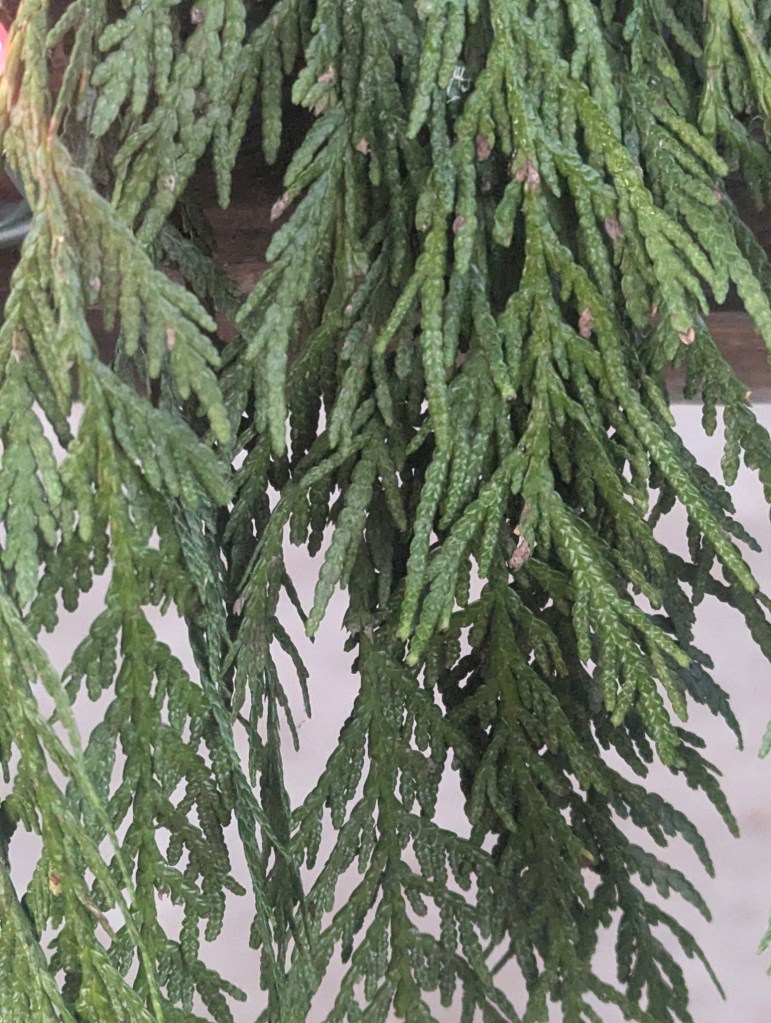
This coniferous evergreen is more appealing as seasonal foliar decor than it is practical. Western red cedar, Thuja plicata, is the most common component of Christmas garlands. Also, it is very popular for wreaths of mixed evergreens. It is the same genus as common arborvitaes. However, this particular species is notably rare among local home gardens.
Western red cedar is native to the Pacific Northwest. Its range extends south to the north coast of California, and east to western Montana. It therefore does not adapt efficiently to the arid warmth of local chaparral climates. Even with generous irrigation, its foliage can be vulnerable to desiccation. The healthiest specimens here are within coastal climates.
Like some other trees within its native range, western red cedar typically grows very big. It can easily reach a hundred and fifty feet tall, and can grow taller than two hundred feet. Although it does not grow as fast as redwood, it eventually needs about as much space. Western red cedar, here, is appropriate only for large landscapes within coastal climates. It is too obtrusive for compact home gardens.
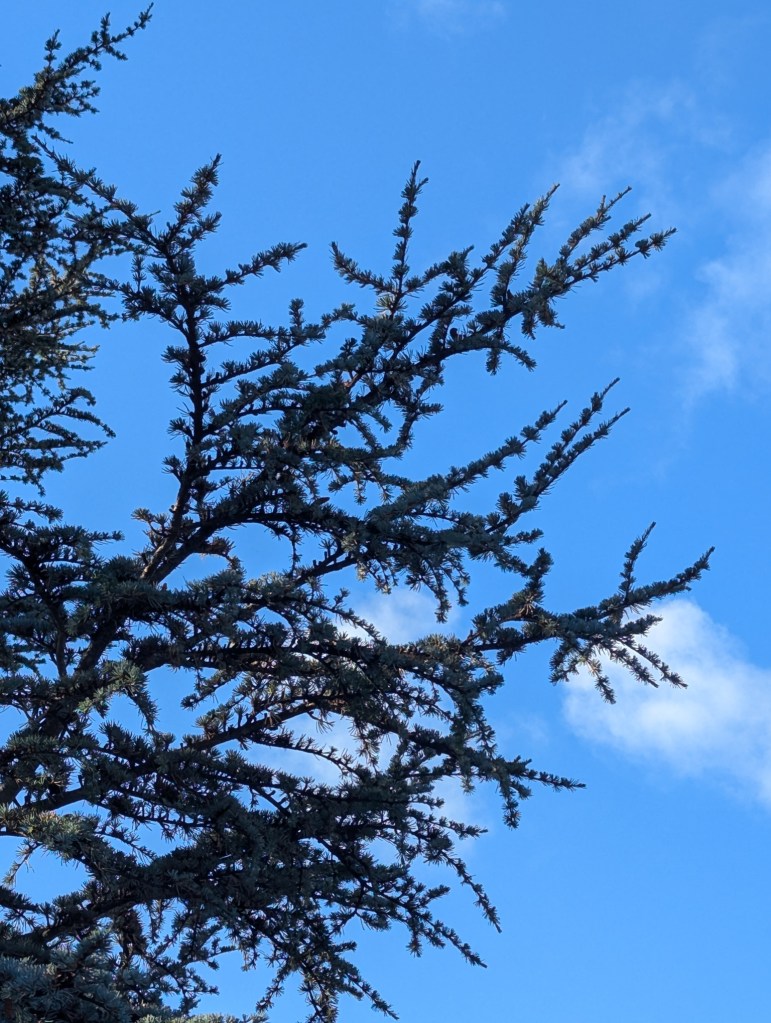
No other coniferous tree develops such distinctively irregular form. Very few exhibit such distinctively steely grayish blue foliar color. Blue Atlas cedar, Cedrus atlantica ‘Glauca’ is no simple shade tree. It is a striking trophy tree that is worthy of prominent display within grand landscapes. It is ideal for traffic circles, without other trees to obscure its boldness.
Blue Atlas cedar is also sufficiently resilient for traffic circles and other difficult situations. Arid warmth, even if enhanced by pavement, roofs or walls, should be no problem. Once established, blue Atlas cedar does not crave much irrigation. It should be able to survive with none. Excessively frequent or copious irrigation is more likely to become a problem.
Blue Atlas cedar can grow a hundred feet tall in the wild within its native range. It should not grow much more than half as tall with good exposure within landscapes. Trunks may slowly grow to almost six feet wide. Canopies can eventually grow wider than thirty feet. ‘Glauca Pendula’ is weeping blue Atlas cedar, which is smaller but even more exquisite. ‘Aurea’ with gold tips, is very rare.
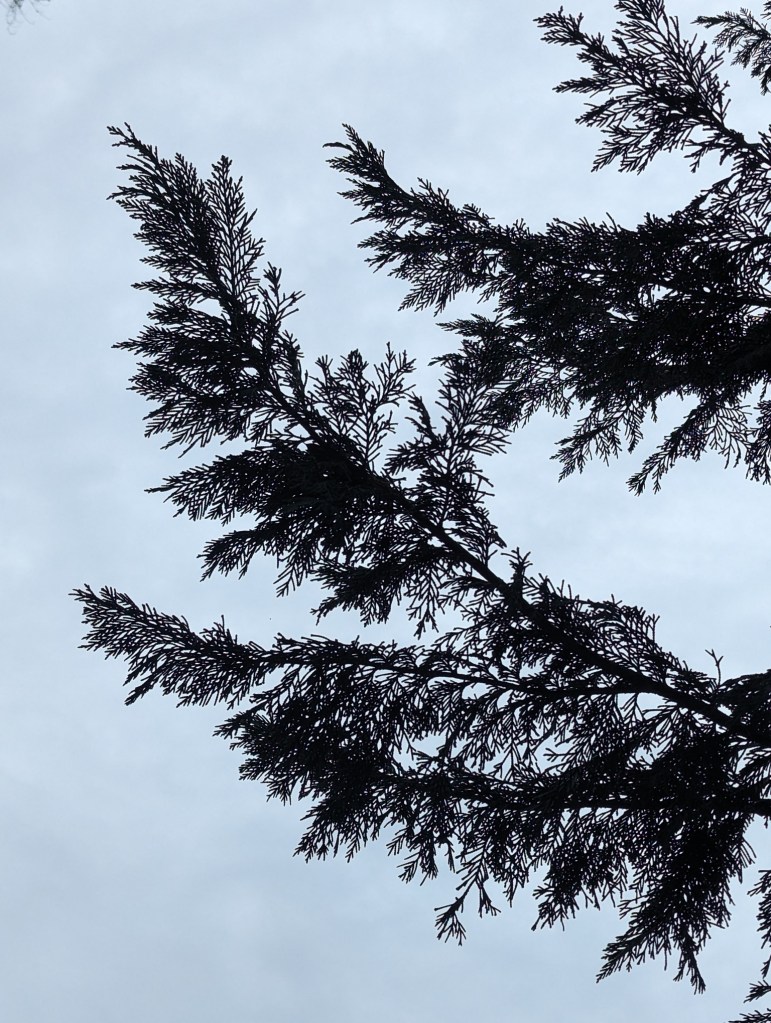
It is difficult to imagine Sawara cypress, Chamaecyparis pisifera, as a timber tree. Within its native range in Japan, it can grow as tall as one hundred and fifty feet. Its trunk can be six feet wide. It is no surprise that it grows slowly though. Its more familiar types rarely grow taller than ground floor eaves. Only the oldest and biggest are nearly thirty feet tall.
Sawara cypress cultivars are uncommon, and some are rare. Among them, ‘Boulevard’ is less uncommon. It has feathery bluish foliage, and can grow eight feet tall. Supposedly, it can eventually grow nearly three times as tall. ‘Filifera Aurea’ has bright yellowish foliage on limber cord like stems. It supposedly gets taller, but it is typically lower and mounding.
Although its cultivars are more diverse, Sawara cypress resembles compact arborvitaes. Its densely evergreen foliage has a similarly soft texture. Its bark is similarly ruddy with a similarly fibrous texture. Individual scale leaves are less than a sixteenth of an inch long. Sawara cypress classifies as the false cypress because it is not of the genus Cupressus.
Although not native, Arizona cypress, Hesperocyparis arizonica, behaves as if it is. It is native to deserts and chaparrals of Mexico, New Mexico and, of course, Arizona. Hence, new specimens only require irrigation until they disperse their roots. Afterwards, they are satisfied with seasonal rainfall. They are more resistant to pathogens than other cypress.
Most modern Arizona cypress cultivars are bluish gray with densely conical form. A few are yellowish, pendulous or columnar. ‘Blue Ice’ is a strikingly silvery bluish gray cultivar of smooth Arizona cypress. Most old Arizona cypress trees exhibit significant variation because they grew from seed. Some develop irregular form or more greenish drab color.
In the wild, Arizona cypress can grow taller than sixty feet. Locally, few get forty feet tall, particularly since modern trees are compact cultivars. Most stay less than twenty feet tall, and some stay about half as wide as they are tall. They work well as informal evergreen hedges. Smooth Arizona cypress exfoliates rough outer bark to expose smooth red inner bark. It is Hesperocyparis arizonica variety glabra.
Taxonomy is a mess for Leyland cypress, X Cupressocyparis leylandii. The X preceding its genus name indicates that it is an intergeneric hybrid. Monterey cypress, Cupressus macrocarpa is the paternal parent of the original hybrid. Nootka cypress, Chamaecyparis nootkatensis, is the maternal parent. However, its name is now Cupressus nootkatensis.
Therefore, Leyland cypress is now Cupressus X leylandii, and an interspecific hybrid. It inherited attributes from both parents, as well as innate vulnerabilities. It can grow very vigorously to more than thirty feet tall in fifteen years. However, it may not live for another fifteen years afterward. It is very susceptible to cypress canker and a few other diseases.
This is why Leyland cypress often accompanies more permanent but slower vegetation. By the time it finishes its life cycle, the other vegetation is ready to replace it. Most large specimens are less than forty feet tall, with densely conical form. The evergreen foliage is grayish deep green. Less common cultivars are more grayish, yellowish or variegated.
Coniferous evergreens are popular Christmas decor.
Christmas trees are extreme cut foliage. They grow on farms like cut foliage that florists use, but are entire trees! Although most fit under household ceilings, some within public venues are famously grand. Nonetheless, they are ultimately as disposable as any other cut foliage. Eventually, after their Christmas season, they become common greenwaste.
Other cut foliage is also popular as home decor through the Christmas season. Much of it is from the same sorts of coniferous trees that become Christmas trees. Almost all of it is evergreen, since deciduous vegetation is already defoliating. A few deciduous stems with colorful bark, such as red twig dogwood, are nice too. So are colorful winter berries.
Cut foliage is more practical as wintry decor within climates with cooler winter weather. Not much blooms during such weather. However, because of this same wintry weather, people prefer to be inside. While inside, they appreciate the color, texture, and perhaps aroma of cut foliage. Locally, such foliar decor for winter is more traditional than practical.
Actually, the most traditional cut foliage of Christmas is uncommon within local gardens. Scraps from the lowest branches of Christmas trees are a good source of minor bits of it. Premade wreaths and garland include a few types that are otherwise unobtainable here. Improvisation is necessary to create wreaths and garlands from locally available foliage.
Only a few of the few blue spruce that live here grow large enough to share many stems. Their best foliar growth is also their most important structural growth. Removal of it might cause minor disfigurement. Other spruce, as well as various fir, are very rare within home gardens. So is Eastern white pine, although a few other pines are notably common here.
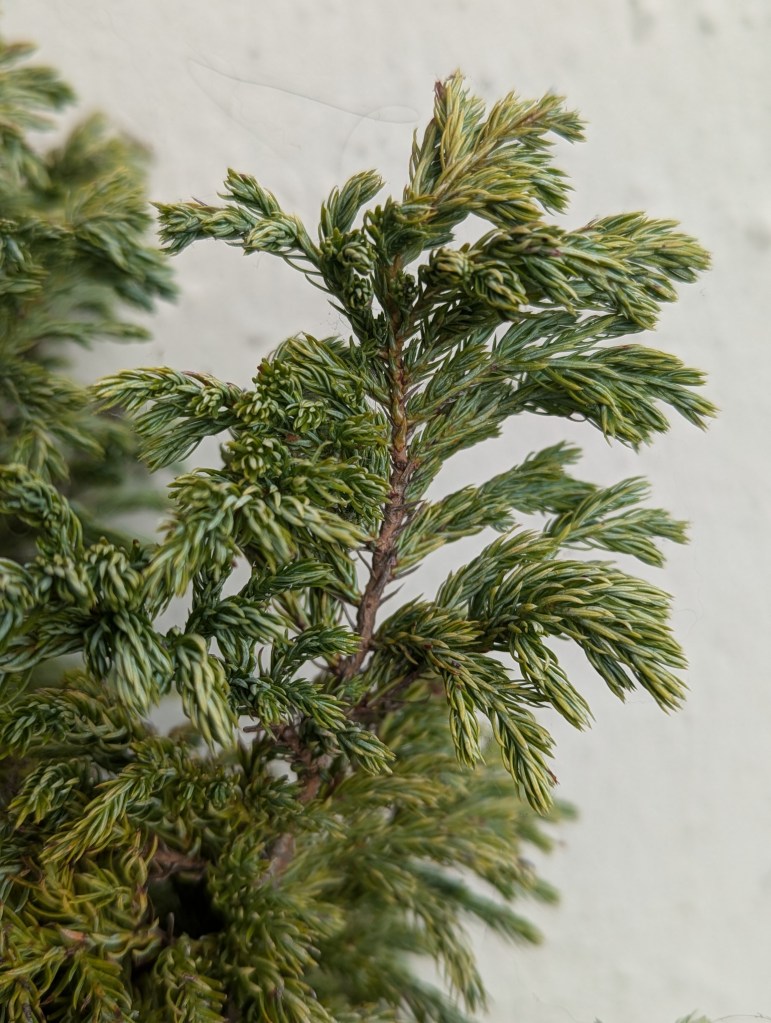
Atlas cedar, Deodar cedar, various cypress and various juniper are also rather common. A few sorts of holly are uncommon but not rare, but they produce only a few berries here. Holly olive may be more common, and resembles English holly, but produces no berries. Southern magnolia is a strikingly untraditional cut foliage, but becomes fragile as it dries.
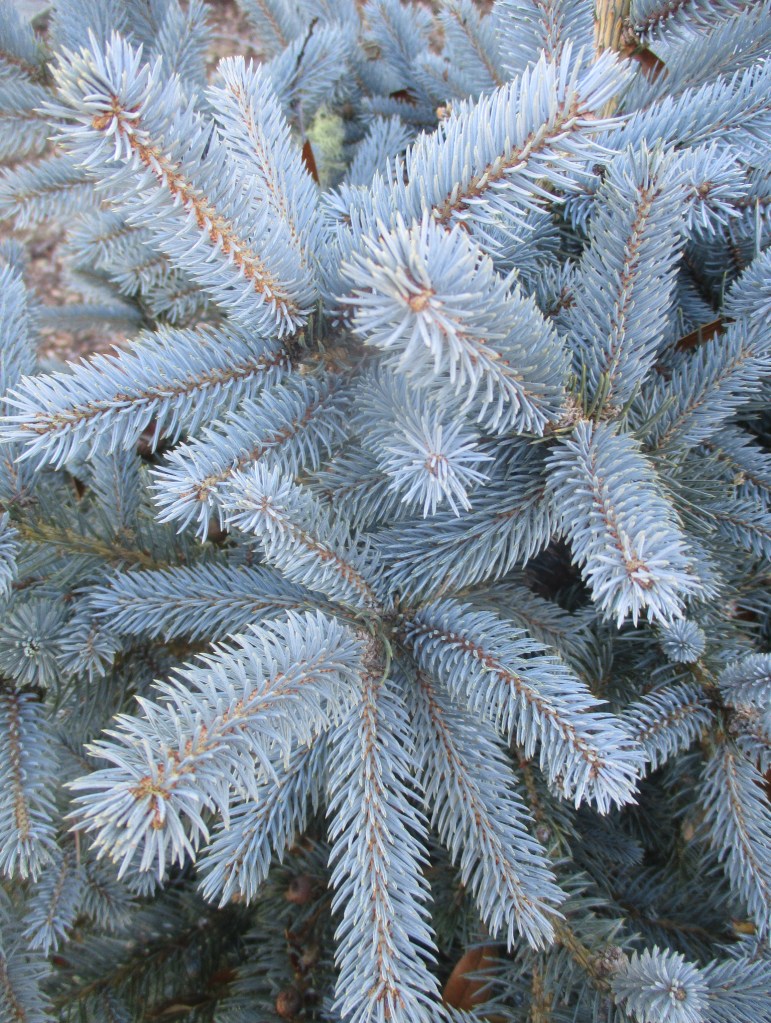
Most trees behave very differently in cultivation than in the wild. Colorado blue spruce, Picea pungens, is naturally a grand tree. It slowly but surely grows almost a hundred feet tall in the Rocky Mountains. Locally, if not competing with taller trees, it rarely gets as tall as thirty feet. Mild winter weather does not stimulate much more than necessary growth.
Furthermore, most home garden Colorado blue spruce are densely compact cultivars. Most are plumply conical. A few are quite rounded or globular. They function more as big shrubbery than trees. They are less conducive to major pruning than shrubbery though. Removal of low limbs for clearance compromises their strict but naturally elegant form.
Foliar color is as appealing as form and foliar texture. Obviously, Colorado blue spruce should be blue. Some are a bit more silvery or grayish. Trees that grow from seed tend to be greener and a bit less dense than cultivars. Such seedlings are sometimes available online. The stiff and prickly needles of Colorado blue spruce are only about an inch long.
Monterey cypress is a famously rugged tree that inhabits harshly exposed coastal cliffs. It grows fast to get big and gnarly with age. Lemon cypress, Hesperocyparis macrocarpa ‘Goldcrest’, is a more civilized cultivar. It might potentially grow nearly forty feet tall, but at less than a foot annually. Vertical trunks support compact and relatively columnar form.
Lemon cypress foliage is densely evergreen, with tiny and tightly set scale leaves. New spring growth is impressively cheery yellow. It fades somewhat to yellowish chartreuse through summer. If the weather gets cool enough through winter, the foliage can get a bit more amber. The foliar aroma is coincidentally slightly lemony, to match the foliar color.
Once established, lemon cypress does not require much more than occasional pruning. It is satisfied with only infrequent irrigation, and might survive with none at all. Actually, it is susceptible to rot with generous or frequent irrigation. ‘Goldcrest Wilma’ is susceptible to foliar diseases within its even denser foliage. It stays compact enough for pots though (Incidentally, Hesperocyparis was Cupressus.)





 Tony Tomeo