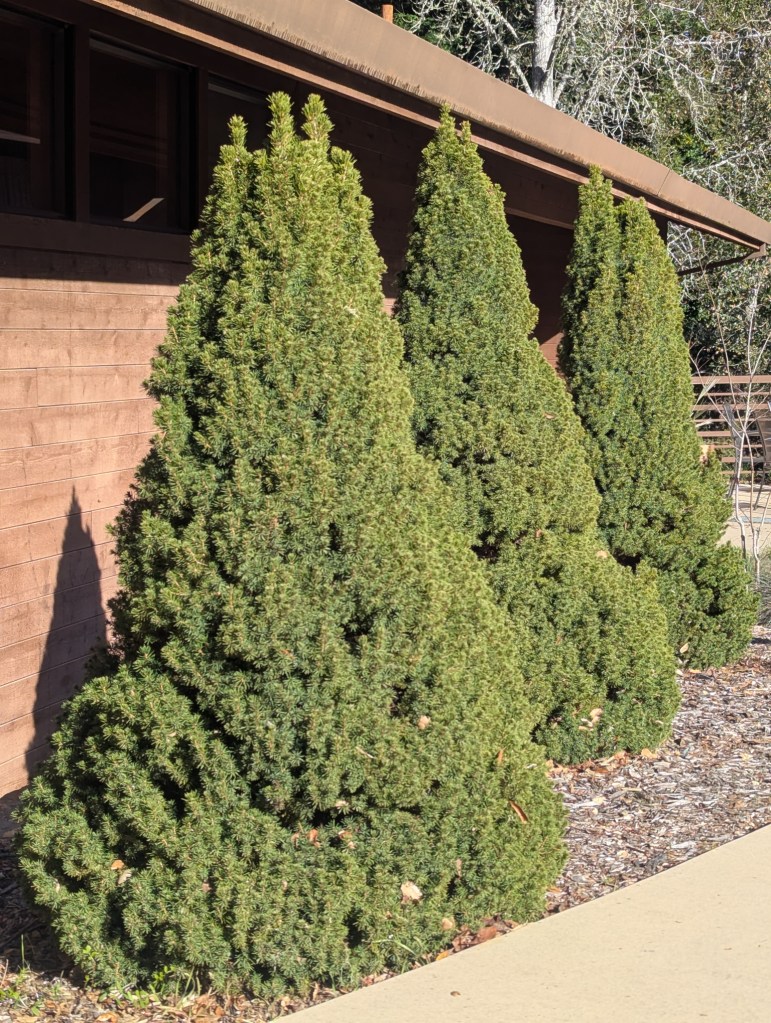
It is a diminutive tree with a big name. Picea glauca var. albertiana ‘Conica’ is commonly known as dwarf Alberta spruce. It is a type of white spruce that grows more as shrubbery than as a tree. After many years, it may be only eight feet tall and four feet wide with strict conical form. Because of its form and tame growth, it is practical as a live Christmas tree.
Potted specimens may remain potted for several years. They maintain their conical form quite naturally without shearing or pruning. Their finely textured needles are only slightly bristly. Their primary disadvantage as a Christmas tree is their foliar density. They do not extend lateral stems for Christmas ornaments to dangle from. Their foliar aroma is slight.
Dwarf Alberta spruce is splendid for formal landscapes. Alternatively, it can instill a bit of formality or symmetry into otherwise relaxed landscapes. Although it does not grow very wide, it should have room to grow. Pruning or shearing for containment compromises its strictly conical form. Potted specimens rely on frequent irrigation, but are not demanding.
Cut Christmas trees are the epitome of cut foliage. They grow on farms until harvest, like most other cut foliage. They then beautify homes and other interior spaces for Christmas. Ultimately, they become compost or green waste. Live Christmas trees are very different. They also grow on farms, and beautify interior spaces, but are living, evergreen conifers.
They are supposed to be the more sustainable option. Ideally, some live Christmas trees function as such for multiple years. A few are actually appropriate to home gardens when they grow too big to bring in. Realistically though, most live Christmas trees grow too fast and too large. Some actually become more of an environmental detriment than an asset.
Furthermore, live Christmas trees are actually less sustainable than cut Christmas trees. Cut Christmas trees grow on plantations where they need merely irrigation and fertilizer. Live Christmas trees require plastic pots, synthetic growing medium and more fertilizers. They only become sustainable after several years of reliable service as Christmas trees.
Among live Christmas trees, the more expensive sorts are typically the most sustainable. Various spruces grow slowly enough to remain potted and symmetrical for several years. They are more expensive because they take so long to grow to marketable size. As they outgrow their pots, most are proportionate to home gardens. Few grow as big shrubbery.
A few compact cultivars of fir and even pine are about as sustainable as spruces. Lemon cypress, Eastern red cedar and arborvitae are more conducive to shearing. Even as they grow faster, they can remain confined to pots for quite a few years. Afterwards, they might fit well into a garden. If not, they can be given to neighbors who can accommodate them.
Cheap, overly common and pre-decorated live Christmas trees are the least sustainable. Almost all are Italian stone pine or Canary Island pine. A few might be Aleppo pine. They may be pretty while new, but do not perform well for long as potted plants. However, they grow much too large for compact home gardens. Their long term options are very limited. Big trees require big landscapes.
Although it classifies as a tree, mugo pine, Pinus mugo, is more like shrubbery. Old trees may be only a few feet tall, and maybe twice as wide. Not many are more than eight feet tall. Their form is densely rounded. Foliage is deep forest green. Stiff paired needles are only about one to two inches long. Plump cones are not much longer, and are quite rare.
Mugo pine, although native to the Alps, is a traditional feature of Japanese gardens. Yet, it is rare within other types of gardens. It does not grow fast or big enough to be practical for much more than aesthetic appeal. It does excel at that, though, by developing such a distinctly rounded form. It can work well as foundation planting or a short informal hedge.
Mugo pine is not particularly discriminating about local soils or climates. It merely craves sunny and warm exposure. Mature specimens do not need much water, but are healthier with occasional irrigation. Mugo pine appreciates room for unrestricted growth. Shearing deprives it of its natural form and texture. If necessary, selective pruning may be tedious.
Most live Christmas trees grow too big for home gardens.
One of the problems with driving my favorite vehicles that were old long before I learned to drive them is that I spend considerable time waiting for a bus or walking. The cool thing about that is that I get to seem so much scenery that I would otherwise drive past. While waiting nearly an hour for a bus at the Cavallero Bus Terminal in Scott’s Valley, I went across the street to see the landscape of the somewhat new Post Office, which has actually been there for many years now.
The landscape is a bit sparse in front (I think because of architectural modifications after the landscape was designed), so was outfitted with recycled live Christmas trees. Although none of these particular trees seem happy in the local climate or sandy soil, I had wanted to get better acquainted with them for some time. They are an odd assortment of spruce and fir that are rare here.
The more typical concern with the more common live Christmas trees is not that they are not well suited to local climates and soils, but that they actually do too well and grow much larger than expected. Except for the small rosemary, holly and English ivy ‘trees’, most coniferous evergreen live Christmas trees are young pines that get remarkably large; and some waste no time doing it! The most common live Christmas trees are Italian stone pines, which happen to be the two very large and broad trees in Blaney Plaza in downtown Saratoga!
Canary Island pines, which had been more common than they are now, do not get quite as broad, but do get very tall and messy. Years ago, Aleppo, Eldarica and Monterey pines all took their turns being popular live Christmas trees. Each of them grows large enough to require significant garden space.
This is of course not a problem for the few live Christmas trees that happen to get planted where they have plenty of space. However, those that get planted where they do not have room to grow can cause serious problems. Because they seem so cute and innocent while they are young, and are so often expected to stay cute and innocent, many often get planted dangerously close to houses, where they can displace porches, walkways and even foundations! Large pines, particularly Italian stone pines, are also too messy and potentially combustible (if not pruned and groomed regularly) to be too close to houses.
Sadly, large pines do not like to stay in containers too long. They can be pruned for a few years, but eventually get congested roots. (Bonsai techniques of root pruning can maintain even the largest types of pines in containers indefinitely, but not many of us know these techniques.) Small pines, like Austrian black, Japanese black and Scott’s pine (which has no relation to Scott’s Valley), as well as other small coniferous evergreens, like certain junipers, can stay in containers much longer, but these are the sort that are small enough to get planted in the garden, so do not necessarily need to stay in containers anyway.
If space is not sufficient, pines and other live Christmas trees that eventually get too large really should be given to friends and neighbors who have space to accommodate them. Fortunately, most do not require much attention once they get established after two years or so.
Classification of this species may be complicated. About five distinct varieties of Arizona cypress, Cupressus arizonica, occur naturally. Some may sometimes classify as distinct species. Some grow no higher than twenty feet, with stout and shrubby form. Some grow fifty feet high, with sculpturally irregular form. Botanists may not agree on their identities.
Old trees that mostly grew from seed are typically noticeably variable. Some exhibit nice bluish green foliar color. Others are more grayish green. Modern trees are mostly modern cultivars with strikingly uniform silvery blue foliar color. Some are supposedly conducive to hedging, which enhances foliar color. Although evergreen, foliage is freshest in spring.
Without hedging, Arizona cypress develops splendid natural forms. Whether sculpturally irregular or compactly shrubby, it may need only minor grooming. Its finely textured foliar debris disappears into any ground cover below. However, such foliage can have a mildly herbicidal effect on lawns. Arizona cypress trees in a row can be an effective windbreak.
“Cedar” is a common name of a few species of a few genera that are not actually cedars. Western red cedar is an arborvitae. Eastern red cedar is a juniper. Deodar cedar, Cedrus deodara, happens to be one of only three real cedars. Atlas cedar and cedar of Lebanon are the other two. Cultivars of Atlas cedar are uncommon. Cedar of Lebanon is very rare.
Although too big for compact gardens, deodar cedar is one of the more popular conifers. It performs splendidly within local climates and soils, as if it is right at home. Mature trees can survive without irrigation. Roots are generally complaisant, and disperse too deeply to displace pavement. However, deodar cedar can grow fifty feet tall and thirty feet wide.
Deodar cedar mostly develop casually conical form. Some develop multiple trunks or big limbs that eventually curve upward like trunks. Otherwise, limbs tend to droop somewhat at their tips. Glaucous grayish needle leaves are about an inch or two long. Most occur in terminal clusters of short spur stems. Some develop singly on elongated vigorous stems. Foliar debris has an herbicidal effect on the ground below.
Cultivars are much more compact than the simple species.
Fifty foot tall Port Orford cedar trees, Chamaecyparis lawsoniana, like those that get harvested for timber from their native range on the south coast of Oregon and the northwest corner of California are almost never found in refined gardens. Their remarkably diverse garden varieties mostly stay less than half as tall, as dense, compact trees or large shrubbery that resembles arborvitaes. Many have bluish or greyish foliage. Some have gold foliage. Finely textured needle-like juvenile foliage that is so prominent among young plants continues to appear sporadically with scale-like adult growth as plants mature. The small round cones are not prominent. Like related arborvitae, Port Orford cedar tolerates a bit of shade.
Dwarf Alberts spruce is more like a conical shrub than a tree.
Most of the familiar conifers, or ‘cone-bearing’ plants, are large trees like pines, spruces, cedars and cypresses. They are practical trees only with sufficient space, and where their debris and constant evergreen shade will not interfere with lawns or other plants below. Their less familiar compact specie and cultivars (cultivated varieties) that grow as smaller trees or large shrubbery are actually more proportionate, and therefore more useful for refined landscapes.
There are actually several small specie of pine, like Scots, Austrian black, dwarf Swiss stone, mugo, and the various Japanese red, black and white pines. Some of the most compact cultivars grow as dense shrubbery. Others grow as small to mid sized trees with the personalities of larger pines.
There are fewer compact spruce to choose from. Dwarf Alberta spruce, which is a very compact cultivar of white spruce, is perhaps the smallest and most symmetrical, growing as a dense and strictly conical shrub. Columnar and pendulous cultivars of blue spruce grow in opposite directions, upright and downward, but stay compact enough to be grown as sculptural specimens or shrubbery. There are also pendulous white and Norway spruce.
Several compact cultivars of western red cedar and northern white cedar (Thuja spp.) are popularly grown as tall hedges. They are not actually cedars (Cedrus spp.) and are more often known by the common name of ‘arborvitae’. There are even more Asian arborvitaes (Platycladus spp.) to choose from; many of which have bright golden foliage. ‘Swane’s Golden’ Italian cypress is narrower and denser than the arborvitaes, but not as brightly colored.
Despite the bad reputation of certain cultivars that were planted too extensively decades ago, many junipers are very practical and sculptural coniferous shrubs, as well as ground covers and even small specimen trees. Some ground cover types stay less than a foot deep. Shrubby and small tree types are at their best where they have room to grow without pruning. If ‘Hollywood’ juniper is too old fashioned, the various Rocky Mountain junipers and Eastern red cedar (again, not really a cedar) are worth investigating for their distinctively picturesque forms.
Chamaecyparis are perhaps the most variable of the evergreen coniferous shrubs and trees. Although there are naturally only a few specie which grow into substantial timber trees, there are countless cultivars that are compact enough for residential gardens. Most stay less than thirty feet tall. Many stay less than half as tall. Most have rich deep green foliage; and many have bluish, greyish or golden foliage.
Chamaecyparis are known by a few different but inaccurate common names, including ‘cypress’, ‘false cypress’ and ‘cedar’. (Although the Alaskan cedar is now classified as a cypress, Cupressus or Callitropsis nootkatensis.) Like almost all other conifers, they are best where they can grow naturally without major pruning or shearing to compromise their naturally appealing forms and textures. The most diminutive cultivars are excellent for bonsai and rock gardens, or even in urns of mixed perennials.
Like the majority of cedars, Eastern redcedar, Juniperus virginiana, is not really a ‘cedar’. According to its genus name, it is a juniper. That may be why it is less common here than within its native range. Even in its native range, most grow wild rather than in cultivation. Junipers gained an unfavorable reputation after becoming overly common decades ago.
Eastern redcedar has traditionally been more utilitarian than merely aesthetic. It can be a delightful Christmas tree, either cut or potted. While old cedar closets are native incense cedar, cedar chests are Eastern redcedar. Baton Rouge derived its name from a red stick demarcation pole. Indigenous people traditionally used Eastern redcedar for such poles.
Wild Eastern redcedar trees are variable and range in height from fifteen to fifty feet high. Cultivars develop compact conical or columnar form. Some are grayish or golden green. The small evergreen foliar scales, particularly juvenile foliage, can be somewhat prickly. The rusty red to grayish brown bark can display a handsomely fibrous or shaggy texture. The ‘silicicola‘ variety of Eastern redcedar is rare.
Giant redwood, Sequoiadendron giganteum, is famously the largest tree in the World. Although not quite as tall as the coastal redwood, Sequoiadendron sempervirens, it is bulkier. It grows taller than three hundred feet, with trunks wider than thirty feet, to weigh more than six hundred thirty tons.
Yet, like many species, it has at least one cultivar. ‘Pendulum’, which is the weeping giant redwood, is nothing like the simple species. It might grow forty feet tall, if it is able to support itself at such a height. It’s canopy might grow a few feet wide, but it really cascades more than it reaches outward. It really is weird. It looks more like a relative of Mr. Snuffleupagus of Sesame Street than like a relative of giant redwood.
Of course, its weirdness is what makes it so appealing. It is sculptural. It is bold. It really makes one wonder what planet it is from.
I got this picture in Kitsap County in Washington, hundreds of miles from the native range of the simple species within the Sierra Nevada. Actually, I see more of this cultivar in the Pacific Northwest than here. It likely performs better there because of the colder winter weather. Furthermore, this weird cultivar is more popular than the simple species, partly because it is so distinctive, and partly because it is more proportionate to home gardens. Simple giant redwoods only fit into very spacious landscapes.
Weeping giant redwood may not be good for anything more than its weirdness, but at least it excels at that. Otherwise, it provides no significant shade. It does not bloom conspicuously. It provides no fruit. It does not even make good firewood. Fortunately, weirdness has certain appeal. Within our home gardens, we can grow what we like, even if merely for its weirdness.






 Tony Tomeo