 It is hard to beat redwoods. Seriously! There are only three specie, which are now three different genera; but one is the biggest tree in the world, one is the tallest tree in the world, and the third is one of only a few conifers that are deciduous. The biggest and the tallest are both native to California. The deciduous redwood is from China.
Dawn redwood, Metasequoia glyptostroboides, is the deciduous redwood from China. (See the picture above.) It was discovered relatively recently, in 1944, so is not nearly as popular in landscaping as the other two redwoods are. Ironically, it is actually better for urban gardens because it does not get as tall as other redwoods. The tallest forest trees (that need to compete with other tall trees) are a mere two hundred feet tall. More exposed urban trees rarely get half as tall. Also, dawn redwood is adaptable to a broader range of climates than the others are.
Giant redwood, Sequoiadendron giganteum, is the biggest tree in the world. It lives in isolated groves in the Sierra Nevada, where old trees can get to be more 3,500 years old. The tallest are more than two hundred and fifty feet tall, with trunks more than twenty five feet wide near the ground. The trees are so massive that they could not be harvested without shattering much of the wood within. Of course, wild trees are now protected from harvest. They protect themselves from wildfires with thick bark and by branching so high above other vegetation.
Coastal redwood, Sequoia sempervirens, gets about half as old, but about a hundred feet taller than the giant redwood. It lives on the coast of California, from Oregon to Monterey County. It has been extensively harvested because the wood is so resistant to rot and insects. Harvested trees regenerate quickly from roots, forming families of several genetically identical trees. Coastal redwood groves are dense enough to exclude other trees, and produce enough debris to prevent seeds of other specie from germinating. They are less combustible than other trees, and protect themselves from wildfires with thick bark. Their foliage regenerates efficiently if burned.
I grew up only a few miles outside of the natural range of coastal redwood, and now live amongst them. I never get tired of them. As majestic as they are, the trees that were harvested earlier were even bigger. I build an outhouse and a shower out of two hollow burned out stumps of coastal redwood. Another nearby stump is big enough build into a shed. It only needs a roof on top. Even after a century, the burned old growth stumps are still intact. They rot very slowly.
The area burned in the 1950s only because so many other more combustible trees grew back with the secondary growth after extensive harvesting of the old growth trees. Much of the secondary growth that was burned while only about half a century old recovered, and is now about a century old. Trees that grew after the fire are now about half a century old. As the forest thickens, firs, oaks, madrones, maples and bay trees get crowded out. Redwood really know how to manage their forest.
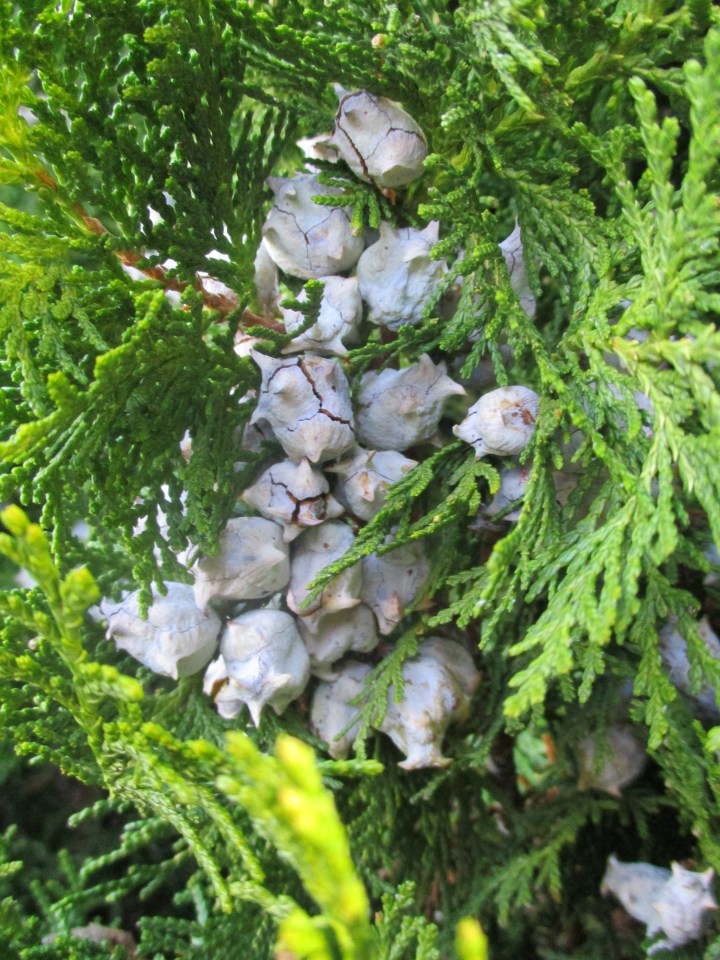 These pale blue . . . whatever they are, were just too cool to pass up without a picture. Technically, they are the ‘cones’ of dwarf golden arborvitae, Platycladus orientalis (formerly Thuja orientalis) ‘Aurea Nana’. They do not look much like cones. They are only about three quarters of an inch long, and are rarely as profuse as they are here. They are less appealing as they dry and turn brown.
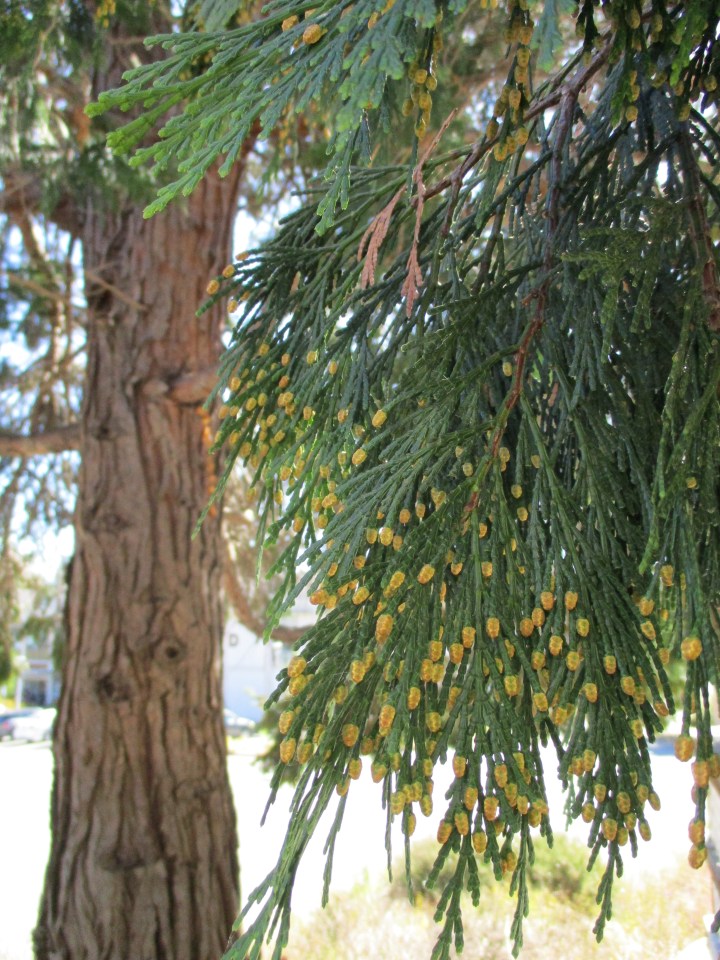 In the west, the incense cedar, Calocedrus decurrens, was made into cedar chests or paneling for cedar closets as a substitute for the more traditional Eastern redcedar (which is incidentally a big juniper). The wood is supposedly aromatic enough to repel moths from woolens and furs. The evergreen foliage is very aromatic as well, so is sometimes used for garlands at Christmas time.
 Tony Tomeo