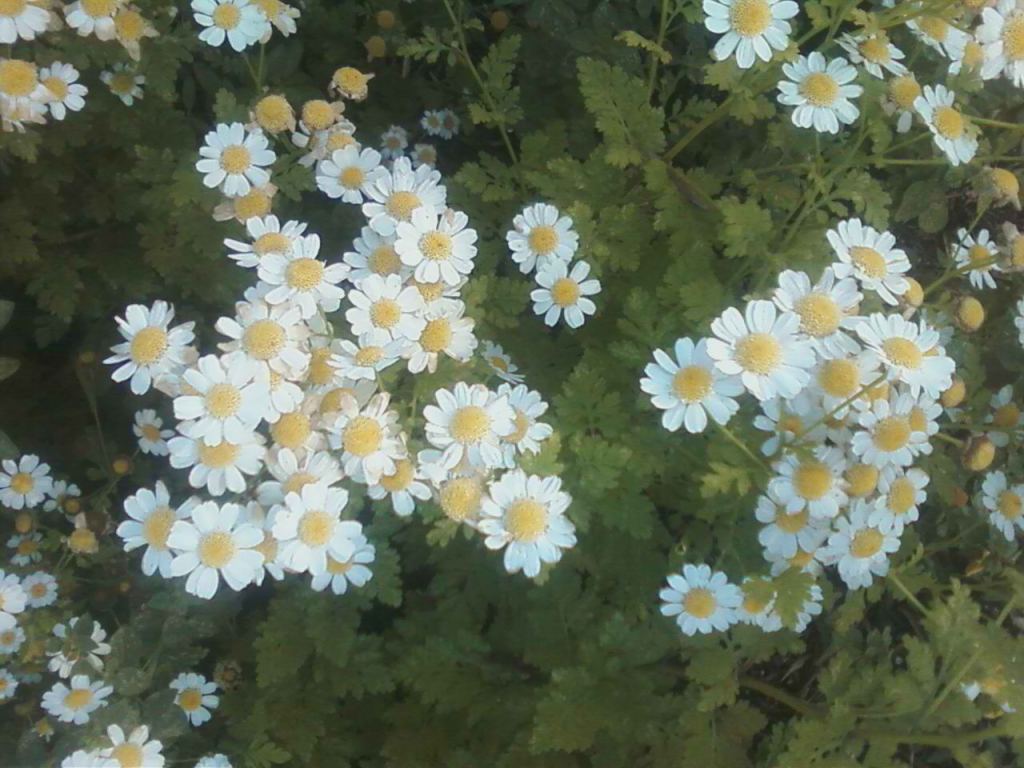
Once naturalized in the garden, chamomile, Matricaria recutita, can get to be too much of a good thing. Seed sown in at the end of winter or early in spring typically does very well in the first year. The new plants bloom abundantly by the middle of summer and eventually become rampant and sparse enough to get cut back by the end of the following winter. The largest and most productive plants can die at the end of their first year, but are only replaced by the formerly smaller plants that survive getting cut back through winter to get an early start the following spring. Self sown seed can fill in where last year’s plants do not, and can migrate into places where no one would have thought to plant them!
The finely divided, lacy foliage stands nearly two feet tall, and more than half as broad on somewhat floppy stems. The inch wide daisy flowers that are white around the edges of big yellow centers can be dried to make chamomile tea.
‘Snowball’, ‘Golden Ball’ and ‘White Stars’ are actually varieties of related Chrysanthemum parthenium that are sometimes sold as chamomile. Feverfew, chamaemelum nobile, stays dense and low, and can be a nice ground cover for small areas. I grew my favorite traditional chamomile (as well as feverfew) from seed from Renee’s Garden.
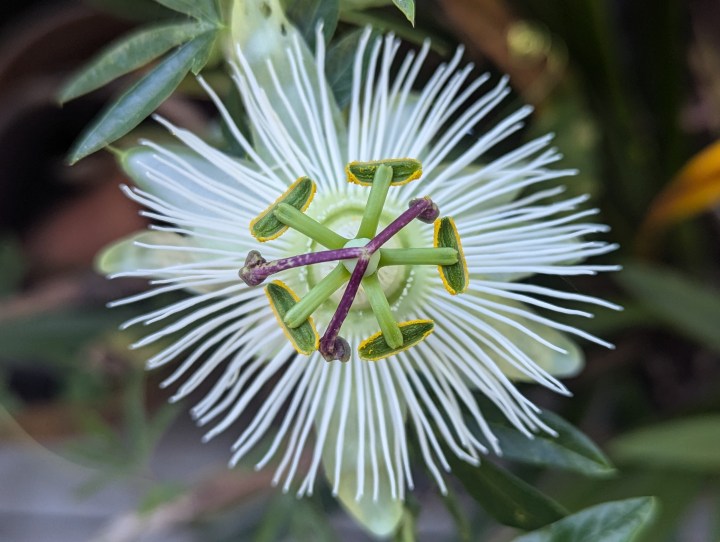
Even passion flower can make a nice, albeit colorless, tea.
When she was younger, my niece, who happens to be the most elegantly refined girl in Gilroy, enjoyed doing tea. She certainly had the technique, as well as two patient grandmothers, to indulge in this particular tradition properly. The only problem was caffeine.
She was such a young lady; and her Nana and Grandma refrained from the consumption of caffeine. Black tea, made from the fermented bud leaves of tea camellias, was not a good option. Even green tea, made from the same leaves but without fermentation, contains some degree of caffeine. Herbal teas were more practical, as well as appealing to the discriminating taste of a young lady of such impeccable refinement.
There are all sorts of herbal teas made from flowers, leaves and fruit that can be grown in home gardens. Mint, chamomile and lemon grass are perhaps the most well known. Peppermint, spearmint and the many other varieties of mint all have unique flavors. Lavender, particularly French lavender, and some of the many sages can be used to add a bit of their distinctive flavors, too.
Thinly sliced and dried ginger and licorice root make spicy teas that are also good remedies to a mildly upset stomach. However, flowering ginger is not as robust as herbal ginger is. Finely chopped dried berries, cherries, apricots and quince, as well as the rinds of lemons and oranges, add their fruity flavors. The extensive tea list at the White Raven in Felton features teas flavored with dried hibiscus flowers, pelargoniums and rose hips.
Experimenting with herbal tea is like cooking. Within reason, anything goes. Tea can even be made from the dried young shoots of Douglas fir! The only plants that can not be used as tea are those that are potentially toxic.
Tea can of course be enjoyed hot, cold, or even at ambient temperature. Herbal tea is almost always made from dried plant parts, but can be made from fresh parts as well. The various mints have different flavors if brewed from fresh bits taken directly from the garden instead of dried leaves. I actually like to add a few fresh leaves from rose scented geranium (pelargonium) to common sun tea made by leaving black tea to brew out in a jar in the sun.
While they are in season, I also like to add a thin slice of fresh quince, which is so strongly flavored that it is just as effective fresh as it is dried for sun tea or hot tea. Apples and crabapples are also nice, but with much milder, and perhaps even boring, flavor. I prefer to eat the apples and then drop the cores into tea. A Slice or two of richly flavored fig can be good in sweetened hot tea.
California bay can work somethin like culinary sweet bay.
While the winter weather is still cool and damp, most of the herbs in the garden are not very impressive. Like vegetables though, herbs that are new to the garden should be planted as winter ends when no more frost is expected. Also like vegetables, some herbs are easier to grow from small plants or seedlings purchased from nurseries, and others are easier to sow directly from seed. Some are annuals or biennials. Others are perennials. Still others are woody plants.
Basil, cilantro and dill are commonly and easiest to grow from seed. Tarragon, sage, marjoram, mint and thyme are probably easier to grow from small plants found in nurseries. Chives, oregano, fennel and parsley are easy to grow by either means. Woody plants like rosemary, lavender and sweet bay can be grown either from small plants in the herb section of a nursery, or more substantial landscape plants.
All sorts of plants are grown as herbs to be used as seasoning, aroma (foliar fragrance) or even medicinally. Some are best grown strictly as herbs in an herb garden or incorporated into the vegetable garden because they lack visual appeal or because they eventually get cut and harvested. Others function quite well out in more refined landscapes.
Basil, cilantro, tarragon, sage, dill and marjoram are more utilitarian but less visually appealing herbs for the herb or vegetable garden, although some look good until they get harvested. Chives, mint, oregano, parsley and thyme look good enough for a landscape, and are not often harvested in quantities large enough to compromise their appearance. Fennel also looks good enough for the landscape, but then gets removed completely when harvested.
A few herbs are actually more often grown for their practicality in the landscape than in the herb garden. Thyme sometimes gets planted as a ground cover between stepping stones, since it is so compact and imparts its fragrance if trampled. Rosemary is actually a rather common ground cover where the soil does not hold enough moisture for more demanding plants. The various lavenders are nice ‘perennial’ shrubs. (‘Perennial’ shrubs do not last as long as woody shrubs.) Sweet bay is a nice small tree where space is limited, or can be shorn into a small hedge.
It seems that most herbs like good sun exposure and warmth during the summer, with well drained soil. Most do not need too much water once established. Only basil and parsley need regular watering. Chives and mint are not so needy, but do prefer to be watered regularly as well. Mint is commonly grown in pots because it can be somewhat invasive.
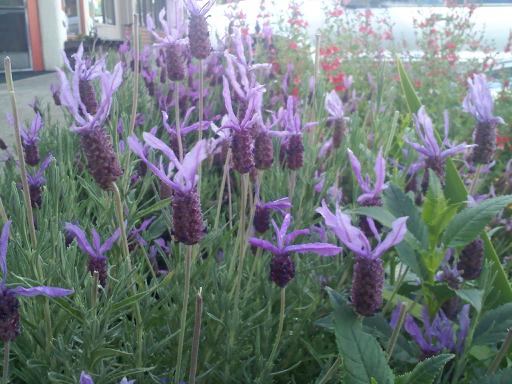
Spanish lavender is as herbal as English lavender.
While waiting for my white mocha at the White Raven coffee shop, I noticed white sage smudge sticks (incense) for sale. I also noticed that white sage is a component of at least one of the many herbal teas available. Although white is my favorite color, I am doubtful that it would be one of my favorite flavors. White sage seems to me to be much too pungent. I suppose that I should at least try it to satisfy my curiosity. Otherwise, the many other herbal teas included more docile but equally compelling herbs like sunflower petals, cactus flowers, chamomile, lavender, mint, catnip and various geraniums.
My mocha was ready too quickly, before I could investigate all of the herbal teas. Since I needed to get out of the way at the counter, I went to peruse the incense, where I again noticed some familiar herbs, like various sages, lavender, rosemary and bay laurel. A few plants that I do not commonly think of as herbs are common components of incense as well, such as juniper, cedar and pine. This was all too baffling; so I took my mocha to a table out front by a roadside garden, where I noticed some of the exact same herbs that I came outside to get away from!
All these fancy herbs and incenses and girly boutique beverages are simply not my cup of tea. Although at the White Raven, I know better than to be surprised by what might be in an excellent tea. Regardless, the garden out front is still more my style, and reminds me of how so many utilitarian herbs can also be very appealing ornamentals.
Rosemary, lavender and several of the sages are actually quite common in ordinary landscapes, whether or not anyone even notices that they have herbal merit. Some types of creeping thyme are sometimes used as ground cover in small areas, particularly around pavers or stepping stones where they release their fragrance if lightly trampled. Santolina and various yarrows and scented geraniums are less ordinary, but are similarly grown more often for their aesthetic value than as herbs. In my own garden, I really do not know what yarrow is good for. I like to add geranium leaves to sun tea, even if it makes it a girly boutique beverage.
Some herbs are almost too happy in my garden. The feverfew, chamomile and nasturtiums (my favorites!) that grew from seed from Renee’s Garden two years ago have spread outside of their area. I actually gave my mints away before they could escape. The catnip is confined to a hanging pot by the neighbor’s cat who gets sufficiently overindulgent to eradicate any self sown seedlings below. I never would have guessed that an inebriated cat could be so useful! Calendula, chive and oregano have all been grown from seed and become happily naturalized.
Bay grows wild here. It is native. It is also known as bay tree, laurel, bay laurel, spice tree, pepperwood, myrtlewood, Pacific myrtle, Oregon myrtle and California bay. All these different common names demonstrate why simple botanical nomenclature is useful. In that regard, this native bay is Umbellularia californica.
Bay is also native to the Mediterranean region. Of course, it is a different species, Laurus nobilis. Like the bay that is native here, it is also known as bay tree, laurel and bay laurel. Furthermore, it is known as Grecian bay, true laurel and sweet bay, although it is not at all sweet.
Laurus nobilis is a common culinary herb though. Umbellularia californica is not. That does not mean that Umbellularia californica can not be useful as such. It merely means that it is not commonly used as such, and is very different from the bay that genuinely is. Some of us here in California and southwestern Oregon actually do sometimes find culinary applications for it.
Umbellularia california has a much more pungent and stronger flavor than Laurus nobilis. Although it has potential to be useful for similar applications, it is by no means a substitute, and should certainly not be used in comparable proportions. Most of us who use it are aware of the differences, and know how to use it, generally quite sparingly.
The problem is that fresh foliage of Umbellularia californica is sometimes available as culinary bay from supermarkets, and is typically labeled as sweet bay, true laurel or Grecian bay. This is no problem for those of us who recognize it, but we would not purchase it from a market while we can get it for free from the wild. Those who purchase it likely do so because they believe that it is genuine Laurus nobilis.
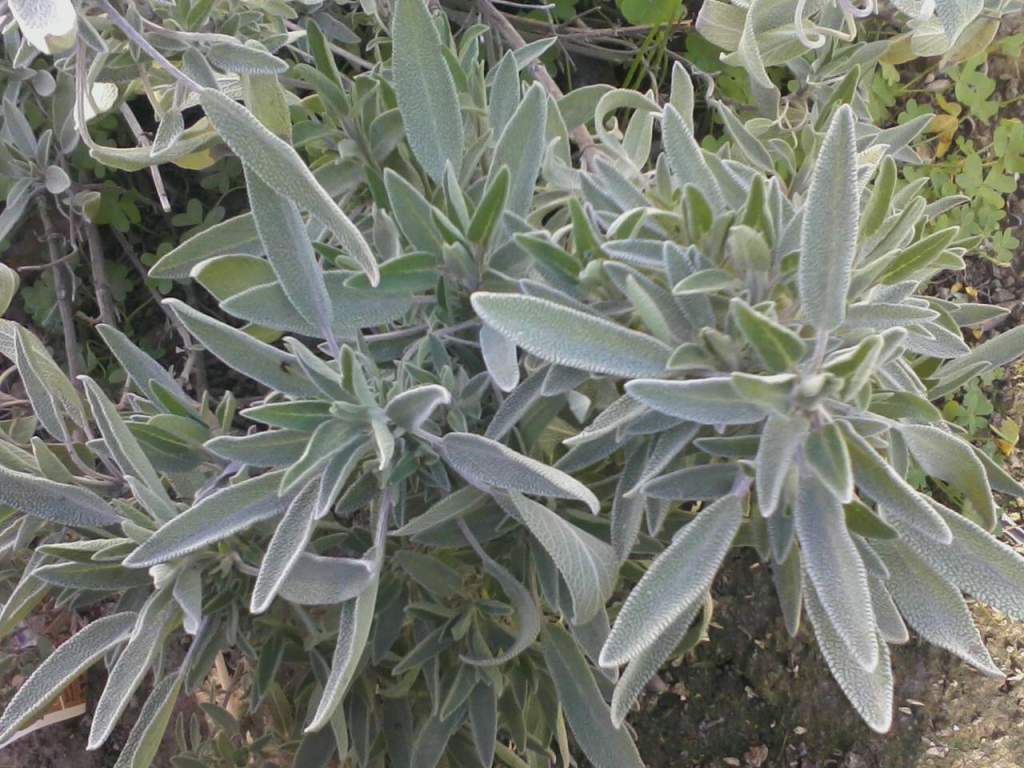
Some cultivars of culinary sage are more colorful for home gardens.
The sage that is most popularly grown for herbal and culinary uses (Salvia officinalis) is originally from the Mediterranean region, so is right at home in much of California. Like the various lavenders and some of the other related herbs, it is a shrubby perennial that behaves like a woody shrub, but lives only a few years like some perennials. Lower stems can be layered (buried where they touch the ground so that they form roots and grow into new plants) to replace older plants before they die.
Modern cultivars are quite variable with purplish, pink, pale yellow or pale white coloration or variegation to new foliage, as well as lower growth habit. The original sage gets almost two feet tall and broad, with very aromatic gray foliage. The narrowly oblong leaves are nearly two and a half inches long and one inch wide. The flowers that bloom in late spring or summer are typically pale blue, but can be purple, pink or white.
Rosemary is more common in common landscapes than within dedicated herb gardens.
Because of the unusually mild weather this past winter, many plants are waking up from winter dormancy early. The shrubby herbs like sage, rosemary, lavender and tarragon are already outfitted with fresh new foliage that will soon obscure the foliage that lingered through winter. Those that have not yet bloomed may do so sooner than expected.
New herb plants can be added to the garden any time now. Even if rain resumes (or actually ‘starts’), there should not be enough to cause new plants to rot, particularly since the warming weather will keep plants growing faster than the root rot that can kill them through cool and damp winter weather. Sage, tarragon, marjoram, mint and thyme are easier to grow from small plants. Dill, cilantro and basil are easier to grow from seed sown directly into the garden. Oregano, fennel and chives can be grown by either means.
Many of the woody herbs, like rosemary and the many varieties of lavender, are commonly used in landscaping, so can be found in even the most basic nurseries that do not feature a selection of other herbs. Because almost all herbs have sensitive root systems, they should be planted while small. The smaller 1 gallon plants are easier to grow (as well as less expensive) than the larger 5 gallon plants are. However, sweet bay is an exception that does not mind being planted as a 5 gallon or even larger tree where it needs to look mature now, even if only a few leaves get used in the kitchen. Low growing rosemary is a common ground cover. Upright varieties can be shorn into small hedges. Thyme makes a nice small scale ground cover between stepping stones, where it shares its fragrance when stepped on.
Chives, oregano, parsley, mint and thyme are not often marketed as common landscape stock, but are visually appealing enough to appear in the landscape. Herbs that are not so visually appealing can be planted in a separate herb garden, among vegetables in a vegetable garden, or simply out of the way. Basil, cilantro, tarragon, dill, sage and marjoram can be too unkempt at times. Basil and cilantro look good most of the time, but then get harvested in large enough quantities to leave bald spots. Fennel can be a striking foliage plant for a while as long as no one minds that it will eventually get harvested.
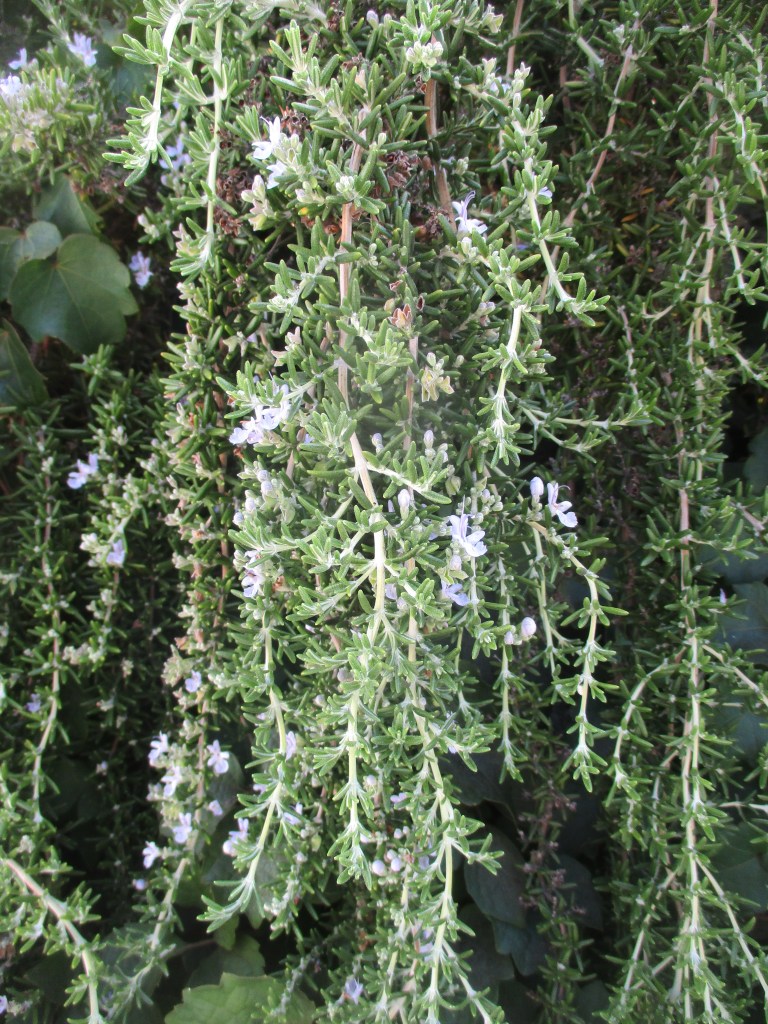
It is as familiar for culinary application as it is for home gardens, even with its new name. Rosmarinus officinalis is now known as Salvia rosmarinus, but the common name is still just rosemary. Like many Mediterranean culinary herbs, it is a member of the Lamiaceae Family. Since it is native to Mediterranean regions, it is quite happy within local climates.
While many culinary cultivars of rosemary are shrubby or upright, the most popular home garden cultivars are trailing types. Trailing rosemary disperses its woody stems laterally, but can eventually get deeper than two feet. Shrubbier cultivars get at least twice as high in less time. The finely textured dark green foliage is evergreen and pungently aromatic.
Bloom is generally most profuse from late spring through the middle of summer, but may never really stop. It can continue in sparser sporadic phases whenever the weather gets warm, and even throughout the year. The tiny flowers are various shades of blue. Purple, white and pale pink bloom is very rare. Bloom is appealing to bees and other pollinators, including hummingbirds.
They are NOT the same thing! Many herbs can be useful for both culinary and medicinal applications, but the distinction between the two is very important. Culinary herbs are used to flavor foods. Medicinal herbs are used like pharmaceutical drugs; but they lack the main safety feature of standardization. That means that they are potentially toxic and seriously dangerous if used improperly!
Even standardized pharmaceutical grade herbal products that are very precisely portioned into specific doses that contain very specific rates of active ingredients have the potential to be toxic if misused, and are of course toxic to anyone who is allergic to what is being used. They must be regarded with the same sort of caution that is warranted by any other pharmaceutical medication.
Digitalis is a perfect example of a very toxic plant that is used medicinally. All parts of the plant are very poisonous! Digitalis is so toxic that it is no longer used directly as an nonstandardized and nonpharmaceutical medicinal herb. However, in a standardized pharmaceutical form, it is still sometimes prescribed for cardiac disorders. Many of us grow it just for elegantly tall flower spikes.
In our own home gardens, the strictly culinary herbs are relatively safe. Even those that can also be used medicinally are not likely used for culinary applications in quantities sufficient to be toxic. Some herbs that are used for herbal tea have more potential for toxicity, particularly if consumed regularly or excessively. Even seemingly innocuous chamomile tea, in excess, can cause nausea.
Herbs that are grown and used for medicinal applications warrant the most caution. The active ingredients as well as other chemicals in such herbs can not be accurately quantified, and are quite often variable. Doses that are measured as small volumes of plant parts might contain minimal traces of active ingredients, but could just as easily contain toxic rates. Herbalists recommend consulting with a physician prior to using any of the more potent of medicinal herbs, even if the herbs come from the garden.



 They are NOT the same thing! Many herbs can be useful for both culinary and medicinal applications, but the distinction between the two is very important. Culinary herbs are used to flavor foods. Medicinal herbs are used like pharmaceutical drugs; but they lack the main safety feature of standardization. That means that they are potentially toxic and seriously dangerous if used improperly!
 Tony Tomeo