A pollinator is a vector of pollen, besides wind. Most are insects. Some are animals. Their only qualification is that they collect and deliver pollen between flowers. Almost all are unaware that they do it as they visit flowers for nectar, which the flowers produce to attract pollinators. Bees, which are probably the most common pollinators, visit flowers to collect pollen with which to make their honey, and pollinate in the process.
So, what about the flowers that provide pollen for pollination, particularly for dioecious species such as hollies, date palms and kiwi vines? (Dioecious plants are either male or female.) ‘Bing’ cherry is not dioecious, but is not self pollinating either, so needs another cultivar of sweet cherry for cross pollination. Such a cultivar is known as a pollinator.
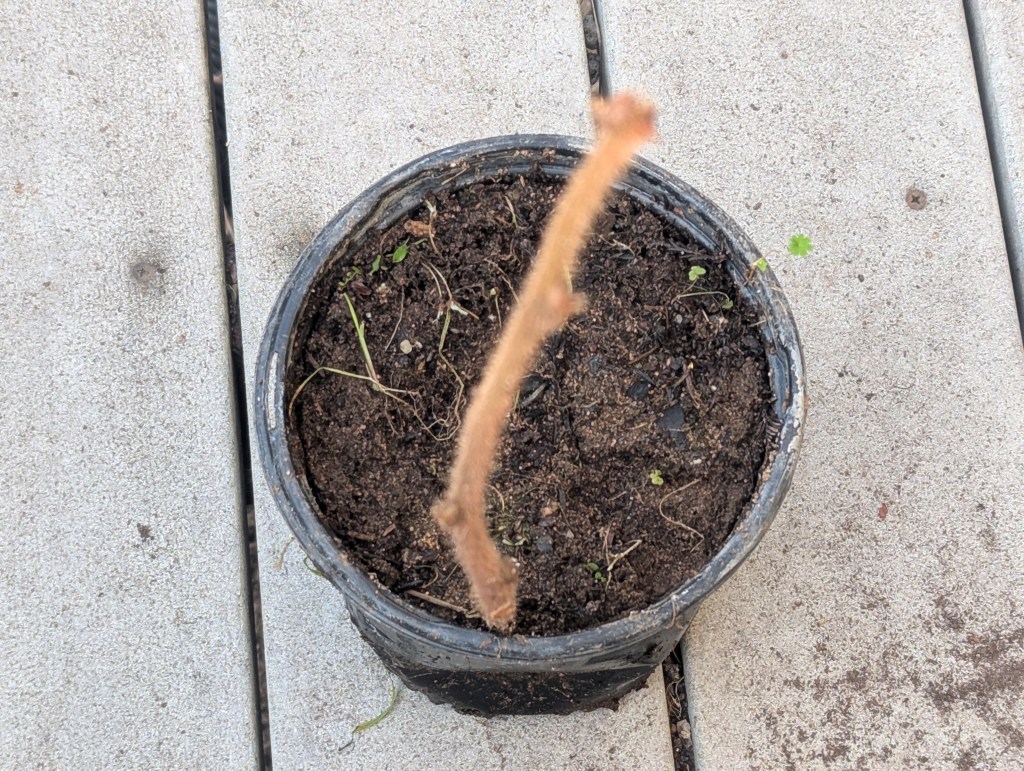
My female kiwi vine just recently acquired a male pollinator. It does not look like much yet, but will grow up to bloom with male flowers to provide pollen for the female flowers of the vemale vine. Because kiwi vines are dioecious, the female vine would be fruitless without pollination from the male vine. Perhaps the male pollinator will need a pollinator to deliver its pollen to the female vine.
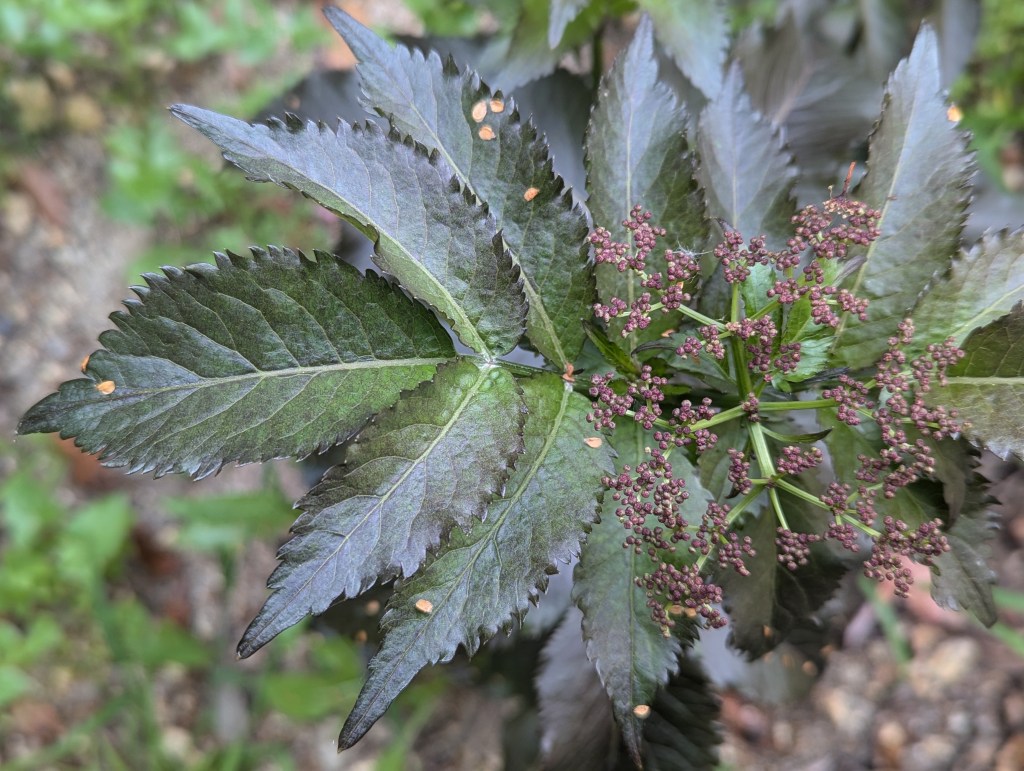
‘Black Tower’ European black elderberry is not very black yet.
Perhaps my explanation of the elderberry glut here was a bit brief last Saturday. Allow me to explain.
Sambucus caerulea, blue elderberry is native and grows wild here, so was innately the first on the scene.
Sambucus nigra ‘Black Lace’ European black elderberry arrived next. I do not know who procured it or why, but it was left here in a can before my time. I put it into a landscape just to get it out of the storage nursery. In other words, I was none too keen on it, so I just wanted to make it go away. Instead, because it was so popular with those who saw it in the landscape, I learned to appreciate it. Then, I figured that it would be even more appealing if it produces berries for birds, so I sought a mate for it.
Sambucus nigra ‘Madonna’ European black elderberry was almost the perfect mate. I would have preferred ‘Albomarginata’, but did not want to pay for it. ‘Madonna’ in a #1 can was available for only a few dollars because it looked so shabby two winters ago.
Sambucus racemosa, red elderberry was a gift from Tangly Cottage Gardening shortly afterward. They were a group of four seedlings, so needed no mate for pollination. Although they are supposedly native here, I had never seen them before, but want to grow them.
Sambucus nigra ‘Albomarginata’, ‘Atropurpurea’ and ‘Black Tower’ European black elderberry, and Sambucus racemosa ‘Lemony Lace’ red elderberry unexpectedly became available for a few dollars each just last winter because, like ‘Madonna’ European black elderberry two years prior, they were shabby while dormant. Without a plan, I procured all of them. ‘Lemony Lace’ red elderberry, the only red elderberry of the four, could be pollinated by the red elderberries that already came from Tangly Cottage Gardening. As I mentioned, ‘Albomarginata’ was the cultivar that I would have preferred to ‘Madonna’ that I procured earlier.
Sambucus canadensis ‘Nova’ and ‘York’ American black elderberry were the last acquisitions at the end of bare root season last winter. They are for fruit production in my home garden.
I would have been pleased with only ‘Black Lace’ and one other pollinator cultivar for it within the landscapes at work. For my home garden, I wanted only blue elderberry, red elderberry and American black elderberry. I would have preferred wild American black elderberry, but can not complain about the cultivars that I got. Collectively, we got much more than we bargained for.
‘Meyer’ lemon was never my favorite lemon. However, when I grew citrus trees in the early 1990s, it was the most popular of forty or so cultivars. There really is nothing else like it. Relative to other lemons, its fruit is distinctively less acidic, more richly flavored, and sometimes ridiculously abundant. All other lemons are more sour but less flavorful. Besides ‘Meyer’ we grew ‘Lisbon’, ‘Eureka’, ‘Variegated Pink’ and ‘Ponderosa’. Of these four others, only ‘Ponderosa’ is not a mutant of ‘Lisbon’, although its comparably mild flavor and robust acidity suggest that it is. All four grow as small but upright trees. Only ‘Meyer’ naturally grows broader than tall, sort of like shrubbery.
‘Eureka’ lemon inhabits one of the landscapes at work, where it produces enough average lemons for those of us who know about them. I grew cuttings from it for my own garden, but am concerned that, since they are not grafted onto dwarfing understock, they could eventually grow quite large. I also grew an ungrafted cutting of ‘Ponderosa’ lemon for the same landscape at work that the ‘Eureka’ lemon already inhabits, because it happens to be at the Ponderosa Lodge. ‘Ponderosa’ lemon grows with an upright form, but because it naturally stays smaller than ‘Eureka’ lemon and its relatives, I am not too concerned about it growing too large.
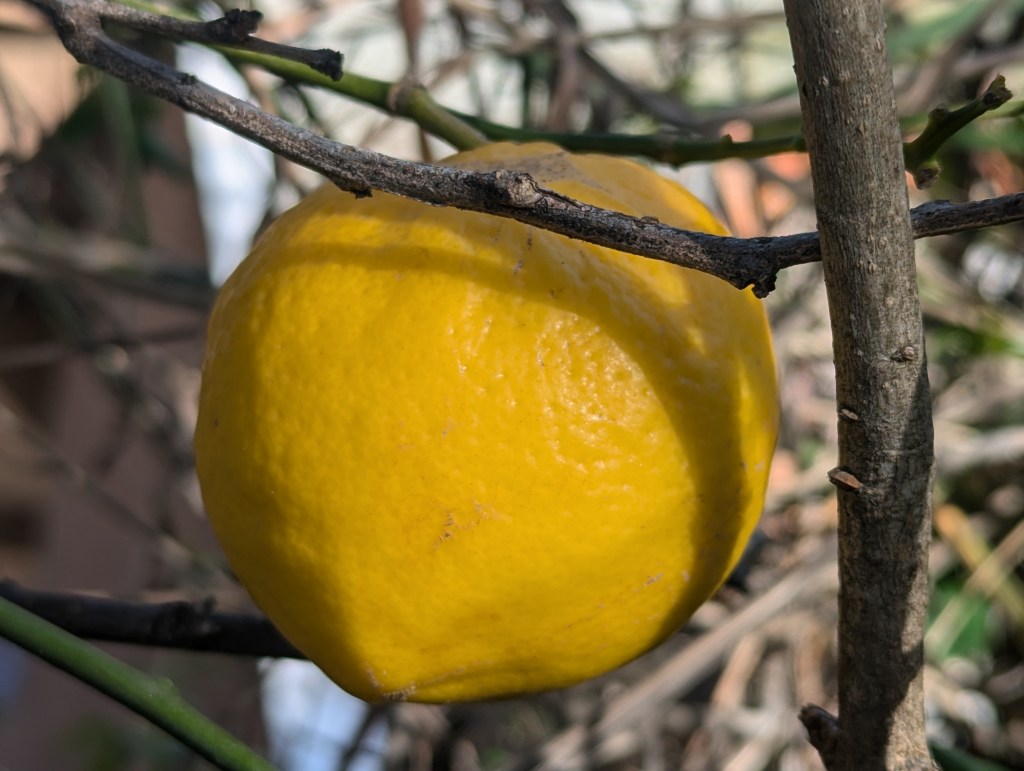
‘Meyer’ lemon came to my garden like a stray cat. Well, it is a bit more complicated than that, but it involved about as much planning. The history of how it came to its previous home is too extensive to describe here. To be brief, I installed it into a garden a few years ago because someone wanted it there after previous unsuccessful attempts to grow the same. Then, it needed to be removed prior to the sale of the home. I did not know what to do with it, so brought it here. I canned it and set it aside until space becomes available for it. I really did not expect it to do much until then. I sort of hoped that someone else would want it for their garden, but after we had been through so much together, I also sort of hoped that it would stay here. Anyway, while I was busy ignoring it in its partly shady and less than ideal situation, I noticed that it had produced this single lemon for me over winter. Well, I suppose that it will be a permanent feature of my garden now.
Peperomia obtusifolia, baby rubber plant is what I suspect this to be. I can not be certain. I do not work with houseplants. I can barely remember that we studied only a few cultivars of Peperomia that happened to be popular back when we were in school during the late 1980s’. The modern cultivars that are popular now were not even developed back then. I do not remember ever getting acquainted with the simple species, which this seems to be. That makes it even more perplexing. Where did someone get this copy of the simple species that has become so rare relative to popular modern cultivars as well as formerly popular cultivars? The rarest of modern cultivars is not as rare as this original. It is an exemplary specimen, too. It is at least two feet wide and stands more than a foot tall in its wide but shallow pot. Someone has maintained it meticulously for several years. Perhaps it grew as a cutting from an even older specimen that was grown before it became so rare so long ago. Perhaps someone appreciated this original simple species as it was losing popularity to more colorful modern cultivars back then. Realistically, without any of the fancy variegation of modern cultivars, the simple green original is undoubtedly more vigorous, and perhaps significantly so. It is therefore more sustainable than cultivars, and more likely to survive and perpetuate itself by cutting for many years. Alternatively, it could have originated as a reversion from a modern cultivar. Someone may have been impressed enough by its relatively vigorous simple green foliage to grow a copy from a cutting. Perhaps relatively vigorous simple green growth merely overwhelmed and replaced original but less vigorous variegated growth. These are merely guesses about its identity, which remains a mystery.
Begonia boliviensis ‘Santa Cruz’ is significantly bigger than it was when I wrote about it three months ago. If I had known that it would have performed so well, I would have groomed it for better form. It grew upright at first. I just let it do so because I wanted to make a cutting from the tip when it got pruned back. However, because it leaned over and branched as it should, it did not get pruned back. It could have developed a better and lower form if I had tended to it better, but I am too pleased with it now to complain that it is a bit more upright than it should be. I do not mind that I did not get a cutting from the primary stem that I did not cut back because there are now many more stems that I can get cuttings from, simply be grooming out a small bit of superfluous growth from within. I could get many more than I want if I were to actually prune this specimen back for winter. It is getting to be too exemplary to cut back for winter, though. Nor do I want to leave it out to get frosted, as I might do with other begonias. The horticulturist who procured it will shelter it from frost, and perhaps groom it a bit after winter, but otherwise try to retain as much of this growth as possible for a head start next spring. I am curious to see what it does. Will it shed most of this growth as it resumes growth from below next spring; or will it grow from near the tips of where it stopped growing this year? I did not expect to be so impressed by this modern cultivar of Begonia.
Acer platanoides ‘Schwedleri’, is Schwedler’s maple, which is an old fashioned cultivar of Norway maple. It is not a red maple. However, because its new foliage initially emerges with deep burgundy red color, it is often mistaken for red maple, particularly where red maple is uncommon. Its deep burgundy red foliar color does not last long before developing deeper purplish bronze color, with tiny contrastingly greenish yellow flowers. For autumn, the foliage turns yellow. Schwedler’s maple was a common street tree for the many large tracts of suburban homes that were built within the Santa Clara Valley during the late 1950s. Although it has not been available from nurseries for the past few decades, at least two similar but more modern and darker bronze cultivars of Norway maple are becoming more available. Modern cultivars are generally sterile, so are not invasive like the simple species has been within some ecosystems that are more favorable to naturalization than that of the Santa Clara Valley. The Norway maple in the picture above is not ‘Schwedleri’ but looks very much like it.
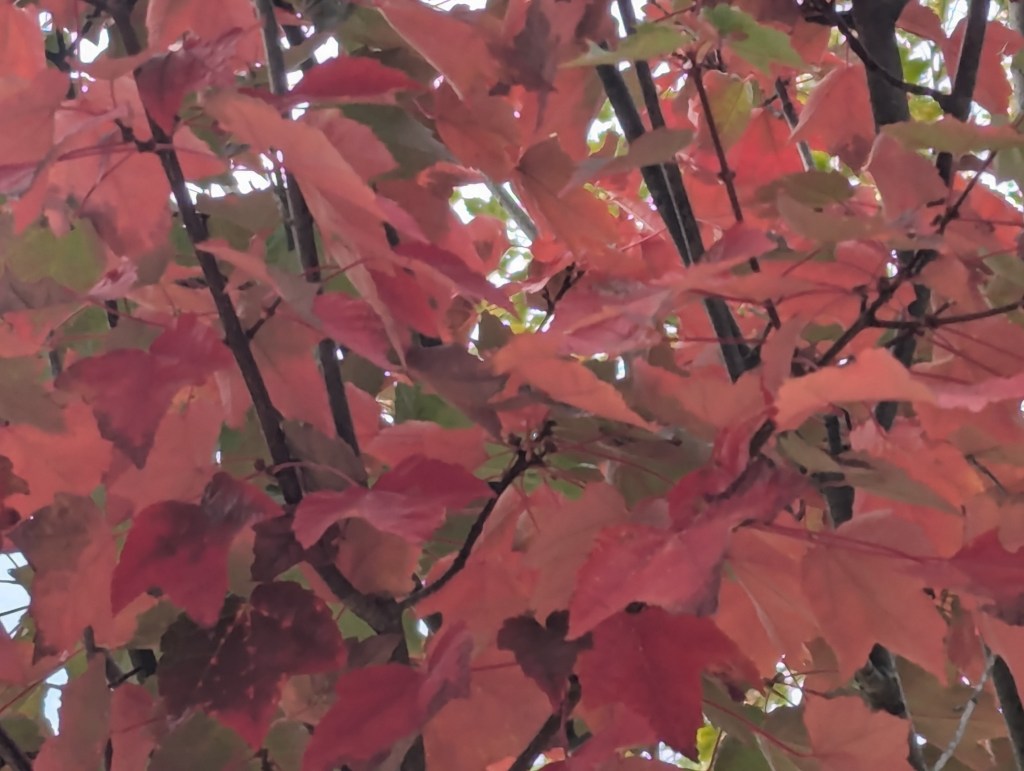
Acer rubrum is the real red maple, not just because of its often bright red autumn foliar color, but primarily because of its red floral buds that emerge immediately prior to foliation in spring. However, prior to autumn, its foliage is simple green. Red maple was rare here prior to 1990, and by the turn of the Century was still only mildly popular in the Santa Clara Valley. It could be more popular than it is, and realistically, performs better as a street tree than cultivars of Norway maple. Although not as colorful as bronzed cultivars of Norway maple are through summer, its vibrant yellow, orange and typifying red autumn foliar color is superior, even in response to only mild chill.
Sniveling works! Perhaps I should say that it can potentially be effective, and is sometimes more effective than expected. I certainly do not want to make the impression that I recommend it. Nonetheless, and contrary to the typical ‘Horridculture’ theme for Wednesdays, I can not deny recent favorable developments that, although not direct results of my snivelling about my lack of a white Japanese anemone, Anemone (or Eriocapitella) hupehensis, two weeks ago, somehow seem to be relevant to it. Firstly, someone at work brought me a pair of copies of an unidentified cultivar of Japanese anemone that is described as being very similar to that which is already here, with slightly pinkish pale gray bloom. Although not the right color, it is the right species. I intend to grow both the new and the old, and even if they are indistinguishable from each other, will continue to grow both because of their different but important origins. Secondly, a new landscape at a new home in the neighborhood includes several specimens of the most enviable and splendidly white ‘Honorine Jobert’ Japanese anemone! Those installing the landscape are completely unaware of the significance, and, as might be expected from such ‘landscapers’, actually told me that these Japanese anemones are the native bush anemone, Carpenteria californica. Why argue? I now know where I can get copies of ‘Honorine Jobert’ Japanese anemone after it has grown through next year. The other horticulturist here is acquainted with those who will live at the new home seasonally, so will have no problem procuring copies for me. As I intended to do with all of the now overly abundant canna and bearded iris, I plan to limit the number of cultivars of Japanese anemone to the original that was already here, the recent gift that might be the same as the original, and the ‘Honorine Jobert’ that I have yet to acquire.
‘Stuttgart’ Canna to the left and an unidentified tall Canna with red bloom and green foliage to the right
It is not as important as it sounds. Two varieties of Canna bloomed for the first time here during the past few weeks. They are important only to me because of their origins. With very few exceptions, such as the still elusive ‘San Jose’ bearded iris, I do not pursue rare or unusual species, varieties or cultivars. Actually, most of my favorites are quite common, and most that are rare here are common where they came from. I obtained some from places I have travelled to. Most were gifts from friends, neighbors and colleagues. The Canna to the left is ‘Stuttgart’ from Tangly Cottage Gardening. This is its second season here, but it did not bloom successfully before autumn chill last year. It is the second of three different Canna musifolia here. The first has moderately bronzed foliage. The third has simple green foliage. ‘Stuttgart’ has the most distinctive foliage that is variegated with variable white bands. All three bloom with similarly subdued and pastel orange flowers, but for this first bloom, ‘Stuttgart’ is blooming with a bit more peachy pink. The Canna to the right was a gift from a friend of a friend last winter. It is the third red Canna here, but the first is an unidentified compact cultivar that gets only about half as tall with garishly big flowers, and the second is ‘Australia’ with darkly bronzed foliage. This new unidentified cultivar is quite tall with simple green foliage, which is actually what I prefer for my own garden. (Although, I like the short cultivar also because it has been here longer than anyone can remember; and I like ‘Australia’ because everyone else likes the impressively darkly bronzed foliar color. Furthermore, I like the moderately bronzed Canna musifolia because it has also been here for a very long time; and I like the simple green Canna musifolia because it was a gift from a neighbor, and it is the biggest Canna here.)
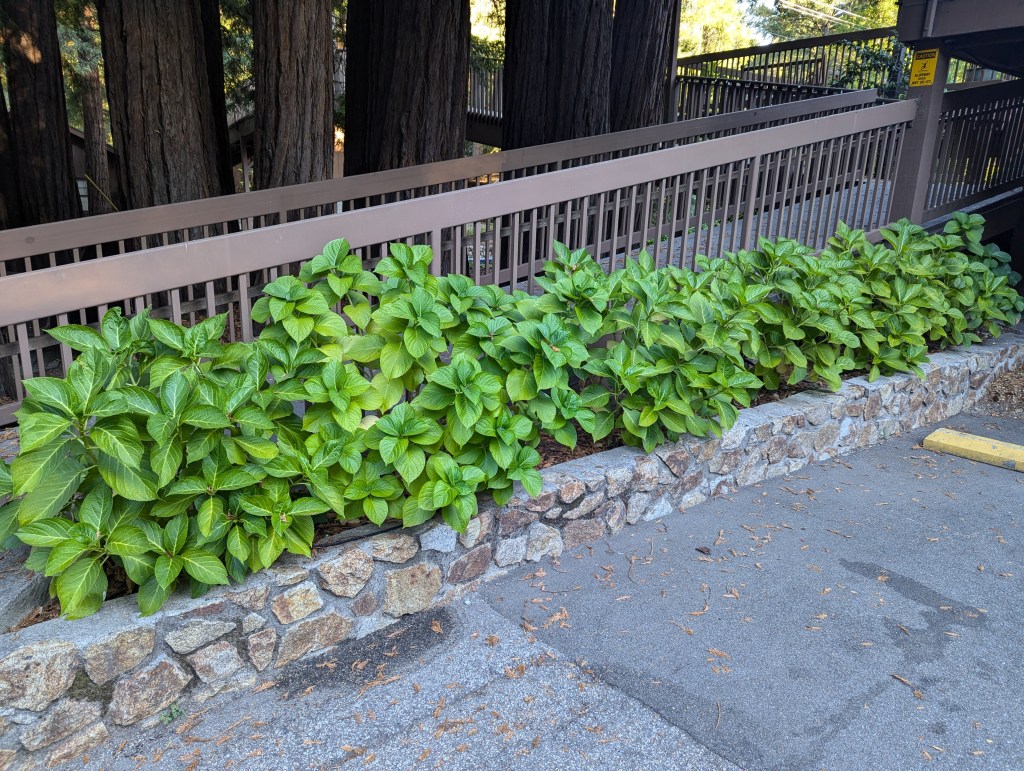
This hedge of modern Hydrangea is completely devoid of bloom.
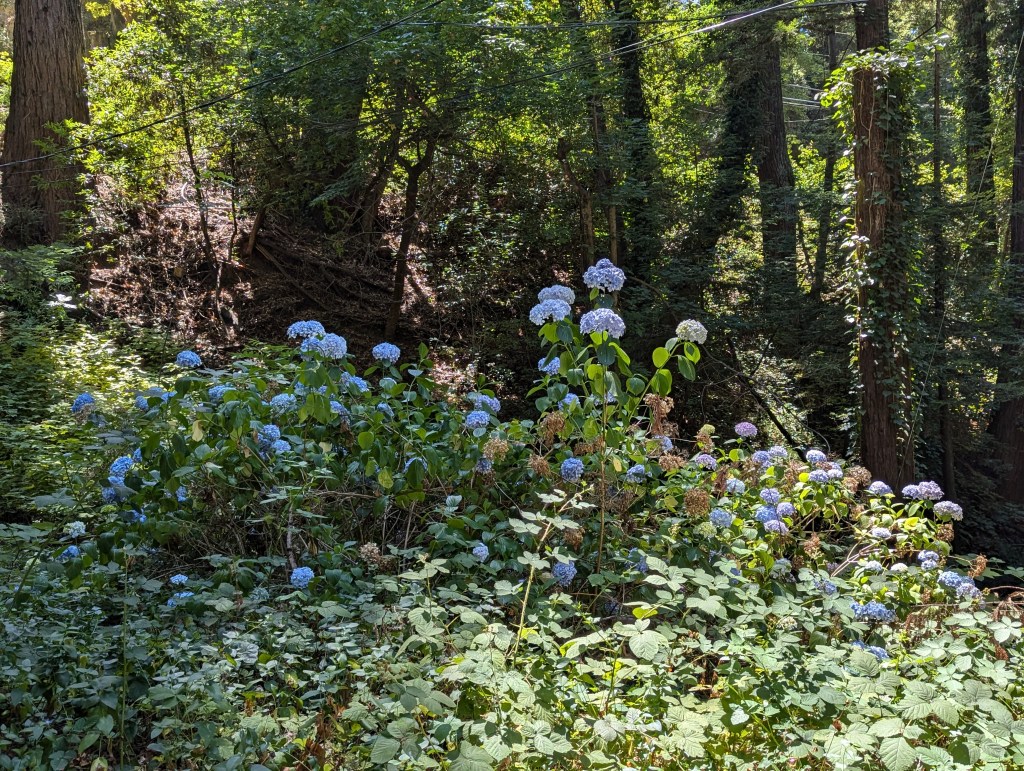
Modern cultivars of Hydrangea were not easy to adapt to. I learned how to prune old fashioned cultivars during their winter dormancy. I knew to retain the terminal buds of their retained canes to bloom for their following season. Pruning canes of modern cultivars back shorter and depriving them of their terminal buds in order to promote shrubbier growth seemed to be more like pruning roses. I did not trust them to bloom without their terminal buds. Not only do they bloom, but they do so a bit more abundantly, and with sturdier floral trusses that last and retain their floral color somewhat longer than those of old fashioned cultivars. Old fashioned cultivars have bloomed so reliably for the past few years that I am not so hesitant about pruning them back. However, this year, they inexplicably did not bloom. I do not mean that they bloomed sparsely, or that a few of the total did not bloom. I mean that none of the modern hydrangeas bloomed at all. The only hydrangeas that bloomed within the landscapes at work this year are the few remaining old fashioned sorts. All of the hydrangeas are healthy with vibrantly green foliage. Neither disease nor insect pathogens have been problematic. I can not explain this odd lack of bloom. With such vigorous canes, pruning should be easy this winter. However, I am more likely to leave awkwardly long canes in order to retain their terminal buds. Even if they are not necessary, terminal buds might provide an earlier prebloom prior to the bloom of stems that grow from lateral buds. I can not help but wonder why, while modern cultivars did not bloom, old fashioned cultivars did. A colony of unpruned feral Hydrangea near the bank of Zayante Creek was unusually prolific in bloom.
Canna ‘Cannova Mango’ is a relatively recent introduction to the landscapes here. I inadvertently brought it back from Southern California about two and a half years ago, without realizing that it is exactly the sort of modern cultivar that I am not at all keen on. It is new. It is improved. It blooms with a strange but trendy color. The problem is that it performs too well to not be an asset to the landscapes. Because it is so short and compact, it starts blooming early, while old fashioned Canna are still only foliar. Because it replaces older stalks with newer stalks so efficiently, it is rarely without bloom until frost. Other cultivars of the series bloom yellow, lemon (which is implied to be distinct from yellow), orange shades (?), red golden flame (?!), rose, scarlet with bronze foliage or orange with bronze foliage. The tallest are less than five feet tall. Regardless of my disdain for modern cultivars, I do not doubt that all of them perform as impressively as ‘Cannova Mango’. Nonetheless, I prefer the older and formerly common sort. A relatively compact cultivar that stays less than about four feet tall with simple green foliage and billowy but simple red bloom has been relocated through a few landscapes here since the early 1980s. Although not many rhizomes survive, I intend to grow more of it, even if not so much within the landscapes at work. Its bloom begins a bit later, and is neither as profuse nor as continuous as that of ‘Cannova Mango’, but it has history here. Besides, its more relaxed foliar texture and bloom somehow seem to be more compatible with the surrounding forested setting than the almost too refined modern cultivars, with their perfectly compact form, overly profuse bloom, and strangely modern floral color.
Unidentified old fashioned red Canna with green foliage.






 Tony Tomeo