Madonna & Black Lace II

Sambucus nigra ‘Black Lace’ can produce a few berries without pollination from another cultivar.

The internet never ceases to amaze with its inefficiency of providing information that should be more readily available. Old fashioned horticultural texts and even encyclopedias were more reliable. I remember reading that elderberry could be self pollinating, but that it would be more productive with another cultivar of the same species. Because I could not remember what species of the genus that information was relevant to, I more recently tried to determine the requirements of each of the few species that I grow. Ultimately, it seems to me that all are about the same in regard to both their ability to self pollinate to a minimal degree, and their ability to pollinate more efficiently with other cultivars. However, I still do not know. Furthermore, I am now confused about the identity of American elderberry, which many sources insist is merely a variety of common black elderberry of Europe.

Sambucus caerulea, blue elderberry is native and too common for me to know or care if it is more productive with other genetically distinct specimens, which, since the species lacks cultivars, are merely other wild specimens. In other words, blue elderberry specimens here can not be adequately isolated from other specimens to determine how reliant they are on others for pollination. Regardless, I will grow about four together within my garden.

Sambucus racemosa, red elderberry is supposedly native here, but I have never seen it in the wild. Consequently, I do not know if other specimens are close enough to pollinate specimens within my garden. Rather than experiment with single and potentially isolated specimens, and because there is no need to separate the four specimens here anyway, I will grow all of them together within my garden. I am considering adding ‘Sutherland Gold’ or other ornamental cultivars in the future.

Sambucus canadensis, American elderberry is not native, so could be grown in isolation here. However, I want berries more than I want to know how reliant this species is on pollination from other genetically distinct specimens. Before I grow cultivars, I will grow about four specimens within my garden from seed. I might consider cultivars in the future, but for now, would prefer to grow them as most people within their native range experience them, and as I grow blue and red elderberries.

Sambucus nigra, black elderberry is a species that I find to be less interesting than the three North American species that I actually want to grow. However, I have grown ‘Black Lace’ at work for a few years, and recently got it ‘Madonna’ as a pollinator so that the two can make berries together. Because I grew several more copies of each than we can accommodate at work, I will likely grow a pair of each within my own garden. Both are ornamental cultivars that happen to also produce berries. However, formerly without a pollinator, ‘Black Lace’ has been fruitless. This year, one of the copies managed to make these few berries in the picture above without bloom from ‘Madonna’. I suppose that this is consistent with what I read about its ability to self pollinate somewhat. Now, I want to see what it does next year if ‘Madonna’ blooms well.
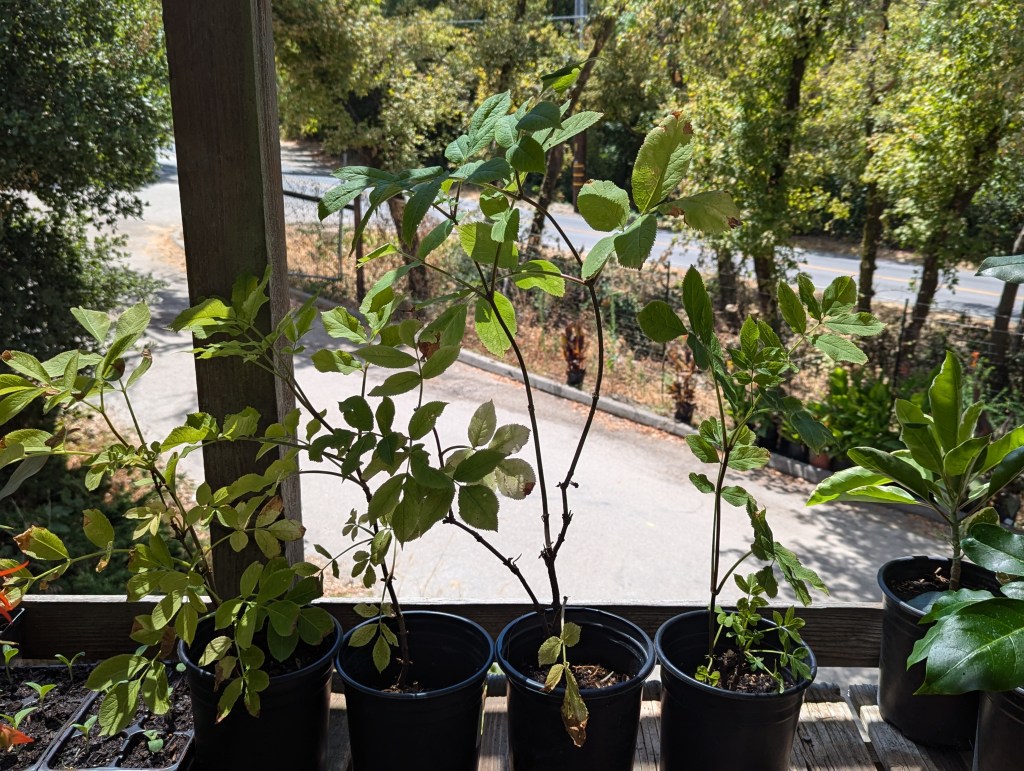
Four wild seed grown specimens of Sambucus racemosa, red elderberry that were a gift from Tangly Cottage Gardening have been canned for too long, and want to get into the garden.

Still Going Bananas!

Most of the banana pups and plugs are manageable, . . . for now.

Three more cultivars of banana arrived this week. There are now as many as twenty here. Three are unidentified. Of these three, two could be redundant to others. Of these two, one is merely dormant corms that could rot before generating new foliage. Another is already generating pups. Another is represented by a pair of pups. Eight grew from pups. Twelve grew from tissue culture plugs. Five have already grown too big to remain in the nursery where this picture was taken. At least three can grow more than twenty feet tall. At least two can grow more than forty feet tall. One is Musa ingens, which is the largest species of banana in the World, which can grow more than sixty feet tall! This sounds like fun, but so far, we only intend to add one of these twenty to only one of the landscapes! Three other small cultivars might remain potted in other landscapes, but are merely a minority of the total. Banana ‘trees’ are not exactly easy to accommodate. They want generous irrigation. Their ‘trunks’ grow very fast, but do not last long. Because they can not be climbed, every ‘trunk’ requires a radius that is comparable to its potential height to free fall when it gets cut down. None of the refined landscapes can forfeit areas that are large enough for ‘trunks’ of the larger cultivars to fall. Riparian areas that can accommodate them, and even without irrigation, are forested with redwoods, which banana ‘trees’ are not aesthetically compatible with. I would say that we will figure this out as they grow, but banana ‘trees’ grow very fast. They can remain canned for the rest of this season, but would be very displeased with such confinement next year. It is about to get even more interesting.

Six on Saturday: Amiss

Heather worked ‘VERY’ late. Labels got switched on two cultivars of passion flower vine. We got another banana tree with no plan. A walnut replaced a palm. Palms did nothing. Oh my!

1. Musa acuminata ‘Popoulu’ banana ‘tree’ arrived in the mail as this tissue culture plug with a crease across it. It will recover, but its blemish is annoying. What is more amiss is that this is the twentieth cultivar of banana here, but we have plans for none of them yet.

2. Juglans nigra, black walnut was a typical understock for the English walnut orchards of the Santa Clara Valley. It is somewhat naturalized nearby, but not here. Where are all these seedlings coming from? Why did this grow in a can for Costa Rican bamboo palm?

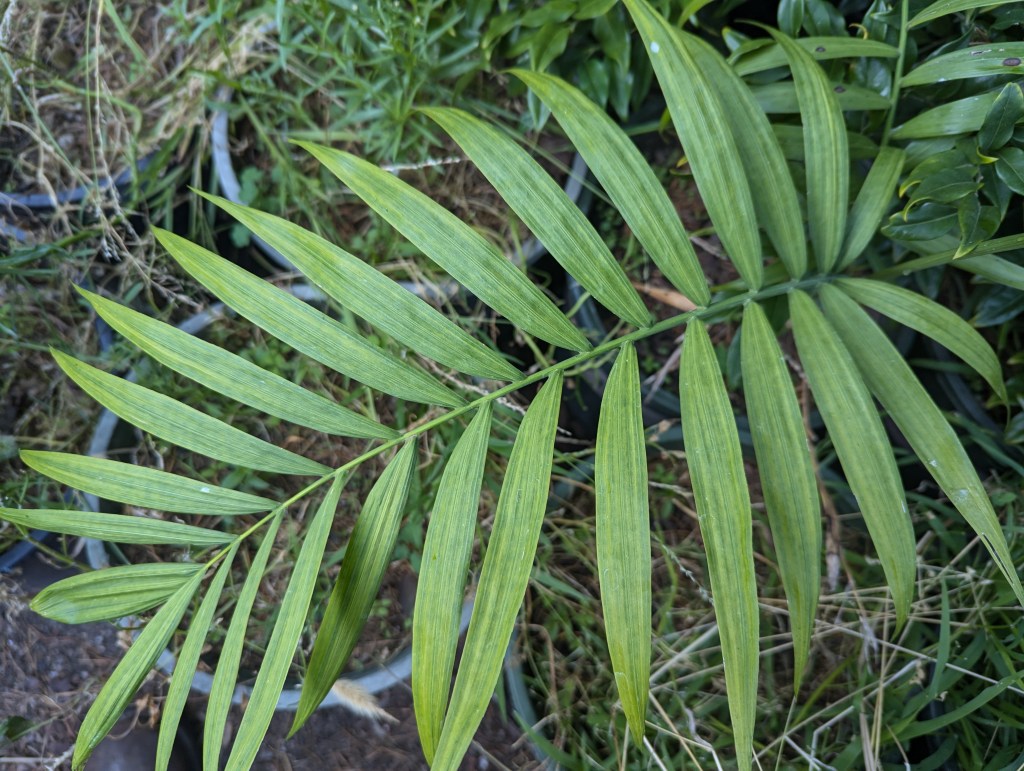
3. Chamaedorea costaricana, Costa Rican bamboo palm is what should be in the can of the black walnut seedling. I brought enough rhizomes from Brent’s garden for about ten #5 cans and about as many #1 cans, but after a year, this is the only specimen that grew.

4. Hakonechloa macra ‘Aureola’ Hakone grass had never performed particularly well. A few other small perennials were added nearby to compensate. Now, the Hakone grass is growing lushly enough to overwhelm some of the perennials that were added to assist it.

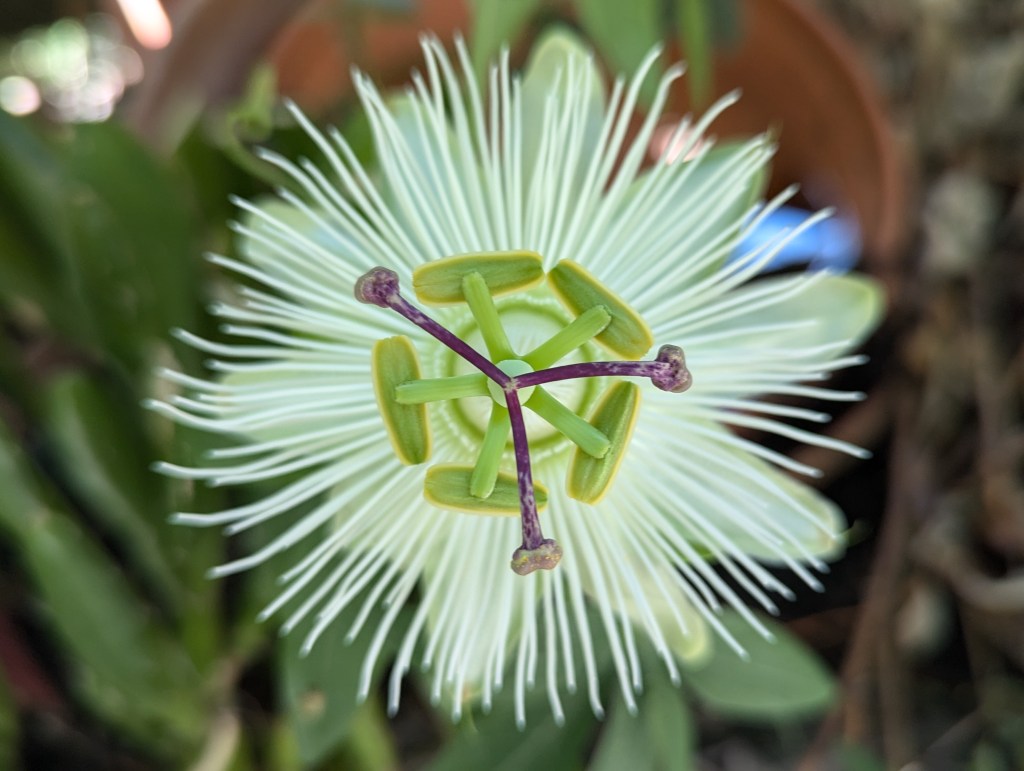
5. Passiflora caerulea ‘Constance Eliot’ passion flower vine went into a landscape after it impressed with purple bloom. Of course, it was expected to bloom white like the original that provided the cuttings. This specimen was expected to bloom purple like its original.

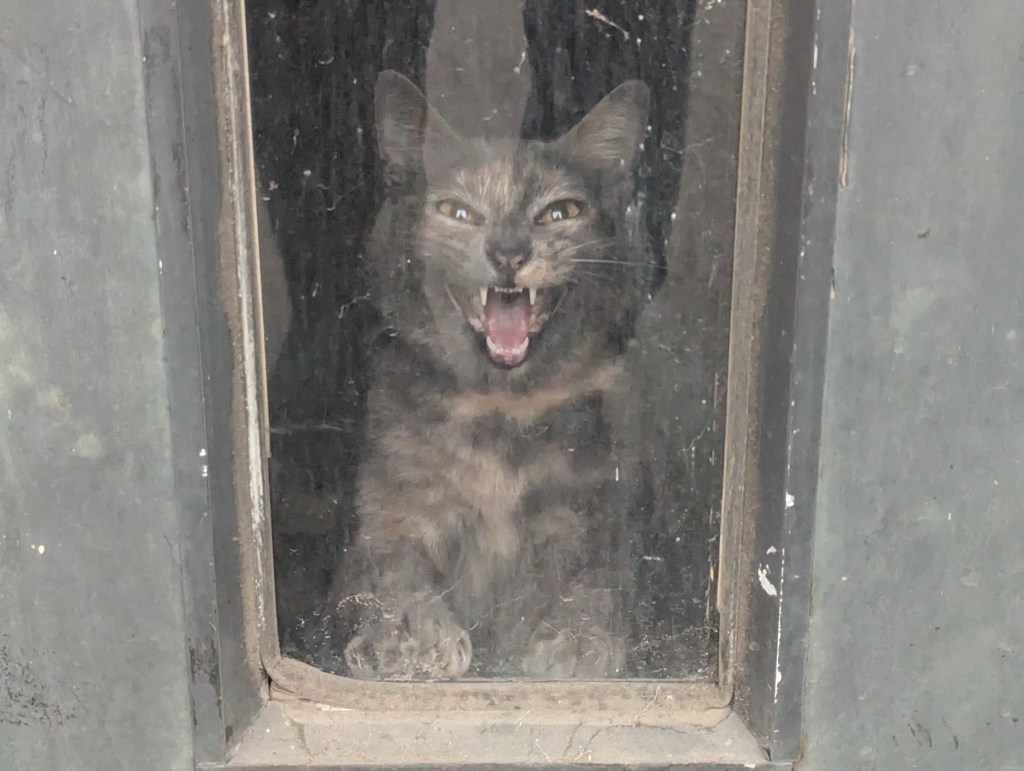
6. Heather is a very proficient mouser. Rodents had been a major annoyance prior to her arrival. They are now no bother at all. However, a rat was observed within this particular shop. Heather apparently went in to investigate, and consequently spent the night there.

This is the link for Six on Saturday, for anyone else who would like to participate: https://thepropagatorblog.wordpress.com/2017/09/18/six-on-saturday-a-participant-guide/

Santa Cruz

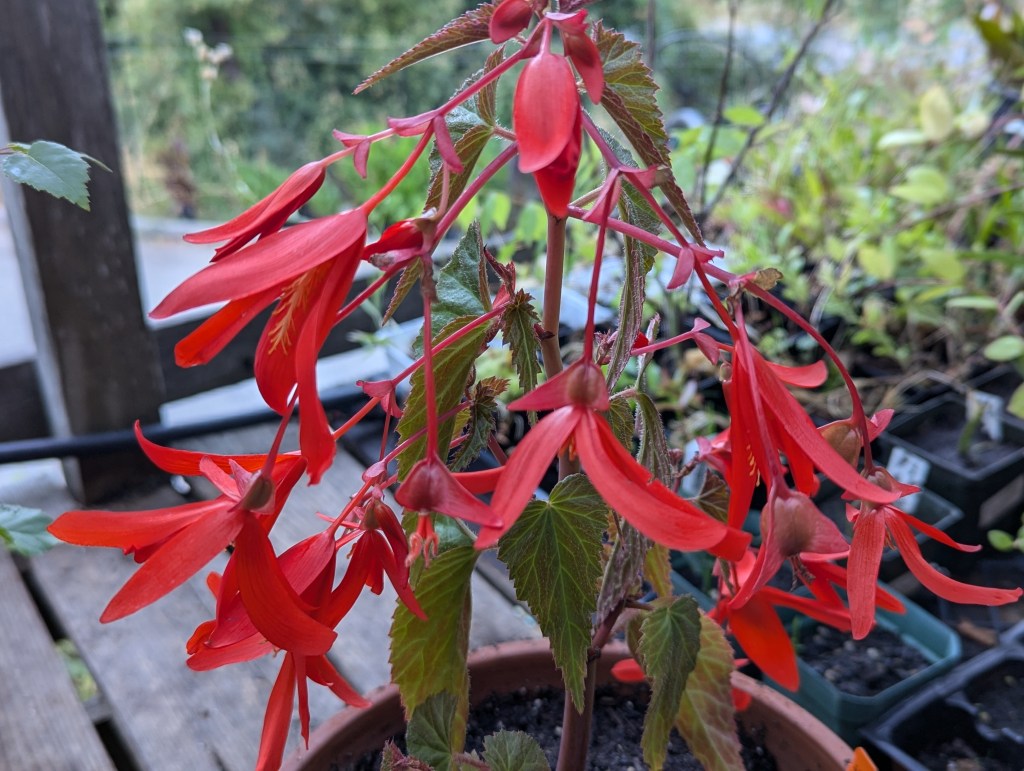
Begonia boliviensis ‘Santa Cruz’

Begonia boliviensis ‘Santa Cruz’ is one of those modern cultivars that I am typically not so keen on. It grows vigorously with abundant red bloom. ‘San Francisco’ is similar but with abundant pink bloom. ‘Santa Barbara’ is similarly similar but with abundant white bloom. All perform splendidly, like so many formerly modern cultivars that were trendy before them. I am not so keen on them merely because they are both modern and trendy. Their names do not help either. My colleague purchased ‘Santa Cruz’ from a nursery in Santa Cruz. It now lives here in Mount Hermon, which is a few miles away from Santa Cruz, but still in Santa Cruz County. I suspect that it is more popular locally because of its name. For the same reason, I suspect that ‘Santa Barbara’ is more popular in Santa Barbara, and ‘San Francisco’ is more popular in San Francisco. I also suspect that I would be less resistant to these modern cultivars if they had more appealing names, such as ‘Los Gatos’, ‘San Jose’ or ‘Palo Alto’. Perhaps the names are for the counties rather than the cities within the counties. All three of my recommendations are within Santa Clara County.

Florist Quality And Landscape Quality

Chrysanthemums are available out of season.

Roses from a home garden are not quite the same as roses from a florist or market. They mostly bloom on stems that are relatively thinner and shorter. Floral and foliar blemishes are more likely. As they unfurl, they can get a bit wider and disperse more fragrance. One of the more obvious differences is their seasonality. They are unavailable through winter.

Florist roses are likewise different from garden roses. They are not as limited by season, so are available at any time of year. Their elegantly straighter stems are relatively longer and a bit heftier. Blemishes are rare. Buds are generally plumper and likely to last longer, but may not unfurl completely. They are typically relatively narrow and a bit less fragrant.

Environmental factors cause most of the differences. Home garden roses develop with a relatively natural exposure to weather. Florist roses develop within synthetic greenhouse environments without natural weather. However, genetics cause some of the differences. Florist roses are not the same cultivars that are available from nurseries for landscaping.

The same applies to several florist quality potted plants. They also grow within unnatural environments. They also are cultivars that perform well for their specific purpose. Some cultivars are impractical for landscapes. Some take quite a while to adapt to landscapes. Many that are seasonally popular for particular Holidays may not last for long afterward.

Most azaleas and hydrangeas are landscape cultivars. Some are florist cultivars though. Landscape cultivars that grew outside in nurseries adapt efficiently to landscapes. Florist cultivars that grew in greenhouses take more time or may not adapt. Those that do might bloom with lavishly large florist type flowers. Such bloom may not be resilient to weather.

Several cultivars of florist carnations and chrysanthemums are also landscape cultivars. Florist lilies are the same that are seasonally available as dormant bulbs from nurseries. Adaptation to a garden can be stressful, especially for those that bloomed out of season. However, once they adapt, they might perform for several years as short term perennials.

Six on Saturday: Surprise

Surprise is a town northwest of Phoenix that I encountered between late April and early May. These six are different sorts of horticultural surprises which I encountered at work.

1. Platycerium bifurcatum, common staghorn fern, Tillandsia usneoides, Spanish moss and two other unidentified species of Tillandsia combined for a surprisingly compelling epiphytic platter. The staghorn fern is from Brent’s garden. The Spanish moss should be fuller as it grows. The two unidentified Tillandsia should be displaced as the fern grows.

2. Brugmansia X cubensis ‘Charles Grimaldi’ angel’s trumpet is no surprise. A picture of it posted here last Sunday. Its richer than typical yellow floral color is a surprise though. It is also from Brent’s garden, and was from one of his projects years ago. Brugmansia X candida ‘Double White’ and Brugmansia suaveolens ‘Single White’ both bloom nearby.

3. Brugmansia, angel’s trumpet of an unidentified cultivar demonstrates why the yellow floral color of ‘Charle’s Grimaldi’ is so surprising. Both were about the same pale peachy color last year, with the same fragrance. I thought that they may be the same. Obviously, but actually surprisingly, they are not. I do not know what it is, but I know what it is not.

4. Persicaria amplexicaulis ‘Firetail’ arrived here with Persicaria bistorta ‘Superba’ and perhaps Persicaria affinis ‘Dimity’ from Tangly Cottage Gardening early last April. I can not distinguish the cultivars, which is why I do not know if they include ‘Dimity’. It was a surprise to see ‘Superba’ bloom immediately after relocation. ‘Firetail’ is a surprise now.

5. Mimulus guttatus, seep monkey flower is blooming with surprising abundance where the stream from Redwood Springs flows into the drainage pond. The location should not be a surprise since, as its common name implies, this species prefers damp situations. It is surprising only because I somehow neglected to observe so much bright yellow earlier.

6. Rosa, rose of an unidentified cultivar would not be so surprising if I were not aware of how it got here. Someone who does not work in the landscapes removed it from where it was obstructing access to one of his projects. I saw it in his pickup as he was about to discard it. I am surprised that it survived, blooms well and seems to be a hybrid tea rose.

This is the link for Six on Saturday, for anyone else who would like to participate: https://thepropagatorblog.wordpress.com/2017/09/18/six-on-saturday-a-participant-guide/

Simple Species

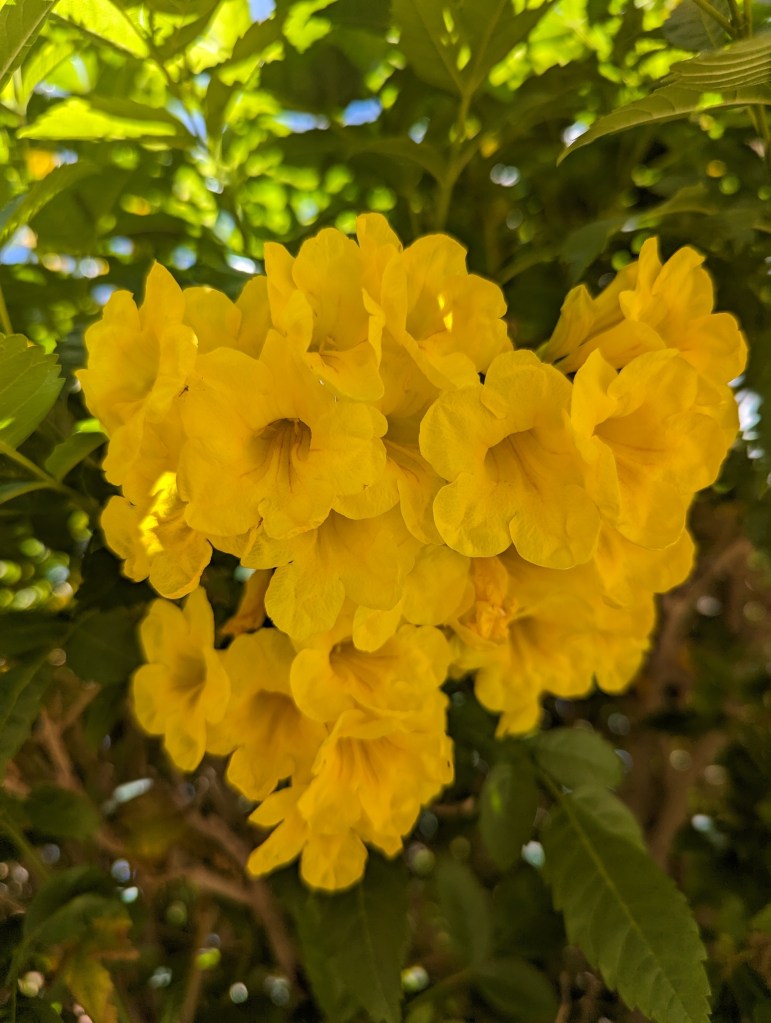
Unidentified cultivar of Tecoma stans

Tecoma stans is somewhat popular within the neighborhood where I stayed while in Arizona. It is available in nurseries also. I suppose that I could have purchased one or more for my garden. I had wanted to grow it for a long time. I refrained. I can explain.

The Tecoma stans that I can get from nurseries is an improved cultivar, or actually, about three cultivars. They are not the simple species, as it would be found growing wild. I realize that improved cultivars are known as ‘improved’ for a reason, but ultimately, I want to grow the simple species.

Crazy Green Thumbs sent me the seed for the simple species of Tecoma stans that I want to grow. That is all I need. Other colleagues have sent me seed, seedlings or cuttings for simple species of American beautyberry, American holly, American persimmon, pawpaw, red mulberry, red elderberry and perhaps too many other species to list briefly. In the future, I suppose that I could try cultivars of some of these species. I would like to get acquainted with them first though.

For most species, I suppose that I prefer cultivars. I want to grow the same ‘Moorpark’ and ‘Blenheim’ apricots that I grew up with. Eventually, I want to grow ‘John F. Kennedy’ rose. Cultivars serve a purpose also.

There are a few reasons why I want simple species rather than cultivars of some species. For American beautyberry, American holly and red elderberry, I want to grow what most other garden enthusiasts within the native ranges of these species grow merely because such species appear uninvited in their gardens. For American persimmon, pawpaw and red mulberry, I want to grow a few of the fruits that people enjoyed for culinary application prior to the development of relatively modern cultivars.

Weird Tree

Sequoiadendron giganteum ‘Pendulum’

Giant redwood, Sequoiadendron giganteum, is famously the largest tree in the World. Although not quite as tall as the coastal redwood, Sequoiadendron sempervirens, it is bulkier. It grows taller than three hundred feet, with trunks wider than thirty feet, to weigh more than six hundred thirty tons.

Yet, like many species, it has at least one cultivar. ‘Pendulum’, which is the weeping giant redwood, is nothing like the simple species. It might grow forty feet tall, if it is able to support itself at such a height. It’s canopy might grow a few feet wide, but it really cascades more than it reaches outward. It really is weird. It looks more like a relative of Mr. Snuffleupagus of Sesame Street than like a relative of giant redwood.

Of course, its weirdness is what makes it so appealing. It is sculptural. It is bold. It really makes one wonder what planet it is from.

I got this picture in Kitsap County in Washington, hundreds of miles from the native range of the simple species within the Sierra Nevada. Actually, I see more of this cultivar in the Pacific Northwest than here. It likely performs better there because of the colder winter weather. Furthermore, this weird cultivar is more popular than the simple species, partly because it is so distinctive, and partly because it is more proportionate to home gardens. Simple giant redwoods only fit into very spacious landscapes.

Weeping giant redwood may not be good for anything more than its weirdness, but at least it excels at that. Otherwise, it provides no significant shade. It does not bloom conspicuously. It provides no fruit. It does not even make good firewood. Fortunately, weirdness has certain appeal. Within our home gardens, we can grow what we like, even if merely for its weirdness.

Dual Citizenship

As brightly colorful as Persian buttercup is, I still prefer white.

French peony Persian buttercup was added to one of our landscapes last year. They are not two different perennials, such as French peony and Persian buttercup. They are a group of cultivars of one species, Ranunculus asiaticus ‘French Peony’. Ranunculus asiaticus is the species of Persian buttercup. ‘French Peony’ is its cultivar.

So, is it French or Persian? Well, yes.

Ranunculus asiaticus, Persian buttercup is native to Southwestern Asia, Southeastern Europe, Northeastern Africa and elsewhere within the Mediterranean Region. This range could potentially include the Southern Coast of France within the Mediterranean Region, but much more likely includes Persia within Southwestern Asia. My guess would be that Persian buttercup is as Persian as its name says it is.

‘French Peony’ is a group of cultivars that could have been developed anywhere and given an appealing name that promotes its marketability, but was most likely developed in France, where most breeding of this particular species was done. My guess would be that ‘French Peony’ is as French as its name says it is.

Of course, French peony Persian buttercup could have been developed anywhere, even Persia, and merely given its appealing French name without actually being French. Alternatively, it could have been developed completely in France, from Ranunculus asiaticus from the Southern Coast of France, without actually being Persian. For that matter, it could have been developed in Greece from Greek stock.

To me, French peony Persian buttercup seems to be chicly cosmopolitan. I remember it as popular for urban window boxes within the greatest cities of the World, such as San Jose, Oakland and San Francisco. If I had not seen that it is also popular in Reno and Portland, I would consider it to be as Californian as so many other exotic species and varieties that are popular here.

These would be nice for Ronald McDonald’s garden.

Horridculture – White California Poppy

White California poppies are naturally very rare.

California poppy is the official State Flower of California. Most Californians are familiar with it. We certainly know what color it should be. With few exceptions, it is bright and clear orange. Some, particularly within desert climates, are golden or more yellowish. White and pastel purple California poppies are rare aberrations. When I was a kid, finding one or the other was comparable to finding a four leaf clover for kids in Ireland. They were even a bit better though, since plants that bloomed with variant color bloomed with more than a single flower.

When I was about a freshman in high school, I found both a white and a purple California poppy just a few feet apart from each other. They happened to be at the Portola Monument in Montara, near where the Portola Expedition discovered San Francisco Bay. It was too early for seed, and I did not return for seed later. Besides, most of such seed produces plants that bloom with typical orange floral color. Nonetheless, at the time, I was very pleased to have found two very rare aberrations.

In more recent years, varieties of California poppy were developed. Some bloom with white or purple bloom. Others bloom with pink, red or yellow flowers. Some have double flowers. They are readily available from mail order catalogues and nurseries, as well as online. White or pastel purple California poppies are no longer rare or special. This sort of takes the fun out of finding one.

I suspect that the white California poppy in this less than exemplary picture is natural. Poppy seed was not likely sown here intentionally. Nonetheless, I do not know. Now that it is no longer special, its source is not so important. Realistically, their typical bright orange floral color is the best anyway.