 Immediately after the Loma Prieta Earthquake, nothing was open for business downtown on North Santa Cruz Avenue south of Bean Avenue. As buildings were inspected for safety and cleaned up, sections of cyclone fence that had kept everyone out were slowly and systematically moved out so that businesses on the east side could open for business. The same slow process was repeated on the west side, moving south from the corner at Bean Avenue, but did not get very far. The old Los Gatos Cinema, as well as the several other building between it and the seemingly destroyed old La Canada Building on the southern corner of the block, were too badly damaged for the fence to be removed.
Right there next door to the Cinema where the fence stopped moving, Gilley’s Coffee Shoppe happened to be one of the fortunate businesses that was able to open for business again, and serve breakfast and lunch to those so diligently reconstructing downtown. It had always been there, longer than anyone can remember. Older people knew it as the ‘Sweet Shoppe’, a soda fountain that was very popular with those who cruised North Santa Cruz Avenue. It was the last of the first business that that moved into the old Cannery Building when it was converted to retail stores. Gilley converted it to more of a coffee shoppe and named it after himself in the 1970s. While everything in Los Gatos changed around it, Gilley’s remained about the same. Everyone knows Gilley’s.
I had not gone there more than a few times prior to the Loma Prieta Earthquake. I was away at school for the second half of the 1980s, and just did not go downtown much while in high school or earlier. I stopped by on the way to work early one autumn morning in 1990 because it was the only restaurant that was open in the recovering downtown neighborhood It instantly became my place to go for breakfast, and sometimes for lunch. It was nothing fancy, but it was what I wanted.
For the past twenty eight years, Gilley’s was where many of my work days started. I used their tables to sketch out irrigation systems and small sections of landscapes. I met clients there rather than at my home office. Back when I was able to write about local gardening events in my gardening column, I conducted interviews there. Readers sometimes brought me pieces of plants for identification, or for diagnoses of a disease. When Gilley’s sold and was prettied up a slight bit in the early 1990s, I procured small potted bromeliads, and later, cut flowers for the tables. Before permanent succulent were installed into the big pots flanking the door, I cycled flowering annuals for a little bit of color out front. A whole lot of horticulture went on at Gilley’s.
Sadly, nothing is permanent. Los Gatos is always changing, just like it has always done. By the time you read this, after 3:00 on September 30, 2018, Gilley’s will have closed for the last time.


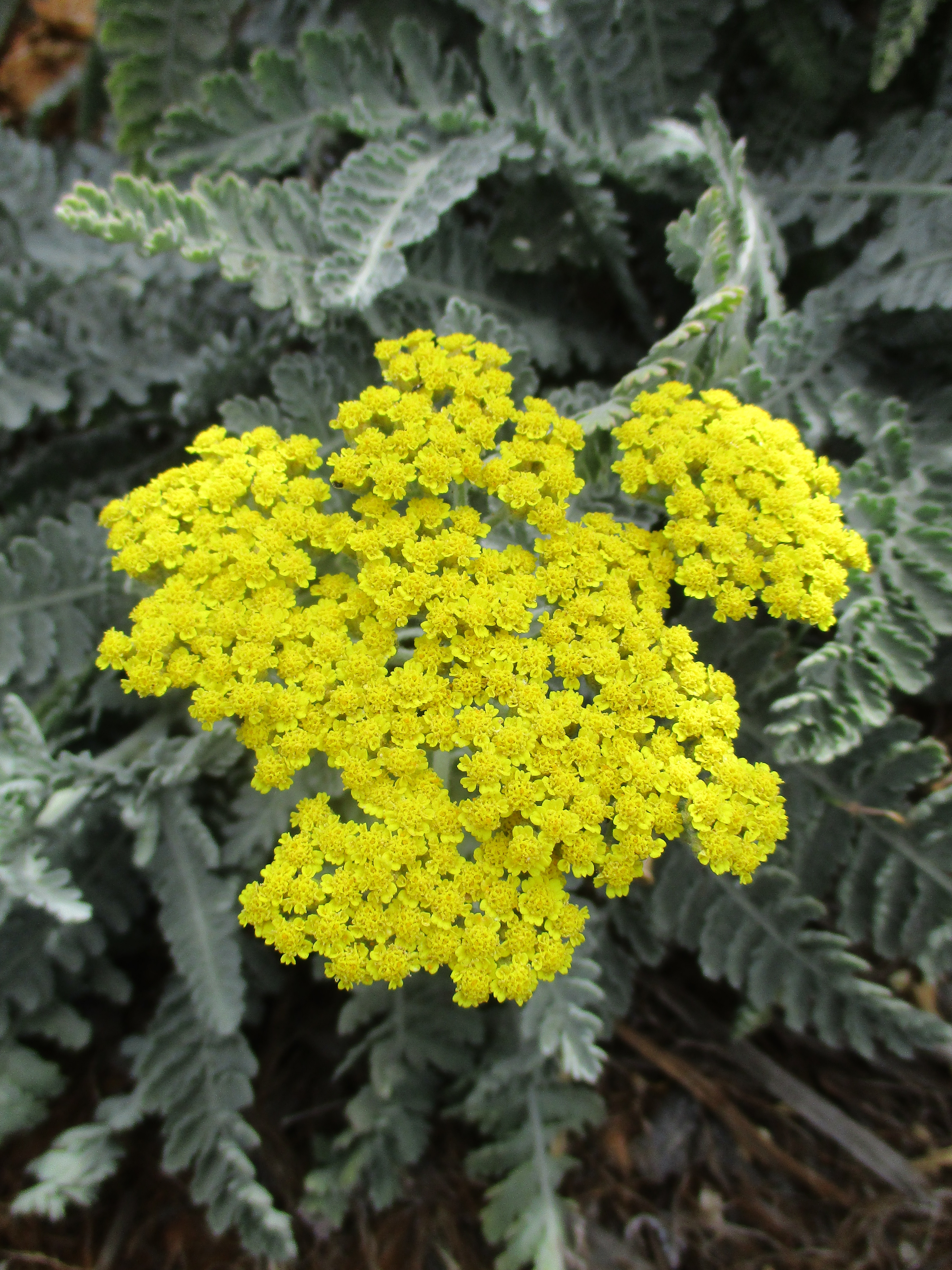 ‘Moonshine’ is probably the epitome of fernleaf yarrow, Achillea filipendulina, even though it is technically a hybrid. From the middle to the end of summer, its three inch wide corymbs (flat-topped trusses) of tiny bright yellow flowers stand as high as three feet above ferny and gray basal foliage. Bloom is best in full sun and warm exposure. Established plants do not need too much water.
 Tony Tomeo