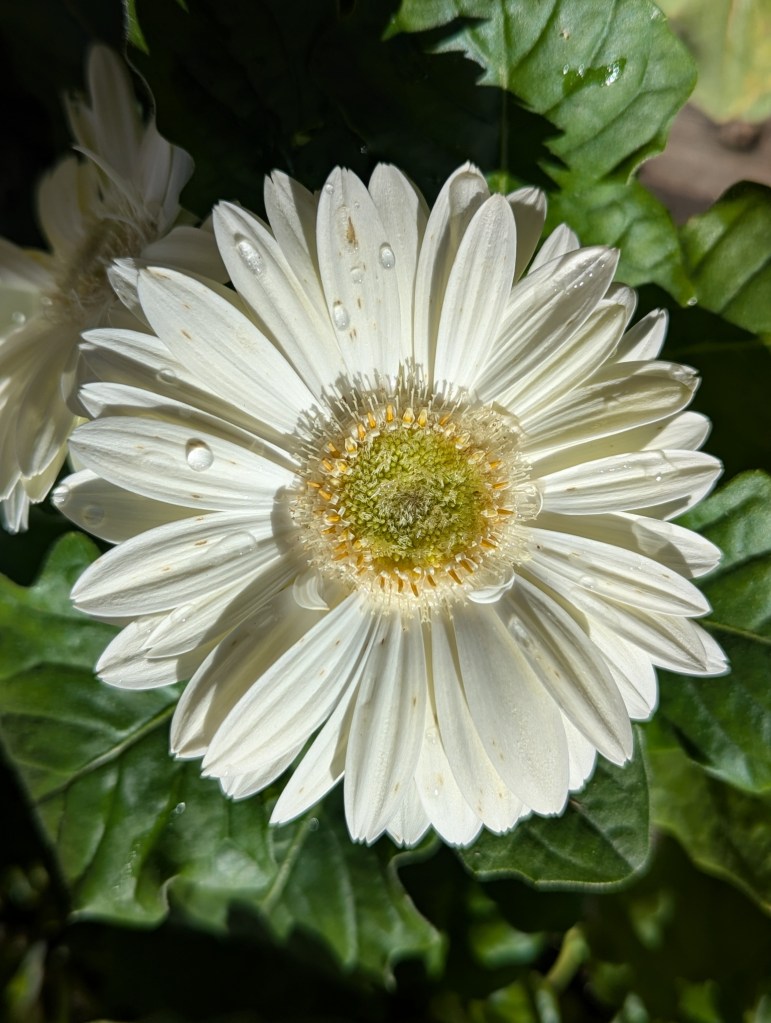
Though a popular cut flower, Transvaal daisy, Gerbera hybrida, is rare in home gardens. When it does appear in home gardens, it is typically within pots or planters as an annual. As a perennial, it gets shabby during winter, and is very popular among slugs and snails. It performs best with partial shade, but can tolerate full sun exposure if it is not too warm.
Coarse basal foliage of Transvaal daisy can grow a foot high and a foot and a half wide. Its solitary floral stems stand a few inches higher. Bloom is two to four inches wide. Most garden varieties bloom with simple single blooms. Most florist varieties are semi-double. The floral color range includes cartoonish pastels of yellow, orange, red, pink and white.
Floral structure of Transvaal daisy is more variable than it seems to be. Several varieties produce blooms with brown or black centers. A few varieties with fuller double bloom are uncommon but increasingly popular. Fewer varieties that resemble spider mums are rare but could become more available. Transvaal daisy becomes available in nurseries now. They are seasonable in spring and autumn.
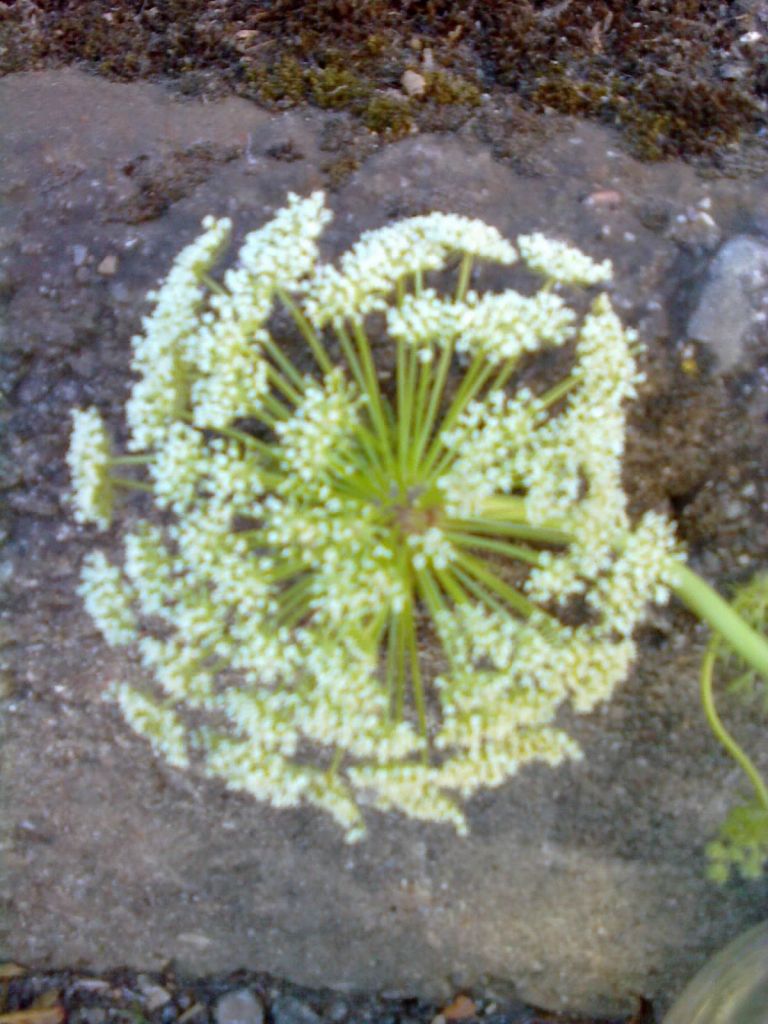
There are actually a few different flowers known as Queen Anne’s lace. The most common species, Daucus carota, that has naturalized and even become somewhat of a weed in some areas, has two and a half inch broad, flat-topped trusses of delicately minute but abundant flowers, with a single red flower at the center of each truss. Apparently, Queen Anne pricked a finger with a needle while making the lace, leaving a drop of blood. Modern varieties have broader and fluffier trusses, often lacking central red flowers. They are a popular ingredient or fill for mixed bouquets with more colorful flowers.
The biennial foliage of Queen Anne’s lace grows to about three feet tall in the first year, with weedy but intricately lacy leaves. It blooms in summer of the second year. It is very similar to poison hemlock, which is poisonous enough to kill Nero, so should not be allowed to grow in vegetable gardens or where toxicity might be a problem; just in case.
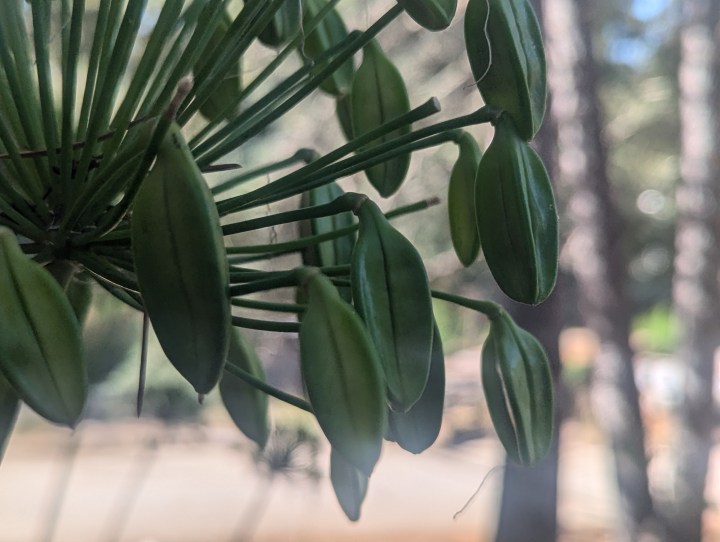
Lily of the Nile floral trusses are appealing even without bloom.
Most flowers bloom in spring. Many bloom a bit later and though summer. Not nearly so many start to bloom in autumn or though winter. This time of year, there is more to clean up from fading blooms than there are fresh blooms to cut and bring in.
Much of the color in the garden through autumn is provided by colorful foliage or foliage that gets colorful as the weather gets cooler. Later in winter, some plants have colorful bark and stems that gets revealed by winter defoliation. Coral bark Japanese maple, red twig dogwood and some arctic willows have remarkably colorful twigs.
Blooms of a few plants are sometimes cut and recycled after they fade because their dried flowers, flower stems or seed pods are appealing. Hydrangeas are not so attractive as they deteriorate out in the garden, but can be cut and hung upside down to dry to substitute for fresh flowers later. If done quickly, many types hold their color somewhat. Those that do not hold their fresh color may turn an appealing shade of brown.
Queen Anne’s lace can likewise be a nice dried flower, but is not so easy to hide in the garden while it dries. If cut and hung to dry, individual stems should be hung separately, since they bend and are difficult to separate if hung in clusters. Their flat-topped flower trusses curve inward as they dry, so they look nothing like they do fresh.
The rigid flower stems of New Zealand flax are rather sculptural protruding from their softer foliage. These same stems can be cut, plucked of seed pods, and like dried hydrangeas, used as cut flowers when there is not much else to get out of the garden. Ironically, New Zealand flax flowers sometimes get cut before they bloom, since not everyone appreciates their contrast against their own softly textured foliage.
Years ago, New Zealand flax flower stems were actually dried and spray painted! For those daring to try this technique, it also works well with lily -of-the-Nile flowers stems and trusses (plucked of their seed pods), Heavenly bamboo flower stems, and even dried pampas grass blooms. However, pampas grass blooms are deprived of their fluffiness and most appealing quality by spray paint. Bird-of-Paradise leaves twist interestingly as they dry, to provide texture with or without paint.
Fronds (leaves) of some fan palms can provide bold cut foliage. Mediterranean fan palm is difficult to handle because of the nasty teeth on the stalks, but has nice rounded leave that fan out nicely behind other flowers. They can be cut into smaller fans, or even other not so rounded shapes. Windmill palm is much easier to handle, but is a bit larger, so is more likely to need to be trimmed to shape. All are easy to cut with common scissors, and can be dried and spray painted.
There is probably more in the garden to substitute for cut flowers than would be guessed. Useful plant parts can be found in the least expected of places.
Once it gets established in a garden, it will likely always thrive there. Torch lily, Kniphofia uvaria, is as reliable and resilient as lily of the Nile and African iris. It is as easy to divide for propagation too. Mature specimens can survive without any more water than they get from annual rainfall. They might appreciate some through the middle of summer, though.
Old fashioned torch lily blooms for summer or early autumn, so some are blooming now. Modern cultivars are more likely to bloom earlier. Densely conical floral trusses suspend many narrow and tubular flowers. They stand as high as five feet on otherwise bare floral stalks. Dense mounds of grassy basal foliage should grow no more than three feet high.
Flower buds are orange as they begin to bloom, and then fade with age to pastel yellow. Because floral spikes bloom upwards from the bottom, they turn yellow at the base while orange on top. They resemble candy corn. Some cultivars are paler white at the base, or more reddish orange at the tip. Others are uniformly orange, yellow or soft creamy white.
As diverse as they are, popular varieties are a minority of countless hybrids of the genus. Most common and popular hybrid tulips qualify as the neo-species of Tulipa gesneriana. In other words, they are not an actual species. Most but not all are descendants of Tulipa suaveolens. More sustainable varieties of simple species are becoming more available.
The most popular of tulip are early spring bulbs that went into their gardens last autumn. Floral color ranges through pink, red, orange, yellow and white, mostly with dark centers. Their basal foliage is rather light green or perhaps almost grayish, with a rubbery texture. Most tulips stand singly on straight stems about a foot tall, but some can grow a bit taller.
Tulip bulbs enjoy organically rich soil with regular irrigation throughout their bloom cycle. They should get all the moisture they want from rain through their winter dormancy cycle. Tulip prefer a bit of chill in winter, so may not be as reliably perennial here as elsewhere. They are most spectacular in herds or large beds, but mix nicely with other spring bulbs. Simple tulips are among the most popular of cut flowers.
Marigold is a warm season annual that gets more popular later than earlier in its season. It is prominent for autumn but does not last for long into winter. Stock, Matthiola incana, is a cool season annual for the opposite extreme of the year. It is popular for late winter and spring but may not perform well into summer warmth. It is unreliable as a perennial here.
Stock bloom can be white, or rich shades or pastels of purple, red, pink, yellow or cream. Most bloom is double, but some is single. Floral fragrance is alluringly rich and complex. It resembles that of carnation, but is notably stronger. The narrow leaves are oblong with pastel grayish green color. Removal of deteriorating bloom promotes subsequent bloom.
Garden varieties of stock are quite different from florist varieties. For home gardens, most popular stock is relatively compact, and blooms freely. Florist stock is taller, and tends to bloom abundantly but at about the same time. In home gardens, florist stock may require staking if it grows as tall as three feet. Home garden stock may grow no taller than a foot.
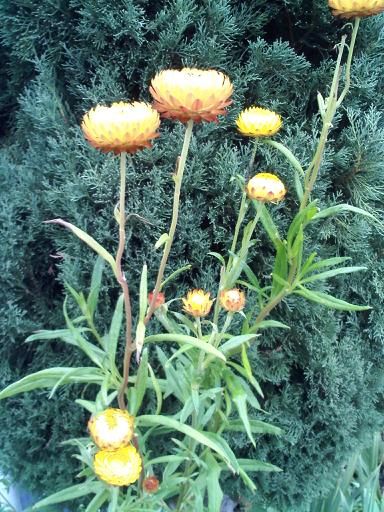
Strawflower retains its color and form, although not foliage, as it dries.
Just like cosmos, zinnias and other related flowers, strawflower, Helichrysum bracteatum, seems to be at its best as its bloom season ends. Bloom started in summer and should finish now that weather is getting cooler. The two and a half inch wide flowers last in the garden until they get ruined by rain. They are excellent cut flowers, and even better dried flowers.
Strawflower can be white, pink, red, orange or yellow. Their seed should be sown directly where they are wanted in spring. Mature plants are about two and half feet tall and a foot wide, with three or four inch long and somewhat narrow leaves. Dwarf varieties are not as good for dried flowers, but are fuller and look better in the garden.
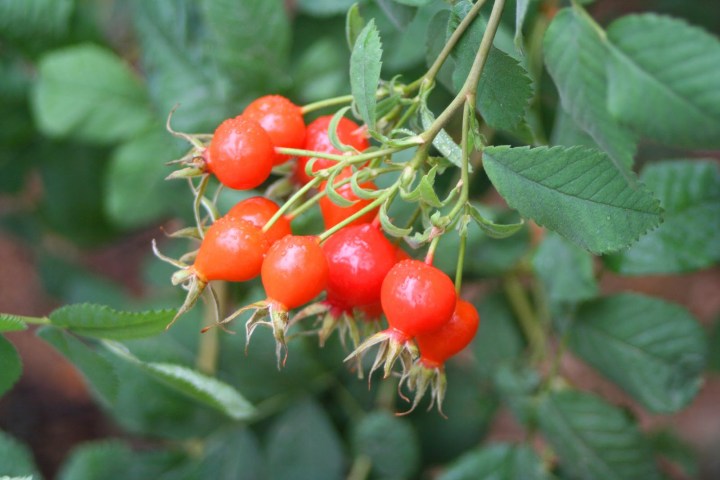
Rose hips are pretty fresh, and can alternatively be dried.
The problem with an abundance of bloom by lily-of-the-Nile over the summer is that all the spent blooms need to be plucked about now. Fortunately though, not all of the spent blooms need to go to compost or greenwaste. The stalks and floral trusses (the clusters of short flower stems on top of the stalks) can actually become interesting ‘dried flowers’, even though the real flowers are long gone.
Many years ago, my neighbor took many of the lily-of-the-Nile stalks that I plucked from my front yard, plucked off the seed capsules, and hung the empty stalks upside down until they dried and turned tan. Being the artistic sort, she added them to other dried flowers and foliage, and arranged them in a large vase (which I think is pronounced as ‘vahz’). Over the years, we found that we can actually let them dry in the garden if we first remove the seed capsules which would otherwise weigh them down and bend the stalks.
Since my artistic neighbor liked these lily-of-the-Nile flower stalks so much, I brought her other dried flower stalks to see how or if they could also be useful. We found that flower stalks from New Zealand flax were just as interesting and even more striking; and some types make rather tall stalks. The large seed capsules from Eucalyptus ficifolia function like modern substitutes for small pine cones.
There are many other plant parts that can be dried and used with dried flowers as well. Cut bird-of-Paradise leaves become sculpturally twisted as they dry. Petioles (leaf stalks) of windmill palm become simple but striking straight black sticks. While still green, the palm leaves can be cut with scissors into interesting shapes less than six inches wide (larger cutouts disfigure). Some native iris produce large seed capsules that split open as they dry, to reveal bright orange or red seeds within. Money plant is actually grown for its dried seedpods instead of for flowers of foliage.
Even bare stems can be added to dried flower arrangements. Both manzanita and madrone have gnarly stems that turn black or dark brown once cut. Fig has contrastingly thick and curving white or gray stems. Bamboo can be cut into sections of any desired length and stripped of foliage. Heavenly bamboo (Nandina spp.) has shorter canes with a corky texture. Realistically, there are no rules for what works well with dried flowers. Anything that looks good is worth trying once.
Straw flowers, statice (Including sea lavender), lavender, globe thistle and yarrow are some of the more traditional dried flowers. Cat-tails and pampas grass flowers can work as well in large arrangements as they did decades ago, but should be sprayed with hair spray to keep them from shedding. (Cat-tails can actually be very messy if they happen to explode.)
Although spray paint is much too synthetic for those of us who prefer dried flowers to look natural, it also works well to keep pampas grass flowers and cat-tails from shedding while adding serious color. Some people enjoy the potential for unnatural colors enough to spray paint other dried flowers and plant parts that do not need to be sprayed with a fixative.
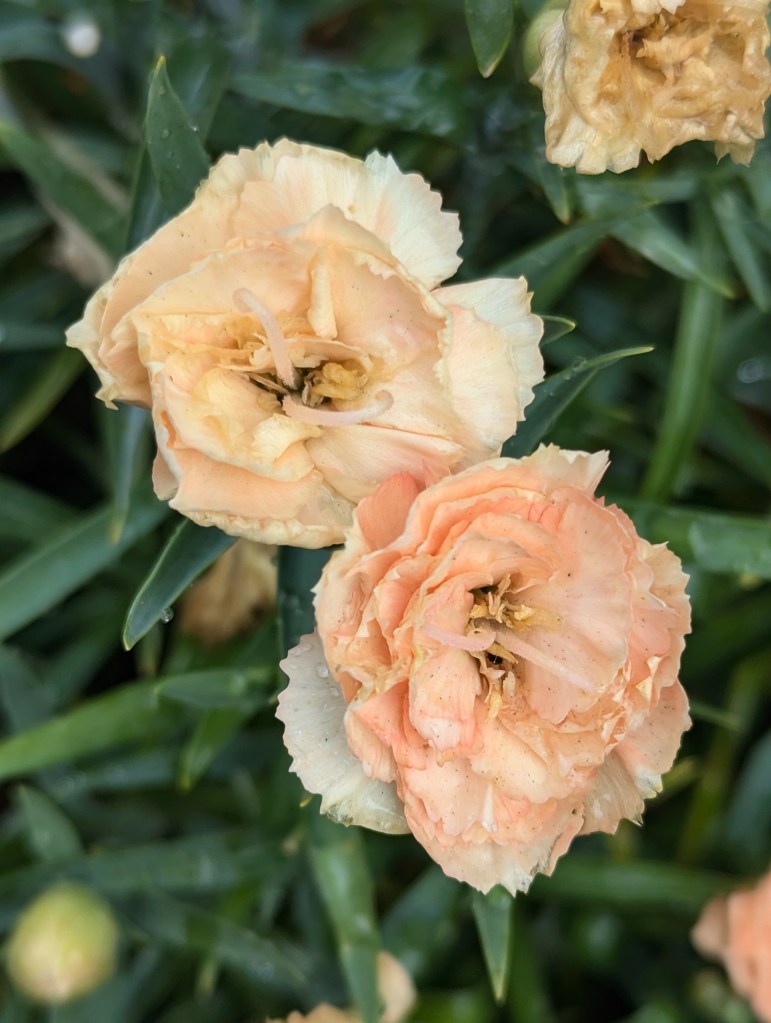
Florist carnation, Dianthus caryophyllus, is not originally as colorful as it seems. It can be red, pink, pastel yellow, pastel orange or nearly purple. Most for the floriculture industries begin as white though. White carnations are conducive to dying with any color that might be in demand. They are therefore more versatile than those with a different natural color.
Furthermore, their natural floral color range is not as natural as it seems. It is the result of extensive breeding of several species. Consequently, several popular types of carnation lack species designation. This includes a few compact cultivars that are more popular as annuals than cut flowers. Within locally mild climates, they can be short term perennials.
Border carnations grow only a few inches tall and less than a foot wide. Eventually, very old specimens may grow more than a foot tall. Such big specimens are very rare though. Border carnation foliage is glaucous bluish gray. The short and very narrow leaves are in opposing pairs. Flowers are less than two inches wide, with delightfully spicy fragrance of clove.
Winter flowering cherry, flowering quince, witch hazel and forsythia are finishing bloom. Later types of flowering cherry and flowering quince bloom immediately afterward. Lilac, redbud and weigela bloom only slightly later. Flowering crabapple extends the season of such flashy early bloom. It is relatively easy to force any of these for even earlier bloom.
Forcing is more popular where cool weather inhibits bloom through winter. It accelerates bloom simply by exposing it to home interior warmth. Bulbs that remain dormant in cold gardens bloom sooner in warm homes. Winter is the most popular time for forcing bulbs. It is now time to force formerly dormant deciduous stems to bloom a bit earlier for spring.
It is less wasteful to force deciduous stems to bloom than to force bulbs to bloom. Bulbs rarely survive because they exhaust their resources without replenishment. Those that do survive and have potential to bloom again may take a year to recover. Bulbs are not cheap. Deciduous stems are free, and are as disposable as other popular cut flowers.
The most popular stems to force are the fruitless counterparts of fruit trees. This includes flowering cherry, flowering crabapple and flowering quince. Flowering quince is actually not closely related to fruiting quince though. It also includes flowering apricot, flowering plum, flowering peach and flowering pear. Flowering pear is likely to smell badly though.
Stems from deciduous trees that actually produce fruit are just as easy to force. They are only less popular because they are not bred to be as pretty. Also, removal of their stems compromises fruit production. Those who plan to force such stems can leave a few extra during dormant pruning. Collection of stems should not damage or disfigure the source.
Stems are ready to force when their floral buds are just about to pop. Ideally, some buds should be slightly exposing their floral color within. A few flowers could be blooming. At that stage, bloom accelerates significantly in response to home interior warmth. Aridity can desiccate larger blooms. Otherwise, wisteria, dogwood, deciduous magnolias and perhaps azaleas are conducive to forcing.



 Tony Tomeo