 Long before my white supremacy garden (https://tonytomeo.wordpress.com/2017/09/21/white-supremacy/), I noticed that some white flowers were inferior to their more colorful counterparts. Brent (to the left in the picture in that other article I just cited) is often pleased to remind me of it. Only a few flowers are at their best in white. I, of course, am pleased to remind Brent of them. Then, he reminds me that black flowers are very rare, as if that makes them special. I then remind him that most black and dark flowers are pollinated by flies, so must imitate the fragrances of what flies are attracted to.
Callas, lilies, gladiolus, camellias, oleanders and dahlias all excel in white. They are at least comparable to their more colorful varieties. White callas, gladiolus and oleanders are actually superior to those more colorful. Some but not all varieties of rose, hydrangea, wisteria and tall bearded iris are exquisite in white as well.
Then there are plants like bougainvilleas, crepe myrtles, geraniums and angel’s trumpets that are less impressive in white. Bougainvilleas and crape myrtles just are not quite as bright in white as they are in their vibrant pinks and reds. White geraniums and angel’s trumpets are relatively weak, and white geraniums do not drop faded flowers efficiently.
Many white flowers do not even try to impress. They throw their pollen to the wind and let it do the work. Color is for flashy flowers that want to attract pollinators. Pyracantha and photinia flowers, for example, are neither colorful nor big and flashy, but are very numerous. They are somewhat fragrant, just in case some sort of pollinators happen to be interested. Other wind pollinated flowers do not even offer that much.
Nocturnal flowers that rely on nocturnal pollinators might be big and fragrant, but are mostly insipid pale white. Some are slightly blushed with yellow or pink. They are not bright white only because they do not actually use the brightness of their white to get noticed. They instead use ultraviolet or infrared color that is invisible to us. Many of these seemingly bland flowers have rather flashy patterns of stripes, spots and blotches that are only visible to nocturnal animals and insects who can see ultraviolet or infrared light. Many flowers that are active during the day use this technique in conjunction with visible color (that we can see) as well. Regardless, it does nothing for us, since we can not see it.
 Okay, so this is not really the time of year that they should be blooming. Torch lily, Kniphofia uvaria, should bloom in the middle of summer. However, without watering, naturalized plants bloom when the weather prompts them to. Some wait out the warm and dry summer weather to bloom as soon as they get dampened by the first rains. Others bloom in spring, before things get too dry.
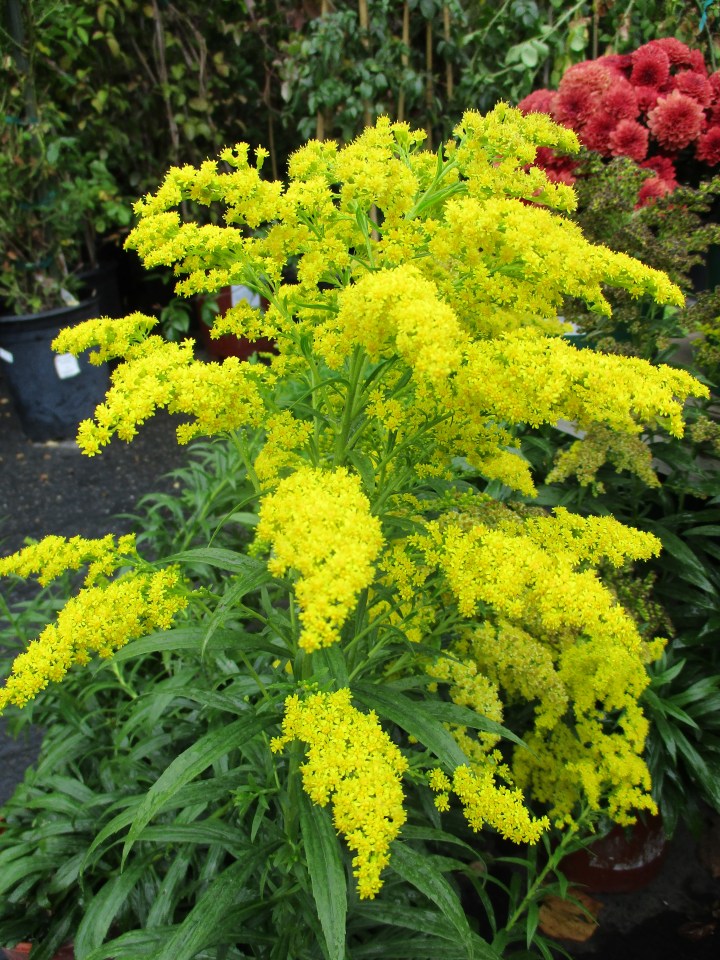
 Here on the West Coast of California, most of us know goldenrod only as a color of crayon. In most other parts of America though, it is a common wildflower that is colorful enough to be popular in home gardens. Yet, with more than a hundred specie, it is hard to say exactly which goldenrod, (Solidago spp.) the crayon color corresponds to. All are some shade of gold or yellow, but some are a bit more orange than others.
 Is it coincidence that the Latin name of black-eyed Susan is Rudbeckia, or was Becky rude enough to give Susan her black eye? The dark center is something that all varieties have in common, and what distinguishes them from most of the related blanket flower varieties. The daisy flowers of black-eyed Susan are traditionally yellow. Modern varieties can be orange, reddish or bronzed.
 Much of the color in the garden through autumn and winter is provided by foliage. Some foliage turns color as the weather gets cooler. Some had been blue, gray, gold, red, bronze or variegated all year, and just happens to get noticed more now that there is not much other color provided by flowers. There are a few flowers that bloom now or even later in winter, but not nearly as many as there were in spring and summer.
 It makes sense for flowers to bloom in spring. Winter is too cool, windy and damp for both flowers and the insects that pollinate many of them. By summer, successfully pollinated flowers have faded, are busy making seed to disperse in autumn. Some plants produce fruit to get birds and other animals to disperse their seed. There are certain advantages to blooming early in the spring.
 Tony Tomeo