Six on Saturday: Miscellaneous

Both work and home gardening were relatively mundane this week. Consequently, these six lack a theme. Irrigation is at that awkward phase when less is necessary, but it is still very necessary. No more rain came after the first storm of the season, but the weather is cooler, and the days are shorter. Autumn is arriving . . . slowly. Maybe I will get pictures of autumn foliar color for next Saturday.

1. Robinia pseudoacacia, black locust is much more out of focus than I was aware of as I took this picture to show how blue the sky is without any rain in the foreseeable forecast.

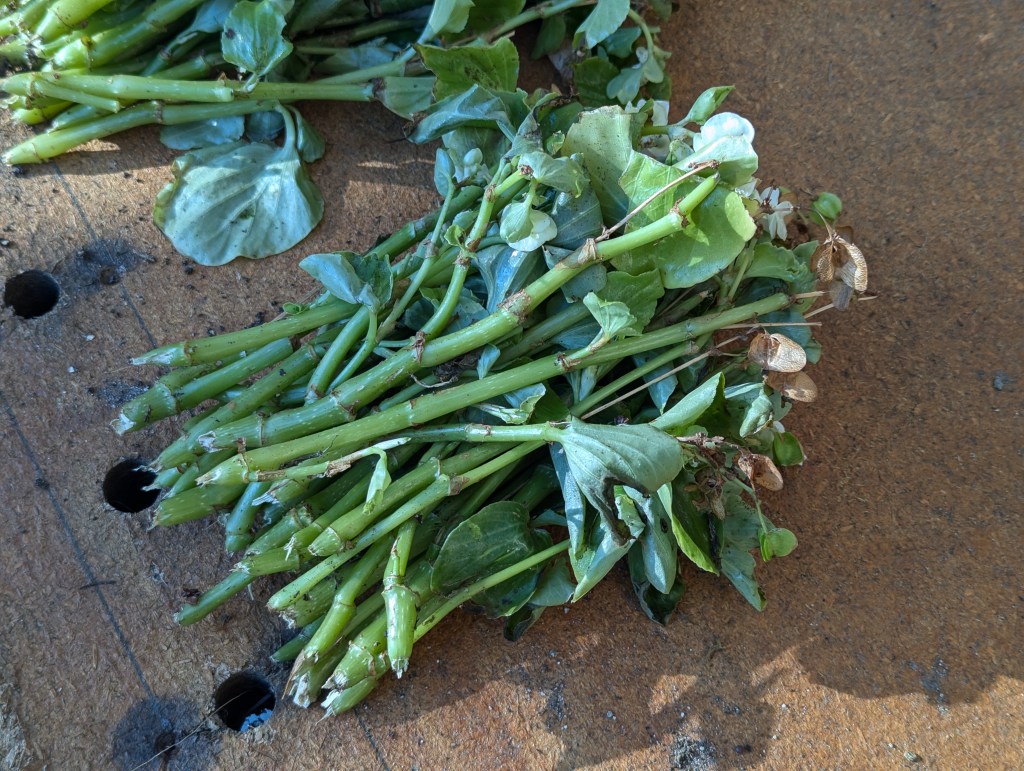
2. Begonia X semperflorenscultorum, wax begonia succumbed to a major infestation of fungus gnat larvae. These fresh cuttings were made from their unaffected upper growth.
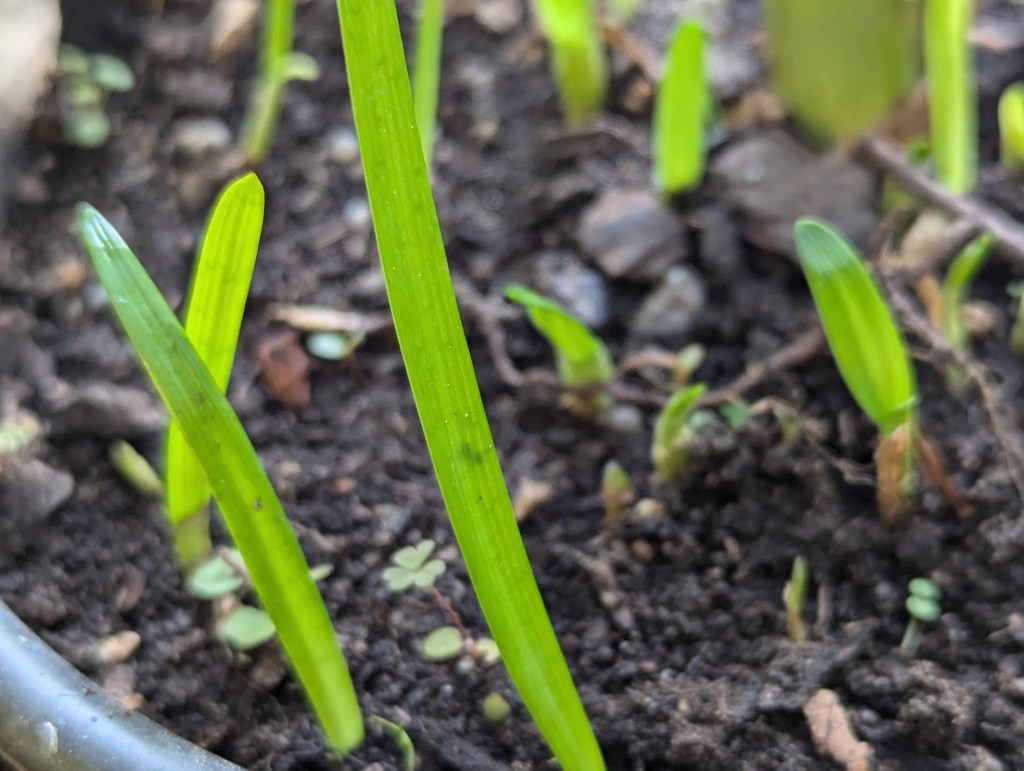
3. Amaryllis belladonna, naked lady seedlings grew from seed from white flowers. They will not bloom for several more years. I am curious to see if they might also bloom white.
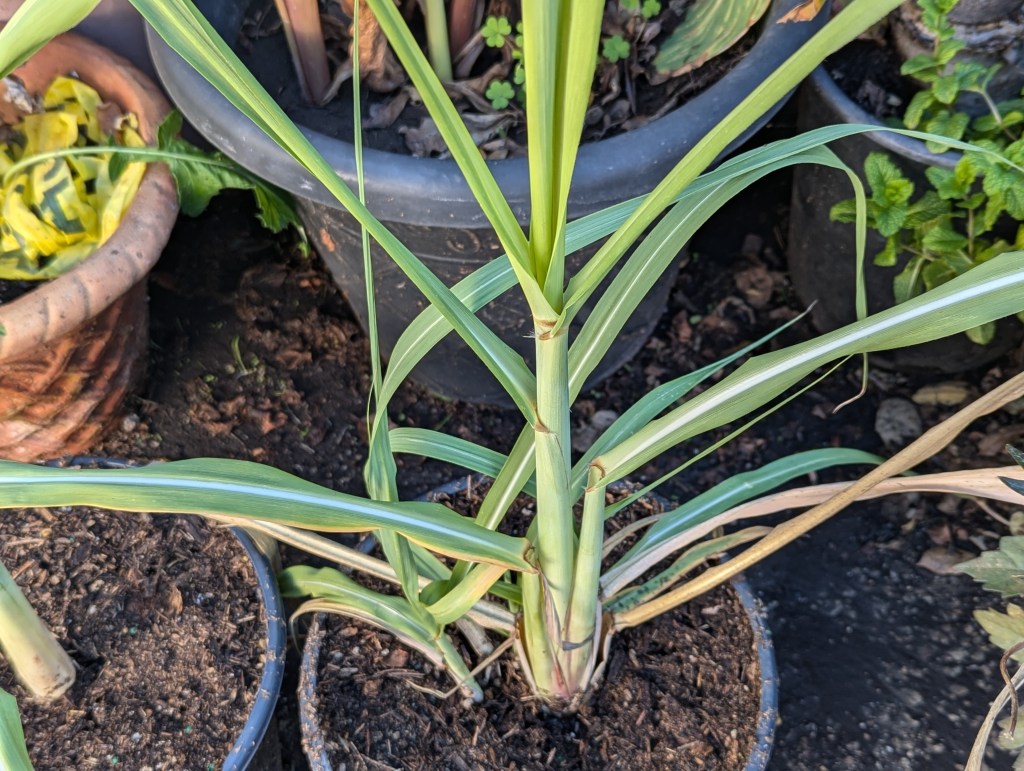
4. Saccharum officinarum, sugarcane probably should not have been bothered until the end of winter, but I separated five clumps. This is the traditional Purple Ribbon cultivar.
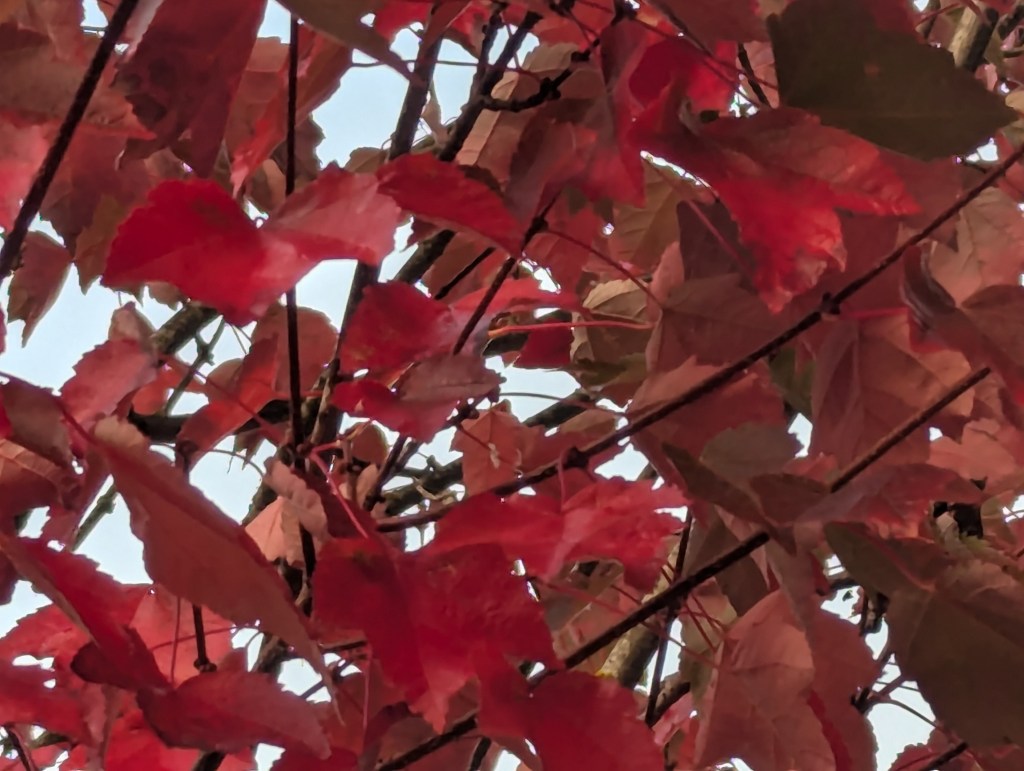
5. Acer rubrum, red maple is redundant to a picture of the same two Saturdays ago, but is too pretty to not get a last picture of before the end of its season. It is mostly bare now.
6. Rhody was busy with relaxation while I was at work on Thursday. He is commendably proficient with such tasks, while not being late for petting sessions and treats afterward.

This is the link for Six on Saturday, for anyone else who would like to participate: https://thepropagatorblog.wordpress.com/2017/09/18/six-on-saturday-a-participant-guide/
Six on Saturday: Bad Timing

Autumn seems to be a bit early this year. The weather is already cooler with a bit of rain. Although no more rain is in the forecast, neither is warm weather. Besides, even if warm weather resumes, it will not last long. Vegetation really should be getting ready for that. A few species, though, are behaving like it is spring or summer. Some were prompted to do so.

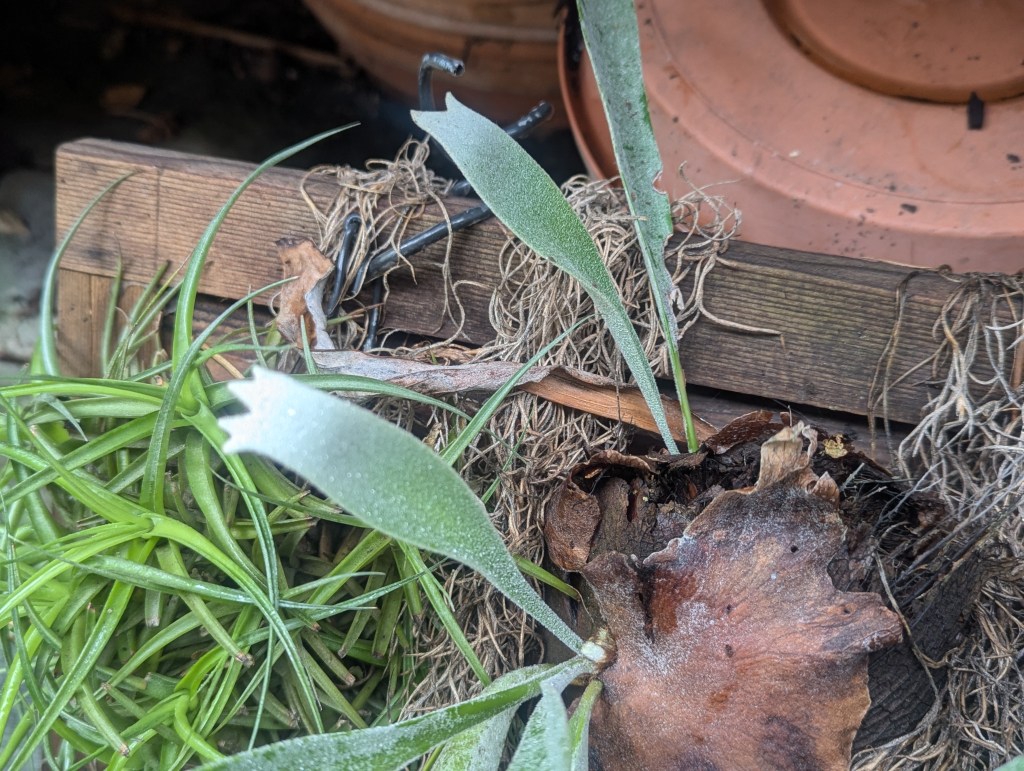
1. Platycerium bifurcatum, staghorn fern has been happy this year, but should not be so active now that the weather is cooling. New growth will be vulnerable to chill this winter.

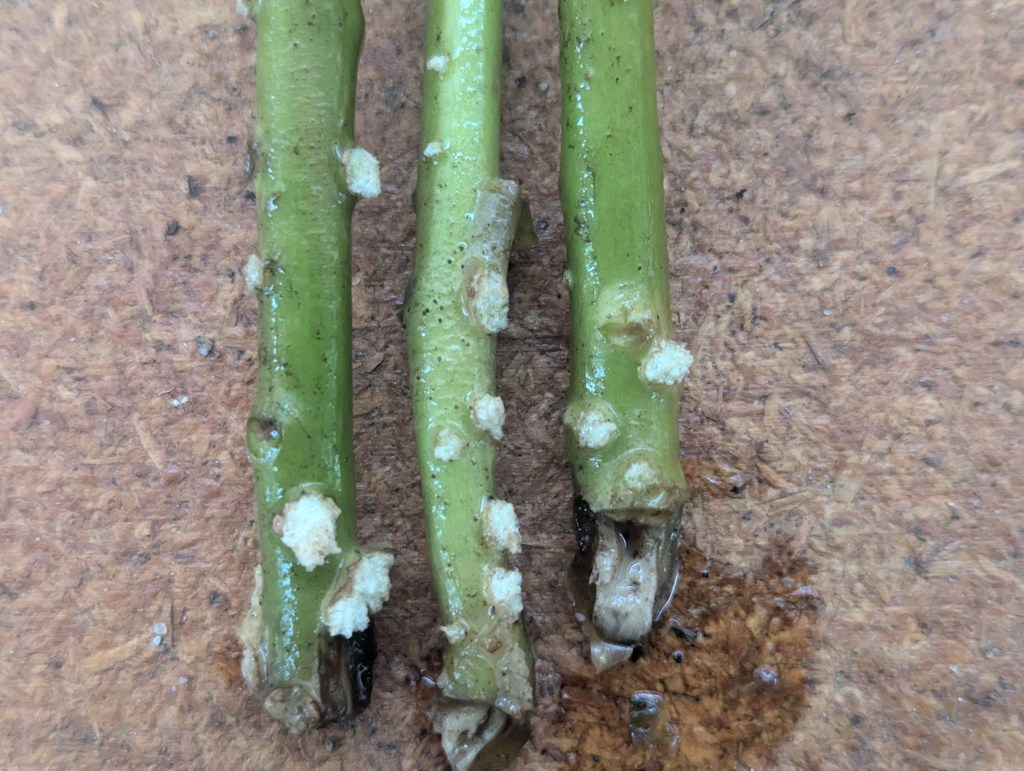
2. Solandra maxima, cup of gold vine cuttings are developing roots now that it will soon be too cool for them to grow. The pruning scrap just happened to become available now.

3. Prosopis velutina, velvet mesquite seedling had all summer to germinate, but decided to do so now. It is the only one of these ‘six’ that is not tropical, so it should know better.

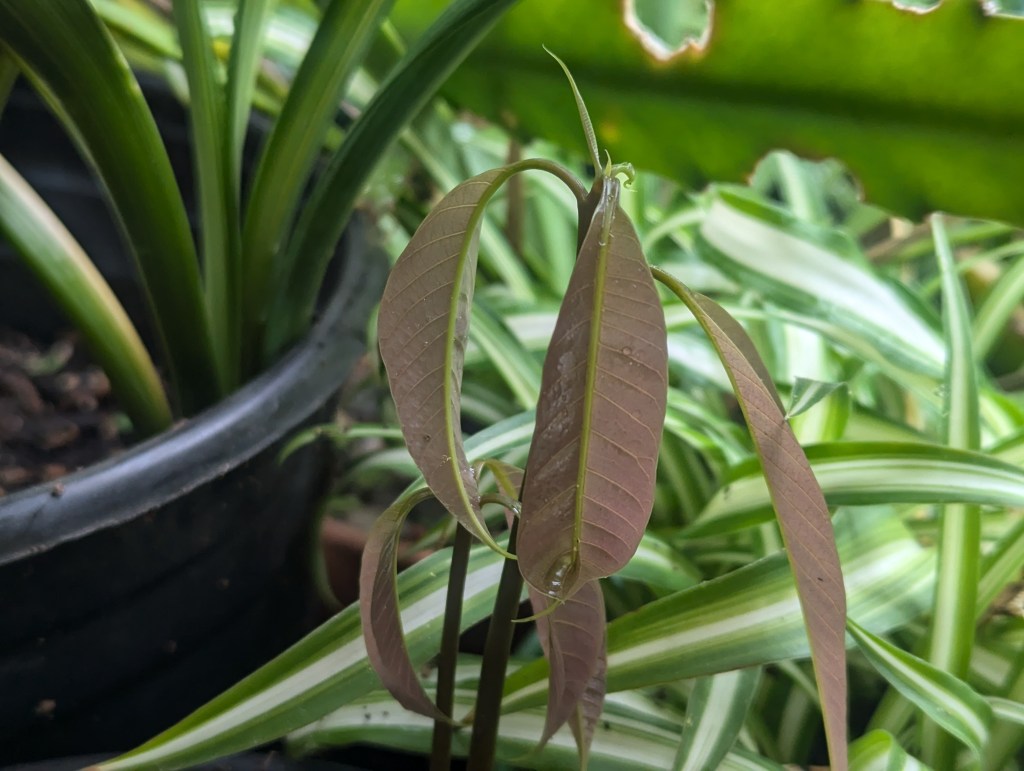
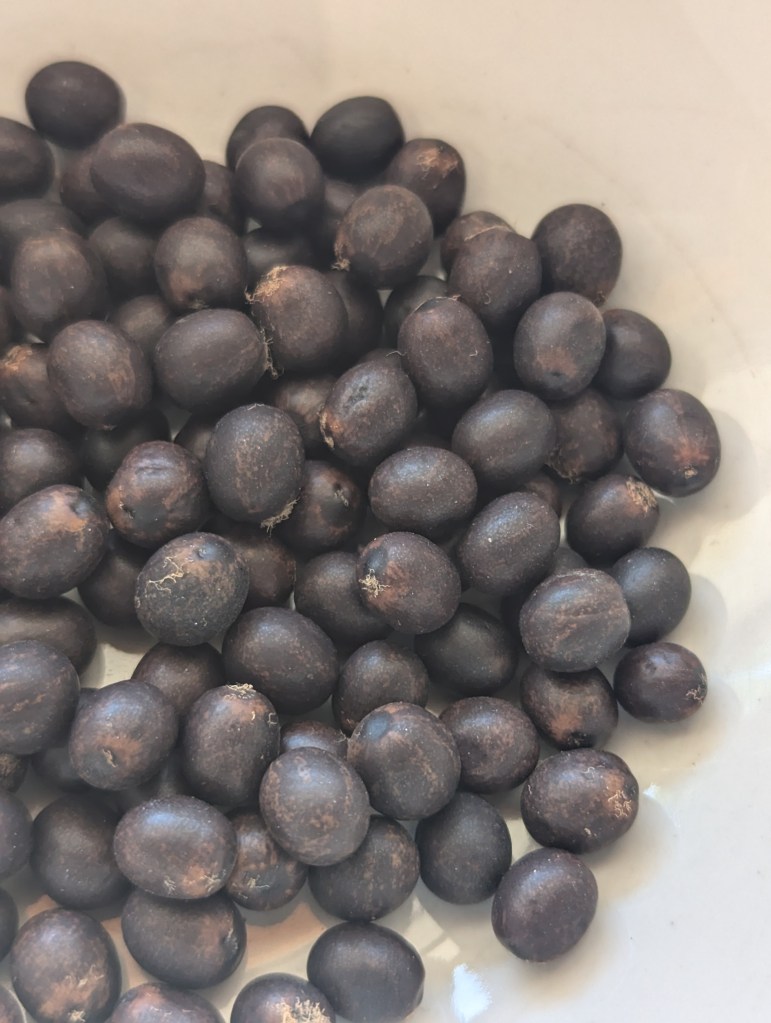
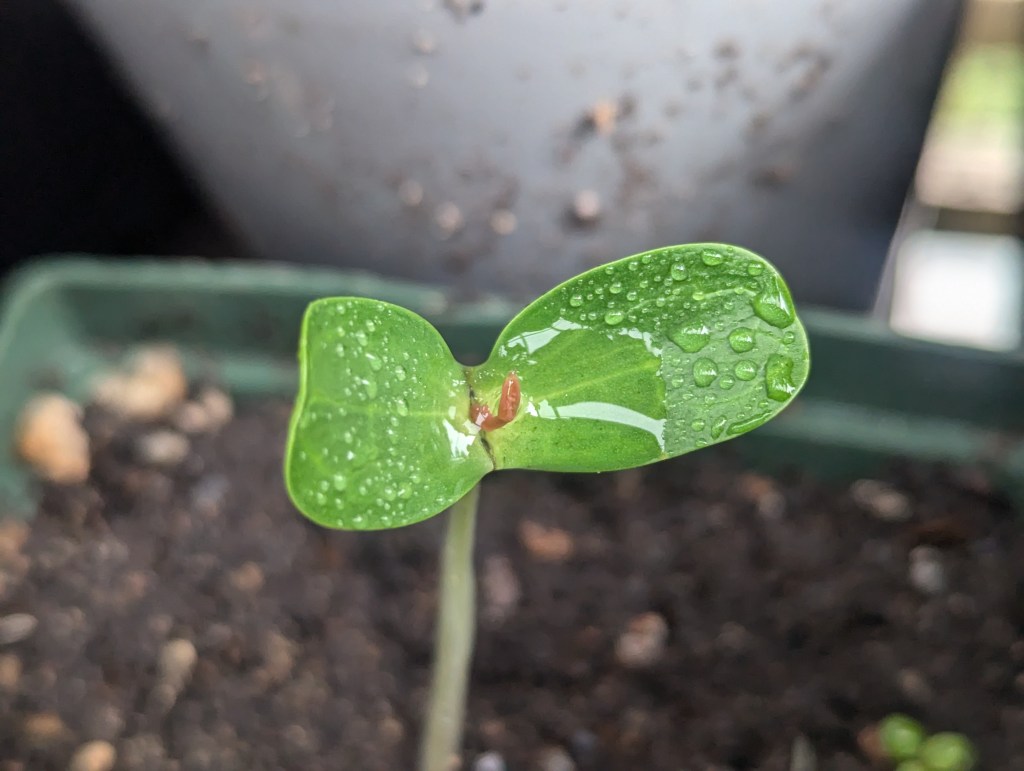
4. Mangifera indica, honey mango seed was sown after its fruits were eaten. Seasonality was not considered. Several seedlings are now growing just prior to autumn and winter.

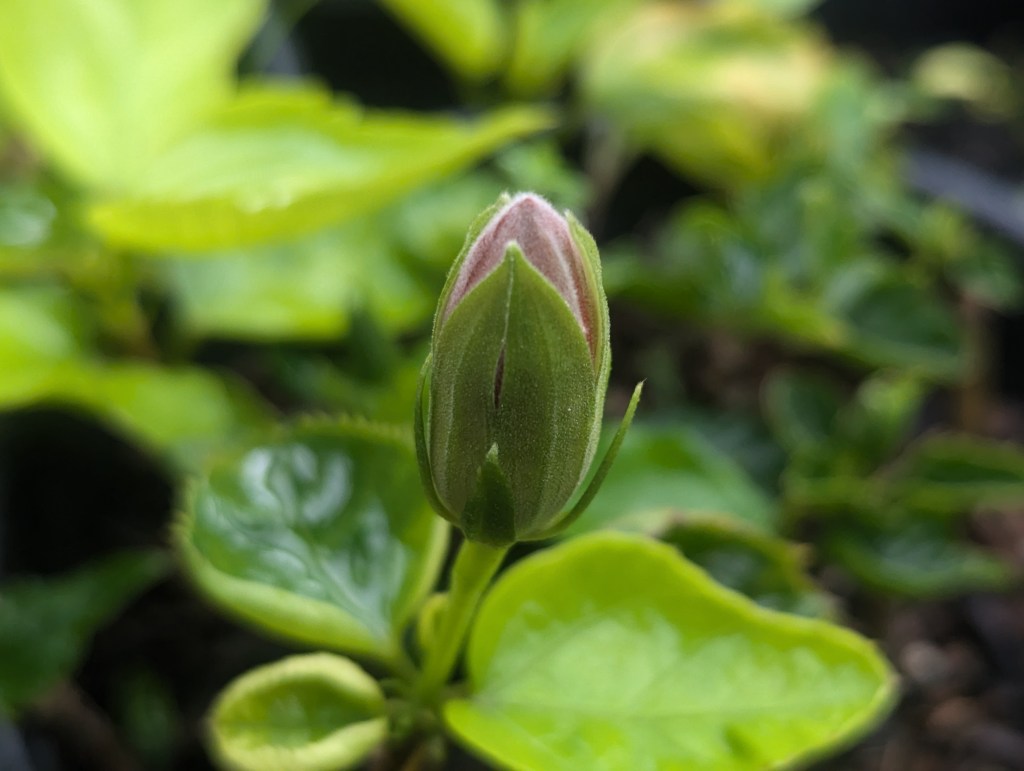
5. Hibiscus rosa-sinensis, tropical hibiscus cuttings have been growing slowly but surely since the end of last winter, but just as they should be slowing, they are trying to bloom.

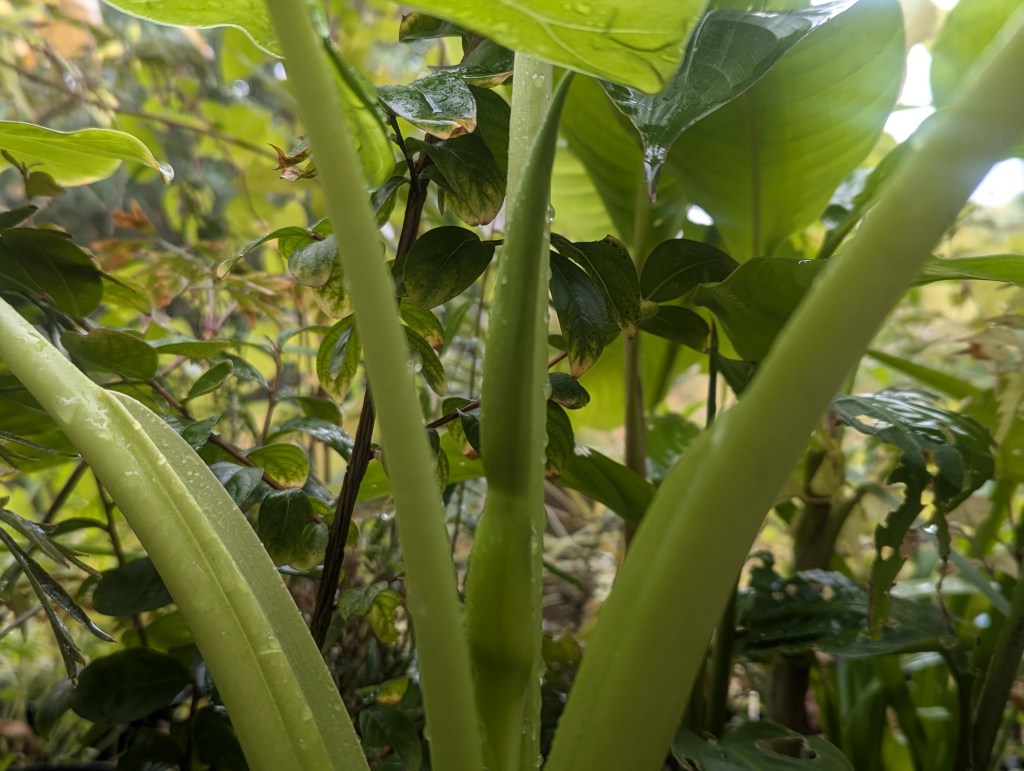
6. Alocasia macrorrhizos, taro is also trying to bloom just as it should be decelerating its growth for autumn and winter. It will be interesting to see how this late bloom proceeds.

This is the link for Six on Saturday, for anyone else who would like to participate: https://thepropagatorblog.wordpress.com/2017/09/18/six-on-saturday-a-participant-guide/
Runt

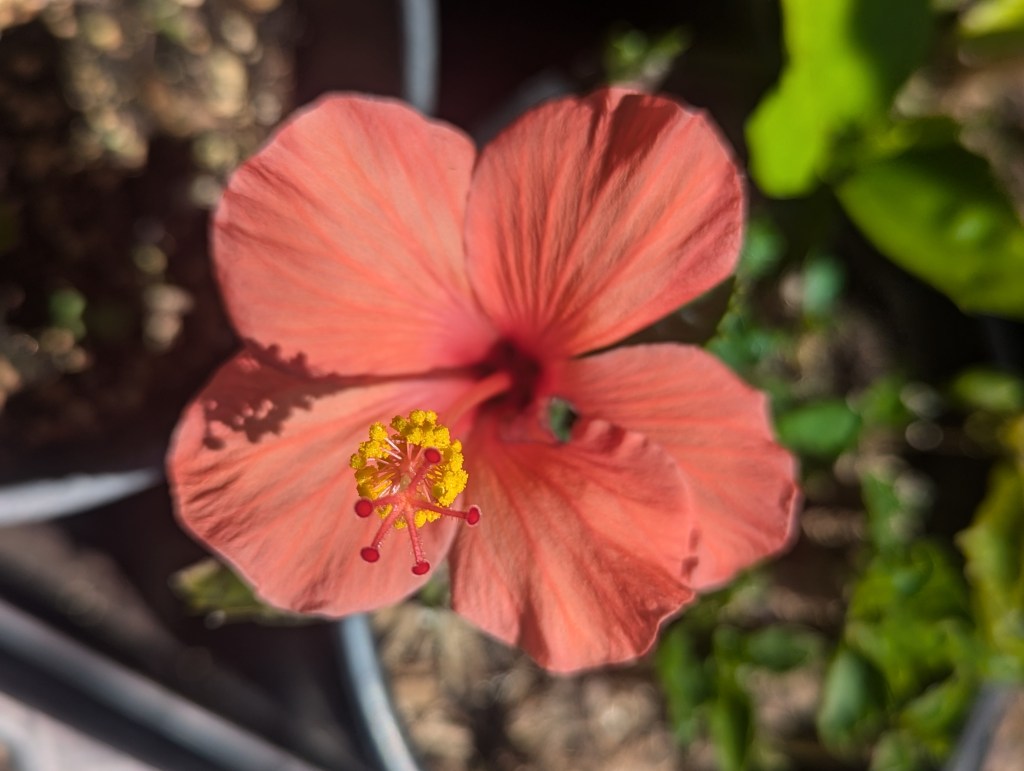
What a pathetic tropical hibiscus flower! It is only about two inches wide. It should be bright red instead of this faded terracotta pink. It even lacks foliage in the background. So, why did I take a picture of it? I was impressed by this flower because it bloomed on a cutting that is still in the process of rooting. I should have removed the bud when it appeared, to conserve resources for root growth. Instead, I let it bloom to see what would happen. This is the result. Knowing all that I know about it, I am somewhat impressed. Of course, I plucked the flower off after taking its picture. After all, I am a nurseryman, not a gardener. I want the cuttings to root as efficiently as possible. Actually, more of them than I expected seem to be rooting, so there may be a surplus of these particular hibiscus in the future. Cuttings of another cultivar that blooms yellow did not perform so well. Only three survived so far, and they are rather wimpy. I may need to go back to collect more cuttings for that one. I also would like cuttings from a cultivar that blooms orange.

Tree of Hippocrates

Platanus, or sycamore, supposedly derives its botanical name from the Greek word “platys”, which means “broad”, and describes its wide leaves. However, some believe that its name was derived from “Plato”, who lectured about philosophy within the shade of a sycamore grove, rather than an olive orchard, outside of Athens. The Tree of Hippocrates, is an individual Platanus orientalis that was planted centuries ago, supposedly where Hippocrates lectured about medicine under a much older tree of the same species. Trees grown from cuttings and seed from the Tree of Hippocrates have been shared with medical institutions, schools and libraries all over the World. One seedling was planted at Dominican Hospital in Santa Cruz in 1968. Until only the last few years, it had been pollarded in an exemplary manner, which left no twigs for me to get cuttings from during winter. Only last summer, a gardener left me a few twigs, which I plugged as early cuttings. Of course, most succumbed to summer warmth. Some of the survivors did not root through winter. Now, though, there are four surviving rooted cuttings! So, we have four copies of a seedling of the second Tree of Hippocrates! Does that count for anything?

Propagation Produces More Garden Plants

Many species propagate reliably by seed.

Seed is the most familiar option for producing new garden plants. Division of perennials, especially overgrown colonies, is another familiar technique. More substantial plants are easier to grow from cutting or layering. Propagation is any process of producing plants. It is how nurseries generate such plants. Some techniques are practical for home gardens.

Propagation by seed is the most practical for most annuals. It is also practical for several perennials and woodier plants. However, not all seed is true to type. Some may become progeny that is different from its parents. After a few generations, ‘Jewel Mix’ nasturtiums revert to orange and yellow bloom. Progeny of most variegated plants lacks variegation.

Propagation by division is more practical for many perennials that form distinct colonies. This includes crowded bulbs. It entails separation of portions of such colonies, or merely single rhizomes. Such portions need only enough root to grow as new plants. Progeny of division are genetically identical to their single parent plant. They therefore do not revert.

Propagation by cutting is the most common technique of propagation among nurseries. It involves cutting pieces of stems and compelling them to grow roots in rooting media. For small scale home garden applications, some of such stem pieces can root in water. Such pieces, or cuttings, are genetically identical to their original parents. They can not revert.

Layering is rather similar to propagation by cutting. Stem pieces remain attached to their original parents during the process though. Burying a portion of stem with its tip exposed stimulates root growth where it is buried. Such stems eventually develop enough roots to sustain themselves after separation. Layering is practical for producing just a few copies.

Propagation is certainly more involved than these brief descriptions imply. It may involve other techniques. Grafting involves assembly of two or more distinct cultivars onto single plants. Rootstock grows from seed, division, cutting or layer. Scions are buds or stems of other cultivars. They graft onto the rootstocks to become the upper portions of the plants.

Male Delivery

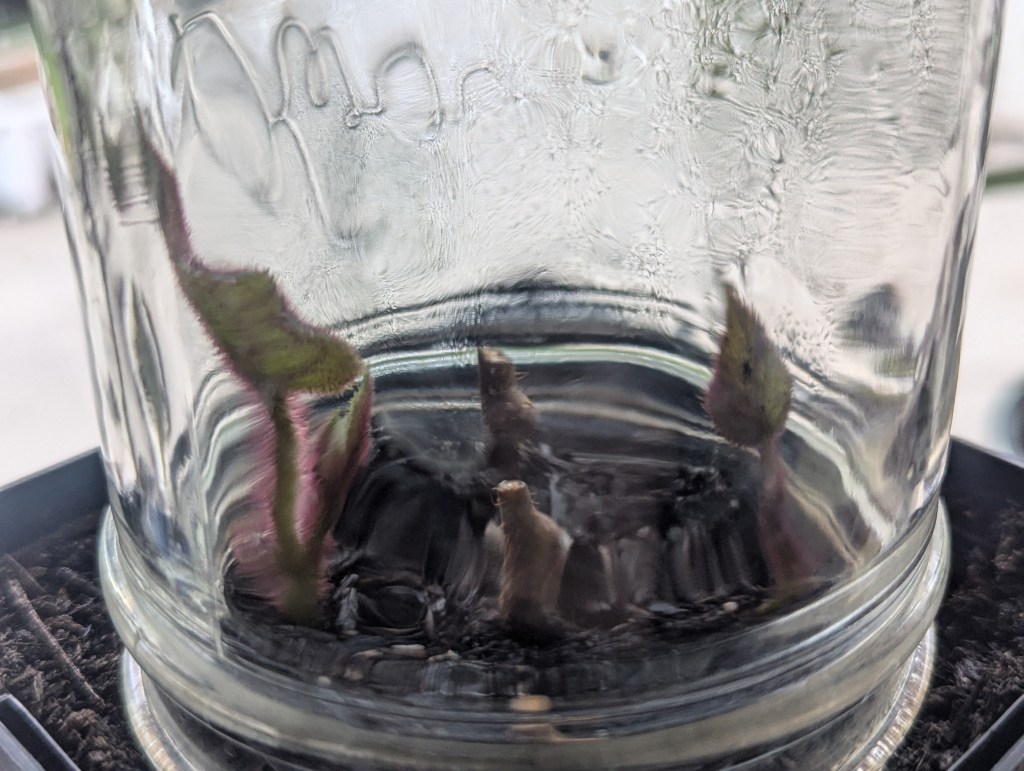
Flowers of all fruit need pollination for fruit to develop. Most are self pollinating. Some require pollination from another variety. Some are dioecious, so female flowers need pollination from male flowers. A few, such as figs and muscadines, are even more complicated, but they are topics for another article. For now, I am concerned with my female kiwi vine, which is growing like a weed, but would have been unable to produce any fruit without a male pollinator. It was not a planned acquisition. I grew it from cuttings from a bit of vine scrap that someone brought to dump in the debris piles here. Because it grew so well, I requested some male vine scrap from the same person who provided the female vine scrap. Obviously, since he grows the female vine in his home garden, he also grows a male vine to provide pollen. I wanted the scrap while it was dormant through winter, because that is when I prefer to start hardwood cuttings. By the end of winter, I figured that it was too late to start cuttings, and that I would need to wait to try next winter. Then, just a few days ago, the person who provided the female vine scrap brought me a small piece of the male vine, which was already foliated and growing! This presents a challenge, since I lack access to a greenhouse with bottom heat and mist. I cut the stem into five cuttings. Three have single axillary buds that are still dormant. Two are vascularly active terminal cuttings, which are merely short shoots that grew from two axillary buds that are still attached. All but the smallest leaves were removed from the terminal cuttings. So far, they seem happy under a jar. Now, I can only watch and wait.

More Sticks

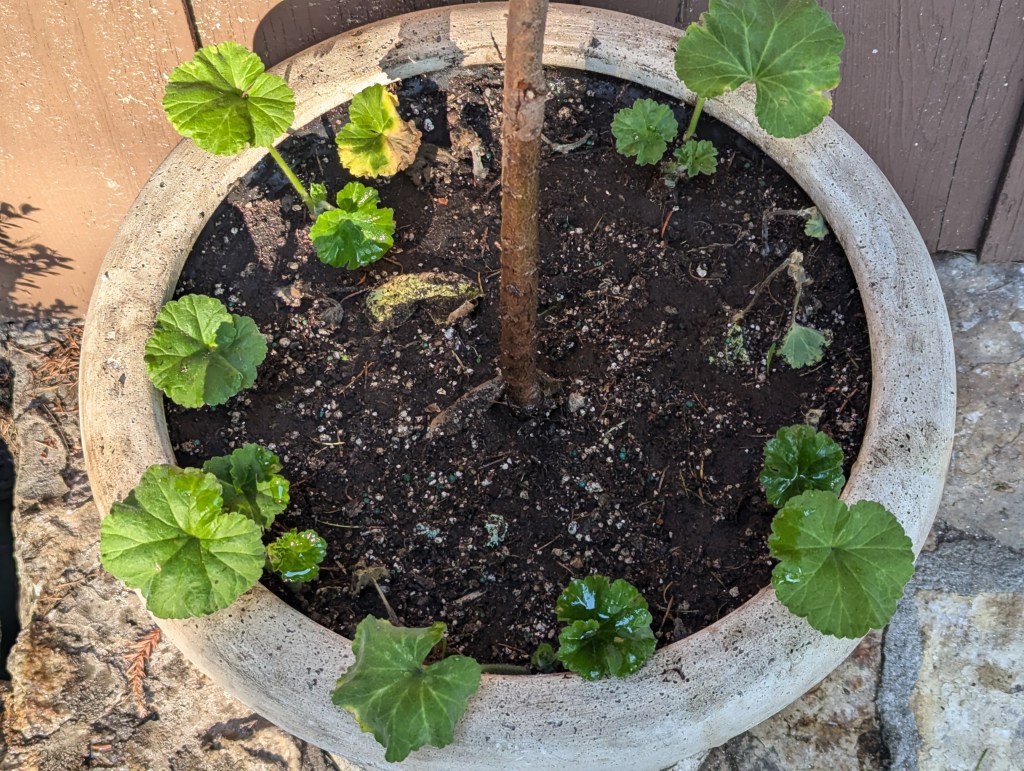
Horticulture involves many sticks. Almost all are pruning scrap. Very few become scions for grafting, like the stick of ‘Beurre d’Anjou’ pear that I wrote about last week. A few more become cuttings, like these white zonal geraniums, Pelargonium X hortorum. These cuttings were processed from scrap of the same that formerly inhabited their same pair of big pots. The original specimens performed well within their pots for a few years, but were about to become overgrown if they had been left to grow for another season. They could have been pruned back and left to regenerate. However, because small specimens of lemon cypress, Cupressus macrocarpa ‘Goldcrest’ were added to their large pots, it was easier and neater to simply remove them completely and replace them with eight cuttings in each of their two pots. These cuttings should grow nicely and perform well for a few more years. Then, they can either be cut back to regenerate, or replaced with cuttings processed from their own scrap after their removal. Such processes cost no more than a bit of time and effort. I have been doing the same with a weedier bright pink zonal geranium that I have been growing since I was in junior high school in about 1979. I acquired the original sticks from a neighborhood garden debris dump, and have been growing them ever since then. I brought them with me to every home that I lived in through college, and then brought them back here when I returned. I acquired a similarly weedy but orangish red zonal geranium in about 1993, and have been growing it since then also. Zonal geraniums are underappreciated for their simplicity, practicality and, most of all, their sustainability. Once they inhabit a garden, there is no need for them to ever leave.

Stick

‘Beurre d’Anjou’

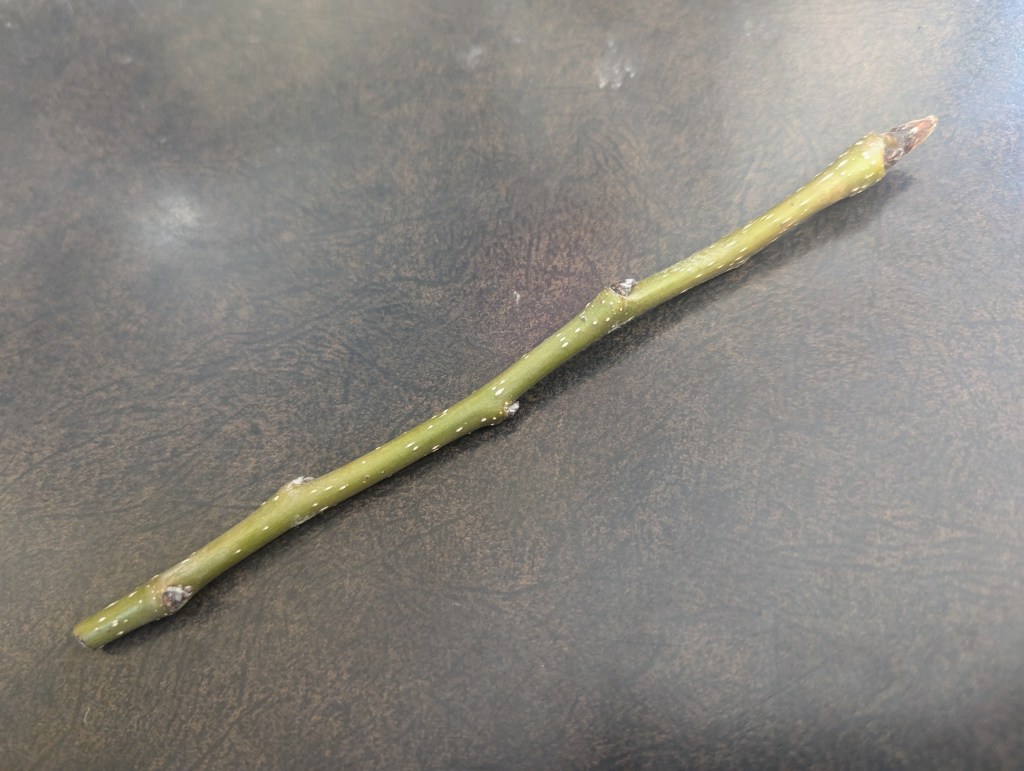
Here it is. The stick! I paid $7.79 for it with delivery from San Leandro, and waited a few days for its arrival last Wednesday. Since then, it was processed into two scions and a cutting, each with two buds. The terminal bud of one of the scions is actually accompanied by a few smaller buds. The scions were grafted, and the cutting was plugged, last Thursday, less than a day after the Stick arrived. I am very pleased with the results, and hope to be even more pleased with their favorable performance in the future. Ultimately, the finished product will be at least one pear tree. More specifically, it will be a ‘Beurre d’Anjou’ pear tree, which is more often known as ‘d’Anjou’ or ‘Anjou’. It and ‘Seckel’ were the only two cultivars of pear that I wanted to acquire this winter. After obtaining scions for ‘Seckel’ pear from the Scion Exchange of the Monterey Bay Chapter of the California Rare Fruit Growers on the first of February, ‘Beurre d’Anjou’ remained elusive. Every pear tree that I could get scions from was either another cultivar, or not identifiable by cultivar. I really thought that the process would be simpler. I could have purchased a tree from bare root stock at a nursery, but that would have been comparable to cheating, and would have cost about $40. The well rooted quince understock for grafting was already here and waiting. I grew a few specimens of it from suckers of an established pear tree, and already used one for the previously acquired ‘Seckel’ scions. Because I was so confident that I would eventually acquire the only pear cultivar that I craved more than ‘Seckel’, I retained the biggest and best of this understock for these recently acquired scions of ‘Beurre d’Anjou’.

Ocotillo Cuttings

Fouquieria splendens, ocotillo

Fouquieria splendens, ocotillo has been an elusive species that I would like to try to grow, even if only to determine that it will not survive for long in my climate. I suspect that there are a few reasons why I have never observed it outside of desert or warm chaparral climates. I know that it is very susceptible to rot if irrigated even slightly excessively, and within some climates, any irrigation may be excessive. If I can grow cuttings, I will put them in stony and very well drained soil on an exposed ridgetop above my garden, where they will get no irrigation. The piece of cane that was given to me a few days ago, and that I mentioned this morning, is about three feet long, with a single offshoot that is a few inches long. Cuttings should supposedly be between four and six inches long. I tend to make short rather than long cuttings, so would be inclined to cut them four inches long, for a total of about ten cuttings, including the offshoot. I am tempted to cut thirteen cuttings, three inches long, but will try to confirm with the recommended four inch minimum. I do not leave many cuttings out for their ends to dry, but will make an exception for these, since that is what is recommended. I will refrain from scarifying the sides of the proximal ends of the cuttings, just because the stems are somewhat wide, with correspondingly wide basal cuts. Rooting hormone powder will be applied, also as recommended. Fortunately, winter is the best time for starting such cuttings. However, they develop roots slowly, so may not be ready for plugging for two years. I can wait. I will continue to maintain these ocotillo cuttings until they either root or rot.

Santa Cruz II

Begonia boliviensis ‘Santa Cruz’

Begonia boliviensis ‘Santa Cruz’ is significantly bigger than it was when I wrote about it three months ago. If I had known that it would have performed so well, I would have groomed it for better form. It grew upright at first. I just let it do so because I wanted to make a cutting from the tip when it got pruned back. However, because it leaned over and branched as it should, it did not get pruned back. It could have developed a better and lower form if I had tended to it better, but I am too pleased with it now to complain that it is a bit more upright than it should be. I do not mind that I did not get a cutting from the primary stem that I did not cut back because there are now many more stems that I can get cuttings from, simply be grooming out a small bit of superfluous growth from within. I could get many more than I want if I were to actually prune this specimen back for winter. It is getting to be too exemplary to cut back for winter, though. Nor do I want to leave it out to get frosted, as I might do with other begonias. The horticulturist who procured it will shelter it from frost, and perhaps groom it a bit after winter, but otherwise try to retain as much of this growth as possible for a head start next spring. I am curious to see what it does. Will it shed most of this growth as it resumes growth from below next spring; or will it grow from near the tips of where it stopped growing this year? I did not expect to be so impressed by this modern cultivar of Begonia.