Please Do Not Pick the Flowers

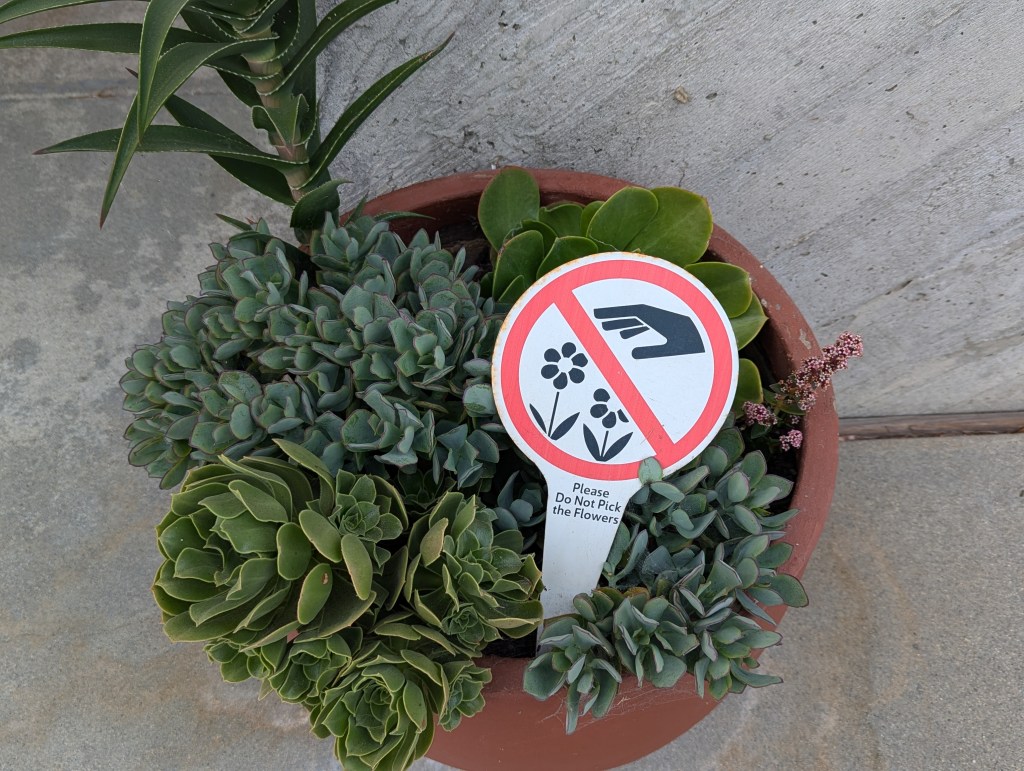
Am I that predictable? How did whoever posted this sign know I would be here? I do not want their stupid flowers anyway. Besides, only that dinky twig of some random species that I can not identify is blooming on the far right. Is that all they got? What I really want, or more accurately, what I would want if I did not find them to be either uninteresting or redundant what is already in my garden, is stem bits of the succulents for propagation. I suppose that I am not the only one who might want that, which is why the sign, although slightly irrelevant to such desires, became necessary. Actually, I have direct experience with pilferage of bits of succulents from my small planter box downtown, so I am aware of why such signs might be useful. I would not install any such sign within my planter box because such a sign would be bigger and more prominent than any of the flowers that it would be intended to protect. If I were to grow more flowers, I would prefer those that are so abundant that no one would miss a few that might get pilfered. The most abundant flowers are also smaller than less abundant flowers, so they would not be as tempting to those who might want more impressive flowers. For example, the bearded iris within my downtown planter box blooms with only a few big and bold floral stalks. Not only are the flowers tempting and easily taken, but when they are taken, there are no more to replace them. Anyway, I do not actually mind if those who want copies of my succulent perennials take a few bits if only they do so properly. It may happen more often than I am aware of, but of course, I am not aware of it if otherwise useless bits are taken from below the visible growth, or where they should be pruned away anyway. That is how I justify what you likely know I will mention next. Yes, only about a hundred feet from this urn filled with succulents and the sign that requests that I refrain from doing as such, even if it does not mention the subject matter and procedure directly, I ‘borrowed’ a few bits of stem from the underside of a shabby specimen of what seems to be ‘Roman Red’ Salvia guaranitica that should eventually get pruned back for winter anyway.

Horridculture – Pilferage

Cuttings could have been taken more neatly than this.

Aeonium arboreum, tree houseleek and a few other succulents within my tiny downtown garden are very important to me. They are from the former garden of a friend who passed away years ago. They have performed very well for this particular application since their arrival. They are resilient and undemanding, and provide delightful foliar color and form. The darkest bronze cultivar of tree houseleek that I ever grew arrived with them, but over a few months, was stolen until none of it remained. As the first few cuttings grew enough to become prominent, they were either taken completely, or deprived of their upper foliar rosettes. Any remaining rooted but bare stems eventually succumbed as any subsequent foliar rosettes that they generated were also taken. The surviving succulents remain only because they are both less popular, and too numerous for complete depletion. Actually, I would not mind if those who find these succulents to be appealing sometimes take a few pieces. I merely find their lack of tact to be annoying. I expect them to know better than to take the last of something. Also, I expect that they should have enough sense to take bits from where they would not be missed, and to do so neatly, without leaving broken stubs. Quite a few stems are sometimes overgrown or extending awkwardly outside the planter box, so should be removed anyway. Many stems that are overwhelmed by upper growth could be removed without compromising collective visual appeal. That might actually be a common occurrence that I am not aware of because it is done properly. Stems of these succulents can be easily broken neatly at their unions, without leaving stubs, so pruning shears are not even necessary. Fortunately, these damaged tree houseleeks will recover like they and other succulents always do.

Horridculture – Profitable Waste

Surplus should be a useful resource.

There is nothing wrong with this picture yet. It simply shows African daisy as it begins to encroach into a row of lily of the Nile. Because it is already September, we will delay the pruning of the African daisy to maintain clearance from the lily of the Nile. Then, we can process the pruning debris into cuttings that we can plug into areas where we want more African daisy. These cuttings can grow slowly and disperse their roots through cool and rainy autumn and winter weather to be ready for next spring and summer. It is how a bit of something that is undesirable here can be desirable somewhere else. That is how the lily of the Nile arrived here. It needed to be removed from where it had migrated beyond its preferable confinement, so was relocated to become an asset to another landscape.

So called ‘gardeners’ would do this very differently; partly because, within their stringent schedules, they have no time to process cuttings or divide perennials, but partly because it is less profitable. They would be more likely to shear a neat edge for the African daisy whenever it happens to be convenient for them, and then efficiently dispose of all of the debris. If more African daisy is necessary elsewhere, they would purchase and install it, and charge their client accordingly. The lily of the Nile would probably not be here, since they would have likely disposed of it immediately after digging it from where it needed to be removed from. If any were desirable here, they would purchase it from a nursery and install it, and, of course, charge their client accordingly. Ultimately, their technique might not be much more expensive, but it is nonetheless wasteful, and frustrating to those who are aware of it.

Six on Saturday: Too Much or Not Enough

Propagation without adequate propagation infrastructure can be disappointing. It might alternatively be a bit too rewarding. I prefer to propagate excessively, to compensate for expected losses. Consequently, I generate surplus much more often than I encounter any disappointment. One of the disappointments this week is actually the result of a surplus that occurred too late within the growing season of that particular species. I managed to find three other disappointments for half of these Six, but they are relatively minor, and should eventually be resolved prior to autumn. Even then, because these three particular species are vulnerable to chill while young, I intend to shelter them through winter. The surplus can eventually be shared with neighbors. It all works out.

1. Passiflora racemosa, red passion flower vine pruning debris was processed into a flat of thirty-six cuttings. I suspected that only a few would survive, but I was wrong. Oh my!

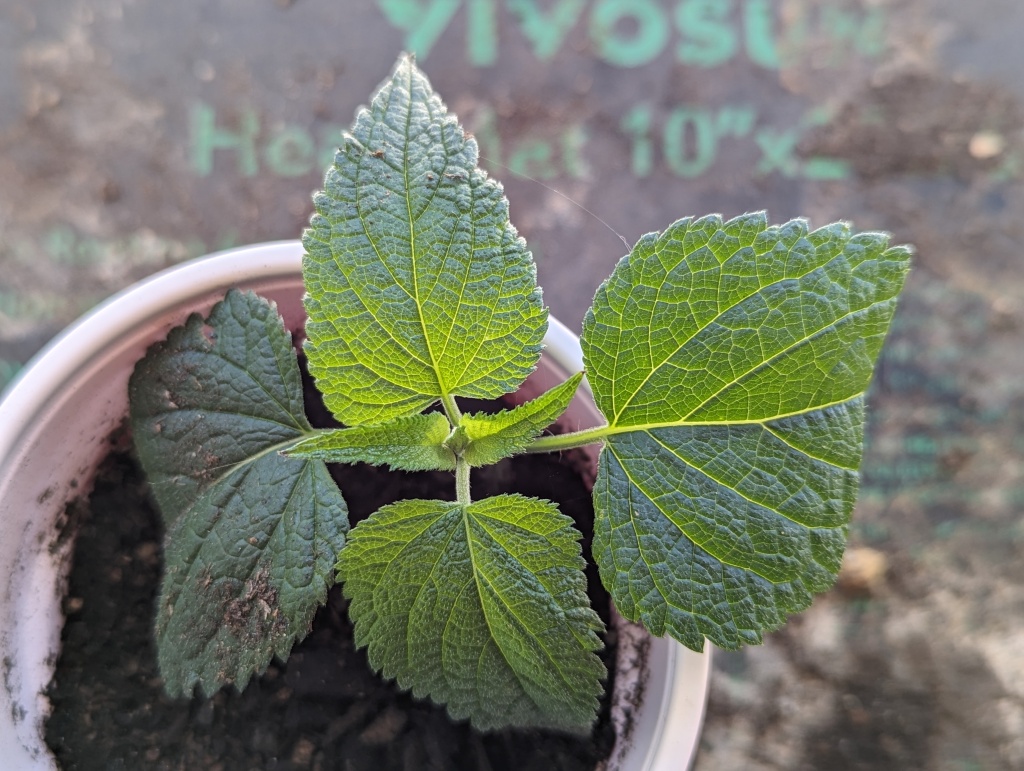
2. Citrus paradisi ‘Marsh’ grapefruit cuttings were initially about as numerous, but very few survived. They defoliated, and are still vulnerably dinky. They are ungrafted anyway.

3. Mentha spicata, mint is still going. There was already too much months ago, but I still plug its trimmings as cuttings. I should stop now. I should have stopped before I started.

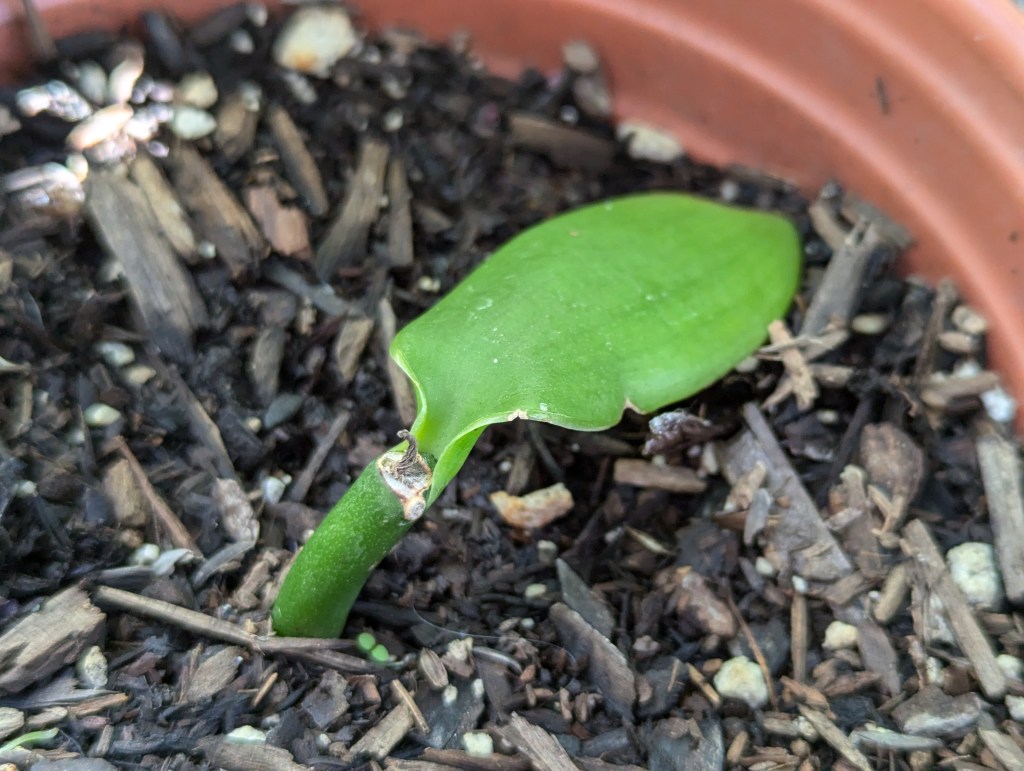
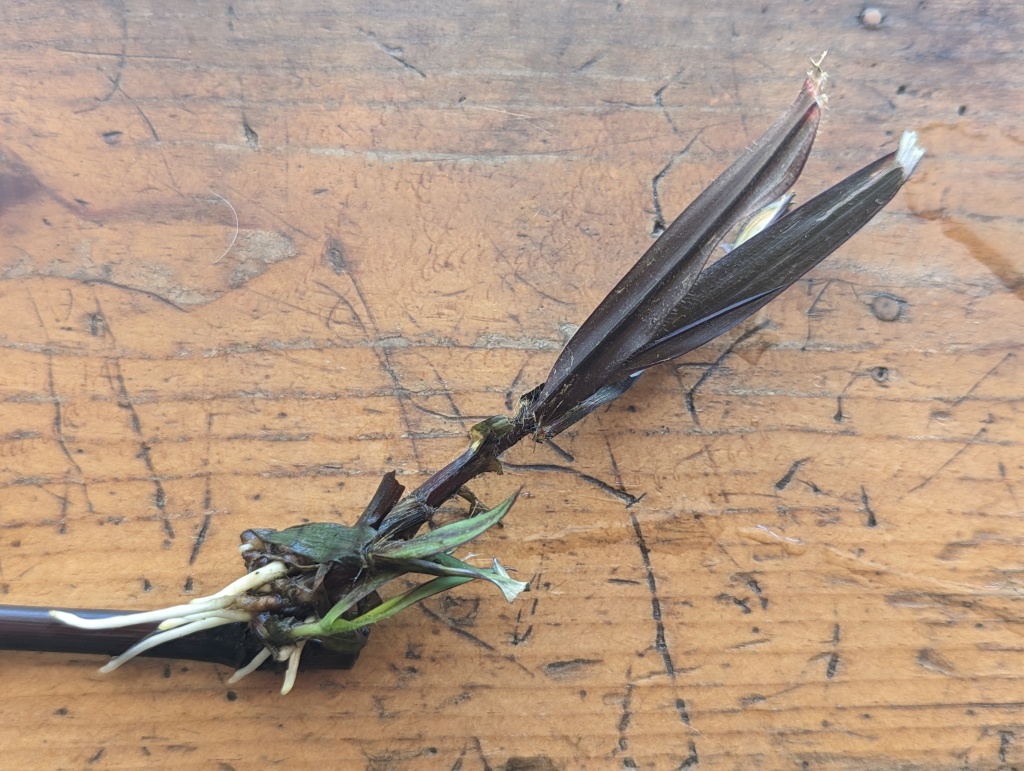
4. Vanilla planifolia, vanilla is still doing nothing. Only this one of five cuttings survives. Its single exposed bud has been inactive for months. Perhaps a lower bud is doing more.

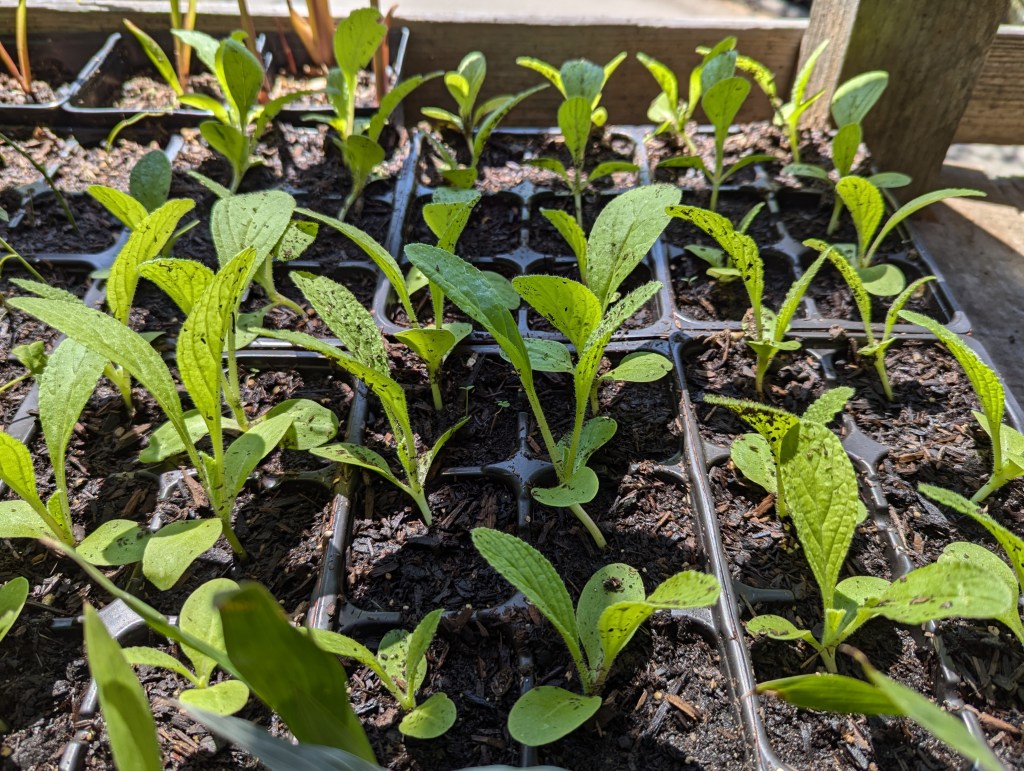
5. Borago officinalis, borage grew unexpectedly from expired seed that got tossed. These thirty-six, which are now in a filled flat, are too many at the end of their growing season.

6. Musa acuminata ‘Popo’Ulu’ banana is the eighteenth of twenty cultivars here, but this is its first new leaf since its arrival. It must grow more prior to autumn to survive winter.

This is the link for Six on Saturday, for anyone else who would like to participate: https://thepropagatorblog.wordpress.com/2017/09/18/six-on-saturday-a-participant-guide/

Sustainability Sometimes Needs Help

Some perennials naturally last longer than others.

            As much as I like to remind everyone of how easy it is to perpetuate many of their perennials for ever, and to share with their friends, neighbors, children, grandchildren, great grandchildren and so on, there are just some perennials that are not meant to last. I do not mean that they can not last; only that they are not as easy to sustain as others are. For most of these not so easy to sustain perennials, the original plants actually die completely, so will only be sustainable if replacement copies are propagated by cuttings or layers before the demise.

             Many of the very easy to grow daisies and daisy relatives are actually not as self sustaining as they should be. Clumping gazanias can actually rot out in the middle after a few years. Before this happens, it is rather easy to propagate replacement plants from division of mature clumps, or to take small cuttings, even though clumping gazanias do not often need to be pruned. Alternatively, side shoots can be layered (pressed into the soil to form roots) right next to parent clumps. Only a few replacements are necessary, but without them, clumping gazanias eventually die out.  

            Even trailing gazanias can eventually die out. Because they sometimes need to be pruned around the edges, there is a regular supply of material to make cuttings to patch bald spots. To get bigger cuttings, I actually like to delay edging until the plants look shabbier than they should around the edges; but my neighbors do not mind. (At least they do not tell me if they mind.)

            Shrubby marguerite daisies (not blue marguerites) and euryops likewise need to be replaced every few years. If there is enough space, outer stems that lay on the ground can be layered. It is best to bury each layered stem in a small hole, and then hold it down with a stone or brick. The layered plants may not be so symmetrical when the parent plants die out, but should fill out nicely. The fourteen euryops in the long park-strip in front of my home did not have enough space for layering, so died a slow, miserable and unsightly death until I finally removed them. If I had planned better, I would have taken cuttings to replace them.

            It is a surprise when pink breath of Heaven (Coleonema or Diosma pulchrum) or coyote brush dies suddenly, because they are really woody shrubs. (Although coyote brush is actually of the family Compositae like gazanias and daisies, etc.) Various ceanothus live longer, but not much longer. These woody shrubs are not so easy to layer, and quite difficult to root from cuttings, so often get replaced with new plants from the nursery, or different plants.  

Sweet Spot

Saccharum officinarum ‘Pele’s Smoke’ sugarcane

‘Pele’s Smoke’ sugarcane has grown enough for installation into the landscapes. I am not certain how happy they will be here through winter, but we will find out. Frost is mild here, but is supposedly enough to kill them to the ground. I expect that. Even if they do not die to the ground, I would prefer to cut them down by the end of winter regardless. Survival of their basal growth is more of a concern. I want them to regenerate next spring. It is difficult to imagine a species as vigorous as this being so vulnerable to the locally mild frost, but all the information that I find about it insists that it is marginal here. There are so many canned specimens that it would be no problem to shelter some through winter to replace any that do not survive in the landscapes. Later, if they get depleted, it would be no problem to take cuttings from those in the landscapes in autumn, and shelter them through winter to put back into the landscapes in spring. However, that is just too much unnatural intervention for me. If they are not happy here, they I do not want to force them. I enjoyed growing them while I did. I got the cuttings from grooming a specimen in Brent’s garden. I was not very careful with them, and did not process them very efficiently because I knew that I would get more than I could accommodate. Ultimately, after sharing a few with friends and neighbors who are aware of the risks, thirty new specimens remain here. Fifteen are in #1 can, including the first three that were just installed into the landscapes. Another fifteen are in four inch pots, which is annoying one less than a full flat of sixteen.

Layering Can Copy Favored Flora

Ivy can grow roots almost anywhere.

Seed is the most familiar method of propagation. However, some popular plants produce no viable seed. Some produce seed that is genetically very different from its parents. For many plant varieties, only vegetative propagation reliably produces similar copies. Such copies can grow from division, cuttings or layering. They are genetically identical clones.

Layering is uncommon for nurseries because it is generally insufficiently productive. It is unpopular for home gardening because it seems complicated. It is actually more reliable for many species than cuttings are. Also, layering is quite practical if merely a few copies are sufficient for home gardening. Realistically, it is not as complicated as it seems to be.

Layering is simply the development of roots where stems lay on the soil. All sorts of flora does it naturally without intervention. For example, ivy vines notoriously develop roots as they extend over the ground. Tips of raspberry canes develop roots where they leap over to reach the ground. These rooted tips grow replacement canes that repeat this process.

With a bit of intervention, several species that do not commonly layer can do so also. For some, it can be as simple as pressing a lower stem into moist soil. Application of rooting hormone to exposed cambium accelerates layering for most. Gouging into the underside of the buried portion of stem exposes its cambium. Tip growth must remain above grade.

For most species, the buried portions of layering stems should be a few inches in length. Extra stem length is no problem. Actually, if stems are long enough, they can be situated into their permanent locations. Stems can layer right below grade, but they prefer to be a few inches deeper. While their roots develop, they require irrigation for evenly moist soil.

The few inches of foliated tip growth above grade sustains actively layering stems. Also, remaining intact cambium provides sustenance from the original plant. Only a few stems can layer simultaneously, but that is enough for most gardens. Hydrangeas, azaleas and camellias layer quite easily. Pines, oaks and eucalyptus do not. Layers should develop quite a few roots before separation.

Reveille

Angel’s trumpet, Brugmansia X cubensis ‘Charles Grimaldi’

Summer has been slow to arrive. Now, some flowers that have been waiting for a bit of warmth to bloom are ready to make up for lost time.

These angel’s trumpets are fortunately silent. Even prior to full bloom, so much bloom looks silly with such minimal foliage.This picture is a few days old; so they are in full bloom by now. More foliage will develop as the summer progresses.

This particular cultivar is the common ‘Charles Grimaldi’, with splendidly fragrant single yellow flowers. Two other cultivars are blooming nearby. One is somewhat less vigorous, with single white but perhaps less fragrant flowers. The other is more compact than ‘Charles Grimaldi’, with double white and comparably fragrant flowers.

All were grown from cuttings, and have potential to grow like weeds. Six more of the cultivar with double white flowers were added to another landscape nearby. Several of both cultivars with white flowers are developing in the nursery, and will need homes either in the landscapes or neighbors’ gardens by next year. Another cultivar in the nursery may bloom with mildly fragrant single pastel orange flowers in the next few days, but we will not know until it actually does so. We have not seen it bloom yet. It could actually be another copy of ‘Charles Grimaldi’.

Daylilies are beginning to bloom now also. Like angel’s trumpet, they seem to have been waiting a bit longer than they wanted to, so are ready to bloom simultaneously in atypical profusion. I hope that such profusion does not compromise subsequent bloom, since they continue to bloom throughout summer and until frost. Also like angel’s trumpet, daylilies are so easy to grow and propagate that there has been no incentive to acquire more cultivars than the three or so that are already here.

Six on Saturday: &

Odds & ends. Bits & pieces. Rhythm & blues. That is all I got here. The latter might make sense with #4 below. It makes this no easier for me though. I have difficulty writing with characters such as “&”, and even “#”, although I do use “#” when necessary to describe a caption number or can size as for #6 below. Perhaps I should challenge my comfort zone a bit more, as I did when I tried using contractions a few months ago. Although I did not continue using them afterward, it was not nearly as awkward as I thought it would be. At least I now realize that I could do so if I choose to. I simply choose to not do so. In other simpler words, I could, but I don’t.

1. Carson, Rhody’s Roady, posed for this thumbnail illustration for a recent article about how similar binomial botanical nomenclature is to traditional automotive nomenclature.

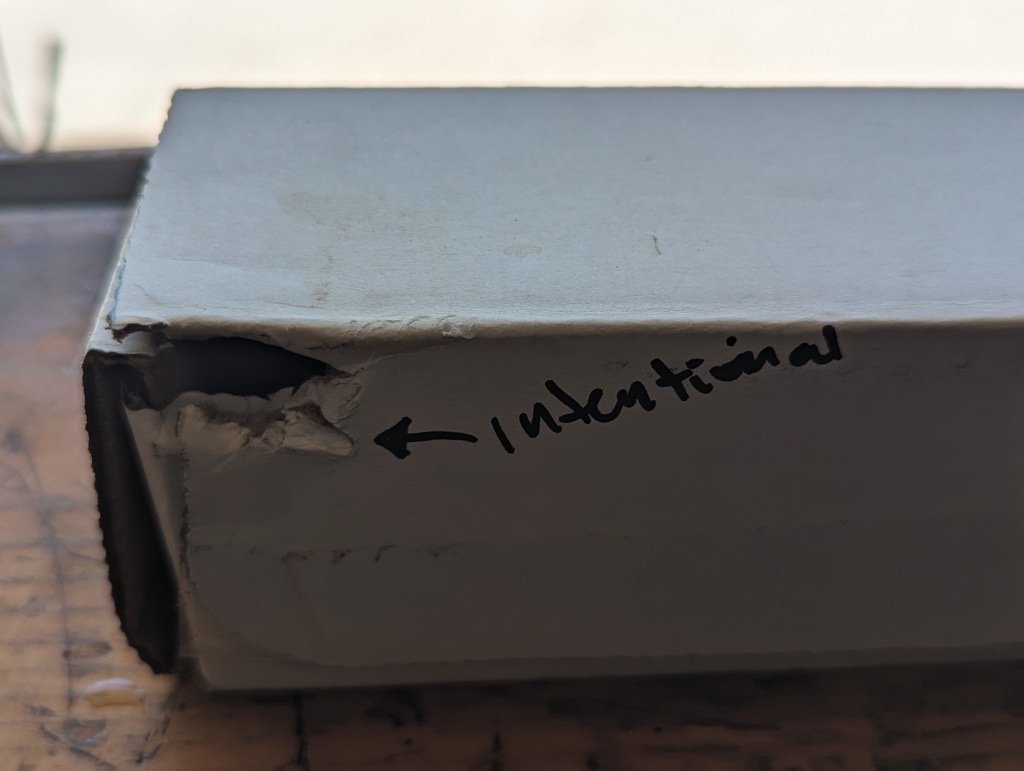
2. Purchases are almost against the rules in my garden. They can only involve items that I lack access to. This purchase that was delivered by mail apparently needed ventilation.

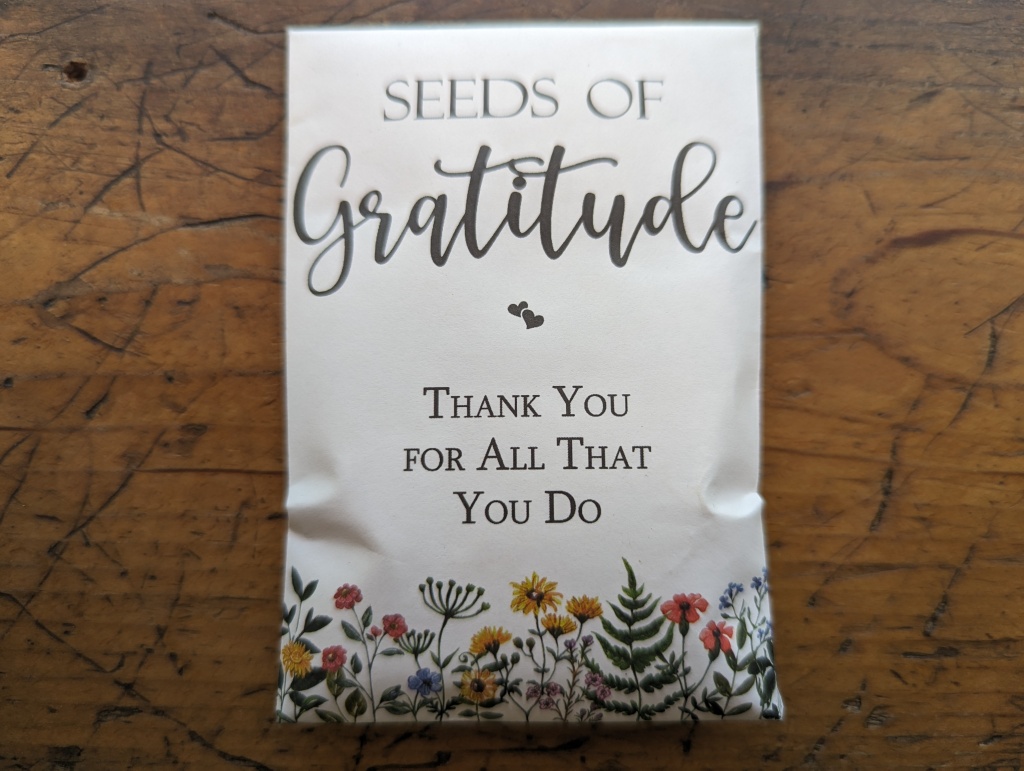
3. Someone who does not take compliments well diverted this one to me. No one knows what seed it contains, but I suppose that we will find out when it grows after next winter.

4. Salvia guaranitica ‘Rhythm & Blues’ came as a cutting in a red Solo cup with the pack of unidentified wildflower seed. This is why I abide by my rule that disallows purchases.

5. Saccharum officinarum ‘Pele’s Smoke’ sugarcane provided more cuttings than I knew what to do with. Fortunately, most succumbed to frost. I can accommodate these fifteen.

6. However, they are merely the fifteen best specimens that were big enough for #1 cans. At least as many smaller cuttings that got separated from them still need four inch pots.

This is the link for Six on Saturday, for anyone else who would like to participate: https://thepropagatorblog.wordpress.com/2017/09/18/six-on-saturday-a-participant-guide/

Crassula tetragona

Crassula tetragona is more similar to related jade plant than it appears.

Although the narrow and pointed inch long leaves of Crassula tetragona (which lacks a common name) are not at all similar to the plump rounded leaves of the closely related but much more common jade plant, it is much more similar to jade plant than it appears to be. Both enjoy sunlight but will take a bit of shade. Both can be damaged by extreme exposure (reflected glare and heat), as well as the opposite extreme, frost. Their succulent stems are so easy to root as cuttings, that rather substantial pieces that may need to be pruned off can be stuck into the soil as instant new plants. Even leaves of these and various other specie of Crassula can be rooted as very small cuttings. Besides its distinctive foliage, Crassula tetragona differs from jade plant only because it is limited to about a foot and a half high and wide, and blooms with unremarkable white flowers instead of more prominent flower trusses.