Sawara Cypress

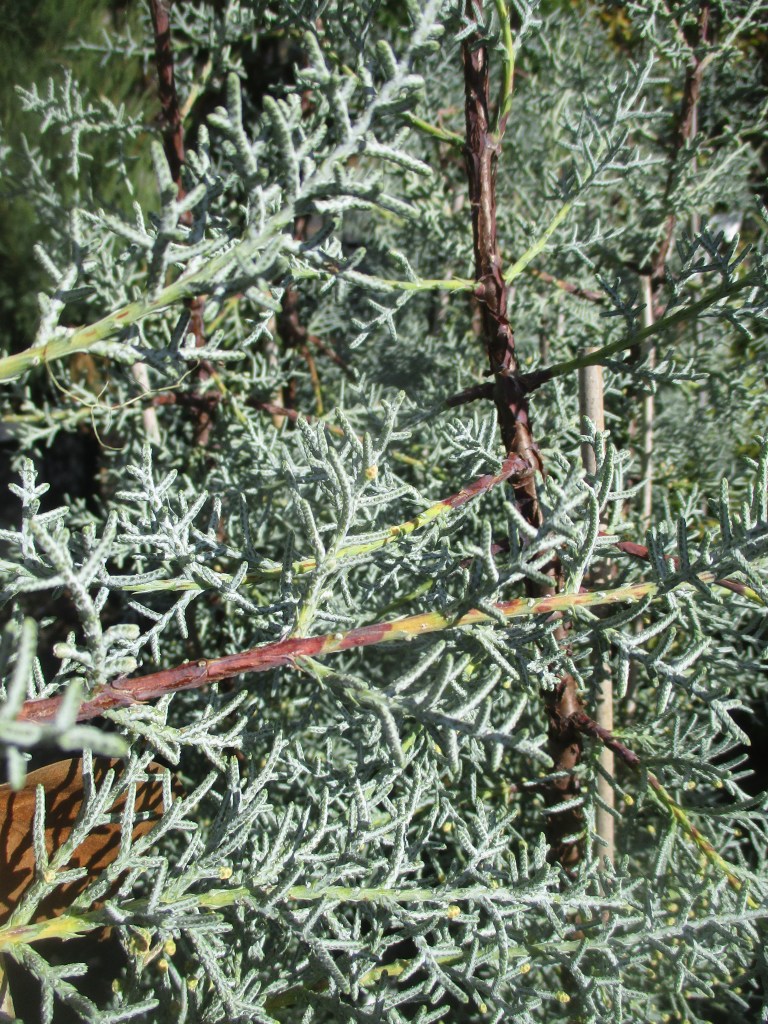
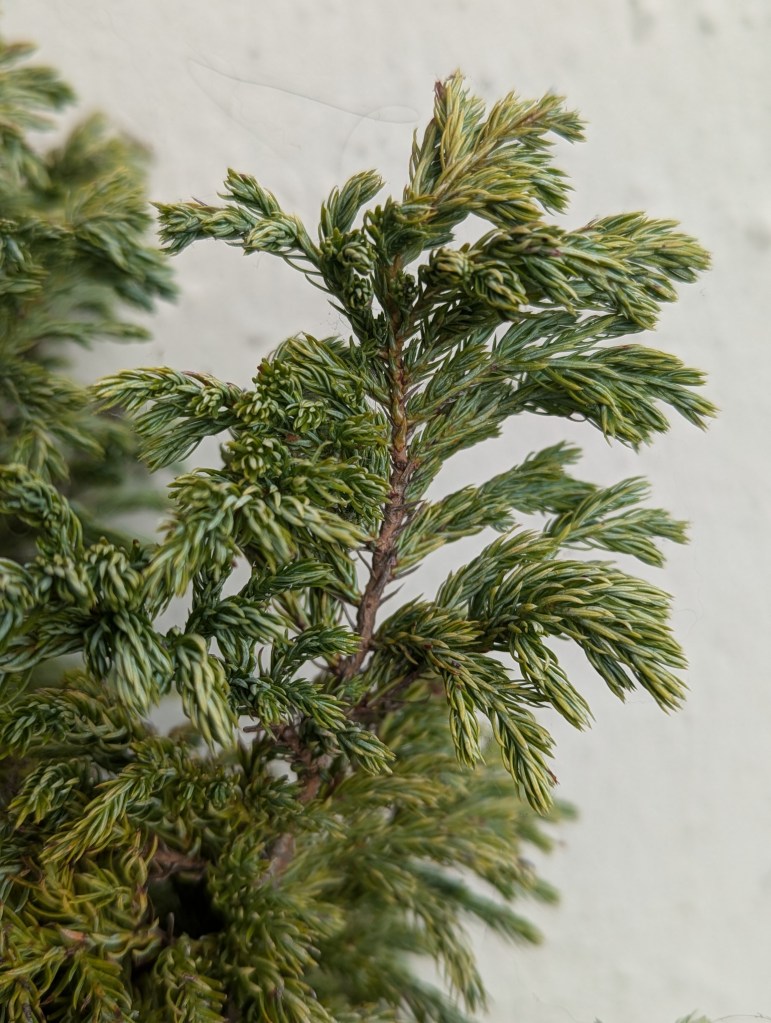
Sawara cypress cultivars are relatively compact.

It is difficult to imagine Sawara cypress, Chamaecyparis pisifera, as a timber tree. Within its native range in Japan, it can grow as tall as one hundred and fifty feet. Its trunk can be six feet wide. It is no surprise that it grows slowly though. Its more familiar types rarely grow taller than ground floor eaves. Only the oldest and biggest are nearly thirty feet tall.

Sawara cypress cultivars are uncommon, and some are rare. Among them, ‘Boulevard’ is less uncommon. It has feathery bluish foliage, and can grow eight feet tall. Supposedly, it can eventually grow nearly three times as tall. ‘Filifera Aurea’ has bright yellowish foliage on limber cord like stems. It supposedly gets taller, but it is typically lower and mounding.

Although its cultivars are more diverse, Sawara cypress resembles compact arborvitaes. Its densely evergreen foliage has a similarly soft texture. Its bark is similarly ruddy with a similarly fibrous texture. Individual scale leaves are less than a sixteenth of an inch long. Sawara cypress classifies as the false cypress because it is not of the genus Cupressus.
Horridculture – Graffiti

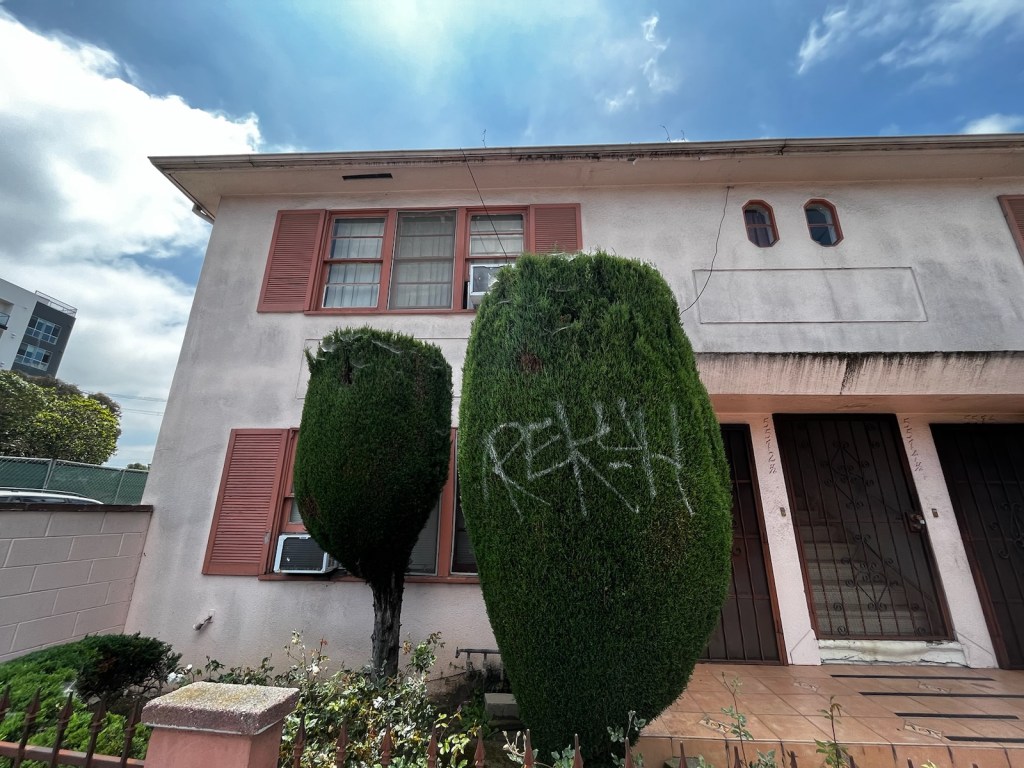
Is this some sort of abstract art?!

This picture is all sorts of wrong! Brent sent it to me from Los Angeles. He has a habit of sending obnoxious pictures such as this.

Firstly, why would anyone install Italian cypress in such pointless situations?! The specimen to the left is centered on a prominent window. It is an unsightly obstruction to the window, and would be just as unsightly and obstructive to the window above if only it had not been so severely disfigured. Although the larger specimen is a bit farther from the window, it is just as unsightly, obstructive and pointless.

Secondly, why would anyone disfigure Italian cypress by topping them like this?! It would be more practical to remove them if their naturally upright form is undesirable for this particular situation. Then, some other preferable vegetation could be installed instead, or perhaps nothing at all.

Thirdly, why would anyone maintain these already disfigured Italian cypress like this?! Just remove them already! They are unsightly! Seriously, someone obviously puts quite a bit of effort into shearing them so systematically. Are they that important?! Does someone actually like these pathetic trees in this pathetic condition?! Am I missing something here?!

Finally, or fourthly, how could someone make this situation any worse by defacing the larger of these two Italian cypress with graffiti?! Seriously, that takes a bit of effort also. Cut the trees down already! Why do these trees not simply die of embarrassment?! Is this supposed to be some sort of conceptual or abstract art?! Is this here merely to see what sorts of reactions it gets?! Can anyone even read what that graffiti says?! Perhaps it translates to “PLEASE CUT THESE TREES DOWN!” This picture leaves me with way too many unanswered questions. Well, if nothing else, these sad Italian cypress were strangely entertaining.

Arizona Cypress

Established Arizona cypress needs no irrigation.

Although not native, Arizona cypress, Hesperocyparis arizonica, behaves as if it is. It is native to deserts and chaparrals of Mexico, New Mexico and, of course, Arizona. Hence, new specimens only require irrigation until they disperse their roots. Afterwards, they are satisfied with seasonal rainfall. They are more resistant to pathogens than other cypress.

Most modern Arizona cypress cultivars are bluish gray with densely conical form. A few are yellowish, pendulous or columnar. ‘Blue Ice’ is a strikingly silvery bluish gray cultivar of smooth Arizona cypress. Most old Arizona cypress trees exhibit significant variation because they grew from seed. Some develop irregular form or more greenish drab color.

In the wild, Arizona cypress can grow taller than sixty feet. Locally, few get forty feet tall, particularly since modern trees are compact cultivars. Most stay less than twenty feet tall, and some stay about half as wide as they are tall. They work well as informal evergreen hedges. Smooth Arizona cypress exfoliates rough outer bark to expose smooth red inner bark. It is Hesperocyparis arizonica variety glabra.

‘Citriodora’ Monterey Cypress

This cultivar is also known as lemon cypress.

            Supposedly, ‘Citriodora’ Monterey cypress, Cupressus macrocarpa ‘Citriodora’, can get more than thirty feet tall and nearly as wide. Yet, it grows slowly enough to function like small trees or large shrubs. Even if it eventually gets a bit too large, it is much more conducive to occasional pruning than typical Monterey cypress is, and can even be artfully pruned into informal hedges. (However, nonselective shearing deprives if of its naturally appealing form.)

            With its lemon yellow foliage, ‘Citriodora’ Monterey cypress resembles golden arborvitae, but is even brighter yellow and has distinctive cypress-like branch structure. Its older foliage within eventually turns darker green to add depth and enhance the structure. ‘Citriodora’ Monterey cypress looks best locally if at least partially shaded by larger trees during the afternoon.

Lemon Cypress

Lemon cypress foliage is mildly aromatic.

Monterey cypress is a famously rugged tree that inhabits harshly exposed coastal cliffs. It grows fast to get big and gnarly with age. Lemon cypress, Hesperocyparis macrocarpa ‘Goldcrest’, is a more civilized cultivar. It might potentially grow nearly forty feet tall, but at less than a foot annually. Vertical trunks support compact and relatively columnar form.

Lemon cypress foliage is densely evergreen, with tiny and tightly set scale leaves. New spring growth is impressively cheery yellow. It fades somewhat to yellowish chartreuse through summer. If the weather gets cool enough through winter, the foliage can get a bit more amber. The foliar aroma is coincidentally slightly lemony, to match the foliar color.

Once established, lemon cypress does not require much more than occasional pruning. It is satisfied with only infrequent irrigation, and might survive with none at all. Actually, it is susceptible to rot with generous or frequent irrigation. ‘Goldcrest Wilma’ is susceptible to foliar diseases within its even denser foliage. It stays compact enough for pots though (Incidentally, Hesperocyparis was Cupressus.)

Arizona Cypress

Arizona cypress can be strikingly blue.

If Hetz blue juniper grew as a tree, it might look something like Arizona cypress, Cupressus arizonica. The evergreen foliage of modern cultivars is almost as blue as blue spruce. Older trees that grew from seed (not cloned) can exhibit significant genetic variability, and are more grayish green than blue. Some are stout and shrubby. Taller specimens might exhibit sculpturally irregular form.

In the wild, Arizona cypress is even more variable, with as many as five distinct varieties. Some varieties are sometimes classified as separate species. Shorter types may get no taller than a two story house. Taller types get twice as tall, and as wide as thirty feet. Trunks can get two feet wide. Smooth Arizona cypress has patches of distinctively flaking bark over shiny chestnut brown bark.

Arizona cypress are best where they can develop their natural form. They prefer no more than minor pruning of awkward stems. Although, none seem to mind grooming to eliminate dead or aging stems. Modern cultivars are more conducive to minor pruning than older trees. Some cultivars supposedly make nicely dense shorn hedges. Furthermore, shearing enhances the blue foliar color.

Bird Nest Cypress

00909
Bird nests should be so refined.

Port Orford cedar is a grand tree. It is native to the southern coast of Oregon and the very northwestern corner of California. Mature trees in the wild are more than a hundred fifty feet tall. Some of the older big trees within landscapes are more than forty feet tall. However, the cultivar known as bird nest cypress, Chamaecyparis lawsoniana ‘Nidiformis’ is remarkably diminutive and shrubby.

Bird nest cypress grows slowly, and may never get more than five feet high and wide. Individual plants are mounding with rather flat tops. A row of plants eventually becomes a low informal hedge. Distinctively flat sprays of slightly grayish evergreen foliage exhibit a soft feathery texture. Unless pruned otherwise, abundant dense foliage obscures main limbs with fissured reddish brown bark.

Most cultivars of Port Orford Cedar, including bird nest cypress, are uncommon here. They actually prefer cooler and moister climates. Locally, they are sensitive to harsh exposure and wind while the weather is warm. A bit of partial shade is no problem. Established plants do not need much water, but should not get too dry for too long. Selective pruning, not shearing, sustains natural form.

Lineup

P00426
The usual suspects.

There is significant traffic right outside. It is one of the three busiest roads around. No one here really minds, because we are mostly too busy with something else while we are here. We are accustomed to it as part of the ‘scenery’. The noise sometimes makes it necessary to shout to each other, or take a telephone call somewhere else, but is not too much of a bother otherwise.

However, the scenery that those in the traffic see from the road might be slightly less than appealing. Industrial buildings surrounded by pavement, building materials, work vehicles and all sorts of associated items are all that are in here. Next door, there is a herd of dumpsters! It is a view worth obscuring. Bay trees and box elders that used to screen the view are too tall now.

I should have planted these five Arizona cypress in a row along the road last autumn. If I were to plant them now, I will need to water them occasionally until next autumn, not that I would mind. After their first winter, they would be happy on their own. They would start to obscure the view within only a few years, and unlike box elders, would stay evergreen through winter.

They really should have been planted a long time ago. They have been in the same cans for so long that the medium within has decomposed and collapsed. Without staking, their lean trunks became disfigured in confinement. They really would not have needed to be staked if they had been planted sooner and been able to grow more vigorously. Fortunately, they should recover.

A Monterey cypress will be planted at the low end of the row next Saturday, even if these Arizona cypress are not planted until autumn. I will explain later.

Kashmir Cypress

70809Plants are usually well suited to the climates that they are native to. Glaucous (slightly reflective grayish) foliage is more common in harsh climates where darker green foliage might get cooked by the sun. Pendulous growth is more common among plants that want to shed heavy snow efficiently. Kashmir cypress, Cupressus cashmeriana, has both, but is from a tropical monsoonal climate.

It is a stately tree that can eventually get taller than fifty feet. Within its native range in the eastern Himalaya, old trees can get three times as tall! Limber stems might hang downward several feet. The minute scale leaves are neatly set on limber stems arranged in flat sprays, similar to, but more defined than those of arborvitae. Foliage is silvery grayish green, and perhaps slightly bluish.

Mature trees do not need much water, but would probably be happier if watered occasionally through summer. Kashmir cypress is unfortunately susceptible to the same diseases and insects that afflict Leyland cypress. That is a serious risk to consider before planting prominent specimens. Incidentally, Kashmir cypress is also known as Bhutan cypress, and is the national tree of Bhutan.

Knees

P80805When a plant that should be compact or shrubby gets too lanky with exposed lower stems, it is described as ‘leggy’. We do not hear much about plants that develop ‘knees’. Perhaps that is because there is only one species that does so. That one species happens to be very rare here. If there are other specie that develop knees, I do not know what they are.
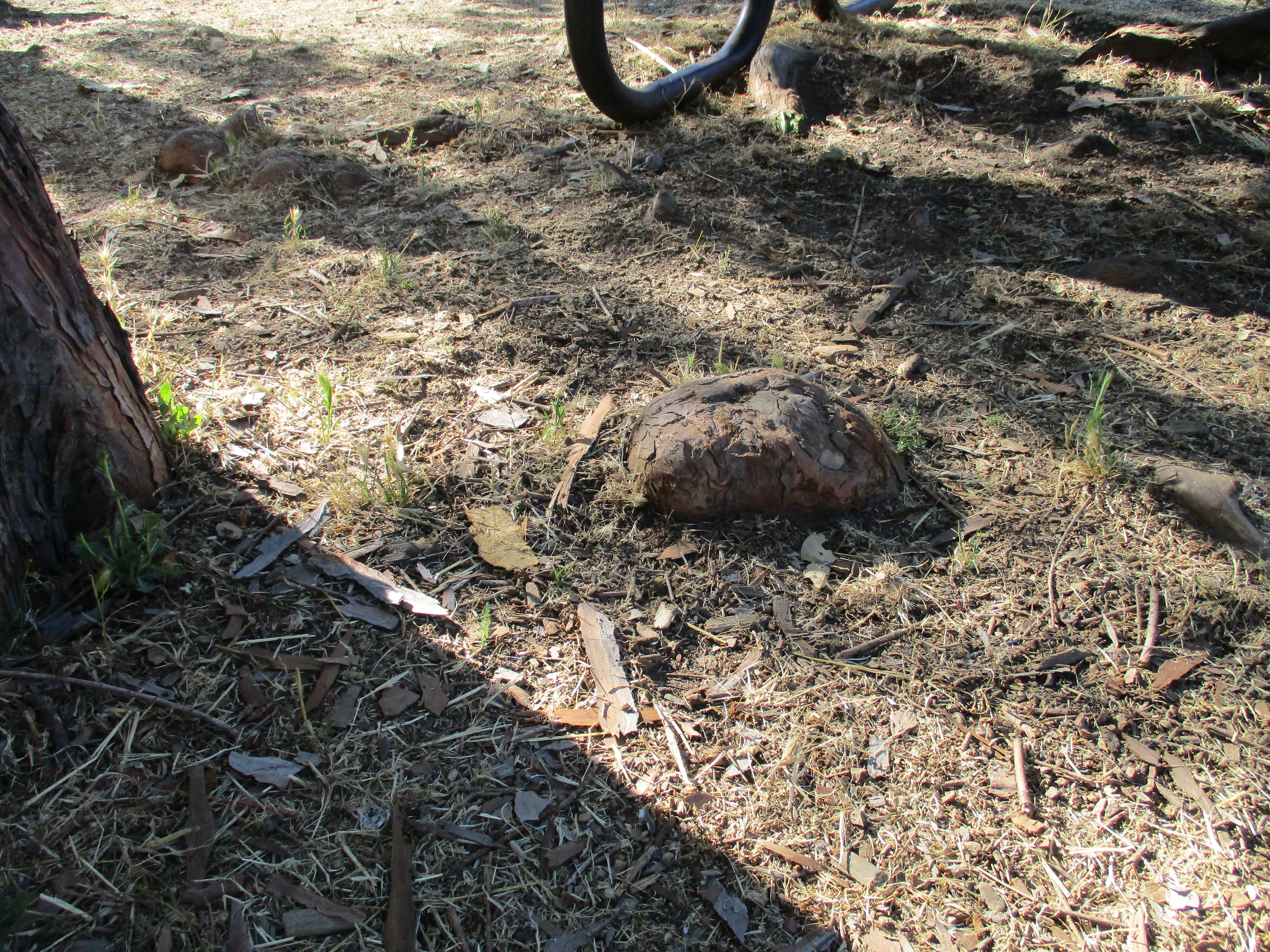
‘Knees’ are weird appendages that grow upward like stalagmites from the roots of bald cypress Taxodium distichum, particularly where the trees grow wild in swampy conditions. Knees can get quite tall. One of our professors used to tell us that they could do some serious damage to a canoe. Perhaps knees are why bald cypress is locally unpopular in landscapes.

However, I happened to notice that bald cypress is a common street tree in downtown Oklahoma City. Just like most other street trees, they are installed into small tree wells, but otherwise surrounded by pavement. They were remarkably healthy and well structured specimens that were too young to have damaged the pavement. Yet, I could not help but wonder what they will do as they mature. Even before the trunks grow as big around as the small tree wells that they are in, what would happen if knees develop?

There happens to be not one, but two bald cypress at work. The smaller is alongside a small stream. The larger is adjacent to a lawn where the soil is seemingly dry on the surface, but quite soggy just below the surface. This larger specimen is already developing distended burls that seem to be rudimentary knees. Although there is no pavement to break, the tree happens to be shading a picnic area where knees, if they develop, would be quite an obtrusive problem.P80805+