Apple

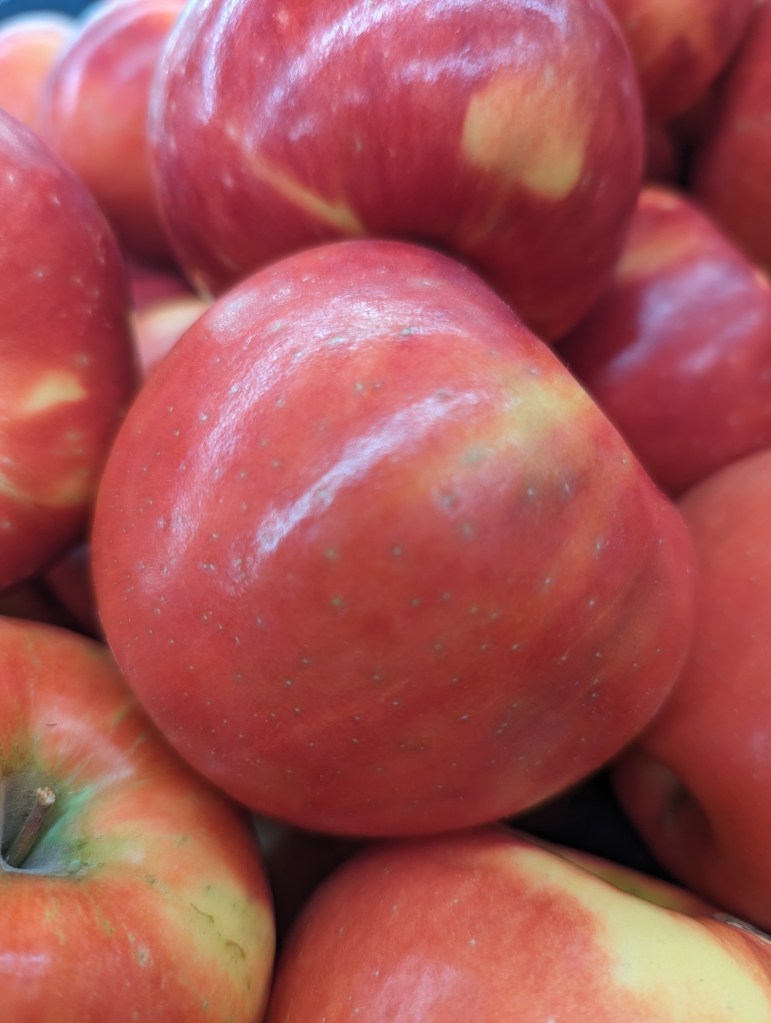
There are countless varieties of apple.

Apples are amazingly diverse. They have been in cultivation for thousands of years. Too many cultivars to document developed during that time. Some ripen as early as summer, while others ripen for late autumn. Some are best for eating fresh, while others are better for cooking, baking or juicing. Some are sugary sweet, while others are impressively tart.

Malus domestica is the general botanical name for most domesticated apples. However, this classification includes countless hybrids of a few species. Some are products of very extensive breeding. Most can grow as large as small shade trees. Grafting onto rootstock limits their size accordingly. Most ‘semi dwarf’ home garden trees are relatively compact.

Apple trees bloom with small but profuse and brilliant white flowers for spring. Flowering crabapple trees generally bloom pink or reddish pink, but produce dinky fruit. Otherwise, apples are about as big as baseballs. Some are significantly bigger or smaller. They can be variable shades of red, yellow or green. Some are striped or blushed with two colors. Their deciduous foliage turns yellow through autumn, and defoliates through winter.

Rain Can Ruin Bloom And Developing Fruit

Bloom is not really early. Frost and unusually torrential rain just happen to be late.

Again this year, the excellent weather that makes gardening so much fun even through winter has the potential to become a problem. Winters are innately mild here, and like this year, are sometimes mild and warm enough to prompt many plants to bloom much too early. Many of the fruit trees and their ‘flowering’ (non-fruiting) counterparts are already finishing bloom as if it is the middle of spring, even though the equinox is about two weeks away. This should not be a problem for the flowering cherries, plums, pears and apples (flowering crabapples), but is risky for the many trees that should produce fruit.

The problem is that, despite the weather, it really is winter and early spring, so could potentially rain while fruit trees are blooming. The rain can batter the blooms, or cause them to rot before they set fruit, compromising or even eliminating the fruit production for the following summer. Trees that are not blooming, or just barely showing ‘color’ of the first few blossoms, should be safe. Also, the trees that bloomed earliest and have already set fruit should likewise be safe, as long as the weather does not stay rainy too long, which it almost never does here. Trees that are in full bloom when it rains are the most sensitive to damage.

It is impractical to cover mature trees with plastic sheeting to protect them from rain. Even if it is possible to get the sheeting over the trees, it knocks much of the bloom or developing fruit off anyway. Also, if the sheeting is not removed when the rain stops, it can trap humidity, which can rot the blooms that were so carefully protected from the rain. (Although, high trees hold the plastic high enough from the ground to allow for good air circulation.)

Small trees are easier to cover, but do not produce enough fruit to worry about. In other words, it would be easier to buy fruit at a market, or to get it from friends and neighbors with different varieties (that bloom at different times) than to put too much effort into protecting trees from the rain. In most situations, it is best to just accept that fruit trees will sometimes have ‘off’ years when they either do not produce, or produce only minimal quantities of fruit. The good news is that trees that lose some but not all of their fruit often produce best.

Plum bloom is not resilient to late frost or rain.

Pomegranate

Pomegranates are autumn and winter fruit.

As for fig, date, avocado, grape and olive, the esteemed pomegranate, Punica granatum, has been in cultivation for a very long time. Several thousands of years of domestication have generated countless cultivars. They are now popular in many regions and cultures throughout the World. They produce very well here and in other Mediterranean climates.

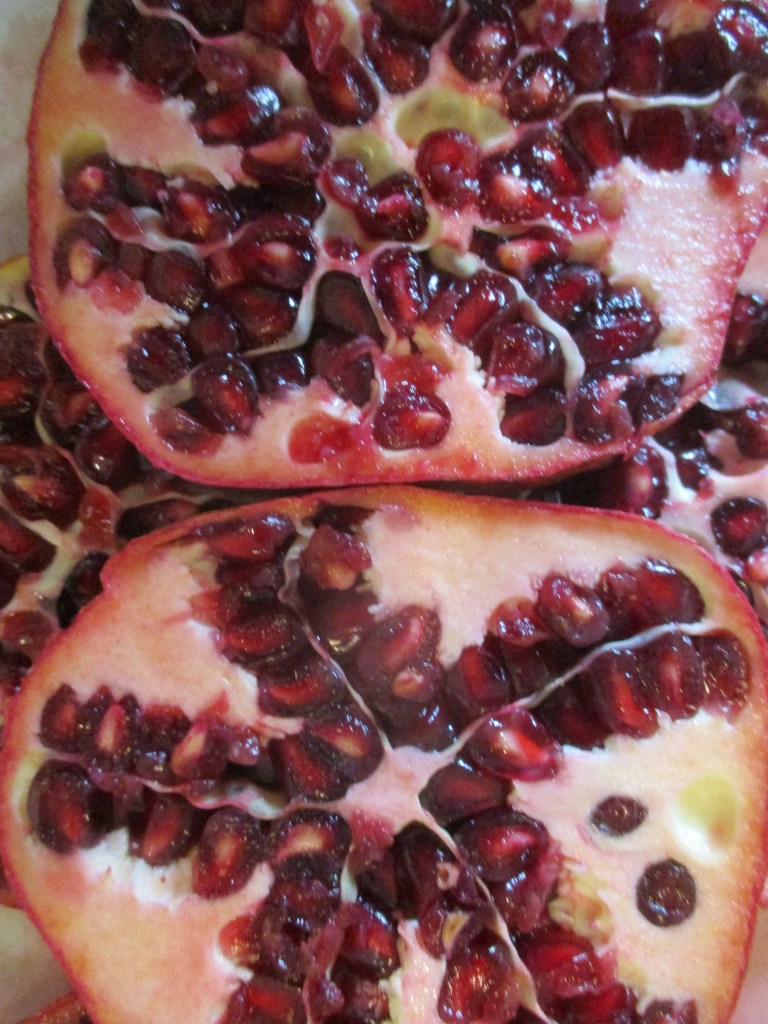
Most locally popular pomegranate fruits are brownish red, and about three to four inches wide. Each fruit contains hundreds of seed, which are surrounded by juicy and delicately succulent flesh. They separate easily, like many tiny and tender berries. Most are garnet red. Some cultivars produce fruit with darker purplish, lighter pink or even colorless flesh. 

Without dormant pruning, pomegranate trees can get taller than fifteen feet, and develop dense thicket growth. Fruit is easier to collect from well groomed shorter trees. Individual trees may develop a few trunks, and live for two centuries. Orangish red flowers bloom in spring. Leaves turn yellow prior to defoliation in autumn. Fruit ripens in autumn or winter.

Persimmon

Ripe persimmon is surprisingly sweet.

Most other deciduous fruit trees provide delightfully profuse spring bloom as well as fruit. Persimmon, Diospyros kaki, does not. It compensates though, with brilliant orange foliar color for autumn. Defoliation reveals comparably bright orange ripe fruit. The awkwardly bulky fruit may look silly on lanky limbs of otherwise bare trees, but they sure are yummy! 

Persimmon trees will not require a pollinator to generate an abundance of fruit. However, according to some experts, paired trees of different cultivars produce more abundant fruit of slightly better quality. Abundance is not necessarily an asset though. Unfortunately, all that very perishable fruit ripens at the same time. Fruit is inedible before completely ripe.

Mature persimmon trees can get big enough to become moderate shade trees. If they do, their abundant fruit will be too high to reach, and will generate a horrendous mess when it falls. Although they are handsome trees, they should probably stay relatively short and compact. New trees should be planted while dormant during winter, preferably bare root.

Plum

Plums are better fresh than dried.

Only recently, and only to be more marketable, dried prunes attained the status of dried plums. Prunes and plums are actually two different types of fruit. Prunes are European fruits that dry nicely, but are not popular as fresh fruits. Plums are Japanese fruits that are best while fresh, but do not dry well at all. Because plums have less of a sugar content, they are likely to mold before they dry.

Plum is of the genus Prunus, just like prune and the other stone fruits. Stone fruits all contain large seeds, which are known as stones. Plums are ‘clingstone’, because the flesh of the fruit clings to the stones within. Prunes are ‘freestone’. Their stones separate easily from the flesh. The most popular plums are purplish or burgundy red. Others are blueish purple, red, orange, yellow or green.

Plum trees grow fast while young, and require aggressive pruning while dormant through winter. Otherwise, they get overwhelmed with fruit, and too tall to facilitate harvest. Even semi-dwarf trees can get almost twenty feet tall. They are spectacular in prolific white bloom. Small bare root trees that are now becoming available adapt to a new garden more efficiently than larger canned trees.

Deciduous Fruit Trees Need Pruning

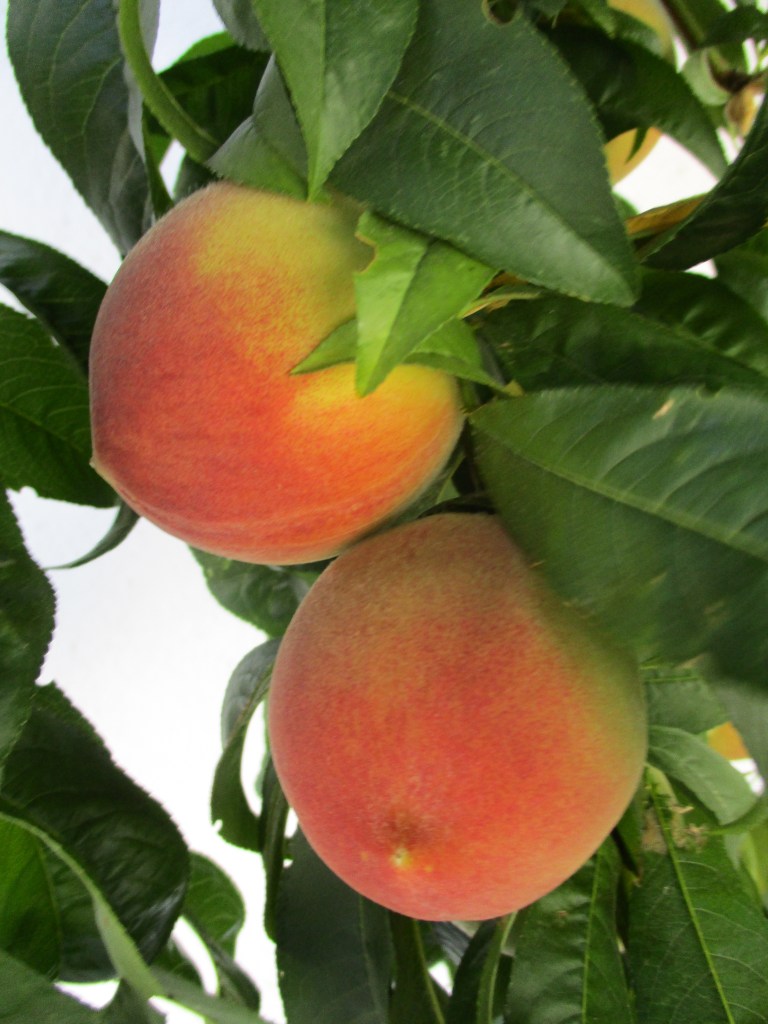
Prune now for better peaches later.

Many plants should get most of the pruning they need while they are dormant in winter. Such pruning is less stressful because it happens while plants are naturally sedated. Some plants that need aggressive pruning during their winter dormancy may need no other pruning until the following winter. Most deciduous fruit trees conform to this category. Their pruning is rigorous and specialized.

The innately aggressive pruning that deciduous fruit trees require may seem to be brutally unnatural, but is very justifiable. It is necessary to compensate for unnatural production. After centuries of selective breeding, most deciduous fruit trees produce more fruit than they can support. Their fruit is unnaturally abundant, unnaturally bulky, or both. Such improvement has distinct consequences.

Unlike their wild ancestry, many modern deciduous fruit trees would not thrive for long without intervention. The weight of their fruit eventually breaks and disfigures limbs. Such breakage exposes sensitive bark to sun scald, and leaves wounds open to decay. Insect and disease pathogens proliferate in deteriorating growth. Furthermore, messy excess and unreachable fruit attracts vermin.

Pruning improves the structural integrity of deciduous fruit trees so that they can support their fruit. It also concentrates resources into fewer fruits of superior quality, rather than allowing production of inferior surplus. Invigorated vegetative growth is more resilient to pathogens. Proper pruning removes dead, dying, damaged and diseased growth, the ‘four Ds’, as well as unreachable growth.

The main categories of deciduous fruit trees are stone fruits and pomme fruits. Stone fruits are of the genus Prunus. They include peach, nectarine, apricot, plum, prune, cherry, their hybrids, and almond. (Almonds are the ‘stones’ of their fruits.) Pomme fruits are apple, pear and quince. Peaches need more aggressive pruning than cherries, simply because their fruits are so much bigger.

Pomegranate, persimmon and fig also need specialized pruning while dormant through winter.