Oakland

Oregon white oak, Quercus garryana

Oakland, fifty miles north of here, was named for the oaks that formerly inhabited it. Imagine that! Although valley oak, Quercus lobata, is native, and assumed to be the origin of the regional name, coast live oak, Quercus agrifolia, was likely more abundant there at the time.

Of the many other towns in California with horticultural names, a few are also named for unspecified oaks, including del Rey Oaks, Oakdale, Oakley and Thousand Oaks. Encinitas, Live Oak and the Encino neighborhood of Los Angeles are named more specifically for coast live oak. Paso Robles is named more specifically for valley oak.

Oakland and Oakridge are the only two towns that I could find in Oregon that are named for Oaks. I suspect that Oakland is named for Oregon white oak, Quercus garryana, only because that is the most prominent species of oak there. It is also native here, although I am not aware if I have ever encountered it locally. It resembles small specimens of valley oak, which, incidentally, is also known as California white oak.

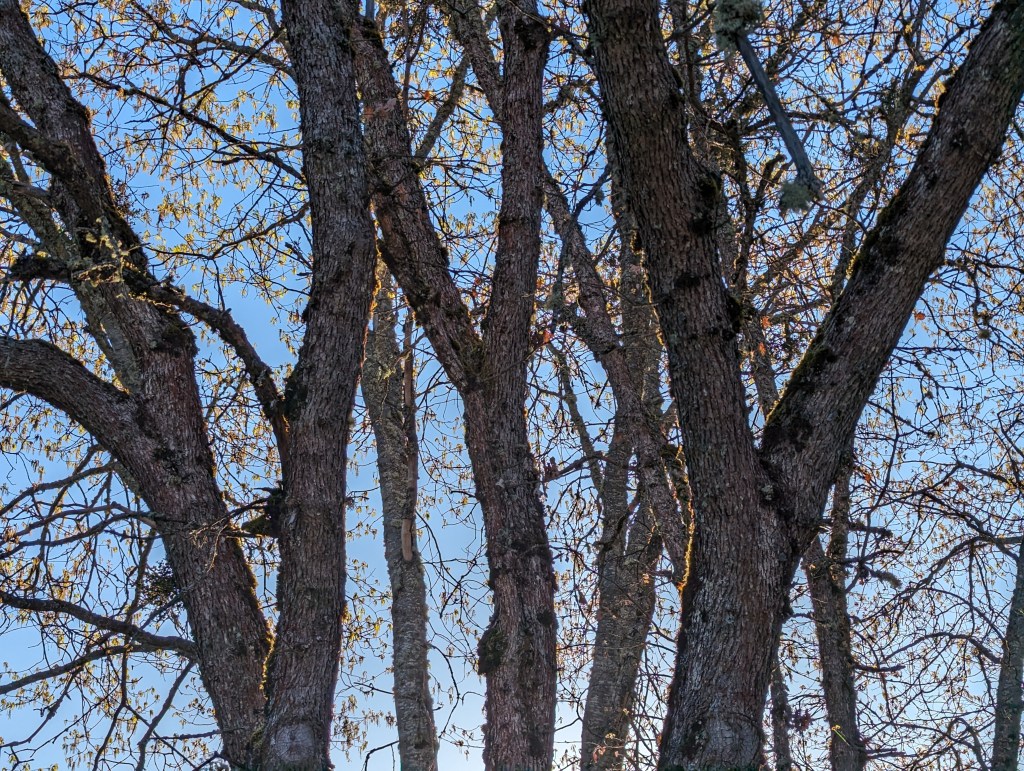
This picture of a few main limbs of an exemplary specimen of Oregon white oak is from Cabin Creek Rest Stop on Southbound Highway 5, just north of Oakland in Oregon. To me, it looks sort of Californian, like something that, a long time ago, was more prominent in Oakland here in California, on ‘the Bright Side of the Bay’.

California Sycamore

California sycamore develops massively gnarly trunks.

The tallest, largest and oldest trees of the World are all native to California. So are the rarest pine, rarest fir and largest oak. California sycamore, Platanus racemosa, is loyal to this tradition of distinction. Although not the tallest sycamore, it might be the grandest. It develops gnarly and sculpturally irregular form. Some develop multiple massive trunks.

Because of its scale, California sycamore is uncommonly available from nurseries. It is simply not proportionate to home gardens or even big landscapes. Most old specimens are older than the landscapes around them. They are somewhat adaptable to landscape irrigation. However, increased moisture increases potential for spontaneous limb failure.

California sycamore can grow a hundred feet tall with bulky trunks and limbs. Old trees may exhibit scars from shedding limbs throughout their long lifespans. The mottled bark is gray and tan, and roughens only slowly with age. The deciduous foliage of such large trees is very copious through a long defoliation. Foliar tomentum (fuzz) is quite irritating.

White Alder

White alder is not exactly . . . white.

During the summer, the native white alder, Alnus rhombifolia, is a nice shade tree that looks bigger than it really is. By late winter, the bare deciduous canopy has an appealingly picturesque silhouette. This time of year is actually when white alder is typically less appealing, with dead foliage that provides no interesting fall color, but lingers until knocked down by rain or late frost. Yet, even now, it sometimes surprises with these funny looking floral structures that are interesting both in the early winter landscape, and with cut flowers.

In past decades, white alder was an ´expendable’ tree that was put into landscapes for quick gratification while slower but more desirable trees matured. By the time the desirable trees matured, the alders were removed to make more space for the desirables. This technique was practical because, like many fast growing trees, alders do not live very long, so start to deteriorate after about twenty five years anyway. However, alders often live longer than expected.

Mature alders are usually less than fifty feet tall where they are well exposed. They can get at least twice as tall where shaded by other trees or big buildings. Their plump trunks with mostly smooth silvery gray bark make them seem larger than they really are though. Too much water promotes buttressed roots which can displace pavement.

Box Elder

Box elder leaves are pinnately compound.

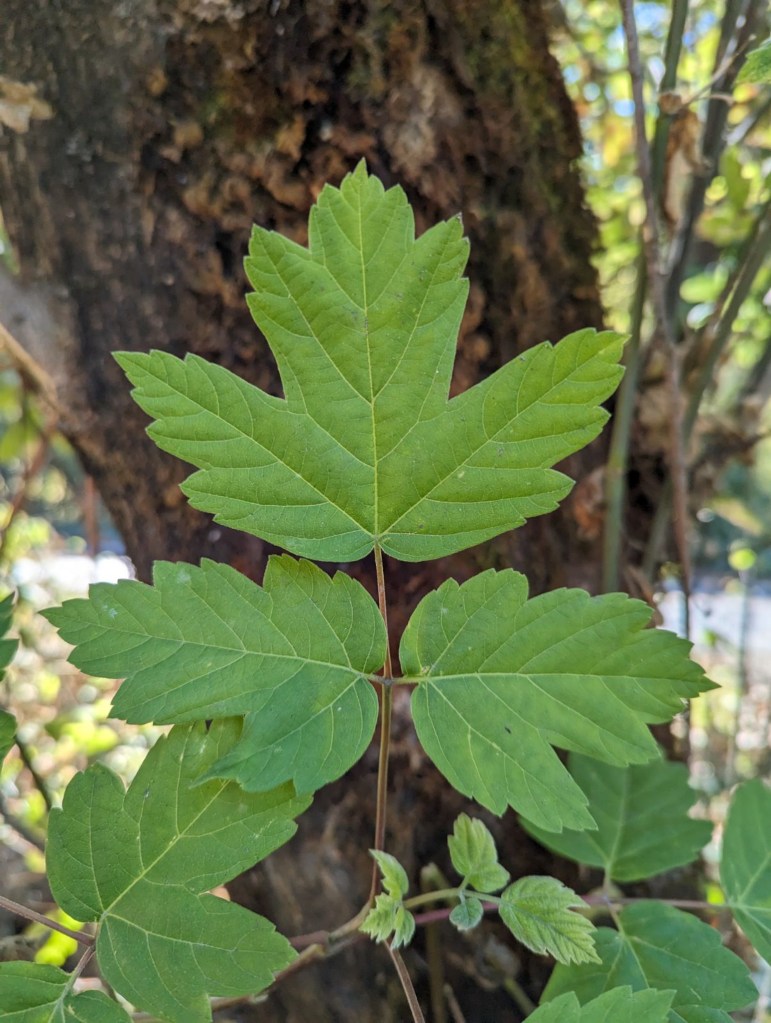
Leaves of three, leave it be, unless one can see that it is a box elder tree, Acer negundo. This is the most common of the North American maples. It is native to all American states except for only Alaska and Hawaii. Yet, it is also unique as the only maple with pinnately compound leaves. Typical leaves have three leaflets, but might have as many as seven. A few rare maples have palmately compound leaves.

Although common in the wild, box elder is rare within refined landscapes. It grows fast to about forty feet tall, but does not live for much more than fifty years. It typically develops a few plump trunks with casually irregular form. Unfortunately though, such form becomes structurally deficient with age. Autumn foliar color is unremarkable yellow or brown here.

However, a few garden cultivars display distinctly colorful foliage for spring. ‘Flamingo’ is the most popular cultivar. Pink variegation of new spring growth fades to white. ‘Auratum’ displays bright yellow new growth. ‘Violaceum’ displays smoky blushed new foliage with purplish red floral tassels. After pollarding, such cultivars are more compact and colorful, but lack floral tassels.

Ginkgo

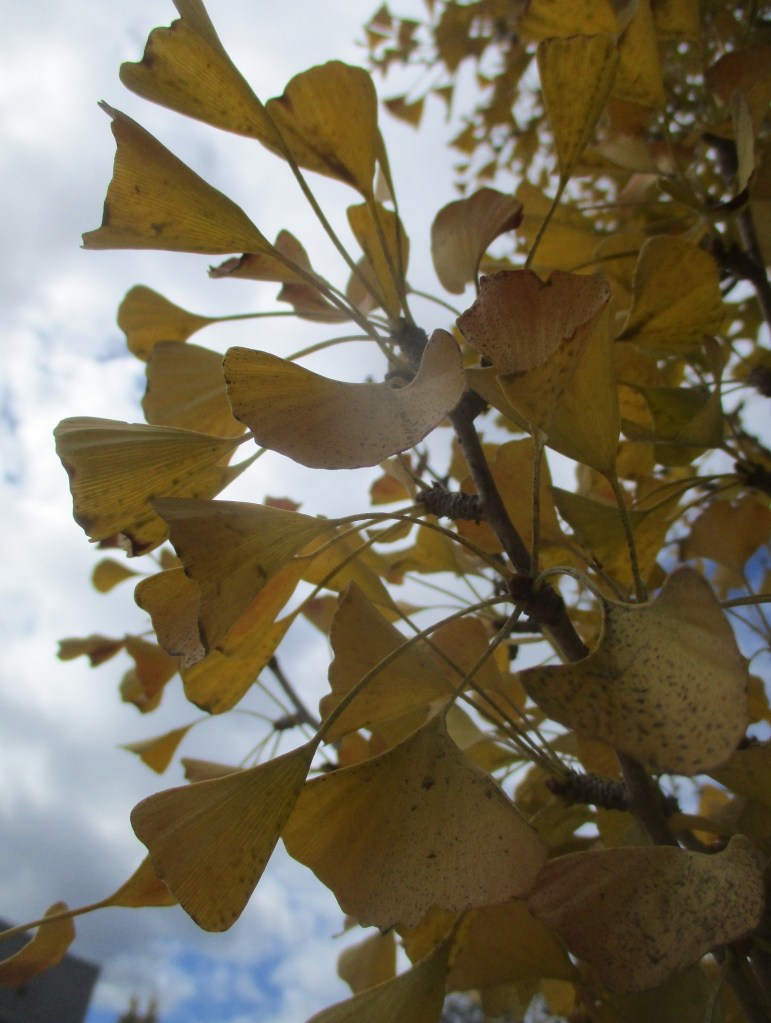
Ginkgo tree develops brilliant yellow color.

Minimal chill is sufficient for ginkgo, Ginkgo biloba, to develop brilliant yellow foliar color. Mild weather actually enhances retention of foliage after it colors. Colder weather or frost accelerates efficient defoliation. Although less messy, it ruins the spectacular display too soon. Autumn foliar color is monochromatically yellow, but is the best yellow of autumn.

Some old ginkgo trees produce messy fruit with objectionable aroma. This characteristic limited their practicality and popularity. Modern cultivars, though, are male and therefore fruitless. Female cultivars are very rarely available, and mostly only by online purchase. Their fruit and the nuts within are edible. However, only mature trees can be productive.

Ginkgo trees grow somewhat slowly, but can eventually get taller than fifty feet. Modern cultivars are rather slender and perhaps lanky while young. They retain their elegantly irregular structure as they broaden with maturity. Leaves are about two or three inches long. Their venation radiates outward from their petioles, like fishtails, with paired lobes.

Fruitless Mulberry

Fruitless mulberry is conducive to pollarding.

Even though silk never became a major commodity in North America, it indirectly made an impression on American gardening. The tree that was developed to most efficiently feed silkworms is now among the most popular of shade trees. The fruitless mulberry, Morus alba, wastes no resources producing fruit while providing only abundant foliage, which is the only sustenance for silkworms.

Young trees grow at a good rate to nearly thirty feet tall, and can eventually reach fifty feet. They are often pollarded (pruned severely back to the same burly ‘knuckles’ every winter), which causes them to regenerate stems at an alarming rate during summer. Shoots from mature pollarded knuckles have no problem reaching fifteen feet in all directions! Mulberries incidentally have the distinction of the fastest motion known to the plant kingdom, because they launch their pollen at more than half the speed of sound!

The serrate leaves are quite variable. Those of vigorous young shoots of pollarded trees are mostly about six inches long with rounded wide lobes, but can be nearly a foot long! They turn bright yellow and typically fall neatly from the tree within a limited time in autumn, facilitating raking. Leaves on slower growing stems of lightly pruned mature trees are mostly unlobed and less than six inches long. They begin to fall earlier in autumn and linger over a longer time, sometimes with slightly subdued autumn color.

Black Locust

Black locust resembles white wisteria up a tree.

If only it were not such an invasive weed, black locust, Robinia pseudoacacia, might be appreciate for remarkably fragrant and abundant white bloom that resembles that of wisteria. The pinnately compound leaves are about five to ten inches long with rounded leaflets that individually are about one half to three quarters of an inch wide and twice as long. Autumn color is soft yellow. Trees can grow fast to more than fifty feet tall. Furrowed and fissured gray bark makes middle aged trees seem older and more distinguished than they really are. The wood is excellent firewood. All parts are toxic so should be kept out of reach of horses.

Black locust is native to a big area between Pennsylvania, Georgia and Kansas. It was brought to California both to produce firewood quickly, and because it is so appealing in gardens. Modern cultivars and other specie with purplish pink or pinkish purple flowers lack fragrance, but  are not invasive.

Cottonwood

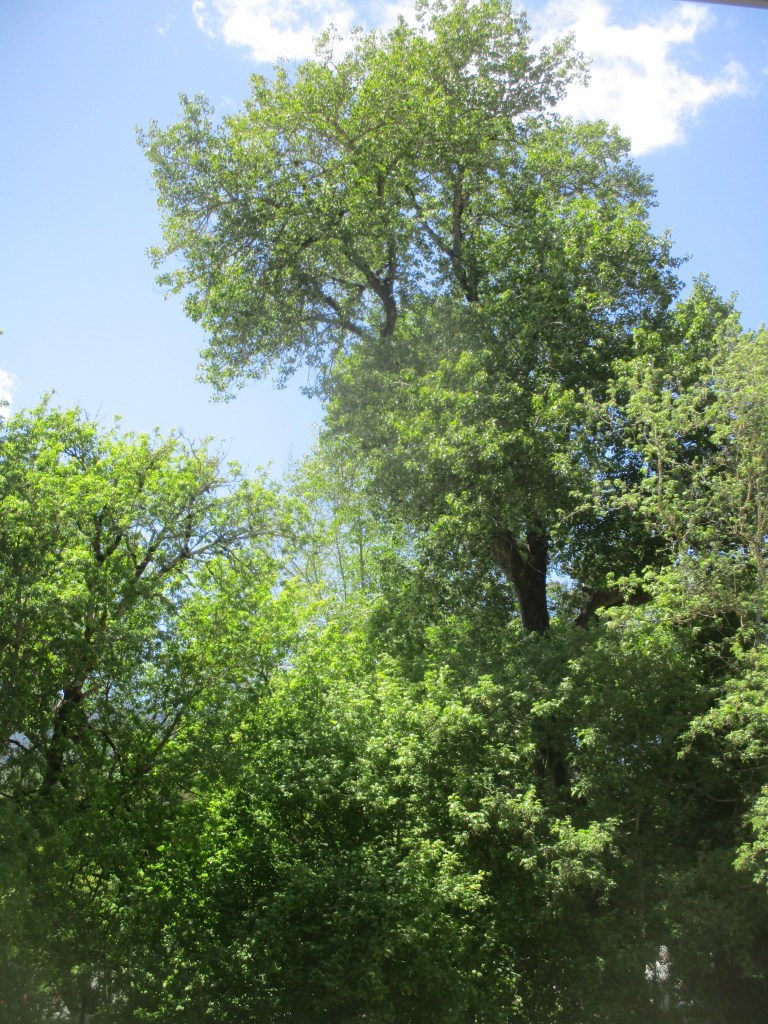
Cottonwood is now defoliated for winter.

The most common of a few species of cottonwood that are native to California seems as if it should not be. Populus deltoides is the Eastern cottonwood. This name implies that it should be native primarily to regions of the East. Yet, it naturally inhabits every American State except for Hawaii and Alaska. Since it is so familiar locally, it is simply cottonwood.

It grows wild in riparian ecosystems, and occasionally sneaks into adjacent landscapes. It is almost never an intentional acquisition. Cottonwood grows too aggressively and too large for refined home gardens. It works better as a grand shade tree for parks and urban waterway trails. As a riparian species, it requires either riparian ecosystems or irrigation.

Mature cottonwood trees may be almost a hundred feet tall, and rather broad if exposed. Their bark is handsomely furrowed. Yellow autumn color of the deciduous foliage can be surprisingly vibrant within arid climates, or if rain is later than frost. Vigorous trees can be susceptible to spontaneous limb failure, so may occasionally justify aggressive pruning. Roots might be voracious.

White Alder

White alder is mostly defoliated by now.

During the summer, the native white alder, Alnus rhombifolia, is a nice shade tree that looks bigger than it really is. By late winter, the bare deciduous canopy has an appealingly picturesque silhouette. This time of year is actually when white alder is typically less appealing, with dead foliage that provides no interesting fall color, but lingers until knocked down by rain or late frost. Yet, even now, it sometimes surprises with these funny looking floral structures that are interesting both in the early winter landscape, and with cut flowers.

In past decades, white alder was an ´expendable’ tree that was put into landscapes for quick gratification while slower but more desirable trees matured. By the time the desirable trees matured, the alders were removed to make more space for the desirables. This technique was practical because, like many fast growing trees, alders do not live very long, so start to deteriorate after about twenty five years anyway. However, alders often live longer than expected.

Mature alders are usually less than fifty feet tall where they are well exposed. They can get at least twice as tall where shaded by other trees or big buildings. Their plump trunks with mostly smooth silvery gray bark make them seem larger than they really are though. Too much water promotes buttressed roots which can displace pavement.

Bald Cypress

Although very rare here, bald cypress is prominent enough in the South to be the state tree of Louisiana.

There are very few coniferous (cone bearing) trees that are deciduous; and because most prefer cooler winters, very few are ever seen in local gardens. The bald cypress, Taxodium distichum, happens to be one of the few deciduous coniferous trees that really could be more popular than it is, since it seems to be right at home in mild climates. It is native to coastal riparian regions from Maryland to Florida to eastern Texas, and up the Mississippi and Ohio Rivers as far as Indiana.

The soft foliage resembles that of coastal redwood, but is more finely textured. It is still mostly light green, but will soon be turning paper bag brown before trees go bare. The tiny individual leaves are shaped like flat pine needles, and are not much more than half an inch long. The ruddy or grayish brown bark is finely shaggy.

In the wild, mature bald cypress trees can get more than a hundred feet tall with trunks more than five feet wide. Some of the largest trees have buttressed trunks as wide as fifteen feet! Trees in swamps develop distended growth from their roots known as ‘knees’, which can stand several feet tall! Fortunately, bald cypress rarely get half as tall or develop such massive trunks locally.

Bald cypress is one of the few deciduous conifers; so the finely textured light green foliage will soon be gone.