Forcing Early Bloom Even Earlier

Home interior warmth accelerates early bloom.

Some of the earliest of spring flowers are done blooming. More are just beginning. Then, a few early spring flowers barely qualify as early. Their fresh color is especially pleasing after such an atypically wintry winter. Many are delightful cut flowers. A few that bloom on bare deciduous stems are conducive to forcing. Even the earliest bloom could be earlier.

Bare stems are simpler and less wasteful to force to bloom than bulbs and potted plants. Most bulbs and some potted plants do not survive long after forcing. Dormant deciduous plants easily replace a few forceable stems. Forcing such stems is as simple as bringing cut flowers into a home. The difference is that it is premature, immediately prior to bloom.

Flower buds on dormant deciduous stems begin to swell during warming spring weather. Such stems are ready for forcing when these floral buds are about to pop open. Ideally, a bit of floral color should be visible through some of the bud scales. A few flowers may be blooming. Collective bloom accelerates within the warmth of a home interior after cutting.

Flowering but fruitless counterparts of popular fruit trees are some of the best for forcing. These include but are not limited to flowering cherry, plum, apricot and other stone fruits. Flowering pomme fruit trees, such as quince, crabapple and pear are almost as popular. Related fruiting stone and pome fruit trees are as conducive to forcing, but not as garish.

Of course, there is nothing wrong with simpler bloom. Some fancy flowering cherry trees bloom with single white flowers like fruiting cherries. However, cutting stems from fruiting trees decreases fruit production. With a bit of planning, dormant pruning can allow a few undesirable stems to remain. These stems are then available for cutting and forcing later.

Witch hazel cultivars are exemplary for forcing, but are done blooming. Flowering quince and forsythia are now finishing within most climates. Redbud, lilac, wisteria and perhaps weigela are still conducive to forcing. Dogwood and deciduous magnolia can perform as well if humidity is not too minimal. So should some acacias, although their fragrance and pollen may be distasteful.

Deciduous Trees Are Not Necessarily The Messiest

This weird Euphorbia is one of the few small evergreen trees that drops no foliage.

Contrary to popular belief, most deciduous trees, those that drop all their leaves in autumn, are not as messy as most evergreen trees. There are of course a few exception; such as cacti that lack foliage completely, or Italian cypress that drop their finely textured foliage straight down within a very narrow drip-zone, where it decomposes and disappears unnoticed. Very few leaves fall from a big silver maple through winter, spring and summer, so that almost all of the raking is done when almost all the leaves get shed in autumn. However, a big Southern magnolia generally drops leaves throughout the year, so that raking is always necessary.

The problem is that when deciduous trees get to be messy, they are very messy. Also, they get to be messy at the worst time of year, when their leaves mix with rain to clog drains and gutters. Unraked leaves become hazardously slippery when they get wet and start to decompose. It is amazing how something that can be so appealingly colorful through autumn can so quickly become such a nuisance.

Leaves of deciduous trees somehow seem to be better for composting than those of some of the evergreen trees. Anyone with a Southern magnolia knows how slow the foliage is to decompose. Foliage of camphor, bay, carob and various eucalyptus certainly decompose slower than various maple, ash, poplar and birch. Many of us outfitted with green waste bins or curbside collection of green waste prefer to recycle the less desirable evergreen foliage, and compost primarily deciduous foliage. Those of us who do not compost but need to rake under large or many deciduous trees may fill bins for several weeks, or leave very big piles of leaves at the curb.

Small leaves, such as those of most elms, or finely textured compound leaves, such as those of silk tree, jacaranda or locust, may not need to be raked if they fall onto lower shrubbery or ground cover. Small leaves or the small leaflets of disintegrating compound leaves simply sift through the lower plant material to decompose below. However, large elms may produce such an abundance of foliage that some may need to be removed. Maple and other large leaves are not so easy to ignore. They can shade lawns, ground cover or bedding plants, so need to be raked as they fall.

Evergreen Foliage Has Distinct Advantages

Evergreen foliage is shady all year.

Gardening was easier before suburban lifestyles became so passe. Now, larger modern urban homes occupy smaller urban parcels. Modern fences are taller to enhance privacy for such densely situated homes. Garden space is both minimal and shaded by so much infrastructure. Ironically, shady evergreen foliage is now more practical for such gardens.

Deciduous trees are still practical for single story suburban homes on suburban parcels. They provide cooling shade for summer, and allow warming sunshine through for winter. Smaller evergreen trees and shrubs closer to fences obscure unwanted scenery beyond, without shading homes during winter. Such strategy is facilitated by sufficiency of space.

It is not so practical for confined and modern urban gardens though. Space is insufficient for big deciduous shade trees. Smaller trees can not get tall enough to shade roofs of tall modern homes. Insulation of modern homes is fortunately so efficient that summer shade and winter sunshine are not as advantageous as they still are for older suburban homes.

Therefore, most trees in modern home gardens primarily obscure unwanted scenery and provide privacy, rather than merely provide shade. Not only should they be proportionate to their gardens, but such trees should also retain evergreen foliage as low as the tops of associated fences. Some of the more practical options are actually evergreen shrubbery.

Large evergreen trees, such as Southern magnolia, California pepper, camphor, various palms and some eucalypti, are too big for some confined modern home gardens. English laurel, New Zealand tea tree, hopseed bush, various arborvitae, and particularly various pittosporum function as small evergreen trees that are proportionate to confined gardens.

As practical as evergreen foliage is for modern urban home gardens, it requires as much maintenance as other forms of vegetation. Contrary to common belief, evergreen foliage sheds. It is just sneaky about doing so slowly throughout the year. Additional foliage also innately adds shade to already shady situations, which can complicate other gardening. To become compact evergreen trees, shrubbery requires directional pruning.

Snowball Bush

Even without the variety of color of hydrangea, these relatively delicate, crisp white flowers of snowball bush are quite elegant.

Like small, clear white hydrangea blooms, the round, three inch wide floral trusses of snowball bush,Viburnum opulus ‘Roseum’, are composed of many smaller flowers. Unlike hydrangeas that bloom after vegetative (stem and foliar) growth, snowball bush blooms early, so that as it finishes, deteriorating blooms will be obscured by soft green foliage before anyone notices. The distinctively lobed, three inch wide leaves get quite colorful in autumn. Snowball bush should not be shorn, but can instead be pruned aggressively while bare in winter. Older or obtrusively tall stems should be pruned to the ground where possible. Good sun exposure without too much reflected glare or heat promotes bloom and autumn foliar color. Mature plants can get ten feet tall and nearly as broad.

Even bare trees have style.

This big perennial ‘sticks of fire’ produces a thicket of bright yellowish orange stems that changes shades through the seasons.

Everyone knows that flowers provide color in the garden, particularly through spring and summer. As blooms become less abundant in autumn, fall color of deciduous plants and trees becomes more prominent. After most plants are finished blooming, and most of the fall color is gone, the garden may seem relatively bleak for winter. Only evergreen foliage remains. This is when plants that exhibit colorful bark or bare twigs really get noticed.

Various types of birch trees exhibit striking white bark all year. While the trees are bare in winter, the bark becomes even more prominent, particularly against a backdrop of evergreen trees. English walnut trees are not as striking, but are more sculptural. Fig trees (fruiting types) are more gray than white, so are more reliant on a backdrop of rich evergreen foliage or a darkly painted wall for contrast; but they grow fast enough to become interesting sculptural specimens within a few years. 

Bright white or light gray bark are certainly no substitute for the colors of flowers or foliage, but are striking nonetheless. They exploit the starkness of winter, and the sculptural nature of bare trunks and limbs.

Even without the sculptural structure of birch, walnut or fig trees, the more colorful twiggy growth of coral bark Japanese maple and osier dogwood trees can be quite an advantage in a stark winter landscape. As the name implies, coral bark Japanese maple has pinkish orange twigs. Osier dogwood can be ruddy brown, brownish orange or pale yellow. Frost improves color.

Unlike other Japanese maples that get pruned only lightly to enhance their form, coral bark Japanese maple can get pruned rather harshly just prior to spring growth in order to promote an abundance of the twiggy growth that is so colorful in winter. Osier dogwoods can get pruned down almost to the ground at the end of winter to eliminate tired older stems and promote colorful new stems for the following winter. They lack the colorful bloom that flowering dogwoods provide; so it is no bother that such harsh pruning prevents them from blooming.

Like trees with white or gray stems, coral bark Japanese maples and osier dogwoods are more striking against a backdrop of rich green foliage. Because winters are so mild here, they should be located where they will be most exposed to chill.

Bare Root Stock For Winter

Bare roots might fail to impress.

Dormant pruning happens during winter, while the plants that benefit from it are dormant. Obviously, it would not be dormant pruning otherwise. Such processes are less stressful to plants while they are inactive and essentially anesthetized like a surgery patient. This is also why fresh bare root stock becomes available and ready for planting during winter. 

Bare root stock grows on farms for a few years. Any grafting is part of the process. When stock is sufficiently mature, growers dig and separate its roots from the soil that it grew in. Much of the stock goes to retail nurseries for heeling into damp sand for sale. Some gets neat packaging with damp sawdust around its roots. Some goes out for mail order sales.

Regardless of the process, it all happens quickly and early during winter dormancy. Bare root stock must then get into soil again, quickly and before the end of winter dormancy. It will not survive if it resumes growth without soil to contain new roots. Planting should be as soon as possible, so that roots can settle in with rain, and be ready to grow by spring.

Bare root stock is less expensive than canned (potted) stock because it is so lightweight and easier to process. Since it occupies less space than canned stock in retail nurseries, more varieties of bare root stock are available. Bare root stock is easier to load into a car, and plant into a garden. Once in a garden, it disperses roots quickly and more efficiently.

Deciduous fruit trees are the most popular bare root stock. Of these, most are stone fruits or pome fruits. The stone fruits, of the genus Prunus, include cherry, plum, prune, apricot, peach, nectarine, their hybrids, and almond. Apple, pear, and quince are pome (pomme) fruits. Pomegranate, persimmon, fig, mulberry and walnut are somewhat popular as well. 

So much more than deciduous fruit and nut trees are available as bare root stock. Grape, kiwi, currant, gooseberry and blueberry are deciduous fruiting vines or shrubs, not trees. Blackberry, raspberry and strawberry are evergreens. Rhubarb, asparagus and artichoke are perennial vegetables. Rose, wisteria, hydrangea and so many more are fruitless ornamental plants.

Evergreen Tendencies Are No Mistake

Evergreen foliage is resilient through winter.

Evergreen plants retain foliage throughout the year. Deciduous plants defoliate for part of the year. That is the simplest explanation. The various reasons for shedding or retaining foliage are not so simple. Annual plants die after their single growing seasons. They can not live long enough to be either evergreen or deciduous. Some plants just may be both.

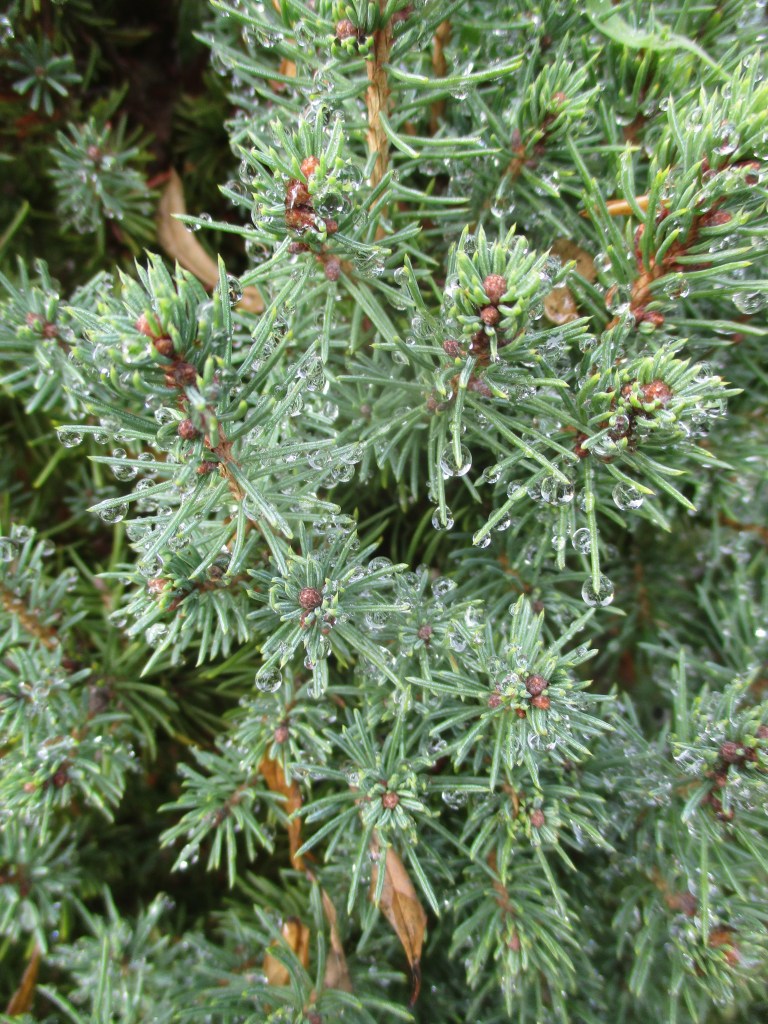
Foliar color, to some extent, conforms to preferable environments. Monterey cypress and Monterey pine have richly deep green foliage. It maximizes absorption of sunlight within the foggy coastal regions that the trees inhabit. Blue spruce has glaucous bluish foliage. It reflects a bit of sunlight to protect from sun scald within severe high mountain climates.

Similarly, deciduous plants generally defoliate for environmental situations. Most go bare for winter, in order to be less susceptible to damage from wind and snow. Bare stems do not collect as much heavy snow as foliated growth. They are also less resistant to wintry winds. If foliated, they are more likely to succumb to wind or overburdening snow weight. 

Evergreen plants may retain their foliage because they are from climates in which winter weather is not so harsh. Wind may be no more extreme than it is in other seasons. Snow may never occur. Plants from tropical regions may be unfamiliar with colder weather and shorter daylength associated with winter. Their evergreen foliage might function all year.

Some tropical plants that are evergreen within their native environments may defoliate or die back as a result of even mild frost. Some recover as if deciduous. (Those that can not survive local climate conditions are not very popular here.) For example, canna die back to the ground after frost, but regenerate later. In tropical climates, they can be evergreen.

Evergreen species from mountainous regions or extreme northern latitudes are generally uncommon here. They prefer harsher weather. Although evergreen, they are remarkably resilient to wind and snow in the wild. They are likely evergreen to always stay receptive to limited sunlight whenever it is available, though wintry weather is possible at any time. 

Gutters Collect Falling Autumn Leaves

Fall color will soon fill gutters.

Autumn is also fall for a reason. It is the season during which most deciduous foliage will fall. Some deciduous trees that lack good fall color may look neater without their shabby old foliage. Sadly though, the splendidly colorful deciduous trees must shed also. All that collective debris that succumbs to weather and gravity gets messy, and can clog gutters.

Evergreen plants shed too. They are just sneakier about it. Some shed old foliage during spring or summer while simultaneously replacing it to stay evergreen. Some shed slowly but steadily for several months, rather than concentrating the mess within a brief season. Many shed during autumn though, as wind and rain dislodge their lingering older foliage. 

Whether deciduous or evergreen, various plants shed at various rates. Monterey cypress shed so steadily through the year that they are never caught in the act. Fruitless mulberry can defoliate in just a few days if frosted suddenly enough. Sudden defoliation seems to be messier, but can be an advantage. For example, gutters may need cleaning just once. 

Weather is also variable. Rain began a bit early this year. The associated dampness can accelerate defoliation for some species. Other species respond more to temperature. An early chill may accelerate their shedding. It is therefore impossible to predict when it will be necessary to rake fallen leaves or clean gutters. There are simply too many variables. 

Unfortunately, the weather that causes leaves to fall is the very same weather that makes raking and cleaning gutters so unpleasant. No one wants to work in the garden while it is cold. Nor does anyone want to get onto a dangerously wet roof to clean gutters. There is no need to rake or clean gutters before rain and cool weather cause debris to fall though. 

It should be obvious when it is necessary to rake leaves from lawn, pavement and street gutters. Bigger leaves tend to be more problematic by clogging drainage. Smaller leaves may just as easily stain pavement or decking though. Roof gutters are not so visible, but probably need cleaning while raking is necessary nearby, and hopefully before clogging. 

Plants Know What Time It Is

Deciduous trees will eventually begin to defoliate.

Even without significant cool weather, the garden knows that it is now autumn. Most of the late summer blooming flowers are finishing their last bloom phases. Leaves of some of the deciduous trees, shrubs and vines are changing color, and some are already falling. Perennials that are dormant through winter are starting to deteriorate.

One of the several difficulties of living in a climate with so few difficulties is that autumn and winter weather is so very mild. Just as so many warm season annuals and vegetables want to continue to perform when it is time for them to relinquish their space to cool season annuals and vegetables, many other plants that should go dormant in autumn really want to stay awake as long as they can. Some semi-deciduous perennials even start to regenerate new growth before they shed their old growth.

Where winters are cooler, such plants generally shed the growth that developed in the previous year; in other words, they die back. They then stay dormant through the coolest part of winter, to break dormancy and regenerate late in winter or early in spring.

Beard tongue (Penstemon) can really look bad as the last flower spikes deteriorate, and the foliage gets spotty and grungy. It will be tempting to cut them back early. If possible, it is better to prune off only the deteriorating flower spikes, but wait until later in winter for major pruning. Premature pruning stimulates premature development of new growth that does not mature as well or as fast through winter as it would in spring. Such growth can be discolored, sparse and less vigorous until it gets obscured by later growth.

Marguerite daisy, ginger, canna, some salvias, most begonias, the various pelargoniums and all sorts of other perennials will likewise seem to be rather tired this time of year and through winter, but do not necessarily need to be pruned back just yet. Simply plucking or shearing off deteriorating flowers should be enough for now. Ginger and canna should not need to be pruned back until the foliage deteriorates enough to be almost unsightly. Begonias and pelargoniums, particularly common zonal geraniums, will be better insulated from potential frost damage through winter, and may not produce so much sensitive new growth if not pruned early.

Dormancy And Defoliation Are Advantageous

Kahili ginger is finished blooming, and should get cut back once the foliage succumbs to frost.

Many plants are deciduous in autumn and winter, which means that they defoliate or die back, and then refoliate or regenerate in spring. Many others are evergreen, which simply means that they are always foliated through all seasons. What many people do not realize is that evergreen plants replace their foliage just like deciduous plants do. They just do not do it in such distinct phases of defoliation, dormancy and refoliation.

Tropical plants like cannas and some of the various begonias really have no need for formal defoliation, since they are from climates that lack winter. In the wild, they continually and systematically shed old stems as they produce new stems. Locally, they tend to shed more than they grow during late autumn and winter. The large types of begonias tend to keep their canes for so many years that it is not so obvious. Where winters are colder, cannas freeze to the ground, only to regenerate from their thick rhizomes as winter ends.

Zonal geraniums may seem rather tired this time of year for the opposite reason. They expect late autumn weather to include frost that would kill them back to the ground where they would stay relatively dormant until warmer weather after winter. Just because their foliage is instead evergreen through winter does not mean that it should be. It lingers and often becomes infested with mildew and rust (fungal diseases) that proliferate in humid autumn weather.

However, zonal geraniums need not be pruned back just yet. Even if they eventually get damaged by frost, pruning should be delayed so that the already damaged older foliage and stems can shelter the even more sensitive new growth as it emerges below. They can get cut back after frost would be likely.

Evergreen pear can get very spotty once the warm weather runs out because the same damp and cool weather that inhibits its growth also promotes proliferation of the blight that damages and discolors the foliage. The damaged foliage eventually gets replaced as new foliage emerges in spring, but will remain spotty and discolored until then. Photinia does not get as spotty, but holds blighted foliage longer into the following summer. Ivy can be temporarily damaged by a visually similar blight.