Our Lord’s candle blooms with very tall floral stalks.
The one or two foot long and nearly inch wide leaves of our Lord’s candle, Yucca whipplei, certainly do not look as painful as they really are. The ridiculously sharp terminal spines can penetrate boot leather and administer a whole new experience of lingering pain! It is no wonder that, although native south of Big Sur, they are uncommon in home gardens.
Their three foot tall and six foot wide stemless clumps of dense foliage would be a very efficient barrier that does not obstruct view, but is not always permanent. Within only a few years, mature plants die after summer bloom. Their big flower stalks emerge like asparagus and grow nearly twelve feet tall, with the upper half of their height branching into hefty spikes of pale white bell shaped flowers one or two inches wide.
Is this velvet mesquite, Prosopis velutina, or honey mesquite, Prosopis glandulosa? It is still too young to identify. I suspect that it is velvet mesquite because I found its seed in a landscape in Surprise, Arizona, and velvet mesquite is the most common species within landscapes there. Also, the foliage of the trees that provided the seed resembled that of velvet mesquite more than that of honey mesquite, with relatively smaller leaflets. The bark was medium brown, so was not quite as dark brown as I would expect for velvet mesquite, but more brown than tan, as I would expect for honey mesquite. This little seedling may not look like much now, but it is the only survivor of the many seed that I collected. Only a few germinated, and slugs ate them before they extended their first leave beyond their cotyledons. This seedling germinated last, and was promptly canned in a four inch pot that I brought inside at night for protection. I hope that, before the end of summer, it grows large enough to survive winter. It should. Regardless of its identity, I hope to eventually use its stems for smoking and, if it grows large enough, barbecuing.
If “verde” translates to “green”, then what color is blue palo verde, Parkinsonia florida? It is simply a bit more bluish green than other species that are a bit more yellowish. Its bark contains chlorophyll to photosynthesize without foliage. Blue palo verde is deciduous so defoliates for winter. Then, it defoliates in response to dryness through much of summer.
Blue palo verde in the wild may develop and retain foliage only during early spring. With landscape irrigation, it can retain some foliage through summer. It can also produce a bit more prior to late autumn defoliation. However, frequent irrigation promotes vigorous but structurally deficient growth. Few blue palo verdes thrive for a century within landscapes.
Blue palo verde can grow almost forty feet tall, but typically grows only about half as tall. It naturally grows as large shrubbery. Removal of lower growth exposes sculptural trunks for small tree form. With staking, trees can develop single trunks. Light yellow flowers are tiny but profuse during spring bloom. Blue palo verde is the Official State Tree of Arizona.
Prosopis velutina, velvet mesquite is supposedly the most popular mesquite within landscapes, such as the landscape in Surprise in Arizona in which I encountered this mesquite. This particular specimen conforms to the description of the species. However, both Prosopis glandulosa, honey mesquite, and Prosopis pubescens, screwbean mesquite, are also somewhat popular within landscapes, and, except for the distinctly twisted beans of screwbean mesquite, both are visually similar to velvet mesquite. All three species are native to the region of Surprise. Because beans that I collected from below this particular specimen were merely somewhat warped, rather than distinctly twisted, I doubt that this specimen is a screwbean mesquite. Also, because the leaflets are relatively short with relatively rounded tips, I doubt that this specimen is a honey mesquite. Therefore, I suspect that this really is velvet mesquite. Although I would prefer to grow honey mesquite, I would be quite pleased to alternatively grow velvet mesquite, or realistically, any mesquite that is useful for smoking. I do not smoke enough vegetables or meats to be so discriminating about the sources of the smoke involved. Besides, if I were so discriminating, I could purchase honey mesquite seed online. For now, I will grow the seed that I collected from below this particular mesquite tree, regardless of its species. The handful of beans that I collected must contain several seed. I have no idea of how many of them will be viable, but will find out. Some of the beans have small holes in them from larval insects who undoubtedly ate some or all of the seed within, but I collected them regardless, merely because they were available. Because the seed are difficult to separate from their beans, I may not bother. I suspect that they will germinate and grow through their bean pods as the pods decay under a shallow layer of medium. Scarification of seed supposedly accelerates germination, but there is no rush. I do not even know where to plant any seedlings that might eventually grow. Although no mesquite are native here, velvet locust, as well as the other two species that this could possibly be, are surprisingly native to nearby counties. Because they are also native to harsh desert climates, I suspect that they prefer the drier and warmer of local climates. I therefore intend to grow them in exposed ridgetop areas with well drained and perhaps somewhat sandy soil.
Fouquieria splendens, ocotillo has been an elusive species that I would like to try to grow, even if only to determine that it will not survive for long in my climate. I suspect that there are a few reasons why I have never observed it outside of desert or warm chaparral climates. I know that it is very susceptible to rot if irrigated even slightly excessively, and within some climates, any irrigation may be excessive. If I can grow cuttings, I will put them in stony and very well drained soil on an exposed ridgetop above my garden, where they will get no irrigation. The piece of cane that was given to me a few days ago, and that I mentioned this morning, is about three feet long, with a single offshoot that is a few inches long. Cuttings should supposedly be between four and six inches long. I tend to make short rather than long cuttings, so would be inclined to cut them four inches long, for a total of about ten cuttings, including the offshoot. I am tempted to cut thirteen cuttings, three inches long, but will try to confirm with the recommended four inch minimum. I do not leave many cuttings out for their ends to dry, but will make an exception for these, since that is what is recommended. I will refrain from scarifying the sides of the proximal ends of the cuttings, just because the stems are somewhat wide, with correspondingly wide basal cuts. Rooting hormone powder will be applied, also as recommended. Fortunately, winter is the best time for starting such cuttings. However, they develop roots slowly, so may not be ready for plugging for two years. I can wait. I will continue to maintain these ocotillo cuttings until they either root or rot.
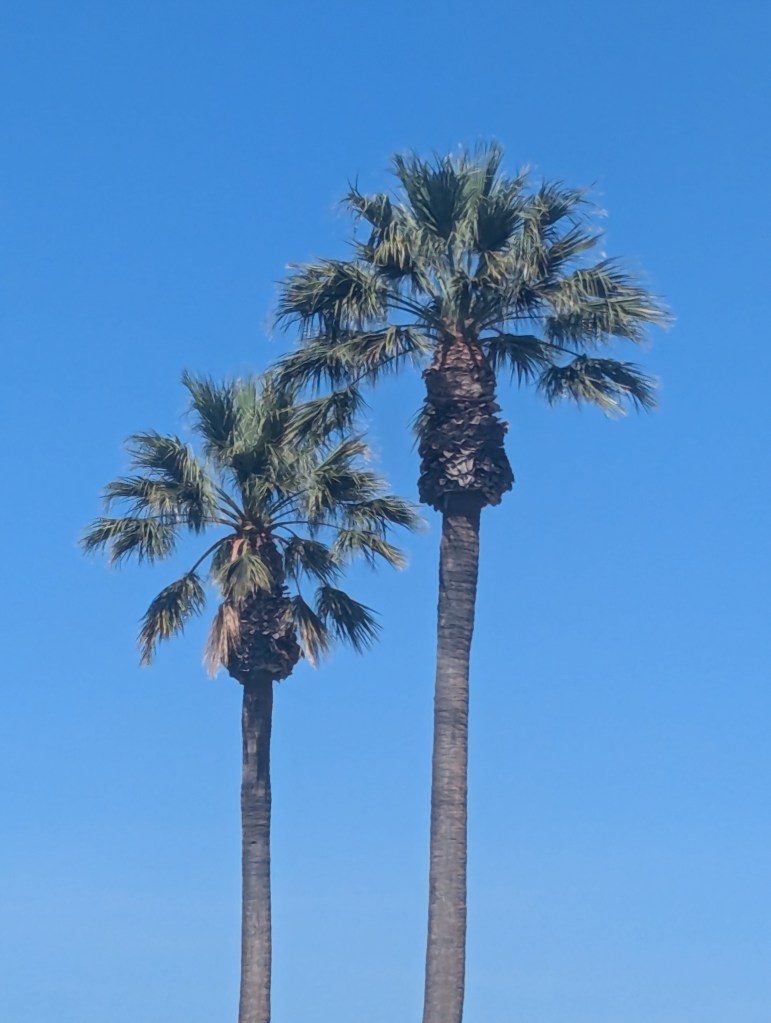
California fan palm, Washingtonia filifera, is the only palm that is native to California. It is naturally exclusive to very distinct ecosystems, though. It inhabits isolated riparian oases of the Colorado Desert. Some also inhabit the Mojave Desert and the Sonoran Desert. It prefers arid warmth. Unfortunately, it may not perform as well within milder climates here.
Otherwise, it is a stately palm that is more adaptable than most are to formal landscapes. It resembles Mexican fan palm, but is shorter and stouter, with a fluffier canopy. It tends to stand straighter, with neatly bare gray trunks. Groomed trees rarely retain petiole stubble. Alternatively, they are handsome, although combustible, with full beards of dried leaves.
California fan palm grows about fifty feet tall, and taller in the wild. Its canopy may be ten to fifteen feet wide. If flattened, its fronds, or complete leaves, might be more than ten feet long. Stiff petioles, with rigid and sharp teeth, are a bit more than half of their total length. The species name filifera describes filaments that hang from the clefts of fronds, and new bud growth.
Ocotillo, Fouquieria splendens, was the species that I intended to procure as Rhody and I walked out and into the desert that surrounded the home we lodged at northwest of Phoenix at the end of last April. I had seen it from the roads on the way there. I should have stopped to procure cuttings or small specimens while I had the chance. Furthermore, I should have stopped for cuttings or small specimens as we left without procuring any earlier. It is a fascinating species that I am completely unfamiliar with.
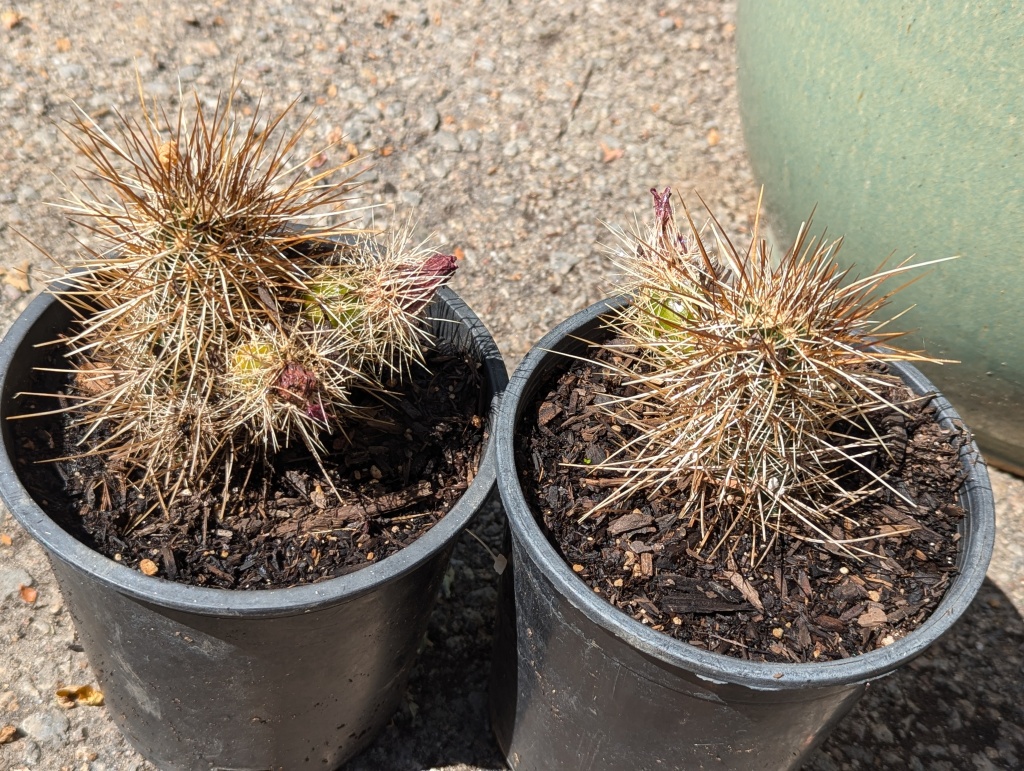
Hedgehog cactus, Echinocereus engelmannii, is all I procured instead. At least I believe that it is this particular species. I really do not know for sure. A few species of the genus are native to the area. This species just happens to be the most common among them, and its description seems to conform to my observations of this specimen. Other species bloom with floral color that is different from that which I observed with a few remaining shriveled floral carcasses. Most other species exhibit different foliar patterns or textures with their spines. This particular species is distinctly more unappealing than the others, but I got it.
Now, I have no idea of what to do with it. First, I should probably wait to see if it survives. The bits that I got might have been a bit too fresh to root before they rot. I suppose that I should remove the developing fruit to divert resources to vegetative growth and root development. I thought that they would abscise naturally after bloom, in response to the distress of separation from the original specimen. I would prefer natural abscission to unnatural intervention. Pruning wounds from such intervention might promote rot while the cuttings are already vulnerable to rot from below.
Desert ecosystems are fascinating, but so are local ecosystems.
Vacation was excellent! I do not get out much, but when I do, I feel as if I enjoy it more than those who travel regularly. The simplicity of my travel allows me to enjoy it more intimately than those who travel more elaborately and put more effort into enjoying what they should probably just enjoy more effortlessly. Anyway, I went to the Pacific Northwest for two weeks, returned for two weeks, and went to the Southwest for two weeks. Actually though, my trip to the Pacific Northwest was limited to Western Oregon and Western Washington, and my trip to the Southwest was limited to the area between Los Angeles and Phoenix. Regardless, it was excellent, and I encountered several climates and ecosystems that are very different from what I am accustomed to. I drove through dense rainforests dominated by massive Douglas firs as well as sparsely forested deserts dominated by sporadic saguaro cacti. Winters are much cooler in some regions than here. Summers are much warmer in some regions than here. It was all so fascinating. I encountered so much vegetation that I would like to grow here, and brought a bit of it back, but can not grow everything that I find intriguing within other regions. However, as excellent as it all was, it also reminds me that I prefer to be here, within the climates and ecosystems that I am most comfortable with. Winters do not get too cool. Summers do not get too warm. I may not be able to grow all the cultivars of apples that prefer a bit more chill in Washington, or all the cacti that prefer more arid warmth in Arizona, but realistically, even if I could work in the garden constantly, I could not possibly grow everything that performs well here.
“Zeroscape” is a neologism that evolved from “xeriscape”. It was a mispronunciation that became a misspelling that became a real word. Ironically, it makes sense. It evolved with the misconception that a xeriscape requires no maintenance. Now, the two are different types of landscapes. A Zeroscape is pavement or gravel that requires zero maintenance.
A xeriscape is a landscape of xeric vegetation. Generally, such a landscape needs less maintenance than conventional landscapes. Nonetheless, some degree of maintenance is necessary. Furthermore, several xeric species require very specialized maintenance. Such specialized requirements may be more demanding than more familiar gardening.
The primary advantage of a xeriscape is that it needs less water than other landscapes. Some xeric species are native to Mediterranean climates. More are native to arid desert climates. Once established, they need minimal irrigation. Many xeric species get all the moisture they need from seasonal rainfall. Some can not tolerate much more than that.
Native species that grow wild can be surprisingly difficult to establish in home gardens. Some xeric species can be even more uncooperative. Cultivation within a garden is very different from natural conditions. In the wild, such species disperse roots proportionately as they grow from seed. In a garden, they begin with detrimentally confined root systems.
Even xeric vegetation within a xeriscape needs moisture while it disperses roots. A few may get enough through winter if they get into a garden early in autumn. Most prefer a bit of irrigation at least through their first year. The difficulty is that some can rot if irrigation is even slightly excessive. They are more susceptible to rot than species that are not xeric.
Maintenance of a xeriscape, is more challenging than demanding. That is because so many xeric species are from harsh desert ecosystems. They innately defend themselves from grazing wildlife. Consequently, cacti, agaves and yuccas are wickedly thorny and spiny. Several are potentially dangerous to handle. So are some euphorbs and acacias. They may not need maintenance often, but when they do, they do not make it at all easy.
Perhaps no one noticed. Most of my posts were automated prior to my departure, and I managed to compose a few brief articles for what was not automated; so ultimately, there was no lapse of posting. I may have only been negligent with response to comments for the last two weeks.
Realistically though, I have been intending to discontinue blogging and recycling old articles, and to post only my weekly gardening column, in two parts, on Mondays and Tuesdays. I merely have not done so yet.
Anyway, my trip, although very different from how it was planned, was totally excellent! Just a short distance from the turnoff for the southbound San Diego Freeway towards my primary destination in Los Angeles, I was diverted to my secondary destination northwest of Phoenix. I missed the desert scenery as I drove all night to arrive shortly before four in the morning, and began my vacation exhausted. Although I missed out on some of my plans in Los Angeles, I got more time in Arizona. The weather was weirdly excellent, with a weirdly torrential thunderstorm right in the middle of it. It was too early in the year to collect the seed that I wanted, but I really was not expecting to find any anyway. I did happen to procure a hedgehog cactus of some sort. I decided that, since my return was already delayed by a day, that I may as well delay it for two days. (I had brought some of my work with me, so was able to tend to it prior to my return rather than after.) Therefore, I came to my original primary destination in Los Angeles secondarily, stayed to help Brent with the View Park Garden Tour on Sunday, and returned home on Monday.




 Tony Tomeo