Horridculture – Trash Talk

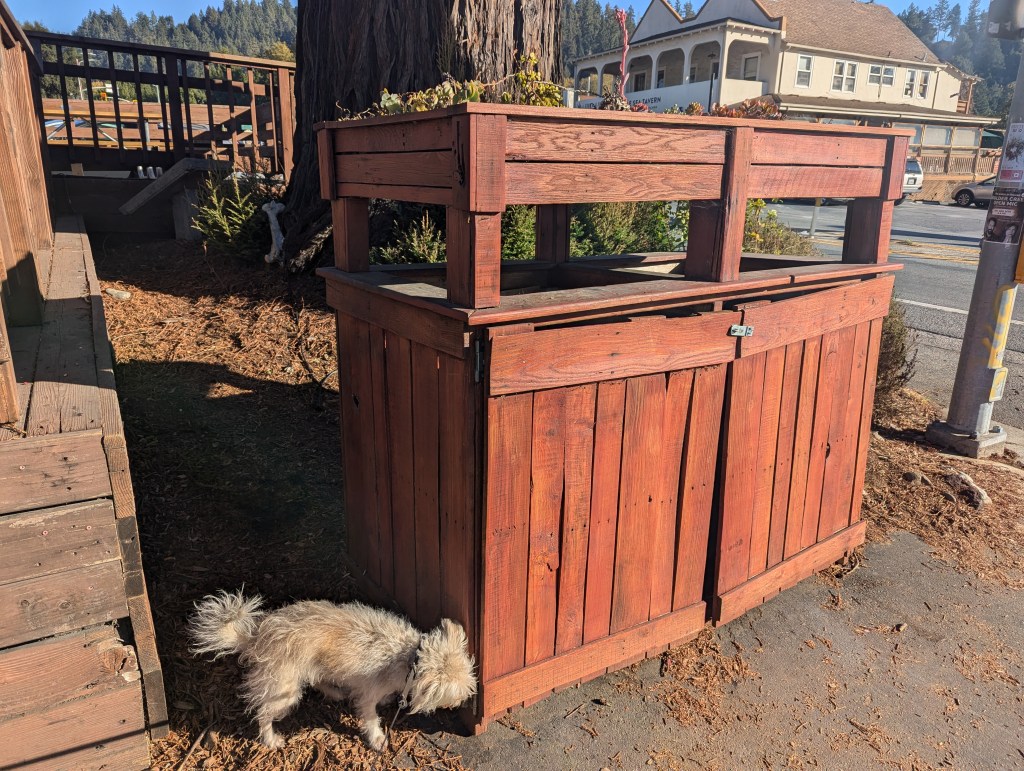
Public trash receptacles are a good concept. Without them, some of us would be more likely to litter. Contraptions such as this are most likely a good concept too, since they are somehow more visually appealing than exposed trash cans. Also, they are unlikely to fall over and spill as exposed trash cans sometimes do. Originally, one half of this receptacle was designated for trash, and the other half was designated for recyclables. This is another good concept, but was very unfortunately discontinued because it is so commonly ignored that someone must sort through less than efficiently sorted trash and recyclables. The only obvious component of this device that may not have been such a good concept is the planter box that hovers above it. Once outfitted with a nice collection of succulent perennials, it was left to survive as well as it can, which has not been very well. Succulents were likely selected for this particular application because they are supposedly ‘drought tolerant’. However, only some are drought tolerant, and only because they extend their roots as they must in order to find moisture, which they are unable to do while confined to this hovering planter box. Although they have been surviving, they have not been very happy about it. I suspect that someone must sometimes give them water, but these succulents want a bit more. Realistically, they would be happier in the ground behind the trash receptacle. There is certainly plenty of vacant space for them there, and they would be more visually appealing where they would actually be more visible than they are above average eye level. If some sort of vegetation is desirable above the trash receptacles, small shrubs or vines in the ground next to them would be happier than succulents above them. It would have been better to maintain the space that is already in need of maintenance than to add more.
Change of Scenery

I am certainly no landscape designer, but I think that I sort of dig this.

Window boxes annoy me. They were originally developed to contain aromatic herbs that dissuaded mosquitoes from entering small windows, likely before the invention of window screens. They remained popular while window screens were expensive, and to grow culinary herbs where garden space was limited in old European cities. None of that is useful to me. Mosquitoes are not much of a problem here, and if they were, window screens are not expensive. There is plenty of space for herbs in the garden. Furthermore, window boxes eventually rot as a result of the irrigated medium within, and share their rot with the wooden walls that support them.

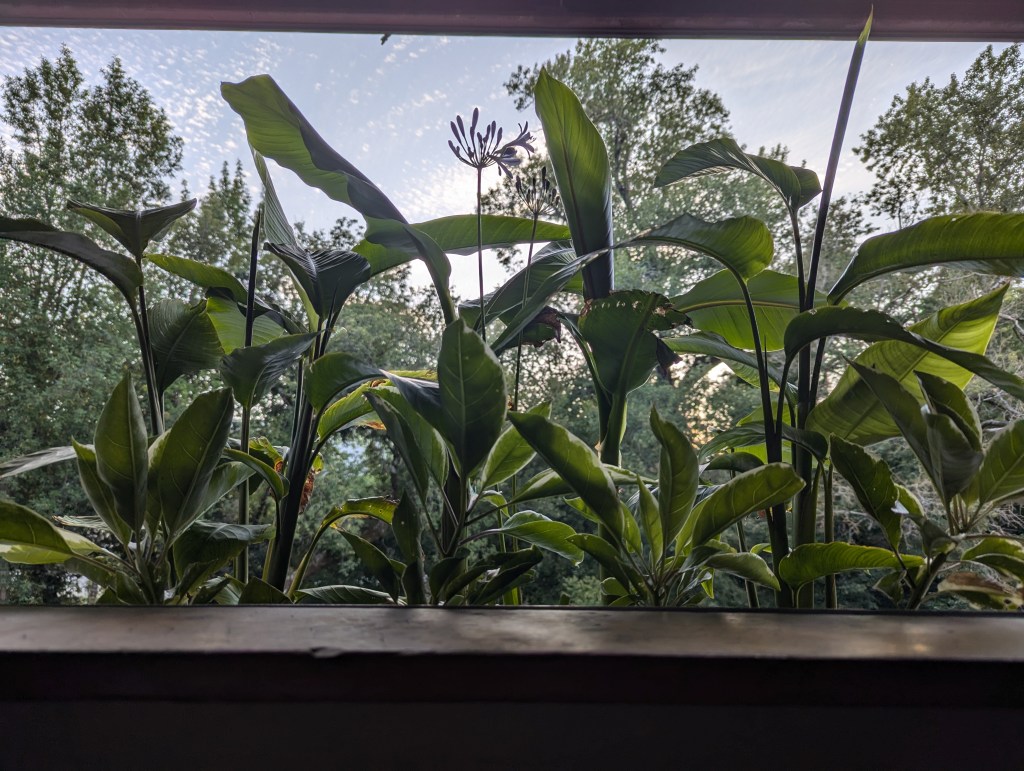
The small shelf that I suspended below this window was intended for eleven small tissue culture plugs of various cultivars of banana. I wanted to shelter them from minor frost last winter. I intended to remove the shelf after winter. Obviously, I did not.

Without a plan, I moved eleven small specimens of various species from the nursery onto the shelf just to see how their composition could develop. I typically do not like to obscure scenery or obstruct sunlight from windows, but thought I could make an exception for this window. The scenery is not particularly appealing, with a busy roadway nearby. Through summer, a bit of shade from the warm late afternoon sun might be nice.

I did not want the grassy texture or bronzed foliar color of the sugarcane right outside the window. Nor did I want the disorganized texture of any of the gingers. I am rather pleased with how these few other species work though. They are nearly half as high as the window, but as I mentioned, for this window, I do not mind. They look rather jungley.

The eleven small specimens here are in eight #1 cans and three 4″ pots. The three 4″ pots are nestled into the gaps in between two rows of four #1 cans. A pair of young plugs of Cucurma longa, turmeric, in two of the three 4″ pots are not visible to the left and right. Only two blooms of a small specimen of Agapanthus africanus ‘Peter Pan’ lily of the Nile in the middle 4″ pot are visible. Four rooted cuttings of Solandra maxima ‘Variegata’ cup of gold vine are in the closer row of #1 cans. A pair of large specimens of an unidentified cultivar of Heliconia psittacorum, parakeet flower, are to the left and right in the rear row. A pair of pups of Musa acuminata ‘Golden Rhino Horn’ banana are in the middle of the rear row. This is so very inconsistent with my style, but I am getting to like it.

More Bad Design

blindfolded house

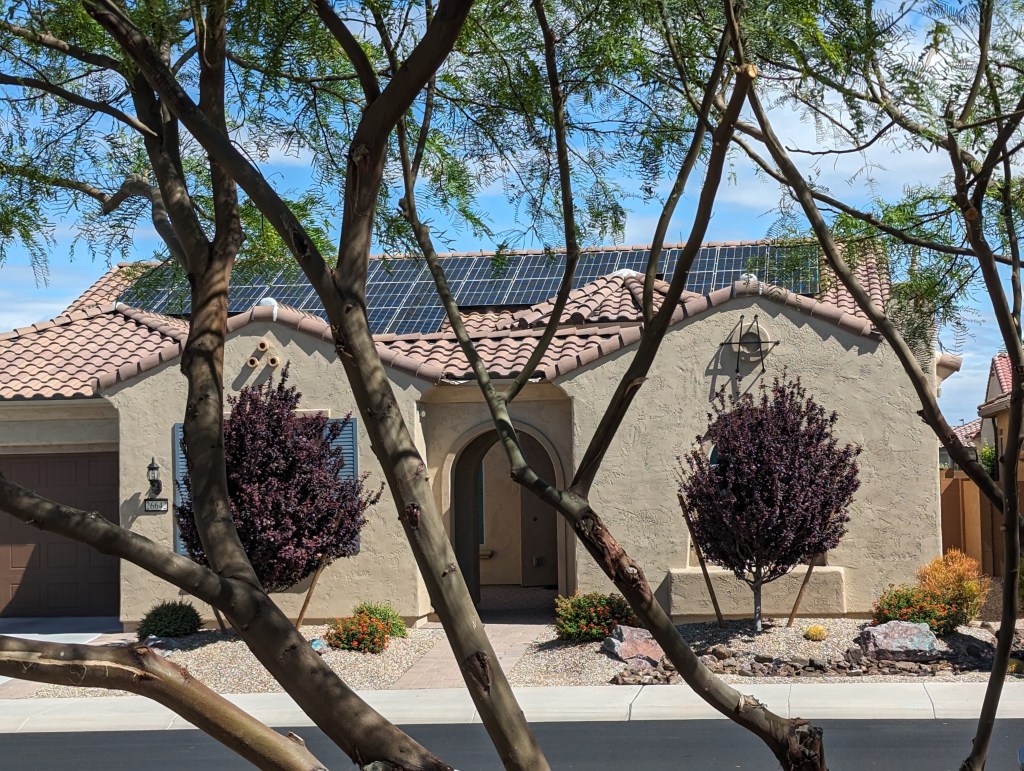
The landscape in front of the home across the road from where I am staying in Arizona is weird. Like many of the landscapes here, it is simple, with only a few small shrubs and stone surrounded by gravel, but also includes this silly pair of purple leaf plum trees. They are pruned into symmetrically round form. The pruning keeps their canopies nicely dense with strikingly bronzed foliage. What makes them so weird is their location. Within the climate here, shade is an asset. However, these trees are not allowed to make much shade. The natural form of these small trees could frame the facade of this house nicely. However, they clash with it defiantly. With their profuse spring bloom and rich foliar color, these trees might enhance the scenery from within the windows. However, they subjugate it and exclude any other scenery, and likely exclude a bit too much sunlight without providing significant cooling shade through summer. I am certainly no landscape designer, but in my opinion, this landscape looks odd. The vegetation is of good quality and quite healthy. The stone and gravel is neatly arranged. The facade of the home is quite appealing. The problem is that the assemblage of the landscape relative to the home is awkward. The tree in the foreground is one of the first three mesquite trees that I ever met when I pruned them up for clearance last year. It and the specimen next to it are also awkwardly placed in front of their home, although the third is in a better situation next to the garage. That is precisely why these three trees were pruned up for clearance, and why they will be pruned higher as they grow. They already provide a bit of shade, and will provide more as they grow.

Design and Implementation

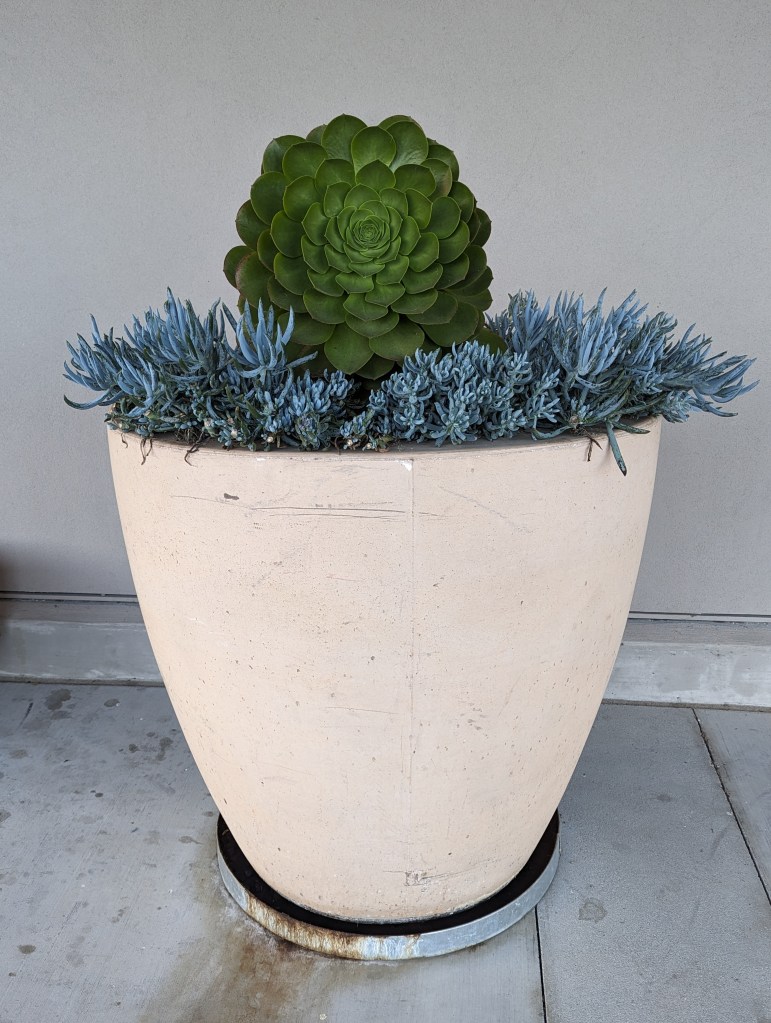
This exposed urn looks like a koala tummy.

This is so silly that I sort of like it. I mean, I found it to be sufficiently amusing to get a picture of it to send to Brent. It is a nice large urn, with an Aeonium arboreum that is a bit bolder than any of mine, and delightfully blue Senecio mandraliscae. It has nothing else going for it, but perhaps its simplicity is an asset. It might look junky if it contained any other well planned but comparably maintained material.

My only personal criticism of its design is that it is located on otherwise useful pavement, where pedestrian traffic must divert around it; but I am merely a horticulturist, not a landscape designer. For all I know, it could be there to intentionally soften the expansiveness of all that useful pavement, without occupying too much of it. I would also say that the urn should be outfitted with species that are more tolerant of the partial shade of its particular exposure, but obviously, these two simple species are reasonably happy there.

My more realistic criticism is of its implementation. Is it really too difficult for so-called maintenance ‘gardeners’ to maintain this as the landscape designer who designed it thought they should be able to? Must landscape designers design their landscapes with the expectation that their work will not be maintained as expected? Although it is delightfully silly, it might be more visually appealing if the Senecio mandraliscae cascaded a bit more over the edge. Alternatively, it could be confined to the upper surface of the urn if a third perennial were allowed to cascade somewhat over the edge; but again, I am no landscape designer. The urn is nice, but might be nicer with a bit of foliar color, form and texture over some of its exterior.

Fads Influence Contemporary Garden Design

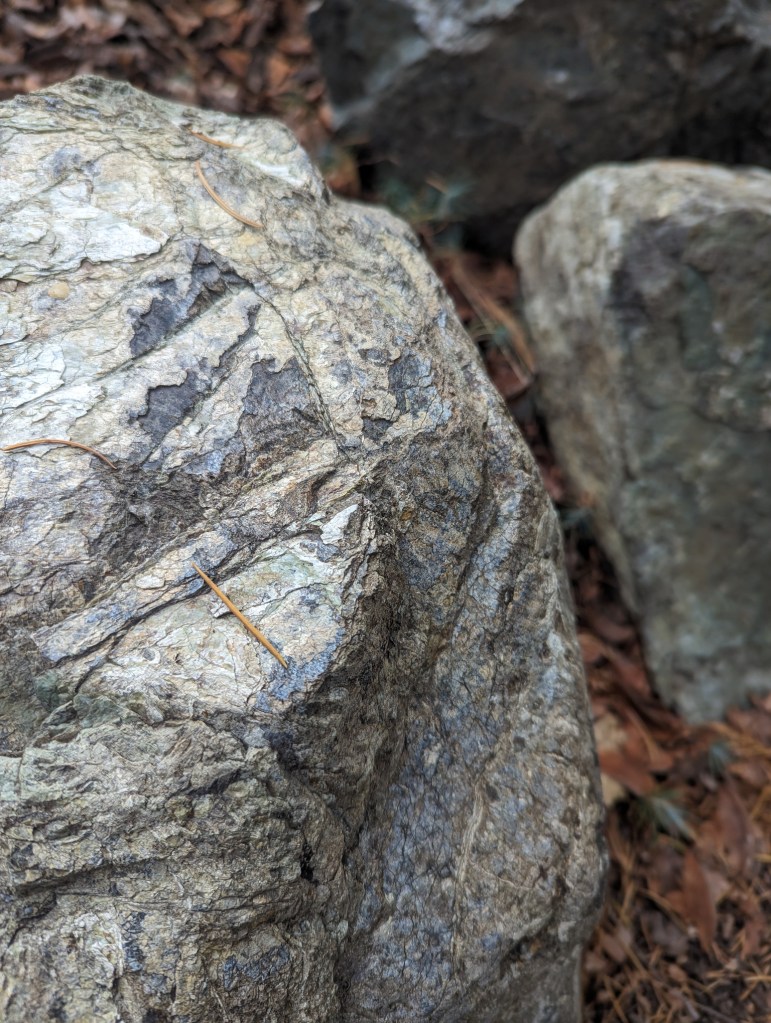
Even boulders can become a fad.

Landscape design and gardening trends change like every other sort of fashion. Several fads of the past were quite practical and justifiable. Many were not. Whether justifiable or not, many merely became old fashioned. Some evolved into a more contemporary style. Others were not so adaptable. Planning for a landscape is easier than planning for fads.

For example, plants seem to be disproportionately small within a new landscape. That is because someone planned for them to have sufficient room to grow. Shade trees should eventually mature to be proportionate to their respective spaces. In fact, all plants should mature accordingly. However, overly trendy queen palms can become passe at any time.

Many home gardens contend with fads from the past that are awkward to accommodate. Strict symmetry that was very common long ago has become more than old fashioned. It is now considered to be unappealing. Relaxed asymmetry is now common and popular. Of course, this is an advantage as aged trees of symmetrical rows begin to die randomly.

Queen palms that became popular in the 1990s are getting more expensive to maintain. Only professional arborists can groom them as they get too tall to reach from the ground. Queen palms at rear fences of backyards were a fad. Sadly, most utility cable easements are above such rear fences. Palms that encroach too closely necessitate costly removal.

Living Christmas trees was another fad that caused serious problems later. Most of such trees were either Italian stone pine or Canary Island pine. Many found permanent homes within confined home gardens after Christmas. They seemed to be so docile while small and potted. The problem was that both species grow too big for compact home gardens.

Sustainability is presently a fad that actually has potential to be beneficial in the future. It only needs proper execution. The results of fads may linger long after the fads are gone. Many trees that are fads now could survive for centuries. No fad demonstrates that more accurately than sustainability. That which is truly sustainable can evolve with future fads.