A pollinator is a vector of pollen, besides wind. Most are insects. Some are animals. Their only qualification is that they collect and deliver pollen between flowers. Almost all are unaware that they do it as they visit flowers for nectar, which the flowers produce to attract pollinators. Bees, which are probably the most common pollinators, visit flowers to collect pollen with which to make their honey, and pollinate in the process.
So, what about the flowers that provide pollen for pollination, particularly for dioecious species such as hollies, date palms and kiwi vines? (Dioecious plants are either male or female.) ‘Bing’ cherry is not dioecious, but is not self pollinating either, so needs another cultivar of sweet cherry for cross pollination. Such a cultivar is known as a pollinator.
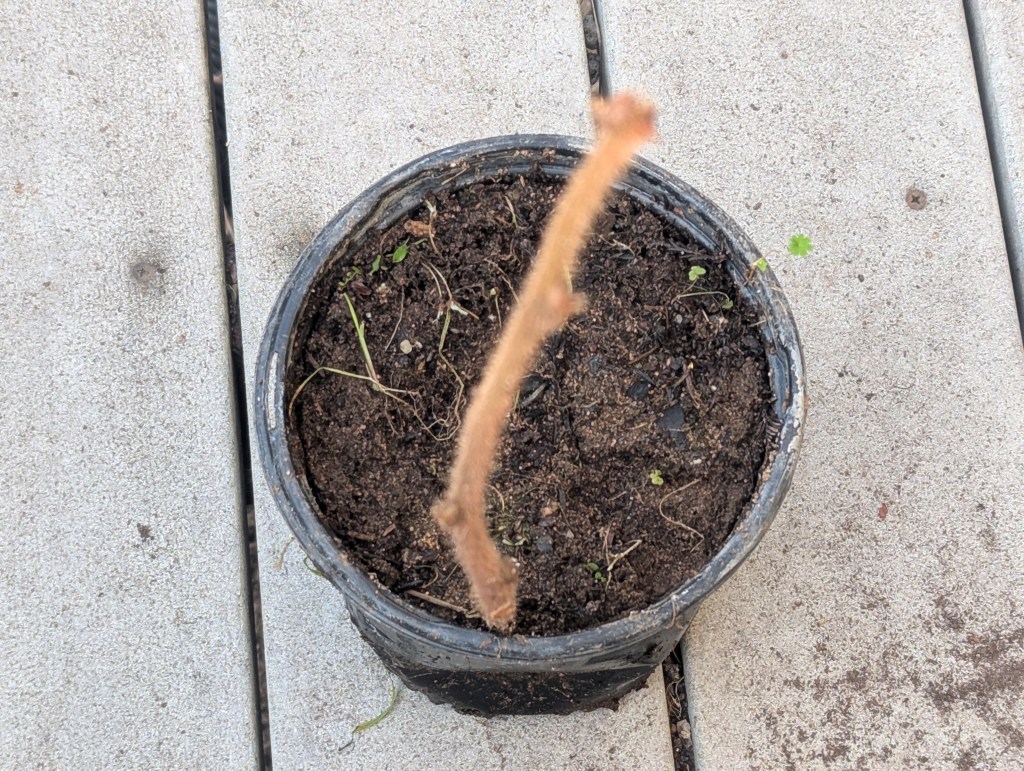
My female kiwi vine just recently acquired a male pollinator. It does not look like much yet, but will grow up to bloom with male flowers to provide pollen for the female flowers of the vemale vine. Because kiwi vines are dioecious, the female vine would be fruitless without pollination from the male vine. Perhaps the male pollinator will need a pollinator to deliver its pollen to the female vine.
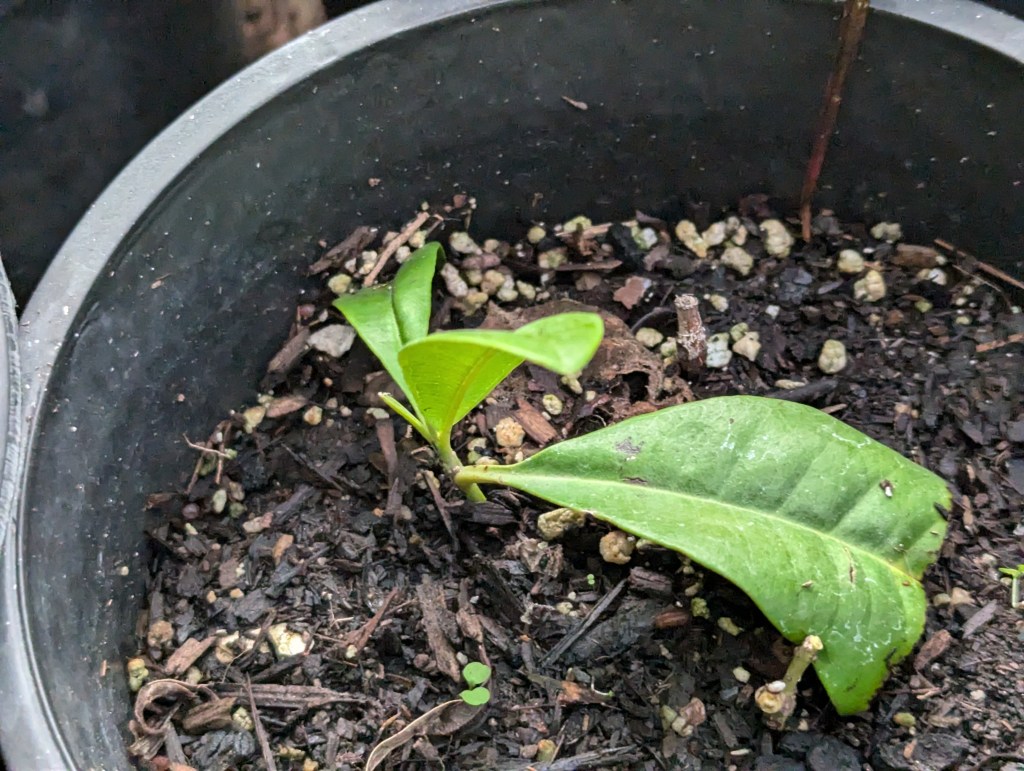
The Shrub Queen sent me seed for sea grape, Coccoloba uvifera. Naturally, it is now very important to me. I wanted to grow it before obtaining the seed. Now, I am obligated to grow it well! Some of the seed germinated readily. The problem is that slugs promptly ate the tops of the seedlings. Only one seedling survived without damage. It now has its first pair of leaves, and looks like a green butterfly. A second seedling that germinated shortly afterward retains one of its first pair of leaves, so could possibly survive. Hopefully, more seed will germinate later. Sea grape is dioecious; so the primary seedling is either male or female, and therefore unable to produce fruit without a mate of the opposite gender. Most sea grape are female; so even if the secondary seedling survives, there is more than a fifty percent probability that both the primary and secondary seedlings are female. If more seedlings germinate in the future, they will increase the probability that at least one will be a gender that is different from the others. Actually though, I would be pleased with only a single fruitless sea grape. The seed was such a generous gift.
Jamaican allspice, Pimenta dioica, is rare here. I am beginning to learn why. Because it is tropical, it is vulnerable to even very minor frost. Actually, it is not so keen on chill either. It is rated for climates that are no cooler in winter than Zone 10. This is Zone 9. It seems to grow reasonably well in the Los Angeles region, where I collected my cuttings from Brent’s Jungalow Garden, but it is rare there also. That could be because it is not much to look at. Its foliage is no more interesting visually than that of common privet. Although the foliage is splendidly aromatic, only those who are familiar with the species, or become acquainted with its aroma while pruning it, would know. Its bloom is neither prominently colorful nor fragrant. What is worse is that the bloom is dioecious, with male or female flowers on different specimens. Single specimens have no problem blooming, but can not produce allspice fruits without a mate. Single male specimens are fruitless for obvious reasons. Single female specimens are fruitless without pollination. Not many people who grow the very rare single specimens are aware of this, although most are satisfied with the delightfully aromatic foliage. New specimens only very rarely become available in nurseries, and when they do, all of them were likely grown from the same stock specimen, so are genetically identical and of the same gender. Only seed grown specimens are random in regard to their respective genders, and even among them, their genders are unknown until they eventually bloom. The potential for growing both genders is proportionate to the number of seedlings. For example, one seedling will be of one gender. Two seedlings are as likely to be of the same gender as they are to be of different genders. Three are more likely to include one of another gender. Several or many are proportionately less likely to be of the same gender. All of my several cuttings were from the same specimen, so would have been genetically identical. It does not matter much now anyway, since only one survived, and even it is still rather wimpy. It has developed only two new leaves, and retains a trimmed portion of one of its original leaves. I am pleased with it regardless of its gender, and will be satisfied with only its aromatic foliage.
It is much too early to distinguish gender of these carob seedlings.
Phoenix dactylifera, common date palm supposedly became more popular than Phoenix canariensis, Canary Island date palm during the 1990s for two primary reasons. Firstly, it is less susceptible to pink rot that was killing so many Canary Island date palms at that time, and continues to do so. Secondly, mature specimens became so readily available as their orchards were being displaced by urban development, particularly around Las Vegas and Palm Springs. Of course, fruiting date palms would have been too messy for the urban landscapes that they were recycled into. So, to prevent such mess, only female trees were recycled for such landscapes. Without their male pollinators, they are fruitless. Female trees are generally shorter, more lushly foliated, and therefore more appropriate to refined landscapes anyway. Besides, all but between one and five percent of trees in date orchards are female. Male trees were not completely wasted though. Although not as lush, they are taller and statelier, so were recycled to landscape remote desert highway interchanges, where their pollen does not reach female date palms that now inhabit more urban landscapes. It all works out well, although contrary to the original purpose of the date palms involved. It would seem silly to separate genders of most familiar dioecious species, such as kiwifruits and hollies. However, only female carob trees are available from nurseries nowadays because they would be messy with pollination, and also because male floral fragrance is horrid! Male carob trees are only available for agricultural purposes, or grow as feral males from seed. The problem that I will eventually encounter with my carob trees is that I grew them from seed, and will not know what their genders are until they are a few years old. I want a female specimen in a specific location, and a male pollinator in another specific location. I think that I will put three seedlings in each location, select one that matures to be the preferred gender for its particular location, and eliminate the other two. Alternatively, I could allow two genders to grow together in such a manner than the male grafts to the female to become a branch that I could prune to be a small but necessary portion of the collective canopy. Of course, there is a possibility that all within each group of three could be the wrong gender. I will not know until a few years from now.
It is about time that someone reintroduced this technique! Blue Princess holly is now available together in the same pot as its male pollinator, Blue Prince holly (Ilex x meserveae ‘Blue Princess’ and ‘Blue Prince’). With careful pruning to prevent one from crowding out the other, both can coexist and provide profuse, bright red berries every winter, indefinitely. As the plants grow, their main trunks will eventually graft together.
Blue Princess holly is purported to be the shrubbier of the two. Blue Prince might be a bit more compact, and might grow a bit slower. Both eventually get about seven feet tall and nearly as broad, with remarkably glossy evergreen foliage. Their rather wavy leaves have sharply pointed teeth. Fortunately, their teeth are not quite as sharp as those of traditional English holly, which happens to be one of their mutual parents.
If possible, it might be helpful to identify the two cultivars of holly in a mixed planting, and label them so that neither one nor the other gets pruned out. Blue Prince will be the plant that produces no berries. Of course, with selective pruning ‘Blue Prince’ can be confined and subordinated to the showier ‘Blue Princess’. Individual ‘Blue Princess’ holly plants are better for hedges, with separate ‘Blue Prince’ plants nearby.


 It is about time that someone reintroduced this technique! Blue Princess holly is now available together in the same pot as its male pollinator, Blue Prince holly (Ilex x meserveae ‘Blue Princess’ and ‘Blue Prince’). With careful pruning to prevent one from crowding out the other, both can coexist and provide profuse, bright red berries every winter, indefinitely. As the plants grow, their main trunks will eventually graft together.
 Tony Tomeo