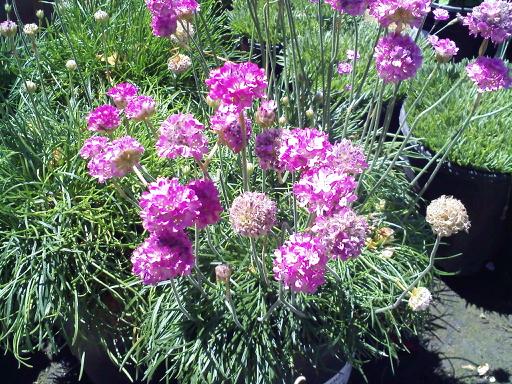
Thrift

Thrift performs well in coastal climates.

When I see common thrift, Armeria maritima, in nurseries now, I wonder what such a diminutive perennial would be useful for. Their densely compact mounds of narrow evergreen leaves rarely get more than four inches deep, and take their time spreading to less than a foot wide. Then I remember how thrift visually softened the straight edges of my father’s brick patio and retaining walls, and fit so nicely into the tight spots. If allowed to do so, thrift creeps slowly over edges of pavement and stepping stones, but is not too eager to overwhelm them.

If it eventually gets overgrown, thrift is easily cut back to the edge of pavement at the end of winter, and will green over its raw edge by spring. The bits and pieces that are left over from cutting back the edges can be plugged back into other areas and will eventually develop roots if initially watered regularly. Once established, thrift stays healthier if allowed to dry somewhat between watering. Bald spots that may naturally come and go as mature plants die out in the center and then regenerate fill in faster if outer edges get cut back.

The dense round clusters of tiny flowers stand above the foliage on bare stems about four to eight inches high. The flowers are almost always bright pink, but are sometimes white or reddish pink. Bloom is most profuse in spring and may continue sporadically all year. 

Dividing Perennials Equates To Multiplying

Yuccas can get divided after bloom.

This seems like bad algebra. Horticulturally, dividing and multiplying really are the same. Division is the separation of crowded perennials into smaller but more numerous portions. It multiplies the number of individual plants. The smaller portions perform better than they did while crowded. Division is both a method of vegetative (clonal) propagation, and a form of healthy social distancing.

Many perennials are ready for dividing about now. They finished blooming through spring or summer, and are going dormant for winter. Some defoliate. Division is not so disruptive to them while they rest. Cool and damp weather keeps them hydrated. They can disperse roots and resume growth as winter ends, as if nothing ever happened. They should bloom right on schedule next year.

The most popular perennials grow for many years before getting overgrown enough to benefit from division. Some may technically never need dividing. They manage to perform adequately even as dense thicket growth. For some, division is primarily for propagation. Only a few perennials appreciate annual division. Perennials that bloom in autumn or winter prefer division in early spring.

Pigsqueak will bloom later in winter. Dividing it now with other perennials would inhibit and retard the blooming process. It will be ready for dividing before winter ends, so can settle in with the last winter and spring rain. The same applies to Japanese anemone, which might still be blooming now. Dividing these two perennials is typically for propagation or containment, rather than crowding.

Lily of the Nile and African iris do not need dividing often, but when they do, it can be a major chore. For moderate crowding, it is relatively easy to pluck many individual shoots without disturbing remaining shoots. However, it is typically more practical to dig bulky colonies, divide them into individual shoots, and then plant the shoots. African iris shoots work best in groups of five to twelve.

Lily of the Nile, with dividing earlier than later, disperses roots in winter, to bloom for summer.