Hydrangeas Perform Better With Proper Pruning

Pruning of one season affects bloom of another.

After decades of breeding, most modern cultivars of hydrangea are much more compact and a bit stockier than old fashioned hydrangeas that had long, limber stems that could bend downward from the weight of their own blooms. They stand up to proudly display their modern, vibrant color, even when their billowy blooms get heavy with rain. Yet, even with all their genetic improvements, they should still be pruned properly and annually to promote continued bloom. Without pruning, even modern cultivars can get floppy and lanky.

Because most hydrangeas bloom on stems that developed during the previous year, they should not be pruned too much while dormant through winter. Instead, solitary (generally unbranched) stems that grew from the base last year and bloomed this year should be pruned back to a pair of buds about a foot high as their blooms deteriorate. Even though some blooms continue to develop late into autumn, most are finishing about now. Therefore, pruning stems back while also removing spent blooms gets the pruning done early enough for the side buds to start to grow into secondary stems.

These secondary stems should not get pruned again, even when they go dormant through winter. They do not grow much before winter, but should be mature enough to bloom during the following spring. Thinning these branched stems through winter by cutting some of the smaller stems to the ground should produce fewer but significantly larger blooms, as well as prolong the blooming season. (However, many modern cultivars naturally bloom sporadically after their primary bloom phase until autumn anyway.)

New canes that develop from the ground to replace older branched stems may not bloom their first year, but can be left unpruned through winter to bloom early the next spring, which starts the process over again. Old stems should be cut to the ground after their third year (second bloom season). Leaving a few spent blooms on the plants long enough to dry (as dried flowers) should not interfere too much with proper pruning.

Defoliation And Dormancy Are Justifiable

Wind blows freely past defoliated stems.

Defoliation and dormancy begin early for quite a few species within desert and chaparral climates. California buckeye can defoliate during the driest summer weather, refoliate for autumn, and then defoliate again for winter. They do what they must to avoid desiccation within their arid climate. Many more species do what they must to survive through winter.

That is why so many plant species are deciduous while they are dormant through winter. They shed their foliage when it is more likely to be a liability than an asset. Like summer dormant plants, they respond to inevitable and potentially detrimental weather. Moreover, they respond to seasonal changes of sunlight as well. Plant species are very perceptive.

With few exceptions, deciduous plants are nonconiferous or broadleaf species. More are endemic to regions to the north and south of tropical regions than within tropical regions. They know that sunlight is less intense and daylength is shorter while the sun is at a low angle during winter. Their defoliation coincides with the least usefulness for their foliage.

Most deciduous plant species are also aware of the sort of weather that they are likely to encounter during winter. Cold and stormy weather with wind and rain or perhaps snow is probably familiar to them. They know that foliage is not only vulnerable to damage, but is also burdensome to associated stems. In colder climates, it can accumulate heavy snow.

Foliage is the source of almost all wind resistance within foliar canopies that suspend it. Such wind resistance causes wind to dislodge limbs or blow vegetation over, particularly while soil is moist from rain. Defoliation eliminates much of such risk prior to the windiest and therefore riskiest storms of winter. Bare stems are more aerodynamic than foliage is.

Defoliation seems to happen at the best time, immediately prior to wintry weather. It even increases warming sunlight exposure during the darkest and coolest season of the year. However, defoliation is also messy while the weather is unpleasant for those who go out to rake it away. Without prompt raking, it clogs drainage of rain while it is most important.

Bare Root Stock For Winter

Bare roots might fail to impress.

Dormant pruning happens during winter, while the plants that benefit from it are dormant. Obviously, it would not be dormant pruning otherwise. Such processes are less stressful to plants while they are inactive and essentially anesthetized like a surgery patient. This is also why fresh bare root stock becomes available and ready for planting during winter. 

Bare root stock grows on farms for a few years. Any grafting is part of the process. When stock is sufficiently mature, growers dig and separate its roots from the soil that it grew in. Much of the stock goes to retail nurseries for heeling into damp sand for sale. Some gets neat packaging with damp sawdust around its roots. Some goes out for mail order sales.

Regardless of the process, it all happens quickly and early during winter dormancy. Bare root stock must then get into soil again, quickly and before the end of winter dormancy. It will not survive if it resumes growth without soil to contain new roots. Planting should be as soon as possible, so that roots can settle in with rain, and be ready to grow by spring.

Bare root stock is less expensive than canned (potted) stock because it is so lightweight and easier to process. Since it occupies less space than canned stock in retail nurseries, more varieties of bare root stock are available. Bare root stock is easier to load into a car, and plant into a garden. Once in a garden, it disperses roots quickly and more efficiently.

Deciduous fruit trees are the most popular bare root stock. Of these, most are stone fruits or pome fruits. The stone fruits, of the genus Prunus, include cherry, plum, prune, apricot, peach, nectarine, their hybrids, and almond. Apple, pear, and quince are pome (pomme) fruits. Pomegranate, persimmon, fig, mulberry and walnut are somewhat popular as well. 

So much more than deciduous fruit and nut trees are available as bare root stock. Grape, kiwi, currant, gooseberry and blueberry are deciduous fruiting vines or shrubs, not trees. Blackberry, raspberry and strawberry are evergreens. Rhubarb, asparagus and artichoke are perennial vegetables. Rose, wisteria, hydrangea and so many more are fruitless ornamental plants.

Dormancy And Defoliation Are Advantageous

Hostas go dormant and defoliate for winter, and regenerate for spring.

Many plants are deciduous in autumn and winter, which means that they defoliate or die back, and then refoliate or regenerate in spring. Many others are evergreen, which simply means that they are always foliated through all seasons. What many people do not realize is that evergreen plants replace their foliage just like deciduous plants do. They just do not do it in such distinct phases of defoliation, dormancy and refoliation.

Tropical plants like cannas and some of the various begonias really have no need for formal defoliation, since they are from climates that lack winter. In the wild, they continually and systematically shed old stems as they produce new stems. Locally, they tend to shed more than they grow during late autumn and winter. The large types of begonias tend to keep their canes for so many years that it is not so obvious. Where winters are colder, cannas freeze to the ground, only to regenerate from their thick rhizomes as winter ends.

Zonal geraniums may seem rather tired this time of year for the opposite reason. They expect late autumn weather to include frost that would kill them back to the ground where they would stay relatively dormant until warmer weather after winter. Just because their foliage is instead evergreen through winter does not mean that it should be. It lingers and often becomes infested with mildew and rust (fungal diseases) that proliferate in humid autumn weather.

However, zonal geraniums need not be pruned back just yet. Even if they eventually get damaged by frost, pruning should be delayed so that the already damaged older foliage and stems can shelter the even more sensitive new growth as it emerges below. They can get cut back after frost would be likely.

Evergreen pear can get very spotty once the warm weather runs out because the same damp and cool weather that inhibits its growth also promotes proliferation of the blight that damages and discolors the foliage. The damaged foliage eventually gets replaced as new foliage emerges in spring, but will remain spotty and discolored until then. Photinia does not get as spotty, but holds blighted foliage longer into the following summer. Ivy can be temporarily damaged by a visually similar blight.

Prune Fruit Trees While Dormant

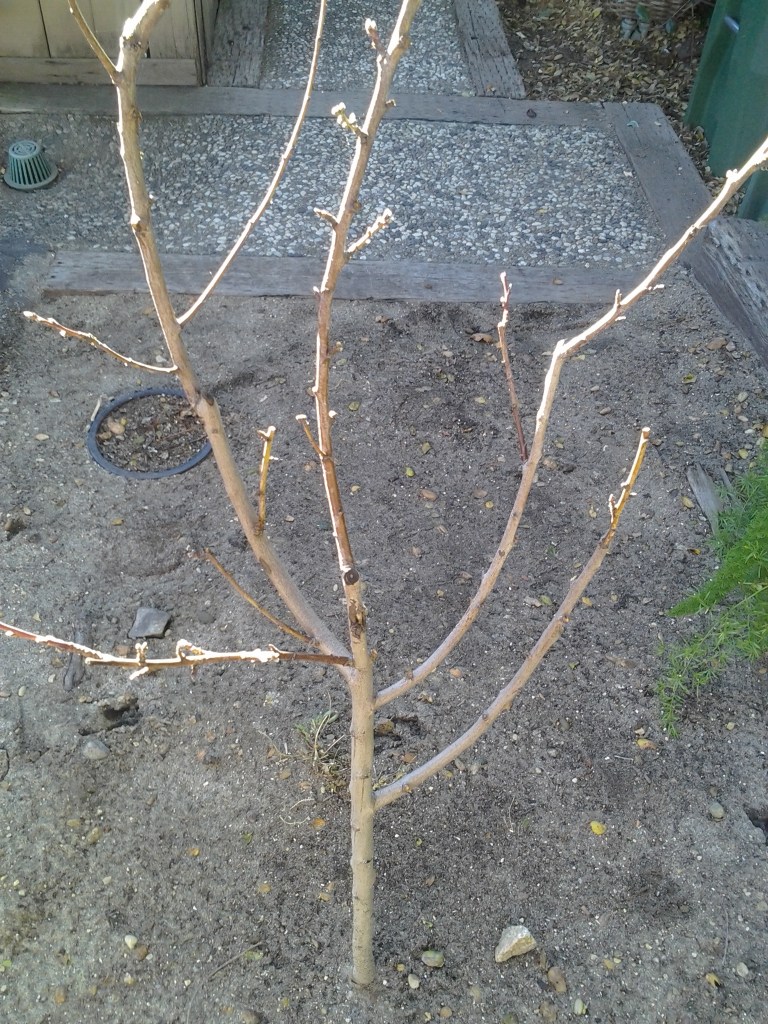
Dormant fruit trees should be pruned aggressively.

After centuries of breeding for abundant production of unnaturally large fruit, deciduous fruit trees have become dependent on specialized pruning while they are dormant through winter. Without pruning, most eventually become overgrown and overwhelmed by their own fruit. The weight of excessive fruit disfigures and breaks limbs. Pathogens proliferate within distressed foliage, crowded fruit and surplus fruit that falls to the ground.

Pruning not only improves the structural integrity of the limbs, but also limits the production and weight of the fruit that will be produced. Limiting production concentrates resources, so that there are fewer, but considerably better fruits, instead of too many inferior fruits. Concentrating the growth of the fewer new stems that develop in spring promotes vigorous growth that is more resistant to pathogens. Ideally, pruning also limits the height of fruit trees, so that much of the fruit develops closer to the ground.

Peaches, nectarines, apricots, plums, prunes, and cherries are all relates ‘stone’ fruits (of the genus Prunus), so require various degrees of similar pruning. Peach trees produce the heaviest fruit, so need the most aggressive pruning. Cherries trees produce significantly lighter and smaller fruit, so get pruned relatively minimally. Almonds (which are actually the ‘pits’ of a similar type of stone fruit) get shaken from their trees, so there is no advantage to keeping production close to the ground.

The ‘four Ds,’ which are ‘Dead, Dying, Diseased and Damaged’ stems should be pruned out first. Then the vigorous stems that grew last year should be thinned and cut back, but not removed completely. They are the stems that will bloom and develop fruit the following year. Pomme fruits, such as apples, pears and quinces, develop on similar newer stems that should likewise be pruned down, but many also develop on lower ‘spur’ stems that elongate so slowly that many spurs may never need to be pruned.

Most young deciduous fruit trees will need more pruning each year as they grow. Fortunately, pruning becomes more familiar with experience. Because pruning fruit trees is so specialized and important, it is worth studying more thoroughly.

Dormancy And Defoliation Are Advantageous

Kahili ginger is finished blooming, and should get cut back once the foliage succumbs to frost.

Many plants are deciduous in autumn and winter, which means that they defoliate or die back, and then refoliate or regenerate in spring. Many others are evergreen, which simply means that they are always foliated through all seasons. What many people do not realize is that evergreen plants replace their foliage just like deciduous plants do. They just do not do it in such distinct phases of defoliation, dormancy and refoliation.

Tropical plants like cannas and some of the various begonias really have no need for formal defoliation, since they are from climates that lack winter. In the wild, they continually and systematically shed old stems as they produce new stems. Locally, they tend to shed more than they grow during late autumn and winter. The large types of begonias tend to keep their canes for so many years that it is not so obvious. Where winters are colder, cannas freeze to the ground, only to regenerate from their thick rhizomes as winter ends.

Zonal geraniums may seem rather tired this time of year for the opposite reason. They expect late autumn weather to include frost that would kill them back to the ground where they would stay relatively dormant until warmer weather after winter. Just because their foliage is instead evergreen through winter does not mean that it should be. It lingers and often becomes infested with mildew and rust (fungal diseases) that proliferate in humid autumn weather.

However, zonal geraniums need not be pruned back just yet. Even if they eventually get damaged by frost, pruning should be delayed so that the already damaged older foliage and stems can shelter the even more sensitive new growth as it emerges below. They can get cut back after frost would be likely.

Evergreen pear can get very spotty once the warm weather runs out because the same damp and cool weather that inhibits its growth also promotes proliferation of the blight that damages and discolors the foliage. The damaged foliage eventually gets replaced as new foliage emerges in spring, but will remain spotty and discolored until then. Photinia does not get as spotty, but holds blighted foliage longer into the following summer. Ivy can be temporarily damaged by a visually similar blight.