Six on Saturday: Pruning Apple Trees

This is a rather cursory Six for this Saturday, since Rhody and I are on vacation, pruning apple trees in Washington. I should do better next Saturday.

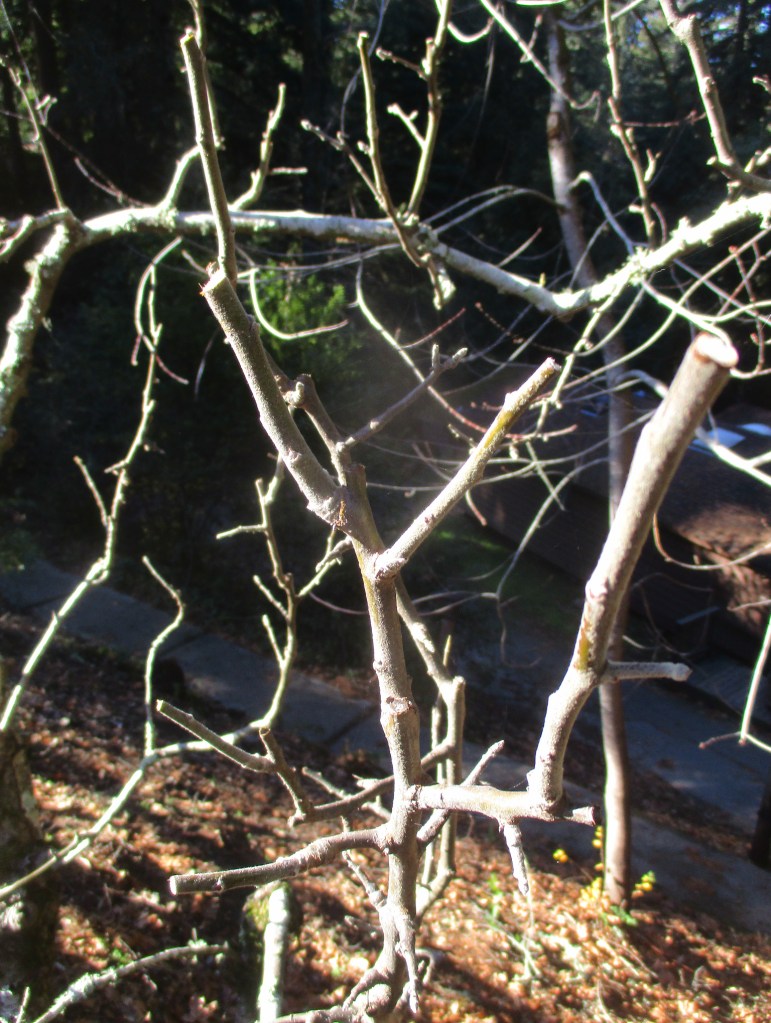
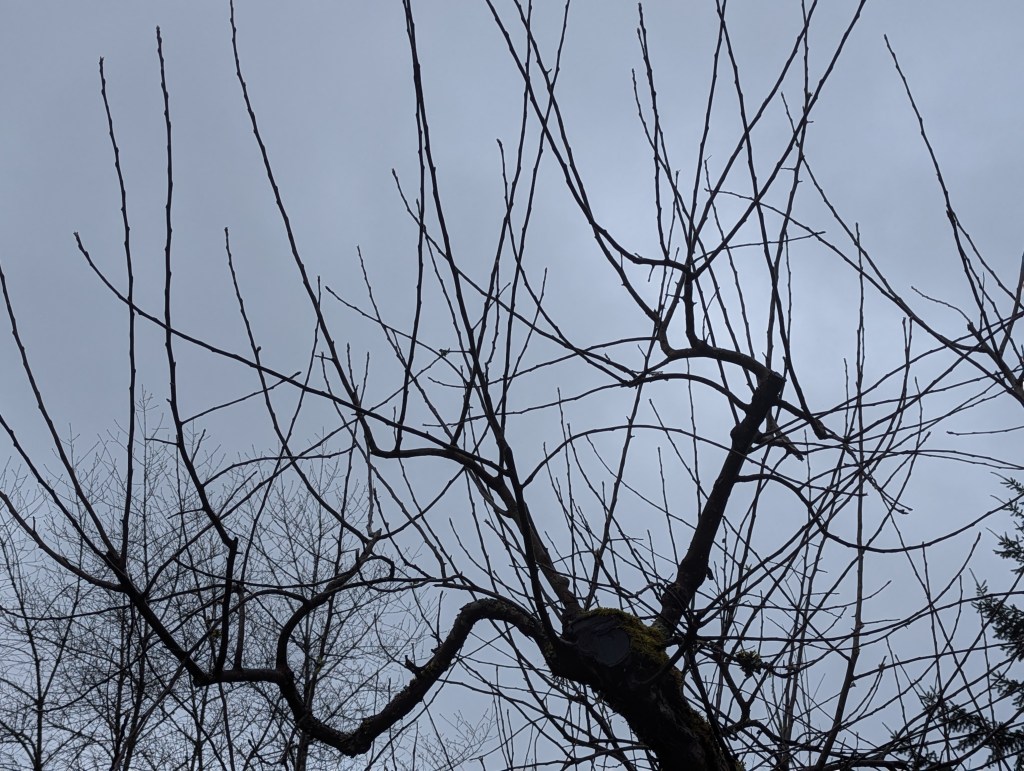
1. Malus domestica, apple trees, even after thorough pruning last winter, are a hot mess now. I prune a small herd of only eleven, but some of them are quite large. Several other assorted fruit trees remain in need of renovation nearby. A tenant maintains a few more.

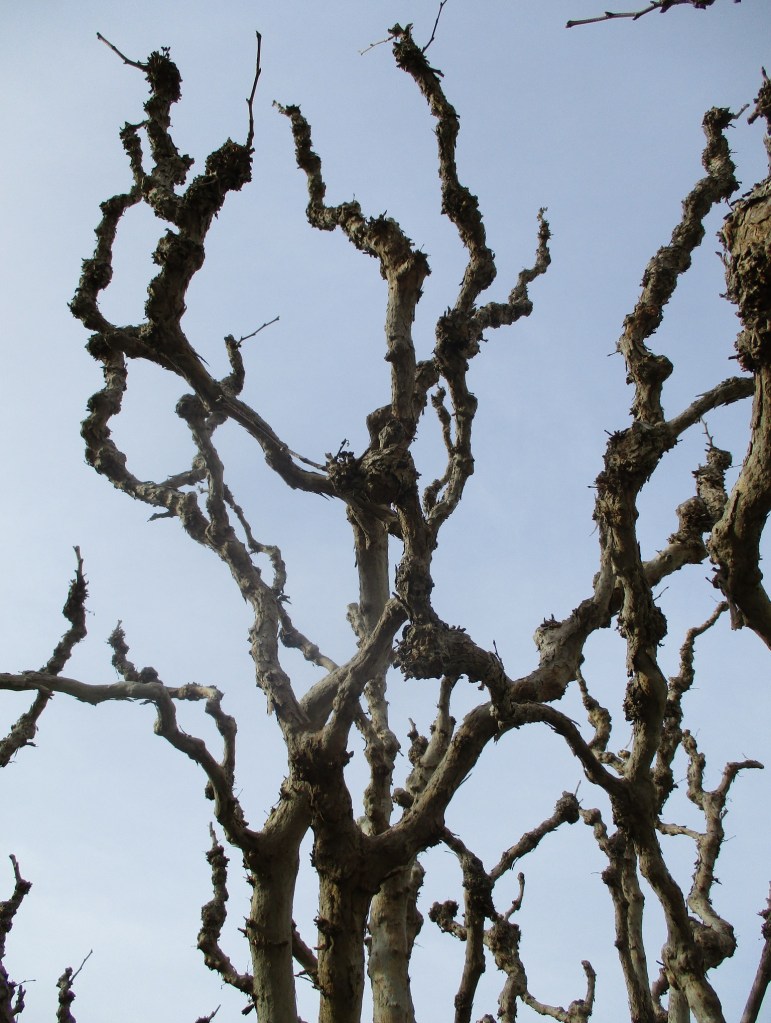
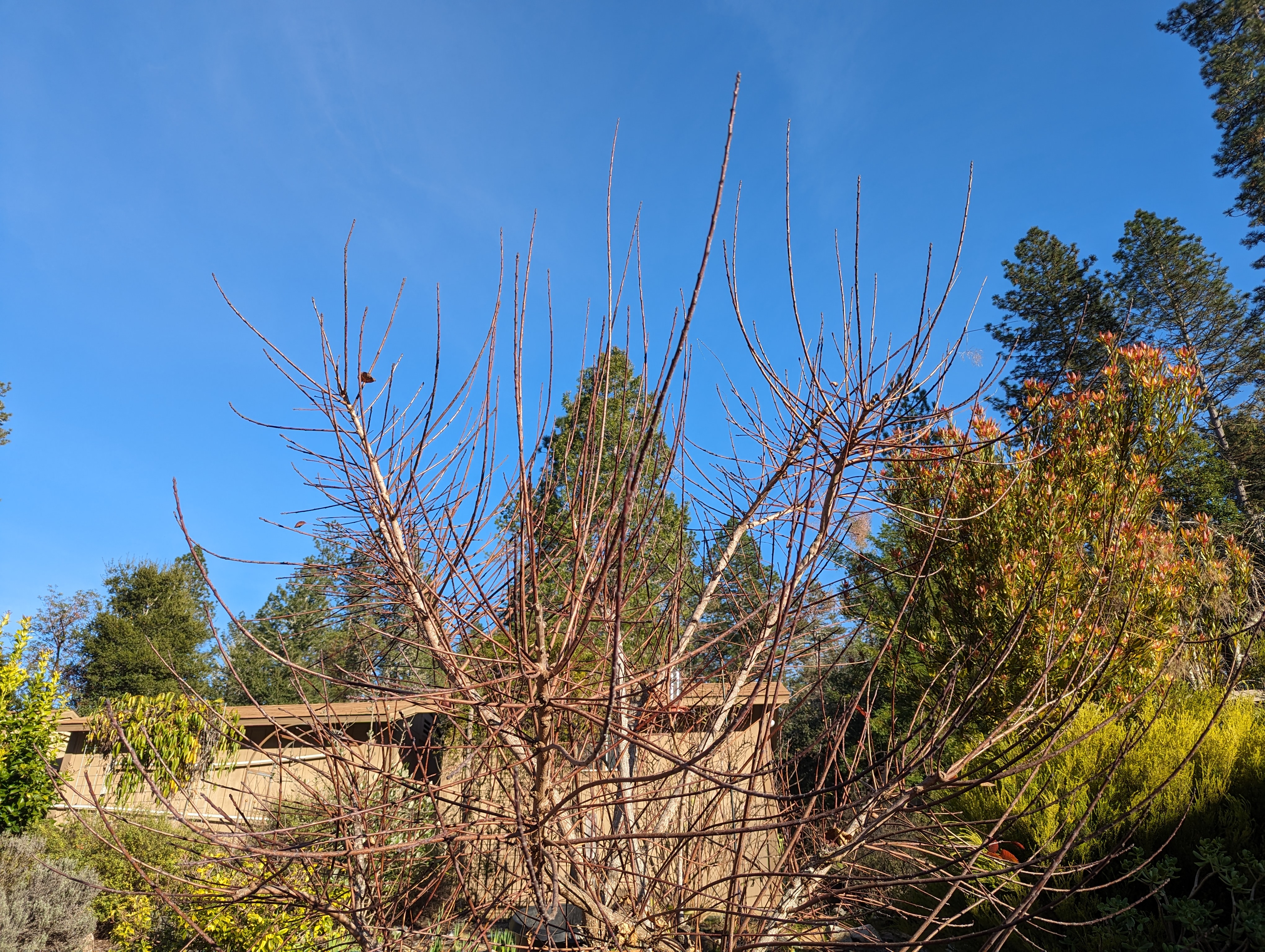
2. Dormant pruning maintains and contains the otherwise rampant growth of the apple trees, and limits their otherwise messily excessive fruit production, but does not actually improve their visual appeal much. The most meticulously pruned trees will look twiggy.

3. Malus sylvestris, crabapple demonstrates why I am in a rush to prune the apple trees before their bloom and foliation. They are about to bloom, and apple trees bloom shortly afterward. I try to get here earlier each year, but always get here at about this same time.

4. Pyrus communis, pear is already beginning to bloom a slight bit more than crabapple. Fortunately, the pear trees are still somewhat small, and do not yet need major dormant pruning or renovation. I might prune back a few minor spires from one of the pear trees.

5. Prunus cerasifera, Myrobalan plum is in full bloom, but needs no pruning anyway. It is merely the understock of an unidentified stone fruit tree that was cut down years ago. It serves no purpose, but is too pretty in bloom to merely cut down without justification.

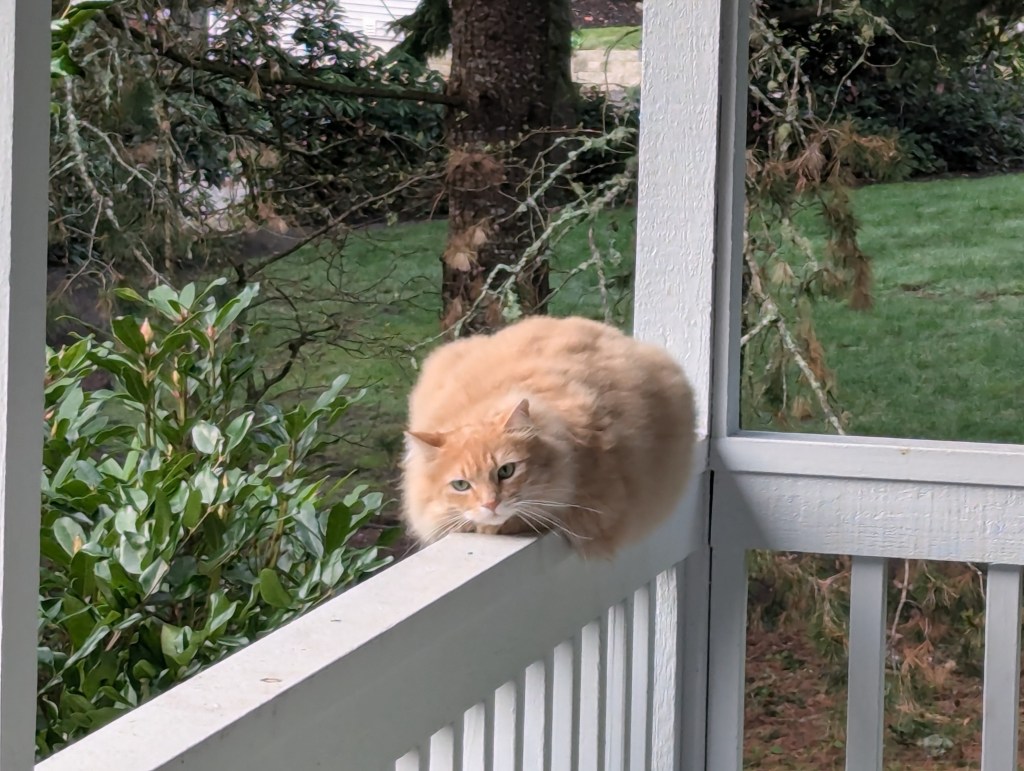
6. Arlo was waiting for us on the porch when we arrived. He lives at another house in the neighborhood, but visits neighbors for food and treats. He was not pleased when Rhody noticed that he was watching us. He did not exactly put much effort into hiding, though.

This is the link for Six on Saturday, for anyone else who would like to participate: https://thepropagatorblog.wordpress.com/2017/09/18/six-on-saturday-a-participant-guide/

Pruning Cane Berries

Their habit of overwhelming untended gardens gives blackberry canes a bad reputation. Their thicket like growth in their native habitats does not help. They are certainly not ‘low maintenance’ and need intensive specialized pruning later in the year. Yet, they become available with other bare-root plants this time of year for a reason. They make great blackberries!

New bare-root blackberry plants do not look like much when they are first planted, and do not produce berries in their first year. They will instead be busy dispersing roots and producing biennial canes that will produce berries the following year. Root barriers can prevent their aggressive roots from getting into neighbors’ gardens, particularly since south or west facing fences are just as practical for supporting trailing canes as trellises are.

‘Trailing’ types like ‘Marion’, ‘Boysen’ and ‘Olallie’ blackberries, which are also known as ‘boysenberry’, ‘marionberry’ and ‘olallieberry, are the most popular locally. ‘Erect’ types, like ‘Arapaho’, ‘Choctaw’ and ‘Navaho’ are more tolerant to frost, so are more popular where winters are colder. ‘Semierect’ types are hybrids of trailing and erect blackberries. 

In their second year, trailing and semierect canes that grew during the first year should be trained onto trellises, fences or wires. As their fruit gets depleted later in summer, these canes can be cut to the ground. Some of the new canes that developed through the season need to be trained onto the same supports to replace the older canes as they get removed.

There should be more than enough new canes. About ten to fifteen of the best canes of trailing types should be selected and pruned to about six or seven feet long. Semierect types need about half as many canes, and can be pruned about a foot shorter. Extra canes should be cut to the ground. A few of the smaller extra canes can be left through summer to be separated with roots as new plants during the following winter.

Side branches that grow from the pruned canes through late summer and early autumn should get pruned to about a foot long at the end of the following winter. New growth from these stubs will produce fruit during the following summer. The process of replacing the old canes with new canes can be repeated as the fruit gets depleted.         The process is similar for erect blackberries, but no support is needed. During the second year, canes should be cut to about two and a half feet tall in the middle of summer. Secondary branches from these canes should be cut to about a foot long in winter. As fruit gets depleted and replacement canes develop during the following summer, these mature canes can get cut to the ground. New canes then get pruned just like the older canes were.

Restorative Pruning

There is some good flowering quince in there, . . . somewhere.

Winter is the time to go wild in the garden, while plants are mostly dormant and not aware of what is going on. This is the time to tend to all the aggressive pruning that fruit trees and roses need annually, and to take care of overgrown deciduous plants that may not need to be pruned every year, but need it now. . . or may have needed it last year. . . or even a few years ago.

Regardless, if they are bare now, they are dormant. By the time their buds start to swell in spring, it will be too late, since they will no longer be dormant, and are likely to be damaged by overly aggressive pruning. Evergreen plants that can be sensitive to frost, like avocadoes and citrus, are the only ones that should not be pruned now, since aggressive pruning may stimulate new growth that is even more sensitive to late frost.

Plants that are too overgrown to be salvaged by tame pruning or typical shearing should be evaluated. Would a particular plant be more desirable if it were tamed? Is removal the only alternative to aggressive pruning? It is sometimes worth taking a chance that an obtrusively overgrown but otherwise desirable plant may actually be killed by aggressive renovation if it is about to removed anyway. For example, overgrown oleanders can be cut down instead of removed. Those that survive will grow into fresh new shrubs by the end of summer.

(The last paragraph of this recycled article is omitted here because the information that it provides about a particular horticultural event is very outdated.)

Dormant Pruning of Deciduous Fruit Trees

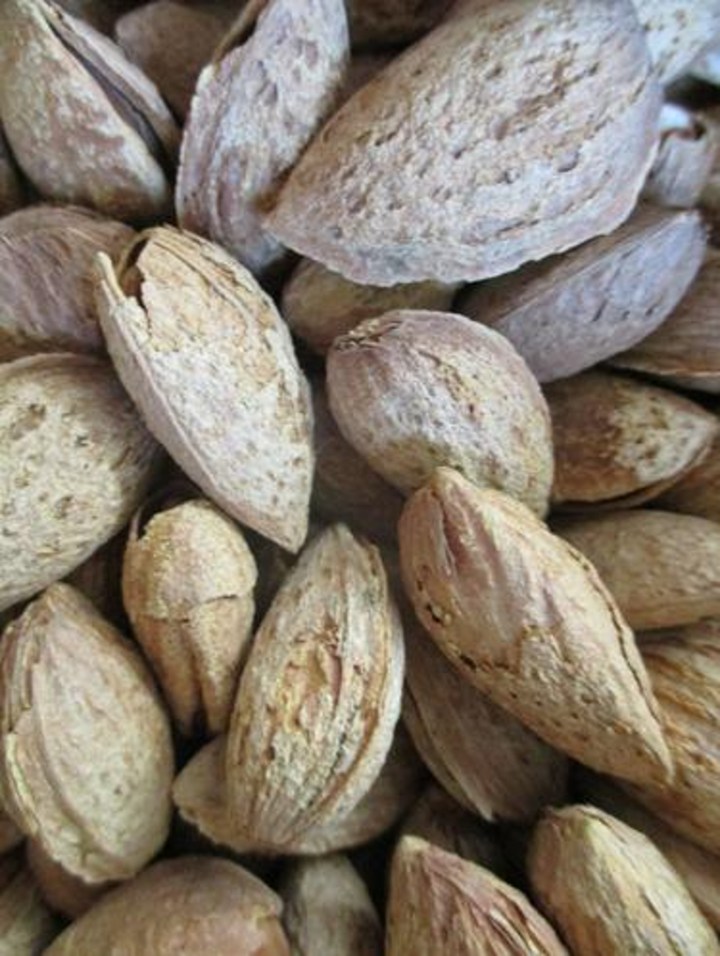
Almond trees require specialized dormant pruning.

There is nothing like the flavor of ripe fruit fresh off the tree during summer; whether cherries and then plums, prunes and apricots early, or peaches and nectarines in the middle, or pears and apples at the end of summer. Even though summer is still a few months away, it is already time to get ready for summer fruits, as well as almonds, by pruning the deciduous fruit trees that produce them while they are still dormant in winter.

Because fruit trees have been bred over the past many centuries to produce unnaturally large and abundant fruit, most are unable to support the weight of their own fruit without some sort of unnatural intervention. Trees consequently need to be pruned so that they do not produce so much fruit that their limbs break, destroying the fruit and disfiguring the trees. Pruning also helps to concentrate resources into fruit of superior quality instead of excessive but inferior fruit.

There are as many different techniques for pruning deciduous fruit trees as there are different types of deciduous fruit trees, and certainly too many to write about in a single gardening article. For example, cherries, plums, prunes, apricots, peaches, nectarines and almonds are all ‘stone fruit’ which need varying degrees of similar pruning. Peach trees produce the heaviest fruit, so require the most aggressive pruning. Cherry trees are pruned in a similar manner, but only minimally because they are not so overburdened with fruit. Only evergreen fruit trees like citrus, avocado, guava, olive and tropical fruits do not get some sort of pruning this time of year.

(Stone fruit have substantial seeds which are known as ‘stones’. Almonds are the stones of the fruit that comprises their hulls.) 

It is best to become familiar with the pruning requirement of each type of fruit tree before planting them, since some are simply too labor intensive for some people, and most are too involved for almost all maintenance gardeners. It is also easiest to start with young trees and become more familiar and comfortable with pruning them as they grow over the years.

(Because this post is from an old article, outdated information was deleted below.)

Apricot, cherry, prune, almond, walnut, apple, pear, plum, fig and various other trees will be there. The 3.3 acre Historic Orchard was developed in 1994 to include more than 220 of the many types of fruit and nut trees that once made the Santa Clara Valley famous as the Valley of Hearts Delight.

Nectarine

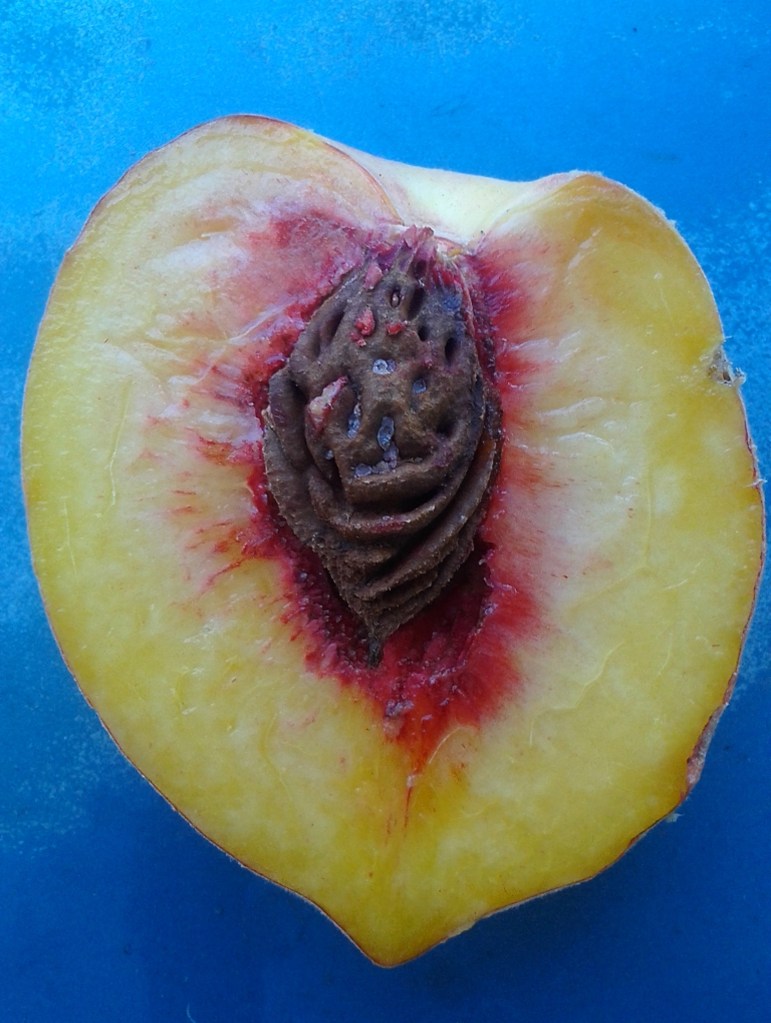
Nectarines are merely peaches without fuzz.

Stone fruit classification can get confusing. All stone fruit are of the same genus, Prunus. This includes almonds, which are stones or seeds of inedible fruit. Prunes are European fruits that are conducive to juicing and drying. Plums are similar Japanese fruits for fresh consumption, but not for drying. The two are more different than peaches and nectarines.

Nectarines, Prunus persicaria var. nucipersica, are simply peaches without fuzz. Cultural requirements are about the same for both. They need only very minor chill through winter to vernalize, and enjoy summery warmth. Trees are not very productive for their first year or two. Then, they may produce for only about twenty years. Thirty year old trees are old.

Both nectarine and peach trees require aggressive pruning while dormant during winter. Otherwise, they can not support the weight of their big and abundant fruit during summer. Semidwarf trees, which are the most popular, can potentially grow twenty feet high. They should stay half as high with adequate pruning. Most of their fruit should be within reach. Bare root trees initially disperse roots more readily than canned trees.

Bloomless Hydrangea

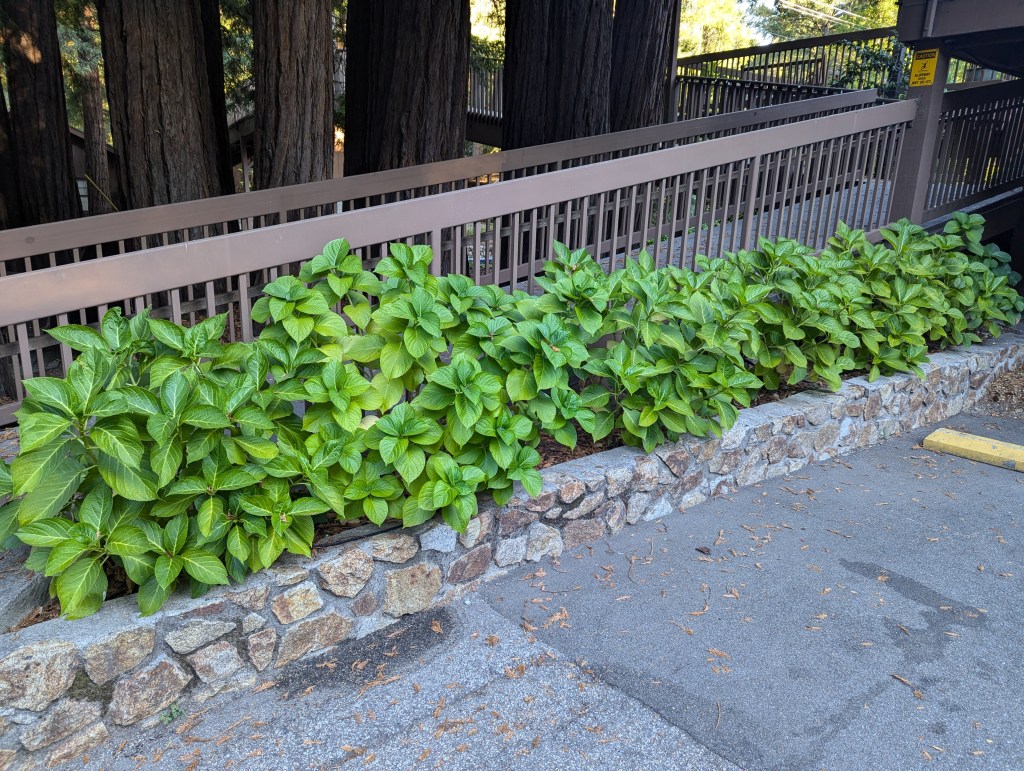
This hedge of modern Hydrangea is completely devoid of bloom.

Modern cultivars of Hydrangea were not easy to adapt to. I learned how to prune old fashioned cultivars during their winter dormancy. I knew to retain the terminal buds of their retained canes to bloom for their following season. Pruning canes of modern cultivars back shorter and depriving them of their terminal buds in order to promote shrubbier growth seemed to be more like pruning roses. I did not trust them to bloom without their terminal buds. Not only do they bloom, but they do so a bit more abundantly, and with sturdier floral trusses that last and retain their floral color somewhat longer than those of old fashioned cultivars. Old fashioned cultivars have bloomed so reliably for the past few years that I am not so hesitant about pruning them back. However, this year, they inexplicably did not bloom. I do not mean that they bloomed sparsely, or that a few of the total did not bloom. I mean that none of the modern hydrangeas bloomed at all. The only hydrangeas that bloomed within the landscapes at work this year are the few remaining old fashioned sorts. All of the hydrangeas are healthy with vibrantly green foliage. Neither disease nor insect pathogens have been problematic. I can not explain this odd lack of bloom. With such vigorous canes, pruning should be easy this winter. However, I am more likely to leave awkwardly long canes in order to retain their terminal buds. Even if they are not necessary, terminal buds might provide an earlier prebloom prior to the bloom of stems that grow from lateral buds. I can not help but wonder why, while modern cultivars did not bloom, old fashioned cultivars did. A colony of unpruned feral Hydrangea near the bank of Zayante Creek was unusually prolific in bloom.

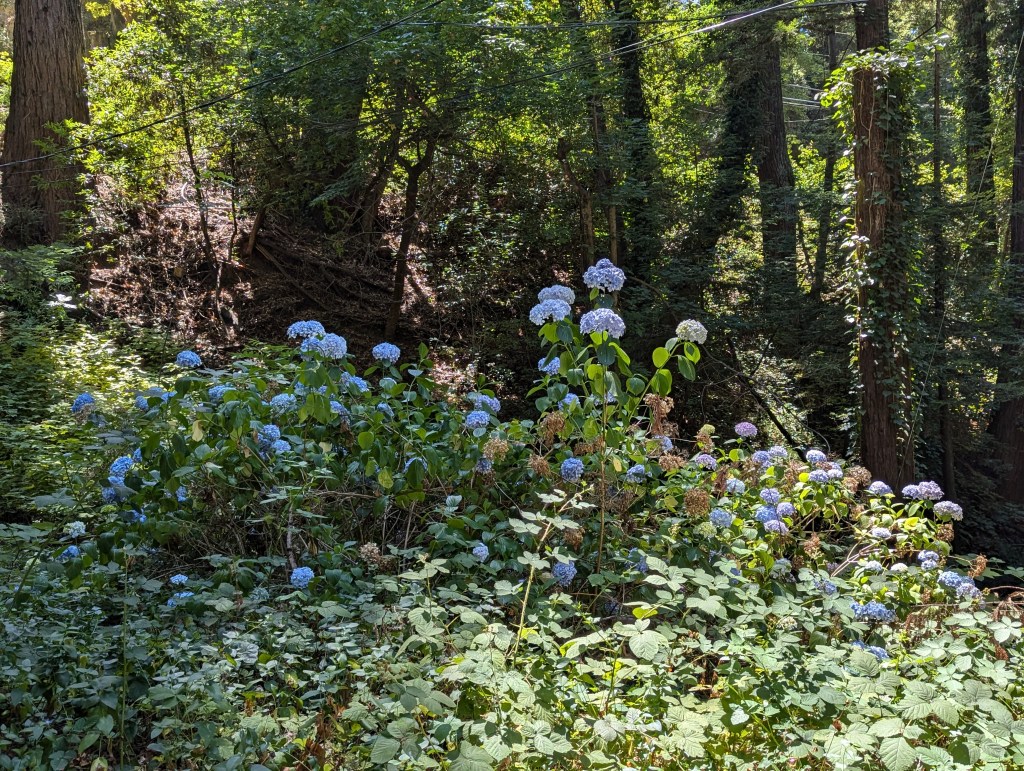
Unpruned feral Hydrangea bloomed unusually prolifically.

Pollard And Coppice During Winter

Proper pollarding and coppicing are rare.

This is extreme dormant pruning. Pollard and coppice pruning involve complete removal of all new growth. They typically involve growth from a previous season annually. A two year cycle involves growth from two previous seasons, and so on. This repetitive pruning to the same origins stimulates distended callus growth there. It is as brutal as it sounds.

This is why pollard and coppice pruning are vilified in America. The techniques evolved through centuries of horticulture and several cultures. Both are still practical for various reasons everywhere else. However, American arboriculture classifies them as topping or disfigurement. Consequently, very few arborists here know how or want to do it properly.

Like other dormant pruning, pollard and coppice pruning must happen during winter. It is too severe for active vegetation. Also, pollard pruning exposes bark of trunks and limbs. Such bark would scald during sunnier summer weather. Growth from distended callus growth, or knuckles, shades lower stems by summer. It is very vigorous through spring.

That is what pollard and coppice pruning is still useful for within other cultures. Vigorous foliage is useful for fodder for livestock, including silkworms. Vigorous stems are useful for kindling and basketry. Some species bloom more vigorously on vigorous new growth. Others can not bloom to produce unwanted pollen or messy fruit within the same year.

Colorful or variegated foliage is more colorful in response to pollard or coppice pruning. Some eucalypti generate juvenile foliage for floral design. Such foliage is more aromatic than adult foliage. Improved foliar vigor enhances resistance to some diseases, such as mildew and rust. Coppicing can renovate some types of overgrown or shabby shrubbery.

The difference between pollard and coppice pruning is that pollard pruning retains limbs. Coppice pruning retains only a stump near grade. It is less reliant on repetition, and may never need it again. Pollard pruning compromises structural integrity, which necessitates repetition. Otherwise, pruning to restore structure will eventually become necessary. Not many species are receptive to such extreme pruning techniques.

Do Not Try This At Home

Before and After pollarding

Pollarding and coppicing are very unfortunately vilified here. I just wrote an article about these topics for the gardening column. Arborists are taught that they are comparable to topping, and that they cause irreparable disfigurement.

It is unfortunate because both procedures have very practical application. Both are still commonly practiced in other regions. If performed properly, both are quite sustainable, and can actually maintain some specimens of a few species longer than they typically live naturally. I use both techniques to a minor degree at work, and will likely do more of both within my home garden.

However, I almost never recommend either technique. Because they are so vilified, arborists do not learn about them. Consequently, it is nearly impossible to find an arborist who can perform either technique properly. Trees and shrubbery can very easily be ruined by either technique if performed improperly.

In fact, I am hesitant to allow reliance on pollarding and coppicing by trees and shrubbery at work because I am concerned that no one else will want to repeat the processes after my retirement or resignation, which could be at any time. Coppicing carpet roses should be no problem for whomever performs it in the future, but I can not be certain. Pollarding is a bit more specialized, so concerns me more.

This smoke tree was initially pollarded for renovation. It was previously distressed and weak, but is now quite vigorous. Its purple foliar color is more vibrant through summer. So is its autumn foliar color. I previously believed that it bloomed only on year old stems, so would be unable to bloom on exclusively new canes after being pollarded. Instead, it blooms better on vigorous new stems that it on distressed year old stems.

It is not forming knuckles though. New stems emerge from all over the permanent stems, so leave pruning wounds that do not compartmentalize as efficiently as they would on knuckles. Also, without terminal knuckles, some permanent stems die back an inch or two annually. Although pollarding successfully renovated this smoke tree, it is not as sustainable as I would like it to be.

So, because the procedure is not sustainable for this particular specimen for very long, and I suspect that no one will want to repeat the process annually in the future, I will likely encourage more natural form. I left a few extra new canes for this year. For next year, the twiggy interior growth may be thinned, while upper and outer growth is allowed to develop into a more permanent canopy.

Learn How To Prune Dormant Deciduous Fruit Trees Properly

(This article is recycled from 2010, so includes outdated information. It is deferred from yesterday because Wi-Fi was not operational.)

Deciduous fruit trees require very specialized pruning.

            So many of the kids I grew up with now have an apricot tree in their own back yard, even though not many of us actually like the fruit. We all remember the remnant orchards, mostly apricots, which were scattered about the Santa Clara Valley when we were young. We also remember how we consumed vast volumes of apricots in every form imaginable; including fresh, dried, canned and stewed, and in jams, jellies, compotes, syrups and pies. I could go on, but it would ruin my appetite.

            Deciduous fruit and nut trees are certainly not ‘low maintenance’. Most need to be pruned annually, while dormant in winter. If not pruned correctly, they become overburdened with their own fruit. Also, the process of selecting from the many different cultivars of the many different types of fruit is quite a chore. There are many more cultivars to choose from for home gardens than for orchards, particularly with the many modern cultivars introduced during the past few decades.

            Because those who maintained the orchards are now as nearly extinct from the Valley as the orchards are, we need to know how to care for our own trees. This is why Friends of Guadalupe River Park and Gardens has scheduled the Dormant Fruit Tree Pruning Class with Sean McGrail in only a few days, on January 23, from 9:30 to 11:30 a.m.. Tools, techniques and basic pruning concepts will be explained and demonstrated among the many fruit trees, including apricots, cherries, prunes, apples and others, of the Historic Orchard of Guadalupe Gardens. Participants will then get to participate in pruning some of these trees. The Historic Orchard is located just south of Taylor Street in San Jose, adjacent to the Guadalupe River Park Trails. Admission is $15. 

            A week later, on January 30 from 9:00 a.m. to noon, the Best of the Best class, also with Sean McGrail, as well as Nancy Garrison and the California Rare Fruit Growers, will discuss many of the best fruit cultivars for the Santa Clara Valley. Afterward, planting, site selection, drainage and pruning of new trees will be demonstrated in the Historic Orchard. Admission is $30. Required registration can be arranged by telephoning 298 7657. Information about both classes can be found online at www.grpg.org.     

Dormant Pruning Exploits Winter Dormancy

Fruit trees become congested without pruning.

Bare root season begins as the year ends for a simple reason. That is when deciduous plants are dormant. They are unaware of the otherwise distressful process of relocation. This is also why winter is the season for dormant pruning. Such pruning would be very distressful at any other time of year. While dormant, deciduous plants are unaware of it.

Dormant pruning of fruit trees is also important for a simple reason. Extensive breeding has increased reliance on horticultural intervention. In other words, deciduous fruit trees now generate more fruit than they can support. Their fruit is both unnaturally abundant and unnaturally large. It is both too heavy and too consumptive for its unpruned stems.

Dormant pruning enhances the quality of fruit by concentrating resources. Although less copious, fruit is bigger and better. Also, dormant pruning enhances structural integrity of supportive stems. Although more vigorous, vegetative growth is more compact. Stouter stems endure less leverage from fruit weight. As a bonus, more fruit is easier to reach.

Almost all deciduous fruit trees require very specialized dormant pruning. This includes some nut trees, as well as grapevines, kiwi vines, cane berries and roses. However, it does not include evergreen fruit trees, like citrus and avocados. They do not need such aggressive pruning. Besides, pruning stimulates new growth that is vulnerable to frost.

Unfortunately, dormant pruning is too specialized to describe in a few paragraphs. For most deciduous fruit trees, it is quite aggressive. Peach and nectarine trees may benefit from removal of half of their stem growth! Apricot and plum trees need a bit less pruning. Cherry and almond trees may need only minor pruning. Yet, all six are stone fruit trees.

Apple, pear and quince are all pomme fruits. Their trees require similar dormant pruning. Their many varieties require various degrees of such pruning though. Fig, mulberry and persimmon trees all require particular types of dormant pruning as well. Deciduous fruit trees are certainly not low maintenance. This should be considered before planting any.