Cut Flower Alternatives

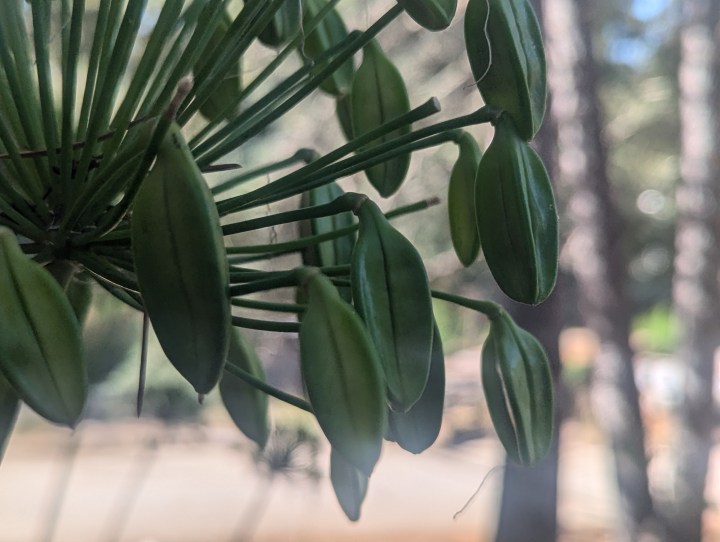
Lily of the Nile floral trusses are appealing even without bloom.

Most flowers bloom in spring. Many bloom a bit later and though summer. Not nearly so many start to bloom in autumn or though winter. This time of year, there is more to clean up from fading blooms than there are fresh blooms to cut and bring in.

Much of the color in the garden through autumn is provided by colorful foliage or foliage that gets colorful as the weather gets cooler. Later in winter, some plants have colorful bark and stems that gets revealed by winter defoliation. Coral bark Japanese maple, red twig dogwood and some arctic willows have remarkably colorful twigs.

Blooms of a few plants are sometimes cut and recycled after they fade because their dried flowers, flower stems or seed pods are appealing. Hydrangeas are not so attractive as they deteriorate out in the garden, but can be cut and hung upside down to dry to substitute for fresh flowers later. If done quickly, many types hold their color somewhat. Those that do not hold their fresh color may turn an appealing shade of brown.

Queen Anne’s lace can likewise be a nice dried flower, but is not so easy to hide in the garden while it dries. If cut and hung to dry, individual stems should be hung separately, since they bend and are difficult to separate if hung in clusters. Their flat-topped flower trusses curve inward as they dry, so they look nothing like they do fresh.

The rigid flower stems of New Zealand flax are rather sculptural protruding from their softer foliage. These same stems can be cut, plucked of seed pods, and like dried hydrangeas, used as cut flowers when there is not much else to get out of the garden. Ironically, New Zealand flax flowers sometimes get cut before they bloom, since not everyone appreciates their contrast against their own softly textured foliage.

Years ago, New Zealand flax flower stems were actually dried and spray painted! For those daring to try this technique, it also works well with lily -of-the-Nile flowers stems and trusses (plucked of their seed pods), Heavenly bamboo flower stems, and even dried pampas grass blooms. However, pampas grass blooms are deprived of their fluffiness and most appealing quality by spray paint. Bird-of-Paradise leaves twist interestingly as they dry, to provide texture with or without paint.

Fronds (leaves) of some fan palms can provide bold cut foliage. Mediterranean fan palm is difficult to handle because of the nasty teeth on the stalks, but has nice rounded leave that fan out nicely behind other flowers. They can be cut into smaller fans, or even other not so rounded shapes. Windmill palm is much easier to handle, but is a bit larger, so is more likely to need to be trimmed to shape. All are easy to cut with common scissors, and can be dried and spray painted.

There is probably more in the garden to substitute for cut flowers than would be guessed. Useful plant parts can be found in the least expected of places.
Pink Melaleuca

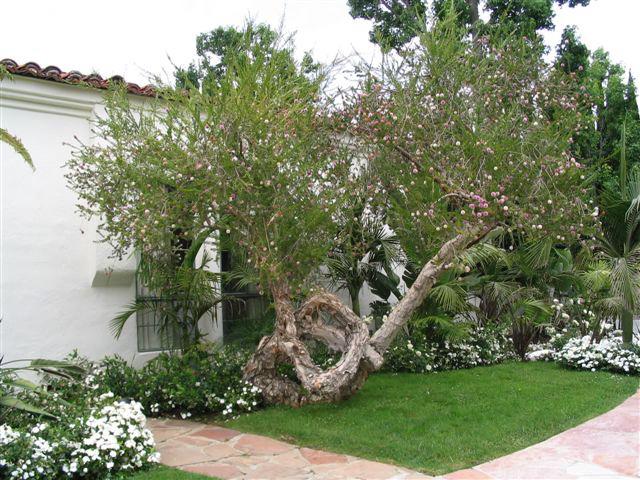
Pink melaleuca can be impressively sculptural.

            Golden Gate Park in San Francisco has some of the most impressive mature specimens of pink melaleuca, Melaleuca nesophila, outside of their native homeland in Australia. Although most are naturally less than twenty feet tall and wide, their disproportionately bulky trunks are remarkably gnarled and sculptural, as if they have been growing there for centuries. Pink melaleuca actually grows and develops trunk and limb structure rather fast while young, without ever becoming too obtrusively large. Spongy pale tan bark covers the distinguished trunks and limbs like a thick parka.

            Sculptural small trees are not the only function of pink melaleuca. They also make nice informal hedges and screens, and can be shorn occasionally if necessary. The round inch long leaves are quite thick. Round inch wide trusses of small staminate flowers bloom slightly purplish pink and fade to pale white through most of the year, except where shorn. (Staminate flowers are showy because of distended stamens instead of petals.) Hummingbirds are grateful for the flowers while not much else blooms through winter. Hard seed capsules that remain in dense cylindrical formation on twigs after blooms are long gone are sometimes used as dried flowers. Like all melaleucas, pink melaleuca is easy to care for, and tolerant of harsh exposure, inferior soil, minimal watering and neglect.

Strawflower

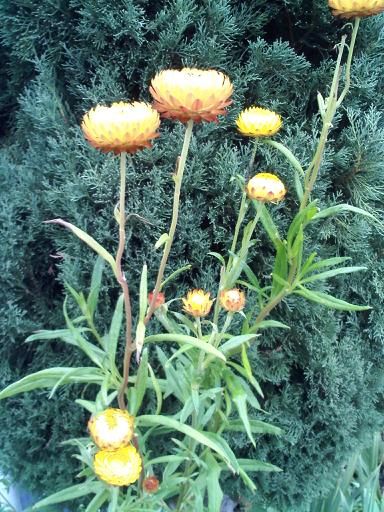
Strawflower retains its color and form, although not foliage, as it dries.

Just like cosmos, zinnias and other related flowers, strawflower, Helichrysum bracteatum, seems to be at its best as its bloom season ends. Bloom started in summer and should finish now that weather is getting cooler. The two and a half inch wide flowers last in the garden until they get ruined by rain. They are excellent cut flowers, and even better dried flowers.  

Strawflower can be white, pink, red, orange or yellow. Their seed should be sown directly where they are wanted in spring. Mature plants are about two and half feet tall and a foot wide, with three or four inch long and somewhat narrow leaves. Dwarf varieties are not as good for dried flowers, but are fuller and look better in the garden. 

Alternatives For Fresh Flowers

Form develops as color fades.

There are so many choices for flowers to grow for cutting between spring and the end of summer. For autumn and winter though, the choices are somewhat limited. Of the few things that bloom this time of year, there are fewer that are good cut flowers, and even fewer that bloom continually or profusely enough to provide an abundance of flowers until other flowers start to become available again in spring. Besides, who wants to go out to the garden in wintry weather to get flowers to bring into the home?

Many plants have other parts that are showy enough to substitute for cut flowers in the home. Cut foliage, stems, seedpods and even bark can be useful. Some flowers can be dehydrated to last all year, but look nothing like they do while fresh; and the process is somewhat involved. The most convincing alternative to fresh flowers is probably dried flowers.

Not many flowers dry well. Almost all simply turn brown and deteriorate. Only a few remain intact and also keep some of their color. Roses and hydrangeas are commonly dried, although their colors fade and they become shriveled. Yarrow and baby’s breath likewise change their appearance as they dry, but not quite as much. It is not so obvious as their tiny flowers shrivel.

The best dried flowers look somewhat fresh when they are actually dried. Strawflower, statice, globe thistle and globe amaranth are four of the best examples. These flowers are actually rather ‘crispy’ while they are still fresh, and only become crispier as they dry. If left in the garden, the flowers deteriorate only because of exposure to weather, and eventually rot in winter rain.

Simply as fresh cut flowers, strawflower, statice, globe thistle and globe amaranth flowers last longer than just about any other flower. They can even be separated from mixed bouquets and dried as the other flowers deteriorate and get discarded. They only need the lower portions of their stems that were originally soaking in water to be cut off if significantly deteriorated.  

However, most dried flowers probably look best if dried immediately after getting cut, since their foliage yellows more as it dries slowly. Lightweight flowers, like baby’s breath and statice (except bulky perennial statice) can be arranged fresh but without water, and simply allowed to dry as they are arranged. The only potential problem with this technique is that flowers may be difficult to separate and recycle later.

Flowers are more often laid out to dry individually and then arranged afterward. Globe thistle and globe amaranth are rather pliable and can wilt while drying, which can change the shape and consistency of a formerly fresh floral arrangement. Once dried though, their stems remain firm, and they can then be arranged more permanently. Most flowers are adequately dry in about a week indoors (or outdoors in warm dry weather).  

Because strawflowers are rather bulky on soft stems that may wilt, they dry with straighter stems if hung upside down while drying. The biggest flowers should be hung singly. Smaller flowers can be hung in small bunches. This works for heavy flowers like roses, and wide flowers like yarrow as well.

Dried Flowers Were Formerly Fresh

Some faded bloom retains striking form.

All sorts of flowers bloom through autumn as well as winter. Honeysuckle still exudes its richly sweet summery fragrance. Honestly though, most flowers bloom for spring or early summer. They finished a while ago, and are now going to seed. Even flowers that bloom repeatedly do so less now. This is when floral design can get creative with dried flowers.

Straw flower, statice and globe amaranth are among the most familiar of all dried flowers. While still fresh, they already seem to be dry. They do not seem to change much as they dry. They neither fade nor wilt very much. Only their stems sag. If they hang upside down as they dry, their stems remain straight as they stiffen. Their foliage is likely unimportant.

Rose and hydrangea are among less conventional dried flowers that actually look dried. They fade and shrivel, but somehow develop a distinct visual appeal. Amaranth, celosia, lavender and globe thistle fade and wilt only somewhat. Because amaranth stems curve downward anyway, they need not hang to dry. Lavender stems can dry before collection.

Pampas grass and cattails are big and bold dried flowers that were popular in the 1970s. Hairspray should contain dislodged fuzz that otherwise escapes pampas grass bloom. It can also prevent cattail bloom from bursting to disperse its fuzz. Cattails typically grow in marshes, where they are difficult to reach. Pampas grass foliage inflicts nasty paper cuts.

Some dried flowers are better dried than fresh. Some are mere by products of bloom that deteriorated earlier. Dried floral trusses of lily of the Nile, without their seed capsules, are quite striking. So are dried floral spikes of New Zealand flax and some yuccas. They are merely deadheading debris otherwise. Even dried queen Anne’s lace is worth recycling.

Dried flowers do not necessarily need to be of floral origin. Dried bird of Paradise leaves develop weirdly twisty form. Colorful deciduous leaves can be as colorful in the home as in the garden. So can firethorn and cotoneaster berries. Twigs of ‘Sango Kaku’ Japanese maple and red twig dogwood provide color with form. These are only obvious examples. There are many more to experiment with.

Money Plant

Money plant becomes more prominent after bloom.

As their coarse, foot wide basal clumps of foliage turn yellow and start to die down, the solitary two foot tall stalks of money plant, Lunaria annua, develop open clusters of flat, inch wide seedpods that resemble coins. The thin outer casing and seeds within fall away as soon as these coins ripen, leaving tan, tissue paper thin discs that are ideal for dried flower arrangements. Seeds self sow reliably enough to naturalize where conditions are right, but not aggressively enough to be noxiously weedy. Money plant does not need good soil, and wants only a bit more water than related mustard and wild radish. Their small, purple or white flowers that bloom in spring look like radish or mustard flowers but are not as colorful.

Unconventional Dried Flowers

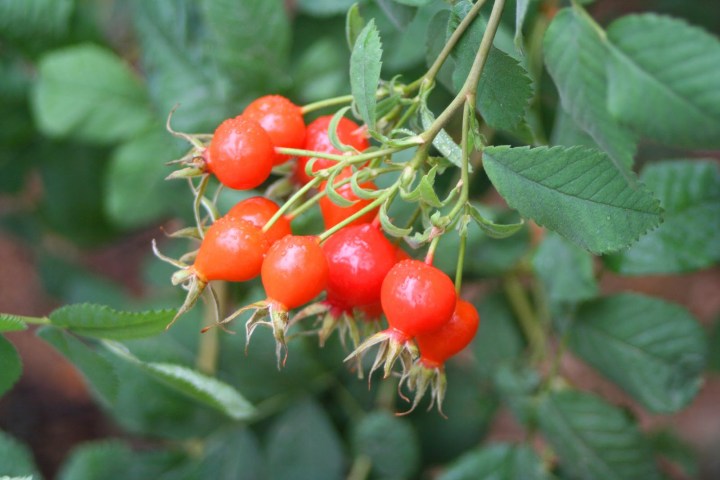
Rose hips are pretty fresh, and can alternatively be dried.

The problem with an abundance of bloom by lily-of-the-Nile over the summer is that all the spent blooms need to be plucked about now. Fortunately though, not all of the spent blooms need to go to compost or greenwaste. The stalks and floral trusses (the clusters of short flower stems on top of the stalks) can actually become interesting ‘dried flowers’, even though the real flowers are long gone.

Many years ago, my neighbor took many of the lily-of-the-Nile stalks that I plucked from my front yard, plucked off the seed capsules, and hung the empty stalks upside down until they dried and turned tan. Being the artistic sort, she added them to other dried flowers and foliage, and arranged them in a large vase (which I think is pronounced as ‘vahz’). Over the years, we found that we can actually let them dry in the garden if we first remove the seed capsules which would otherwise weigh them down and bend the stalks.

Since my artistic neighbor liked these lily-of-the-Nile flower stalks so much, I brought her other dried flower stalks to see how or if they could also be useful. We found that flower stalks from New Zealand flax were just as interesting and even more striking; and some types make rather tall stalks. The large seed capsules from Eucalyptus ficifolia function like modern substitutes for small pine cones. 

There are many other plant parts that can be dried and used with dried flowers as well. Cut bird-of-Paradise leaves become sculpturally twisted as they dry. Petioles (leaf stalks) of windmill palm become simple but striking straight black sticks. While still green, the palm leaves can be cut with scissors into interesting shapes less than six inches wide (larger cutouts disfigure). Some native iris produce large seed capsules that split open as they dry, to reveal bright orange or red seeds within. Money plant is actually grown for its dried seedpods instead of for flowers of foliage.

Even bare stems can be added to dried flower arrangements. Both manzanita and madrone have gnarly stems that turn black or dark brown once cut. Fig has contrastingly thick and curving white or gray stems. Bamboo can be cut into sections of any desired length and stripped of foliage. Heavenly bamboo (Nandina spp.) has shorter canes with a corky texture. Realistically, there are no rules for what works well with dried flowers. Anything that looks good is worth trying once.

Straw flowers, statice (Including sea lavender), lavender, globe thistle and yarrow are some of the more traditional dried flowers. Cat-tails and pampas grass flowers can work as well in large arrangements as they did decades ago, but should be sprayed with hair spray to keep them from shedding. (Cat-tails can actually be very messy if they happen to explode.)

Although spray paint is much too synthetic for those of us who prefer dried flowers to look natural, it also works well to keep pampas grass flowers and cat-tails from shedding while adding serious color. Some people enjoy the potential for unnatural colors enough to spray paint other dried flowers and plant parts that do not need to be sprayed with a fixative.

Nigella

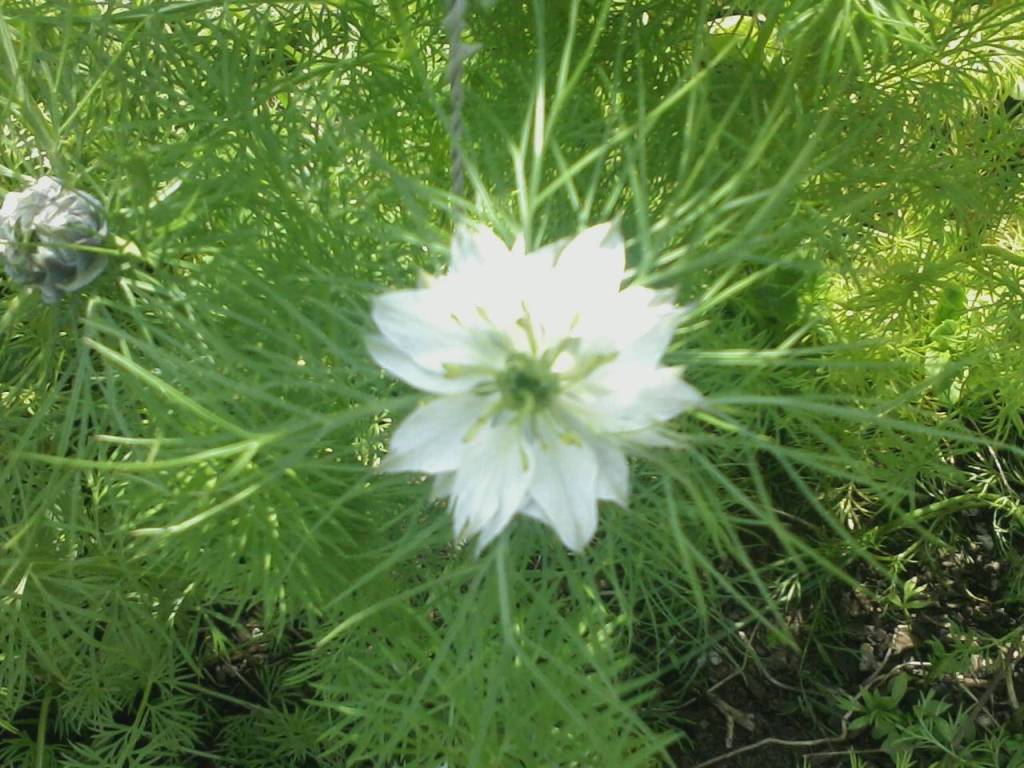
Nigella is more typically blue, but can alternatively bloom white, pink or lavender.

Those who crave blue for the garden probably know nigella, or ‘love-in-a-mist’, Nigella damascena. It blooms in May and June, typically with various shades of pastel blue, or can alternatively bloom pink, lavender or white. The lacy flowers are surrounded by lacier bracts, and suspended on thin stems among delicate pinnately lobed foliage, with very narrow (‘thread-like’) lobes. The plump brown seed capsules that appear over summer after bloom are commonly used as dried flowers. The plants can be half a foot to a foot and a half tall. Although annual, nigella self sows easily, so can grow in the same location for many years if allowed to.

Dried Floral Material Worth Recycling

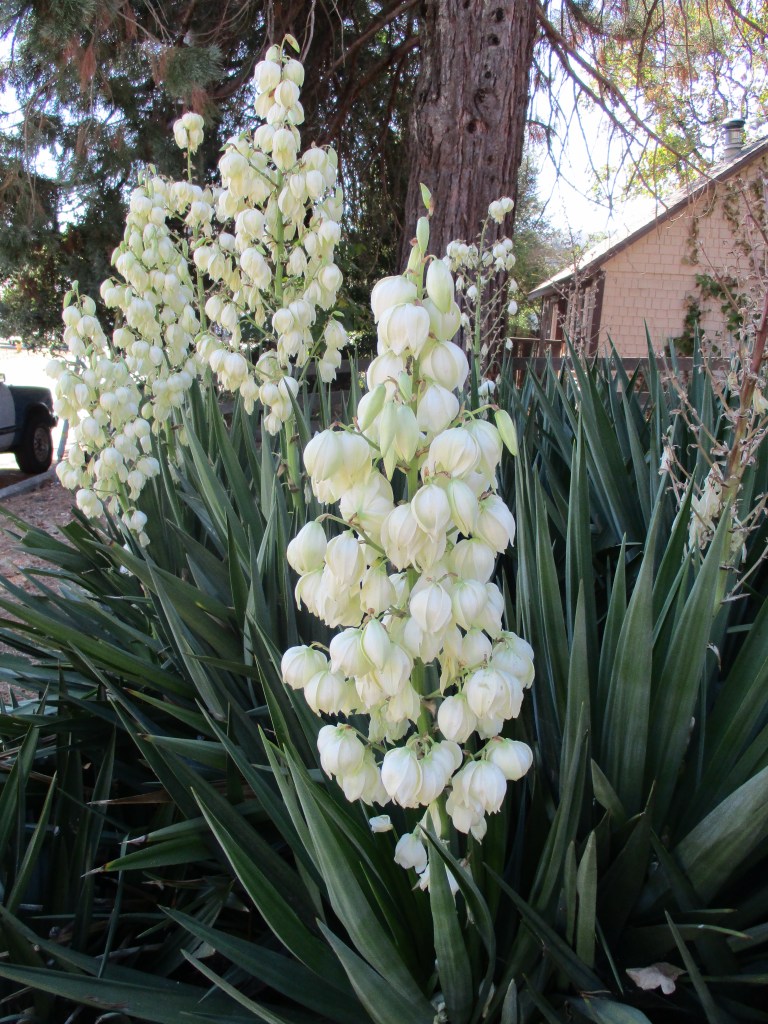
Yucca bloom produces interesting floral stalks.

Gardens might be colorful throughout the year here. There is not much time between the latest of the autumn flowers and the earliest of the spring flowers. Winter flowers are glad to compensate for the lapse. Of course, there are plenty of flowers in spring and summer. Nonetheless, dried flowers are more popular now that there are fewer flowers for cutting.

The quantity of flowers blooming within a particular season might not be proportionate to the quantity of flowers available for cutting. Flowers that bloom through winter, even if as abundant as spring or summer flowers, do not develop as fast. Harvesting too many bird of Paradise flowers depletes the limited supply before something else can replace them.

Deciduous foliage that provides spectacular color through autumn is no substitute for cut flowers. Nor is the majority of colorful bark that becomes more prominent through winter. Some colorful berries can function like cut flowers, but only if there are plenty to spare in the garden. Conventional dried flowers that grew last summer may be useful about now.

For the venturesome and resourceful, unconventional dried flowers and other dried plant parts can also be fun. Such items, unlike statice, straw flower, lavender and other familiar dried flowers, might be byproducts of gardening. They might be derived from detritus that should otherwise go to compost or greenwaste. Some might even be products of weeds!

Pampas grass, both garden varieties and the invasively naturalized type, produces bold blooms that dry quite well. Because the leaves can cause such nasty paper cuts, flowers might be easier to harvest from a distance, with a pole pruner. Hair spray can contain the fuzz, so that it does not disperse indoors. Cat tails, if still intact, are compatible with them. 

Floral stems of lily of the Nile, New Zealand flax, and some species of Yucca are striking even after bloom. After deadheading, they can become flowerless dried flowers. Fruiting structures are no problem to remove. If within reach, some palms may provide distinctive bloom trusses. Floral design can be as imaginative as gardening and landscape design. 

Statice

Statice is about as colorful dried as it is while fresh.

The papery flowers of annual statice, Limonium sinuatum, are so popular as seemingly synthetic dried flowers that many garden enthusiasts are surprised to find that they are happy to bloom naturally in home gardens. The clear shades of blue, purple, pink, orange, yellow and white seem to be dyed. The one or two foot tall flower stems are outfitted with odd papery ‘wings’ that make the stems seem wider than they actually are. Deeply lobed basal foliage forms shallow rosettes. Mature plants are about one or two feet tall, and a foot or so wide. Bloom begins late in summer, and continues into autumn. Good sun exposure and good drainage are preferred. Seed can be sown directly, or young plants can be added to the garden early in spring.