Curve leaf yucca is one of a few species of the genus that is difficult to identify. It may be a distinct species, Yucca recurvifolia. It may be a naturally occurring variety of mound lily, Yucca gloriosa var. tristis or recurvifolia. Yet, it may be a natural hybrid of Yucca aloifolia and Yucca flaccida. To complicate all of this, its physical characteristics are inconsistent.
The evergreen leaves of curve leaf yucca are typically pliable, and curve downward. Yet, they can be quite rigid and upright. Foliar color is typically grayish green but can be olive drab. Stout but upright trunks can potentially develop, but may never do so. Only their tall floral stalks that bloom for summer are consistent. Individual flowers are small and white.
Curve leaf yucca enjoys warm and sunny exposures. Occasional watering through warm weather may improve vigor, but is unnecessary. Old colonies form large mounds that can slowly grow as high and wide as ten feet. With the exception of gophers, which eat roots, not much bothers curve leaf yucca. In fact, it can be very difficult to eradicate if unwanted. Pups may continue to develop from rhizomes for many years.
These are a few plants that survived where my former home was abandoned, and where the new home is to be built. Some of them had been here since 2006 nineteen years ago.
1. Cereus peruvianus, night blooming cereus is from Brent’s former Miracle Mile garden balcony. I do not know why it is so spiny now. Maybe it is angry about being abandoned. Aeonium arboreum, common houseleek is from another friend’s garden near Monterey.
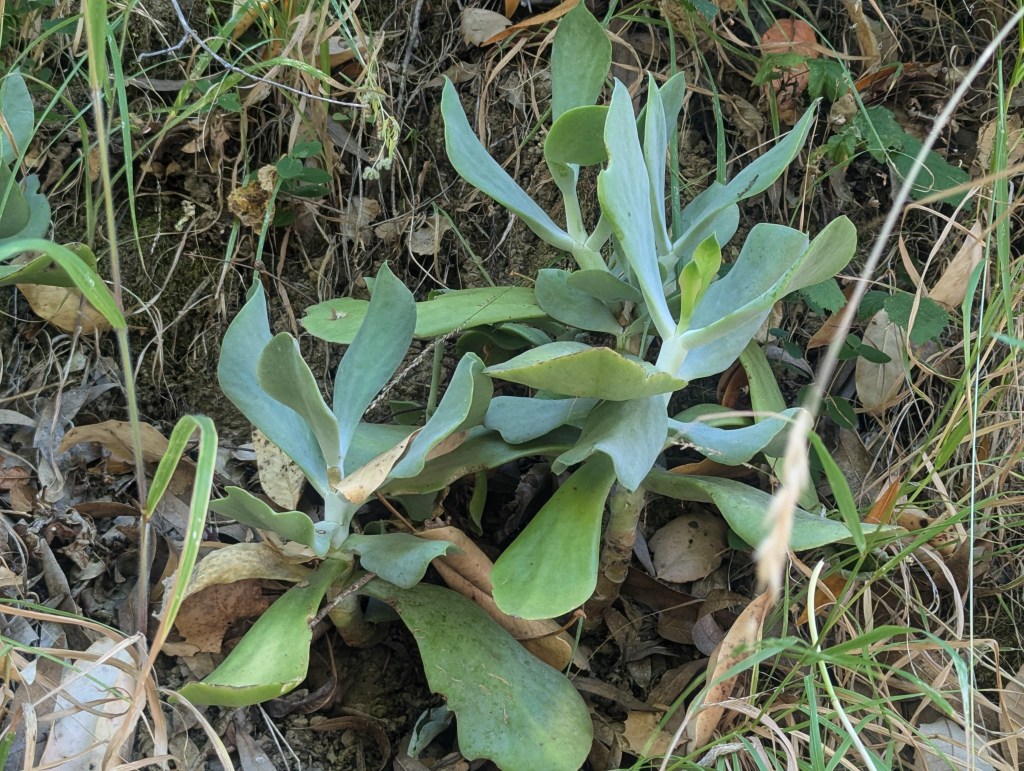
2. Crassula arborescens spp. undulatifolia, ripple jade, as well as the pinwheel aeonium below, remain unidentified. These names that I present here are merely guesses of their identities. Anyway, I procured this from a jobsite that I worked at in Hayward years ago.
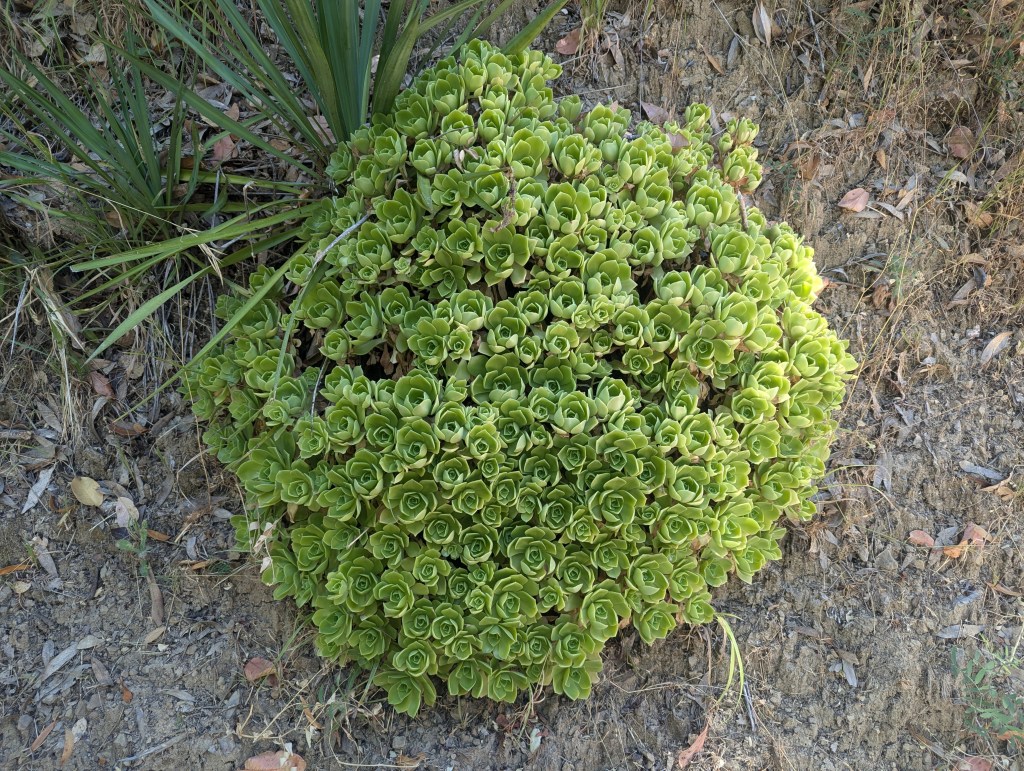
3. Aeonium haworthii, pinwheel aeonium came from the same garden that the common houseleek came from near Monterey. The slope that it is attached to is actually too steep to stand on. Yucca recurvifolia, curve leaf yucca is from an old jobsite in Boulder Creek.
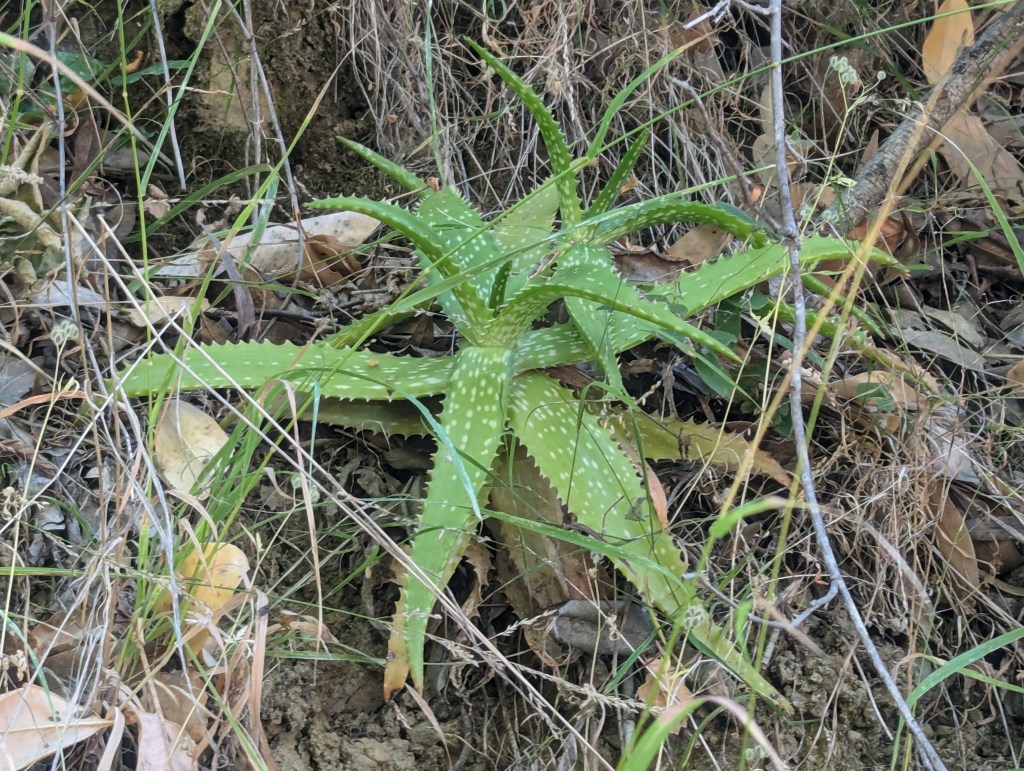
4. Aloe arborescens, candelabra aloe came from the home garden of an old friend in the East Hills of San Jose. It is higher on the same steep slope as the pinwheel aeonium and curve leaf yucca. It should grow better and produce pups for dividing with a bit of water.
5. Pelargonium graveolens, rose geranium impresses me most because it survived for so long, like the other perennials, but is supposedly not as resilient as they are. I found this in an old home garden in San Francisco, although I believe that it is common elsewhere.
6. Iris pallida, Dalmatian iris is important because it is from the garden of my maternal maternal great grandmother in Oklahoma. I acquired it when I was about four. Crassula ovata, jade plant was from my former home in town, where I lived after the earthquake.
Neither lavender nor cotton, but a member of the Compositae Family.
The name is somewhat of a mystery. It is related to neither lavender nor cotton, but Santolina chamaecyparissus is known as lavender cotton nonetheless. The small, silvery gray leaves have a finely wrinkly texture, and are remarkably aromatic, like lavender. Though, the small and round bright yellow flowers look like daisies with the outer petals plucked off.
Unlike lavender and most other similar evergreen semiherbaceous shrubs, lavender cotton is adaptable to shearing, and is actually a classic component of traditional ‘knot gardens’, usually with another species of Santolina with green foliage to provide contrasting color. (Knot gardens feature small hedges with various foliar colors shorn into geometric and sometimes intricate patterns.) If regularly shorn, it is appreciated for its strikingly gray evergreen foliage, since it will not bloom.
Unshorn plants get about two feet tall and a bit broader, and will eventually need seasonal light shearing to remove fading flowers after bloom. Annual pruning at the end of winter keeps plants compact and neat without depriving them of their bloom. They otherwise eventually get bald in the middle and sloppy around the edges. (Some of us know about that.)
Good warm exposure and well drained soil is best. After their first year, lavender cotton does not need much water.
Like oleander and junipers, lemon bottlebrush, Callistemon citrinus, has become passe. It was a victim of its own practicality. It was so popular that it became overly common. Yet it is just as practical now as it was then. It is resilient enough to survive within medians of freeways with minimal irrigation. In less exposed situations, it might require no irrigation.
As a small tree, lemon bottlebrush can grow more than fifteen feet tall. With pruning from below, some grow about twenty feet tall with sculptural trunks. Their canopies eventually become messy though, and require aggressive pruning. Most lemon bottlebrush grow as big flowering shrubbery or high hedges. Shearing can compromise bloom if too frequent.
Bright red bloom should be most abundant for summer, but may be sporadic at any time. It is very popular with pollinators, including hummingbirds. Many small staminate flowers bloom in compact cylindrical trusses, like bottlebrushes. Each truss is about two or three inches long and nearly as wide. The aromatic and evergreen leaves are almost as long. Dark brown bark is handsomely shaggy and furrowed.
Orchid rockrose, as well as other rockrose, are remarkably resilient.
Out in the most remote islands in the vast parking lots of Westgate Mall, the three inch wide, bright pink flowers of orchid rockrose, Cistus X purpureus, defy the harsh exposure and sun baked soil. They begin to bloom somewhat abundantly about now after winter rains, and continue until the beginning of summer. Sporadic flowers can occasionally bloom out of season. The center of each flower looks like a starfish wearing a fuzzy sweater, because each of the five petals has a brownish red spot at the base, surrounding the bright yellow stamens.
Mature orchid rockrose plants are typically less than four feet tall and broad, with somewhat grayish green, aromatic foliage. Individual leaves are about one or two inches long. Older stems can be pruned out as they start to deteriorate and drop leaves, in order to promote new growth that lasts longer. Otherwise, plants look tired after a few years, and eventually die out. Orchid rockrose does not want much water once established, and can only tolerate frequent watering with good drainage.
Even native manzanitas, which really are drought tolerant, need water until they disperse their roots.
Nearly every landscaper and gardener brags about using plants that do not need much water. Buzz words like ‘drought tolerant’, ‘native’, ‘sustainable’ and ‘xeriscape’ have become all too common, even though few actually spell ‘xeriscape’ properly. (It is NOT ‘zeroscape’!) Unfortunately though, most gardeners water so frequently and generously that drought tolerant and native plants are less sustainable than plants that want more water.
The difficulty is that drought tolerant plants generally need rather regular watering immediately after planting, while they are still dispersing their roots, but then want to dry out between watering once they are established. Otherwise, they are very susceptible to rot if the soil is constantly moist. Most drought tolerant plants should therefore not be mixed with plants or lawns that want regular watering.
Trees like incense cedar, beefwood, carob, silk oak, olive, California pepper tree and some eucalyptus, pine and oak can be nice shade trees in lawns that are not watered too much, but do not live as long as they would with less water. (Although many are messy in lawns anyway; and carob smells bad when it blooms.) California laurel, African sumac, Australian willow, strawberry tree and most acacia and cypress are less tolerant of lawn irrigation.
Eucalyptus, pine, oak and acacia have sensitive roots, so do better if planted while young instead of as larger specimens. For example, #5 (5 gallon) red ironbark eucalyptus get established faster and grow larger than 24” boxed red ironbark eucalyptus installed at the same time.
Bottlebrush, oleander, cotoneaster, hop bush, firethorn, grevillea, some types of wild lilac and all sorts of juniper can be happy with or without regular watering. Manzanita, coyote brush, rockrose, flannel bush and western redbud really want to dry out between watering. Like many plants from arid climates, wild lilac, coyote brush, rockrose, flannel bush and western redbud are naturally relatively short lived. Western redbud fortunately has an efficient technique of producing an abundance of seed and replacing itself with new seedlings before if finishes.
Lily-of-the-Nile is one of the most useful perennials, and can survive with annual rainfall or nearly saturated conditions. New Zealand flax is nearly as adaptable, but is more susceptible to rot if watered too much. Rosemary and several iceplants are nice ground covers with or without regular watering.
The various yuccas, aloes, agaves and their other relatives are some of the most practical perennials for arid climates, and many tolerate somewhat generous watering if necessary. However, most agaves and yuccas have nasty sharp leaves; and some agaves get too big to keep at a safe distance. Also, their bold personalities are not adaptable to every garden style.
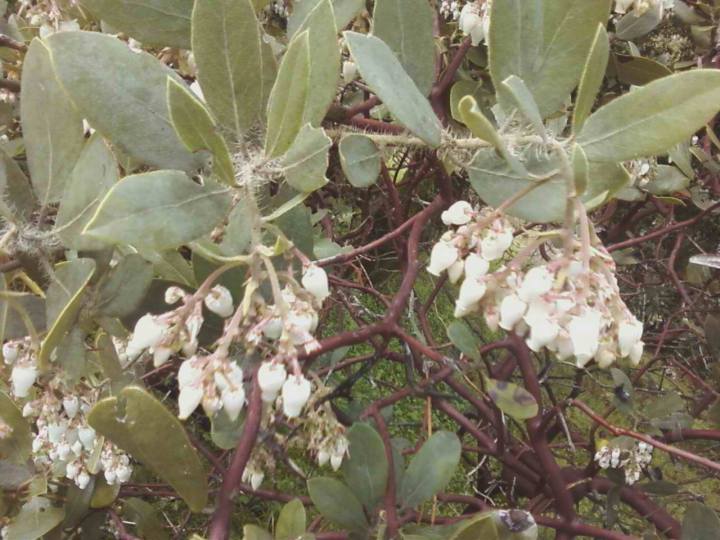
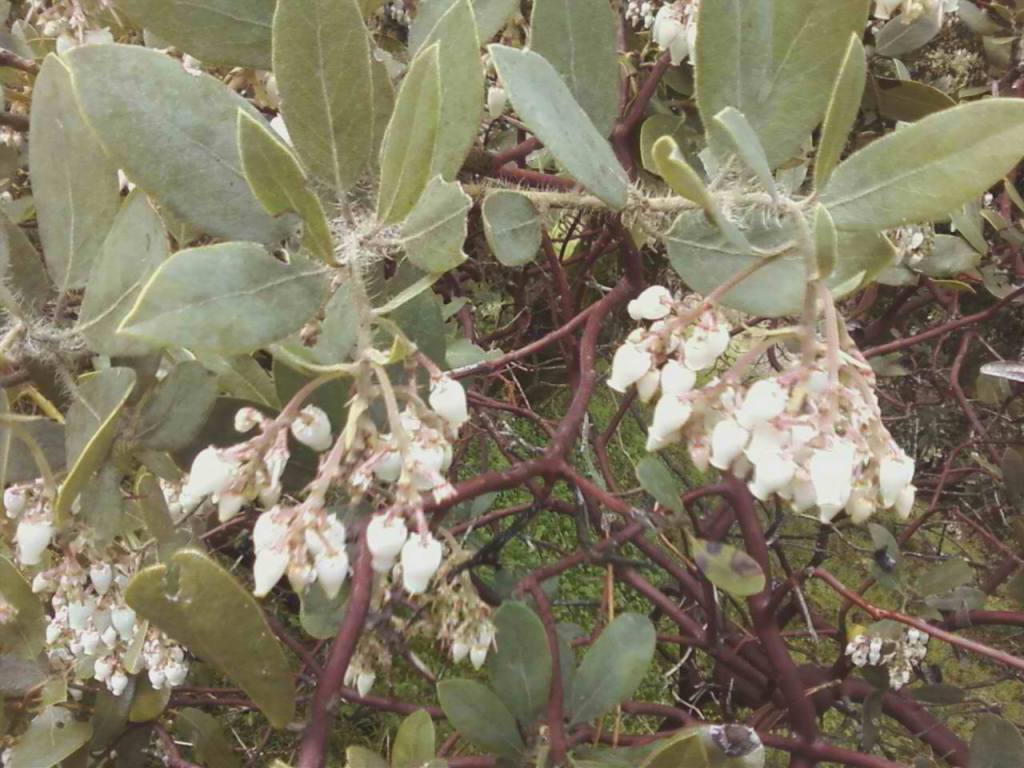
Mature common manzanita, Arctostaphylos manzanita, can get more than fifteen feet tall and about half as wide, so can be rather large shrubbery or small trees. Pruning away lower growth exposes their interestingly sculptural and smooth cinnamon red stems and trunks. The rather stiff light green leaves make light shade that smaller plants can live with. Waxy pinkish buds bloom into small pendulous clusters of tiny white lantern like flowers as winter becomes spring.
Manzanitas prefer to be neglected. They should not be pruned too much, and certainly should not get shorn. Obtrusive stems should be pruned out completely, since stems that get cut back do not regenerate. New plants should only be watered once or twice weekly through the first summer. Mature plants plants only want to be watered monthly or even less. After all, they are native to the surrounding hillsides, so are very satisfied with annual rainfall.
Some wild lilac can grow quite large, but lives only about thirty years.
There are many different forms of wild lilac, Ceanothus spp., ranging from low sprawling ground cover types that get only about two feet deep, to dense shrubs that get a few feet tall and broad, to relatively open and irregular shrubs that are a bit larger. The largest can become a small tree with multiple trunks as tall and broad as twelve feet. Wild lilac flowers can be any shade of blue ranging from deep dark blue to soft pale blue. Only a few have white or pinkish flowers. Some wild lilacs have leaves that are glossy and round like nickels. Others have small but thick and roughly textured leaves, like bacon bits.
However, almost all bloom in early spring, are evergreen, and want well drained soil. Only a few lose their leaves where winters are cold. Most prefer infrequent irrigation or none at all, although some of the ground cover types like to be watered occasionally through summer. Wild lilacs do not like to be pruned, and really do not want to be shorn, so should be planted where they have room to develop their natural forms. Sadly, wild lilacs are not permanent, and typically die within ten years or so.
Saint John’s wort is the common name of a few species of Hypericum. Hypericumbeanii sometimes gets the distinction of Bean’s Saint John’s wort. That sounds more like carob, Ceratoniasiliqua, though. Carob is the locust bean that sustained Saint John the Baptist in the desert. Mr. Bean was actually a respected botanist of the Royal Botanical Garden.
This Saint John’s wort is not as invasive as naturalized sorts, but is as resilient. Although rarely available from nurseries, it survives in old and neglected landscapes. Established specimens need no irrigation, but perform better with it. This species is likely rare merely because of its resemblance to invasive sorts. It propagates quite efficiently from cuttings.
Hypericumbeanii is a shrubby species, unlike more familiar ground cover types. It grows about two or three feet tall and wide. Its bright yellow flowers are about two inches wide, and bloom through summer. Foliage is deciduous where winter is cooler. Here, it is likely to linger until spring foliage replaces it. Partial shade is tolerable, but might inhibit bloom.






 Tony Tomeo