Mound Lily

Mound lily exhibits stiffly spiny foliage.

Yucca is a genus of about fifty species. However, any two can hybridize. They are more like fifty or so varieties of one species. They maintain distinction by blooming at different times or inhabiting different ranges. Mound lily, Yucca gloriosa, is one of these species. However, it is technically a perpetuating hybrid of Yucca filamentosa and Yucca aloifolia.

Mound lily develops symmetrical foliar rosettes that are only a few feet tall. Stout trunks that develop below can very slowly elevate these rosettes about eight feet. Elegantly tall floral stalks can stand as high as five feet higher. The stiff and evergreen leaves are one to two feet long, and about two inches wide. Their terminal foliar spines are very sharp.

The most popular cultivar of mound lily is variegated with creamy white stripes. Tristis is a variety with more flexible and arching foliage. It formerly classified as a distinct species of Yucca recurvifolia. All yuccas bloom with small, pendulous and creamy white flowers. Such flowers may exhibit a pale purplish or faint pale greenish blush.
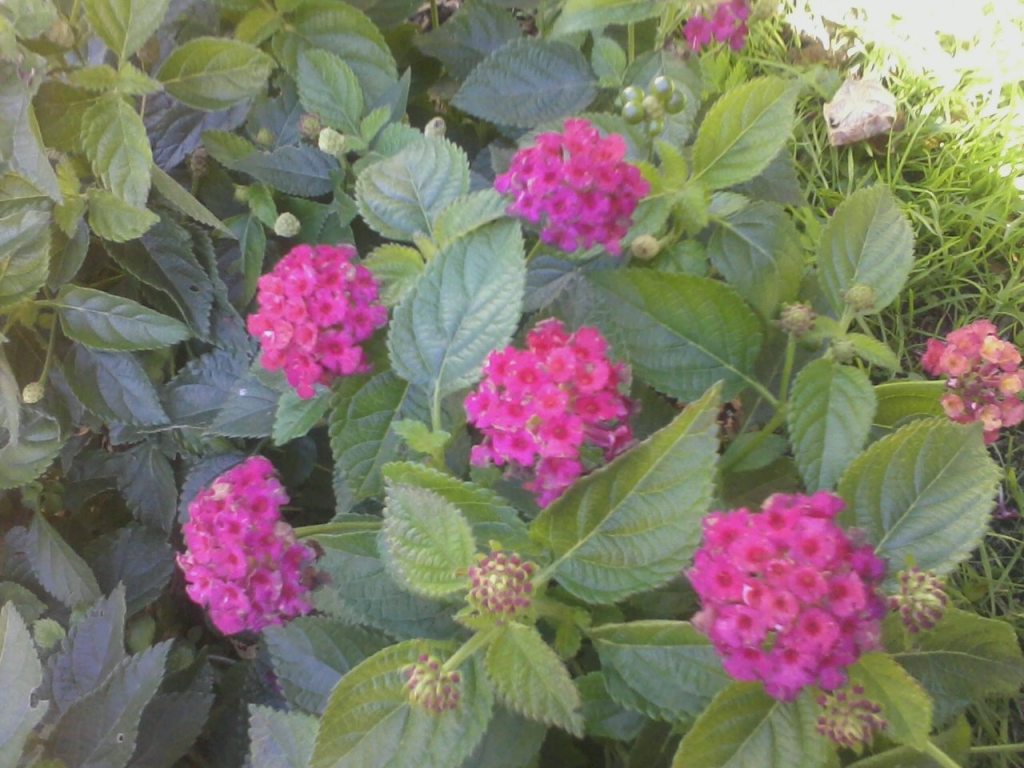
Lantana camara

The foliage is oddly aromatic.

Even as most flowers of summer are finishing, the bright yellow, orange, red, pink and white blooms of Lantana camara continue to brighten gardens until the weather eventually gets too cool and damp for them to perform. This is quite impressive for a species that is endemic to the tropics of Central America, and has a taste for warmth. Blooms are actually one to two inch wide umbels of many small flowers. Individual flowers within each umbel may be different colors at different phases, so that each umbel may have blooms in as many as three different colors.

In the wild, Lantana camara can get almost six feet high and more than six feet broad. Garden varieties are of course much smaller and compact. Since Lantana camara does well in containers, a few cultivars that stay very compact and proportionate to container gardening have been developed, but unfortunately remain somewhat uncommon in nurseries. The potentially objectionably aromatic leaves are about two or three inches long and one or two inches wide, with minor serration and slightly sandy texture. Some dislike the foliar aroma, but many enjoy it.

Lantana camara is not too demanding, wanting only good warm exposure with no more than a bit of shade. Once established, it does not need much water, and can actually rot if watered too frequently, or if soil does not drain adequately. Excessive fertilizer will inhibit bloom. There are not many insects that bother Lantana camara, perhaps because it has an unpleasant flavor. It is actually toxic to animals that may try to eat it. However, butterflies really dig it.

Pincushion Protea

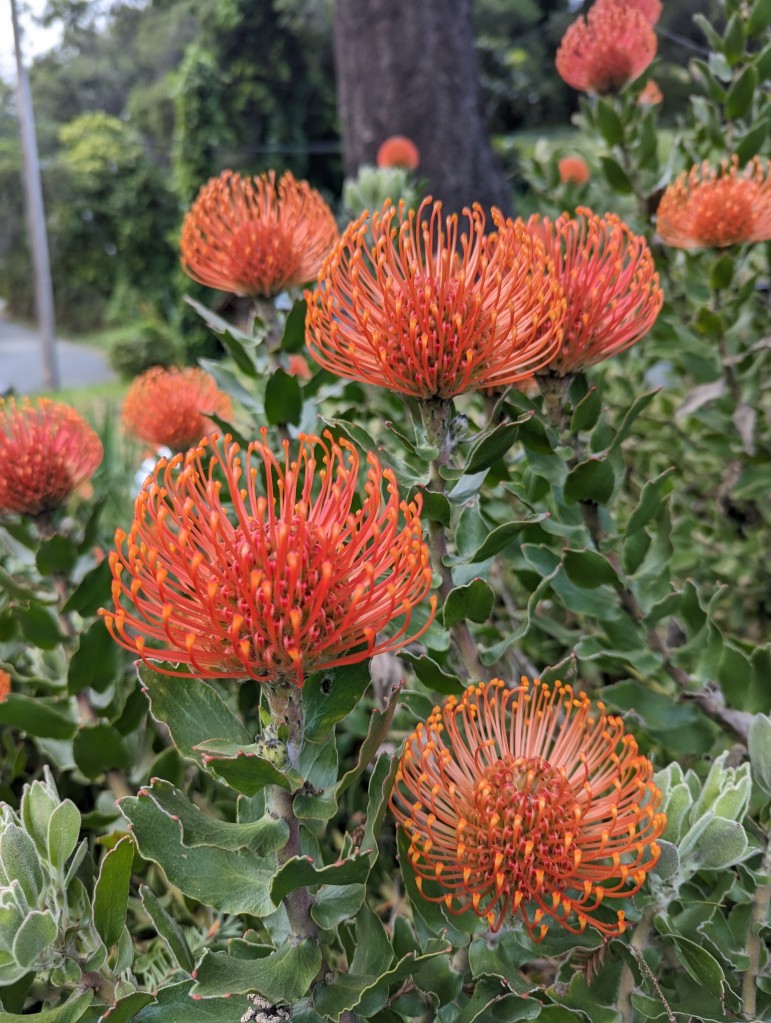
Pincushion protea is most certainly distinctive.

Proteas seem to be as happy locally as they are within their native range in South Africa. The Mediterranean climates there and here must be similar. Like most species from such climates, they are quite undemanding. They enjoy sunny and warm exposure with good drainage. They dislike fertilizer and frequent irrigation. Occasional irrigation is tolerable.

Pincushion protea, Leucospermum cordifolium, is the most popular protea here. Bloom can begin between late winter and early spring, and lasts for weeks. Many are presently blooming. Most are orange. Some are yellow or red. They are excellent cut flowers, both fresh and dried. Each rounded and four inch wide bloom contains many narrow flowers.

Pincushion protea develops stiff branches, but potentially wobbly roots. Sprawling stems that lean onto the ground improve stability. Pruning should remove undesirable stems at their origins, without leaving stubs. Shearing ruins form and texture, and inhibits bloom. Mature specimens can be about five feet tall and somewhat wider. Stiff evergreen leaves are about three inches long and half as wide.

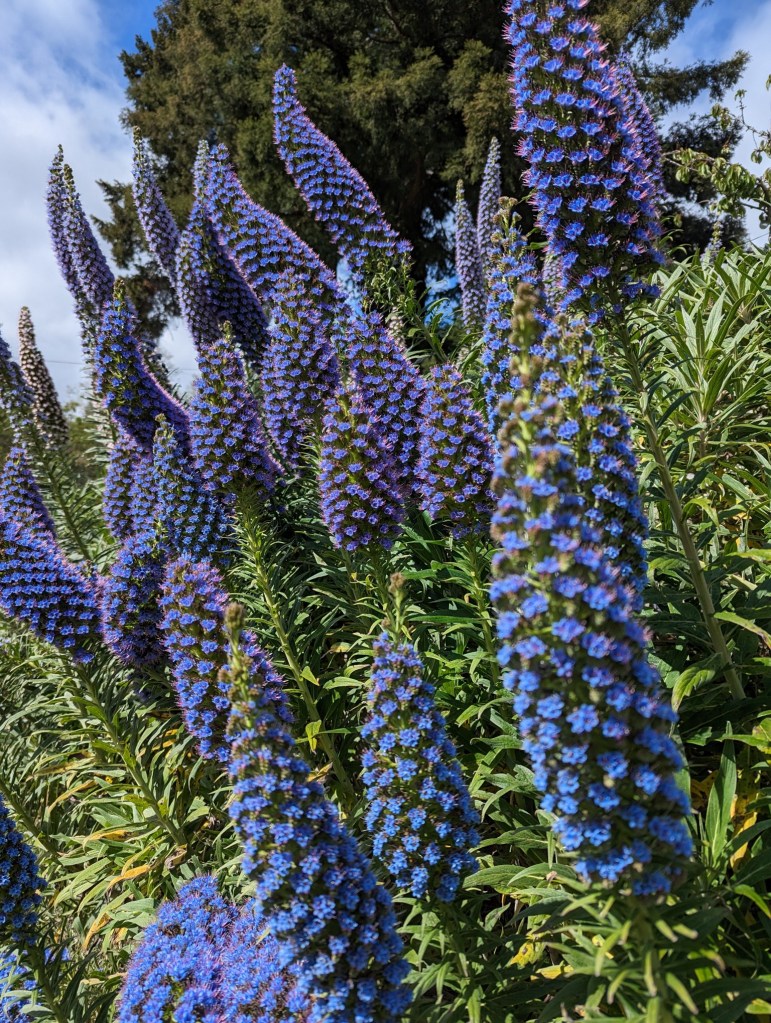
Pride of Madeira

Pride of Madeira blooms through spring.

This is most certainly something to be proud of. Pride of Madeira, Echium candicans (or fastuosum), can bloom perfectly blue. Varieties that bloom white or lighter lavender blue are rare locally. Feral specimens might exhibit such floral color variation though. Bloom occurs only annually, but can last through spring. Butterflies and bees are very fond of it.

Pride of Madeira occasionally self sows, but is not too aggressively invasive. It performs exceptionally well within coastal climates. Feral specimens on inaccessible coastal cliffs are only briefly scruffy after bloom. Deadheading within home gardens is tidier and limits seed dispersion. Moderate watering enhances foliar color. Excessive watering rots roots.

Small new specimens of pride of Madeira grow fast, but perform for only about five years. They generally get about six feet tall and eight feet wide. Cool or foggy coastal weather promotes taller and more vigorous growth. Warm exposure might promote more compact growth. The narrow and grayish leaves are rather raspy. ‘Star of Madeira’ is a variegated and compact cultivar.

Grevillea ‘Canberra’

Most Grevillea are from chaparral climates.

So many similar cultivars of low shrubby grevilleas come and go that it is hard to know what is what. All prefer sunny exposure and good drainage. They really do not like too much watering or fertilizer, particularly fertilizer with phosphorus. Pruning after bloom promotes more bloom, which keeps hummingbirds happy. Some people who are allergic to grevilleas can get a rash from handling the foliage.

Grevillea ‘Canberra’ was probably the most popular grevillea in the early 1990s, but can be hard to find now that other similar grevilleas are more common. It is a mid-sized shrub with dark green foliage that resembles pine needles on arching branches about six feet tall and broad. Small clusters of rosy red flowers bloom along the branches in winter and spring.

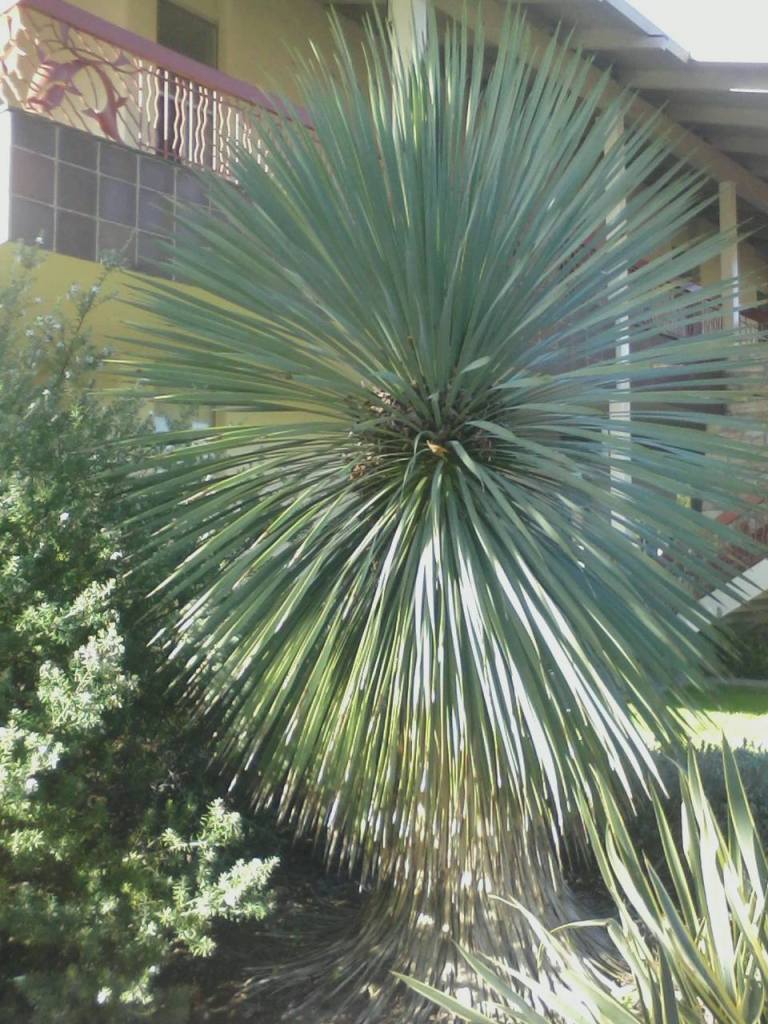
Beaked Yucca

Beaked yucca resembles Cordyline more than Yucca.

The fifty or so specie of yucca that are native to North and Central America are horticultural nonconformists. Like most of the related agaves and aloes, they are classified as succulents; but none have succulents leaves. Their stems store moisture, but are about as succulent as trunks of palm trees. Actually, many are classified as trees because they develop heavy and sculpturally branched trunks, but they are really just big herbaceous perennials that get very old.

From the Big Bend region of Texas and adjoining Mexico, beaked yucca, Yucca rostrata, happens to be one of the yuccas that develops a trunk, but grows so slowly with such billowy foliage, that it respected more as a striking foliage plant. The largest and oldest plants get no larger than fifteen feet tall and rarely develop one or very few branches. Most are less than ten feet tall with single but bulky symmetrical foliar rosettes. The individual grayish leaves are limber and narrow, but very abundant. ‘Sapphire Skies’ has even more striking bluish foliage.

As if the excellent foliage were not enough, mature beaked yucca blooms with small white flowers on big spikes nearly two and a half feet tall. Spikes can appear through winter and are typically finished blooming by spring, before summer dormancy, but do not seem to be too devoted to any particular schedule.

Beaked yucca is less common than it should be; perhaps because it is difficult to grow in nurseries. Besides, they are not for every garden, and are very likely to rot where they get watered as frequently as most other plants get watered. They do not mind if watered perhaps a few times through summer, but are more than satisfied with what they get from rainfall.

Holly Leaf Cherry

Holly leaf cherry fruit looks better than it is. The flavor is good; but there is very little pulp around the big seeds.

Since it is native to coastal chaparral between Monterey and the middle of the Baja California Peninsula, holly leaf cherry, Prunus ilicifolia, is right at home in local gardens of the central and south coasts. Although it can be a nice refined hedge if not shorn too frequently, it is better where it has space to grow wild into a mounding shrub, and can eventually grow into an undemanding informal screen as high and broad as fifteen feet. Width is easier to limit with selective pruning than with shearing. Besides, unshorn plants bloom with clusters of minute white flowers in spring, and produce interesting deep red or purplish red cherries in autumn. Unfortunately, the cherries have very big pits with only minimal sweet pulp. The small glossy leaves have somewhat bristly teeth almost like those of some hollies.

Curve Leaf Yucca

Curve leaf yucca resembles other yuccas.

Several of the fifty or so species of Yucca are difficult to distinguish from similar species. Some are varieties of species, rather than distinct species. Some are naturally occurring hybrids. Curve leaf yucca, Yucca recurvifolia, is supposedly a naturally occurring variety of mound lily, Yucca gloriosa var. recurvifolia (or tristis). Alternatively, it could be a hybrid.

As if that is not confusing enough, its physical characteristics are variable. Foliar color is typically grayish, but might be simple olive drab like that of many other species of Yucca. Its typically pliable evergreen leaves that curve downward as they mature can be almost as rigid as those of common mound lily. Stout but upright trunks may or may not develop.

Curve leaf yucca is remarkably resilient. Actually, unwanted specimens can be difficult to eradicate. Small bits of rhizome can generate pups for many years after the removal of a primary plant. Occasional watering is appreciated through the warmest summer weather, but may not be necessary. Old colonies can get ten feet tall, and occupy significant area, but quite slowly.

Watering Water Wise Plants

Excessive watering rots drought tolerant yarrow.

Native plants like coast live oak, valley oak, toyon, flannel bush, Western redbud and California lilac (ceanothus) are among the most resilient of plants as the weather gets dry and warm after spring. So are plants from similar climates, like bottlebrush, oleander, rockrose, grevillea, acacia and eucalyptus. They survive dry summers by dispersing their roots deeply into soil that does not get as desiccated as surface soil naturally does (without irrigation).

Ironically, these most resilient plants can also be difficult to work with while they are young. Because they rely on extensive root dispersion for survival, new plants that have not yet dispersed their roots can not survive long without regular watering. They only become tolerant to drought as their roots disperse into deeper soil.

However, because they are adapted to arid conditions, they do not like to be too damp for too long. Roots soon rot in soil that does not drain adequately between watering. They therefore need to be watered frequently, but not too frequently. Yes, that is as confusing as it sounds.

To make it even more confusing, these plants will need less watering as they mature and disperse their roots. Bottlebrush, oleander, contoneaster, hop bush, firethorn, grevillea and juniper can certainly tolerate more water than they really need; but wasting water is contrary to selecting drought tolerant plants to conserve water. Manzanita, coyote brush, rockrose, flannel bush and redbud may actually succumb to rot if watered too much. Even perennials like Pacific coast iris and yarrow can have problems.

Pine, oak, acacia and especially eucalyptus disperse their roots as soon as they can, so do not want to be confined in containers. It is therefore best to plant smaller young specimens than larger ones. #5 (5 gallon) eucalypti get established in the garden more efficiently than larger but more expensive #15 (15 gallon) trees. If #1 trees were available, they would be even better.

Flannel Bush

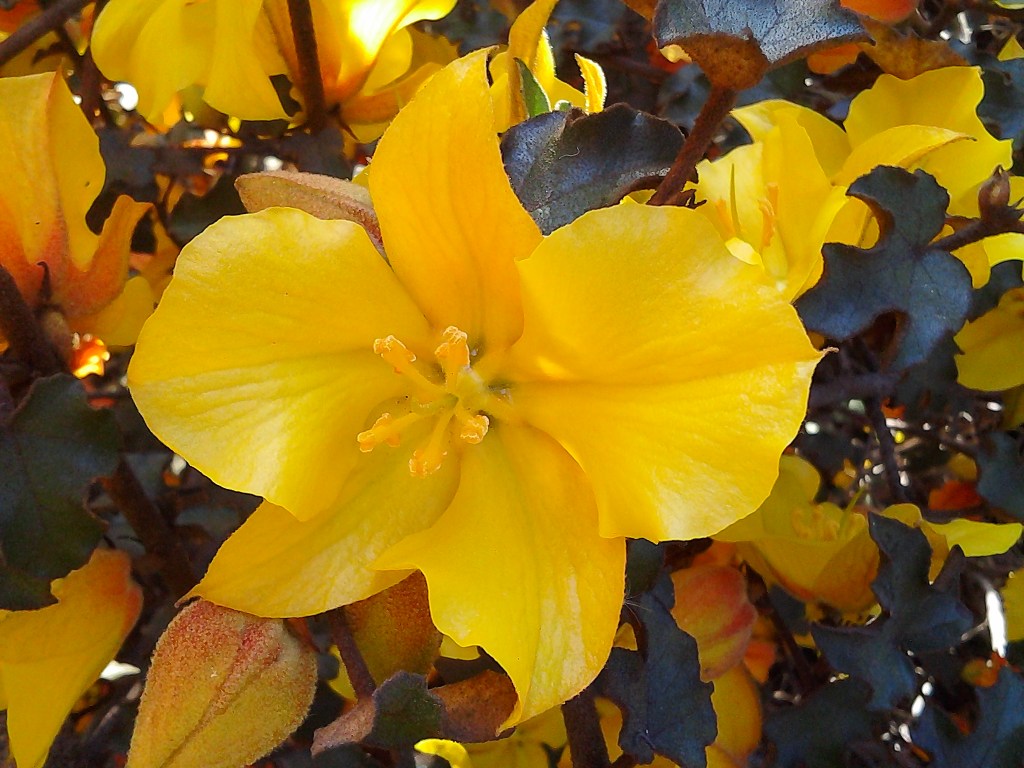
Abundant golden blooms are really spectacular, but because of irritating foliar fuzz, flannel bush should be enjoyed from a distance.

There is no way to say it delicately. Flannel bush, Fremontodendron californicum, is not easy to work with. It grows rapidly and rampantly with awkward form to about ten feet high and broad, but then starts to deteriorate when only about twelve years old. It can deteriorate even sooner if well irrigated. The fuzz on the foliage and young stems is irritating to the skin, especially during warm weather, so is very uncomfortable to handle. Otherwise, for out of the way spots, flannel bush is a striking native plant with impressively abundant bright golden yellow bloom this time of year. Neglected plants that do not get pruned or watered seem to be happier and more colorful, and can get older and much larger.