California Is A Big Place

50311thumb
There are all kinds of natives.

California is a big place, with more environmental diversity than any other state and most other countries. It includes rainy and cool forests of Del Norte County, and dry and hot deserts of Imperial County. The snowy mountains of Placer County and the mild coastal plains of Los Angeles County are here too. There are hundreds of miles of sandy beaches and big fertile valleys.

Consequently, plants that are native to California are just as diverse. Many that are very well adapted to the environments that they naturally live in are not so well adapted to other environments that may be only a few miles away. They really do not want to go to some of the more divergent climates in other regions.

Coastal redwood that is so happy within its natural range on the foggy western slopes of the coast ranges to the north are not so happy on the drier eastern slopes of the same ranges. It probably would not survive for long in the Mojave Desert. California fan palm from the hot and arid region of Palm Springs languishes on the damp and cool western edge of San Francisco.

Most of the popular California native plants are popular because they do not need much water, if they need any at all. However, some are as unhappy with local climate conditions as exotic plants from other continents are. For example, few plants tolerate drought as well as Joshua tree does. Yet, Joshua tree is likely to grow fast and then rot because winters are too damp for them locally.

Of all the excellent plants that are native to California, the most excellent for local gardens are either the few plants that are native to the local region, or the many others that are native to similar regions. They do not need cold Sierra Nevada Winters, hot Death Valley summers, Mojave Desert aridity or San Francisco fog. They are right at home here.

Even natives need some help adapting to a new garden. Confining their roots to cans while they grow in nurseries is very unnatural for them. Once planted, they will need to be watered while their roots disperse enough to survive on rainfall, or with minimal watering.

Barrel Cactus

50225
Barrel cactus spines are serious business!

‘Echino’ translates to ‘spiny’; so the genus name of barrel cactus, Echinocactus grusonii, means ‘spiny cactus’. Duh! The nearly spherical and furrowed (ribbed) plants are completely covered with stout and dangerously sharp spines. The most popular variety, known as golden barrel cactus, has pale amber yellow spines. Another variety has white spines. Tan or ruddy spines are rare.

Growth is quite slow. It takes many years for plants to get to three feet tall. Only plants that are quite mature bloom in spring or early summer with bright yellow or orange flowers that develop in a circle, like a halo around the top of the plant. Pink or red flowers are rare. Old plants typically develop a few pups (side-shoots), which may likewise take many years to bloom.

Like most cacti, barrel cactus wants a warm and very sunny location, and very well drained soil. If they do not get watered too much, they can stay potted for many years. However, because they are so nasty, they are not too welcome on porches or patios where most potted plants live. Because they are so heavy and difficult to handle, they are not as portable as they should be.

Cacti Have Bite Without Bark

50225thumb
Cacti exhibit unique and striking form.

The most inhospitable spots in the garden that no one wants to put any work into seem to be the domain of cacti, whether or not any cacti actually live there. “Oh, I will just put some cactus there!” is cliché in regard to shadeless and dry spots that get too hot with glare from a south-facing wall. Yet, such spots typically continue to be neglected, and the cactus never get planted.

Why are such distinctive and interesting plants considered to be so lowly that they should be banished to the badlands? Why should they be expected to endure what not other plants are expected to endure? After all, there are so many other distinctive xeric plants, like yuccas, agaves and some aloes, that are just as resilient, and according to some, just as lowly.

Cacti really are not as independent as commonly believed. New plants should actually get watered occasionally until they disperse their roots. If they get watered regularly, they need coarse soil that drains very well. Cactus plants that were grown in sheltered spots really can get scaled if planted where they are too harshly exposed during hot weather.

The main problem with cactus is their nasty spines. Simply planting small plants without getting poked is a challenge. Moving big potted specimens or removing overgrown cactus plants without getting seriously perforated can be daunting. So, even though they might do well in the harsh exposure at the curb, they do not belong in such a high traffic area.

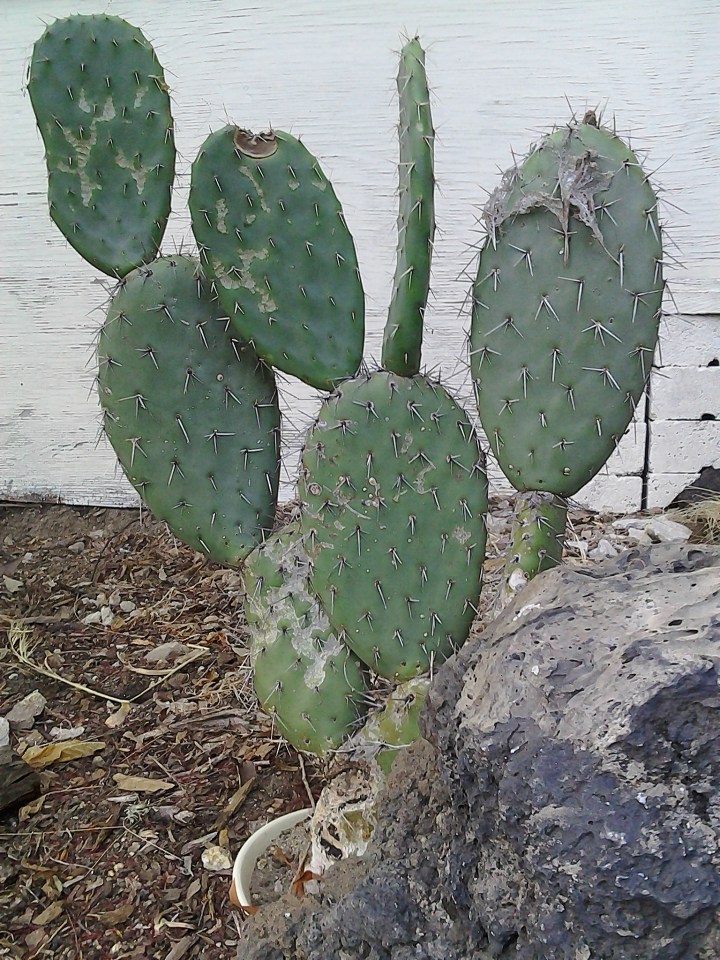
Without foliage or conventional stems, cactus are either awkward to prune, or can not be pruned at all. Barrel cactus have only one or very few round stems. If one of these stems gets to wide, it can not be pruned back. Prickly pear cactus is easier to accommodate only because it has enough stems to spare those that grow out of bounds.

What makes cacti so excellent is their distinctive form. Some have strictly upright stems that resemble those of the organ pipe cactus. Some grow as clumps of short and fat stems. Others grow upward and outward with rounded and flat stems like those of the beaver tail cactus.

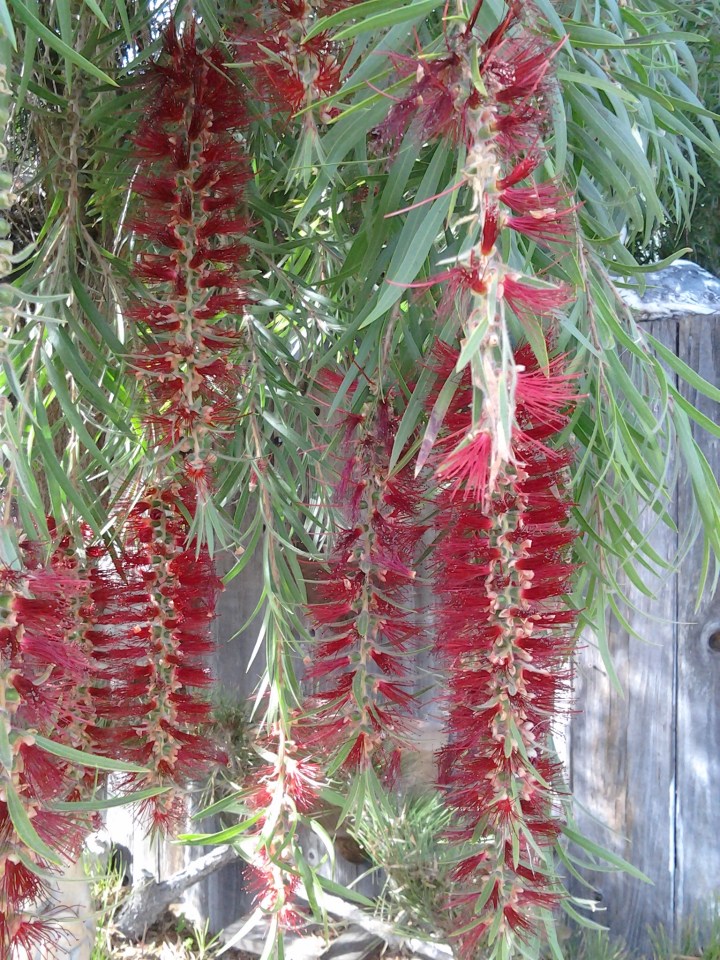
Weeping Bottlebrush

50128
Weeping bottlebrush blooms whenever it likes.

It is no wonder that it takes many years to get to fifteen feet tall, and may never get more than twenty feet tall. Weeping bottlebrush, Callistemon viminalis, may grow less than a foot a year, but seems to hang downward two feet. Because the stems are sculptural, and the bark has an appealingly rough texture, most weeping bottlebrush trees are grown with multiple trunks. The brick red bottlebrush flowers that bloom sporadically at any time of the year are more abundant early in summer. Established plants bloom more colorfully with a bit of water, but can probably survive quite a while without it. The evergreen leaves are narrow and mostly less than three inches long. Weeping bottlebrush needs good sun exposure.

Knife-Leaf Wattle

41231++
This wattle sports texture with color.

Even without the bright yellow staminate flowers (fuzzy with prominent stamens) that bloom in late summer or autumn, the grayish foliage of knife-leaf wattle, Acacia cultriformis, is still striking. It contrasts nicely with dark green foliage of pines, redwood and ivy. What seems to be small triangular leaves are actually ‘phyllodes’, which are modified petioles (leaf stalks) of vestigial leaves. They are about half an inch to an inch long, and neatly arranged on stiff stems.

Mature trees do not get much more than ten feet tall, and grow slowly enough to be kept even shorter. They can tolerate a bit of shade from larger trees. However, they bloom more profusely with better exposure. If the pollen is not a problem, the flowers are nice for cutting. So is the foliage, which is complimentary to many other cut flowers. Like almost all acacias, knife-leaf acacia does not require much water once established.

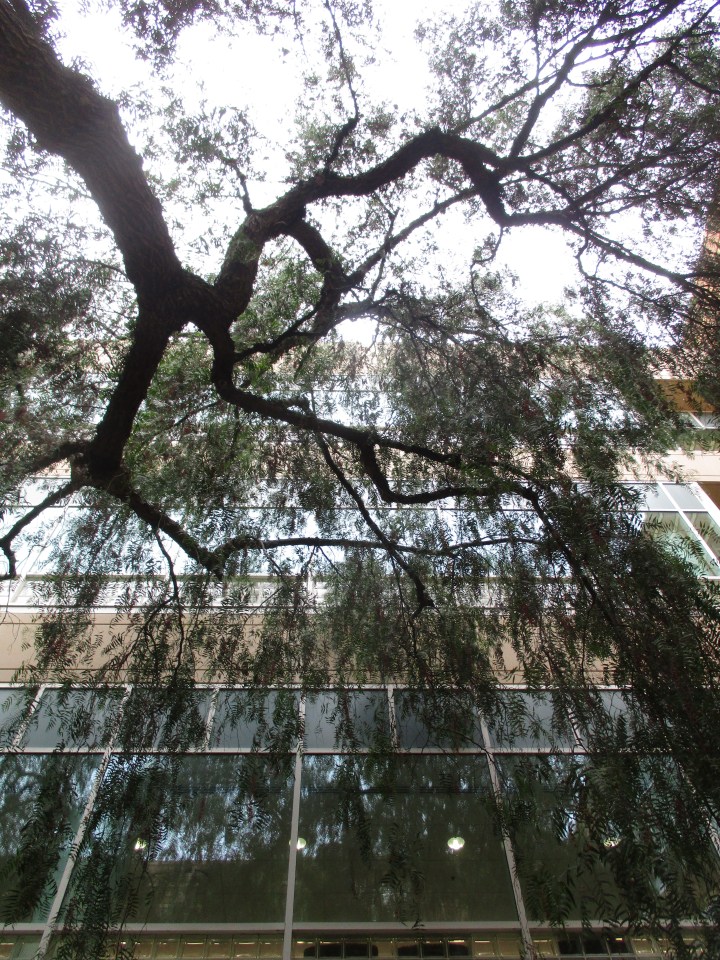
California Pepper Tree

00101It has been naturalized in Southern California long enough to seem to be native. California pepper, Schinus molle, is actually endemic to Peru and adjacent arid regions of South America as far south as Central Argentina. Furthermore, although its small pink fruits with hard black seeds are sometimes used for culinary purposes, it is actually not related to black pepper, and is mildly toxic.
California pepper is as at home here as the name implies. Established and naturalized trees can survive on annual rainfall. They are better foliated if watered a few times through summer, and do not mind average landscape irrigation if their soil does not stay too damp. When they are not dropping a few leaves, they are dropping floral frass or dried berries, so their mess is considerable.

Old trees can eventually get forty feet wide, and almost as tall. Young trees grow rather aggressively. Growth slows with maturity. The distended and irregularly structured trunks and main limbs are picturesquely gnarly, with handsomely flaky tan bark. Foliage and outer stems are delightfully pendulous. The pinnately compound leaves are finely textured, and about three to six inches in length.

Creeping Saint John’s Wort

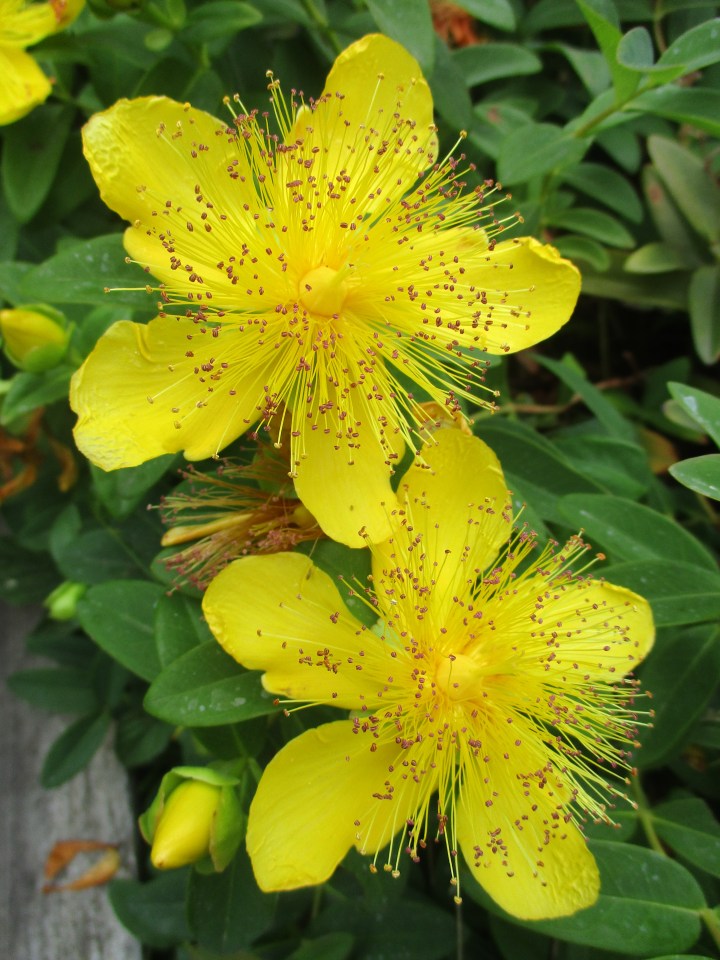
90717This is not the dreaded aggressively invasive Saint John’s wort that has naturalized in other regions. Nonetheless, creeping Saint John’s wort, Hypericum calycinum, does precisely as the name implies. It creeps, and has naturalized to a less aggressive degree in many spots near the coast. Its vigor is an advantage to many landscapes, but might eventually displease adjacent neighbors.

Creeping Saint John’s wort is a somewhat rustic perennial ground cover that does not need much water once established. It naturalizes in coastal climates because it gets all the water it needs from annual rainfall there. Although evergreen, it looks best if mown as winter ends. It happens to be susceptible to rust, and mowing removes much of the old foliage the the fungus overwinters in.

One to two inch wide bright yellow flowers, with five petals and prominent stamens, start to bloom in June and continue into September. By that time, the paired leaves might be getting tired if not watered, or infested with rust, but should stay presentable until mowing at the end of winter. Crowded plants might get three feet high. Otherwise, growth does not get much more than a foot deep.

Lily Of The Nile

60706The Nile River floods annually, inundating everything in its floodplain. Lily of the Nile, Agapanthus africanus, survives by hanging on firmly with a thick network of rubbery roots. It grows and blooms in warm weather as floodwater recedes, and then survives through a long, warm and dry season until the river floods again. It tolerates both drought and flooding, although it prefers more stability.

The blue or white blooms resemble fireworks, and happen to bloom in time for the Fourth of July. The small tubular flowers are neatly arranged in big and round trusses on top of slender and bare stems that stand about two to four feet tall. ‘Storm Cloud’ has darker blue or purplish flowers. Other purple varieties have larger and more pendant flowers (that hang downward from their trusses.)

The dense evergreen foliage is quite luxuriant, and is just as appealing as the bloom is. The rubbery leaves are up to two feet long, and arch outward from basal rosettes. Deteriorating lower leaves are typically obscured by fresh new foliage above. The thick rhizomes can be divided for propagation. Plants known as Agapanthus orientalis may have bigger blooms and wider leaves.

Matilija Poppy

90703If California poppy had not been designated as the California state flower, Matilija poppy, Romneya coulteri, might have been. It was nominated, but was less popular at the time, partly because it was familiar only to those near its native range in Southern California. Some of us know it as ‘fried egg flower’, because the big and floppy white flowers with yellow centers look like fried eggs.

Matilija poppy is a big and bold perennial, with flowers that are bigger than any other native species. They can get more than six inches wide! These flowers stand on top of lanky stems that might get taller than six feet. The somewhat sparse and light grayish foliage has a uniquely bristly but also slightly rubbery texture. Individual leaves might be longer than six inches, with elongated lobes.

As a native of dry chaparral regions, Matilija poppy is very resilient, and does not need watering once established. However, to survive long and dry summers, it starts to die back early, so should get cut to the ground later in summer or early in autumn before it becomes too unappealing. It then stays dormant through winter before regenerating in spring. Rhizomes can spread aggressively.

Some Plants Should Stay Wild

P80804+Native plants should be the most sensible options for local landscapes and home gardens. It seems natural that they would be the most sustainable, since they survive in the wild without watering, soil amendment or fertilizer. Once established in landscapes, they should be satisfied with the moisture they get from annual rainfall. Plants that are not native are considerably more demanding.

However, even native plants are not perfect. Some of the same qualities that help them survive in the wild are not so desirable around the home. To make matters worse, adapting to unnatural landscapes and home gardens can be as difficult for native plants as it would be for many of the common exotic (non-native) plants to adapt to the natural climate and endemic soils without help.

Natives obviously do not need much water. They certainly do not get much in the wild. They are resistant to drought because they disperse their roots so efficiently. The problem with this technique is that it does not work while plants are confined to cans (nursery pots). Once planted, new plants might take a bit of time to disperse their roots enough to survive without supplemental watering.

This might not seem like much of a problem for those who do not mind watering new native plants while they get established. New native plants still use less water than established exotic plants. The difficulty is that too much water can rot roots before they disperse! So, new native plants need to be watered regularly, but also need to not be overwatered! Monitoring them can be a hassle.

It might seem that larger new plants would be more resilient than smaller plants would be, but it is quite the opposite. Smaller plants (such as #1 or 1 gallon) disperse roots more efficiently, so get established sooner than larger plants (such as 5 gallon). Roots contained within small volumes of media (potting soil) are damaged less when planted than roots in larger volumes are. Roots of native plants, although efficient at dispersion, are innately sensitive.P90309+++++