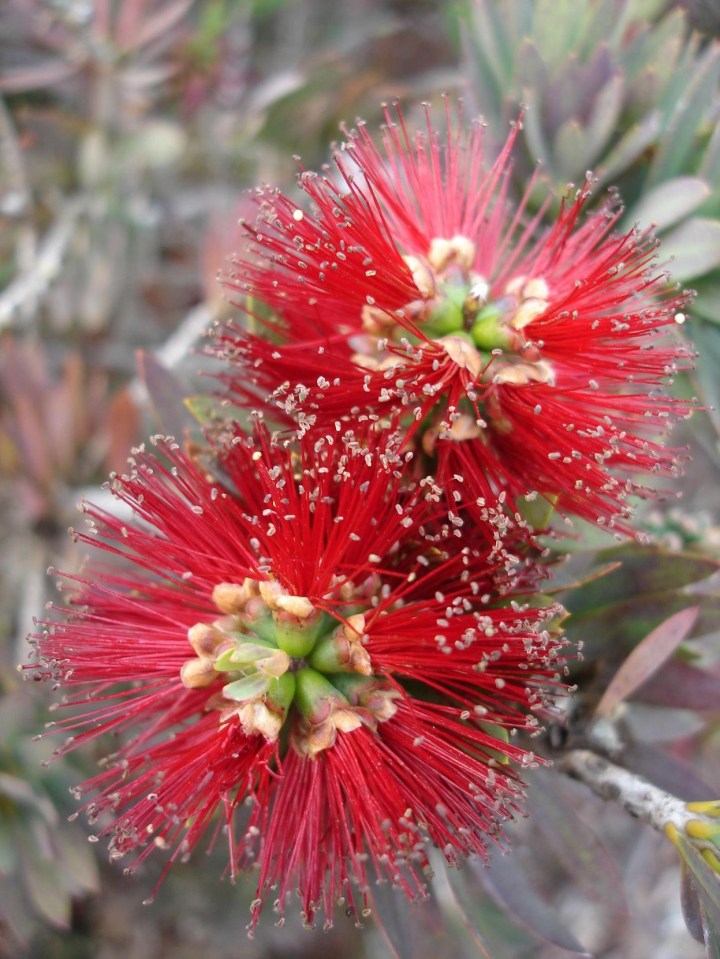
 Where it has space to grow, classic lemon bottlebrush that was so popular in the 1960’s is still a practical and resilient large shrub, and is happy to bloom with bright scarlet flowers as long as the weather is warm. It is resistant to most diseases and pests, and once established, survives on annual rainfall. Its main problem is that it simply gets too big for many situations.
Dwarf bottlebrush, Callistemon ‘Little John’, is more often a better fit, although it has a very different personality. It is short and dense, and spreads more laterally than upright. Mature plants are only about three or four feet tall, and maybe twice as wide. The smaller leaves are somewhat grayish. The distinctive bottlebrush flowers are a slightly darker shade of purplish red.
Even though established plants do not need much water at all, regular (but not necessarily generous) watering promotes bloom and growth. However, excessive watering can be lethal. Full sun exposure is best. A bit of light shade should be no problem. Dwarf bottlebrush makes a nice low informal (unshorn) hedge. Flowers attract bees and hummingbirds.


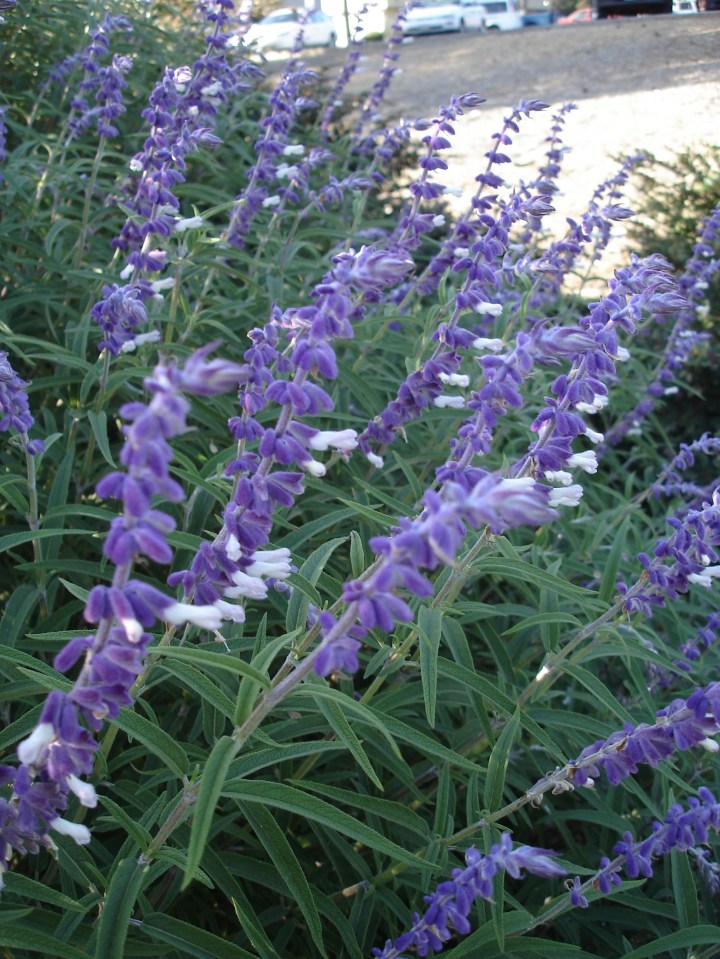 In the first year, Mexican bush sage, Salvia leucantha, does not get very big. Then it gets cut back to the ground at the end of winter. It gets about twice as big in the second year, only to get cut back again as winter ends. By the third or fourth year, healthy maturing plants can grow to five feet tall and seven feet wide each season. While cut back, big clumps can be divided to propagate.
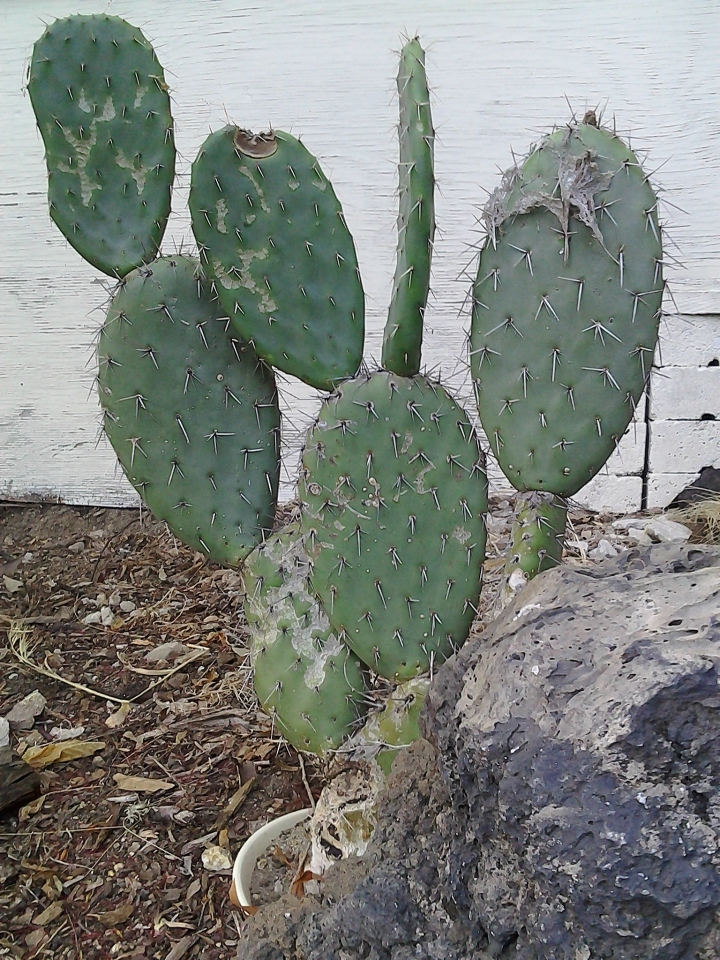 Almost everyone thinks of cacti as tough plants that live out in the hottest and driest parts of the deserts, where few other plants can survive. They are the sorts of plants that we threaten to plant out in the most inhospitable or neglected parts of the garden. We never actually do so, just because we do not appreciate cacti any more than weeds. They are fine over in the neighbor’s garden.
 The delightfully clear sky blue flowers of blue plumbago, Plumbago auriculata, seem like they belong with colorful annuals or in a tailored border of colorfully blooming perennials. However, the rampant canes of mature plants are really best in the background where they have room to grow wild. The canes do not climb like vines, but can flop over other shrubbery as high as fifteen feet.
 There really is a bearded iris that happens to be named ‘San Francisco’. It is related to ‘Los Angeles’, but not ‘San Jose’. (I really want to find a copy of ‘San Jose’ for my own garden!) Both ‘San Francisco’ and ‘Los Angeles’ are white with a slight blue highlight, and an even slighter reddish edge that is easy to miss. I can not remember which one of the two is whiter than the other, but the whiter one may lack the reddish edge altogether.
 Although a relatively small agave, the Queen Victoria agave, Agave victoriae-reginae, is also one of the most striking. Mature plants form dense foliar rosettes that are between only a foot, and a foot and a half tall and wide. What is so striking about them is the abundance of stout succulent leaves that can be so densely set that some older plants look like big, round and green pine cones.
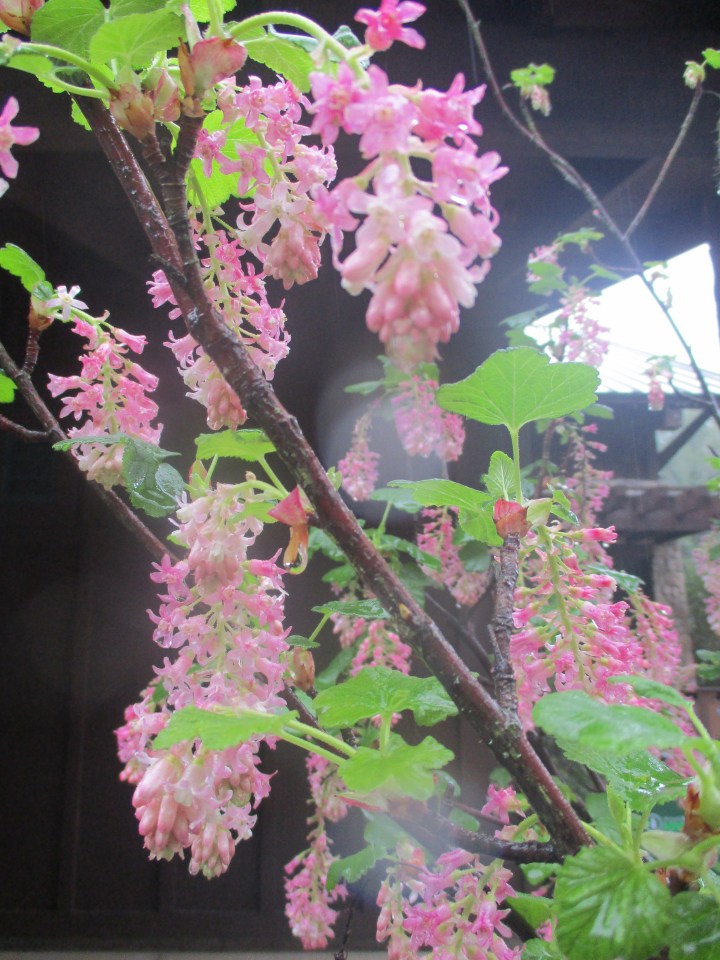 We tend to think of currants as being from Europe, Russia or Eastern North America. The pink flowering currant, Ribes sanguineum glutinosum, is actually endemic to canyons and riparian sites of the coastal ranges of California. Because it is an understory species that lives in the partial shade of large trees, it is quite tolerant of shade, and even prefers a bit of shade rather than full sun.
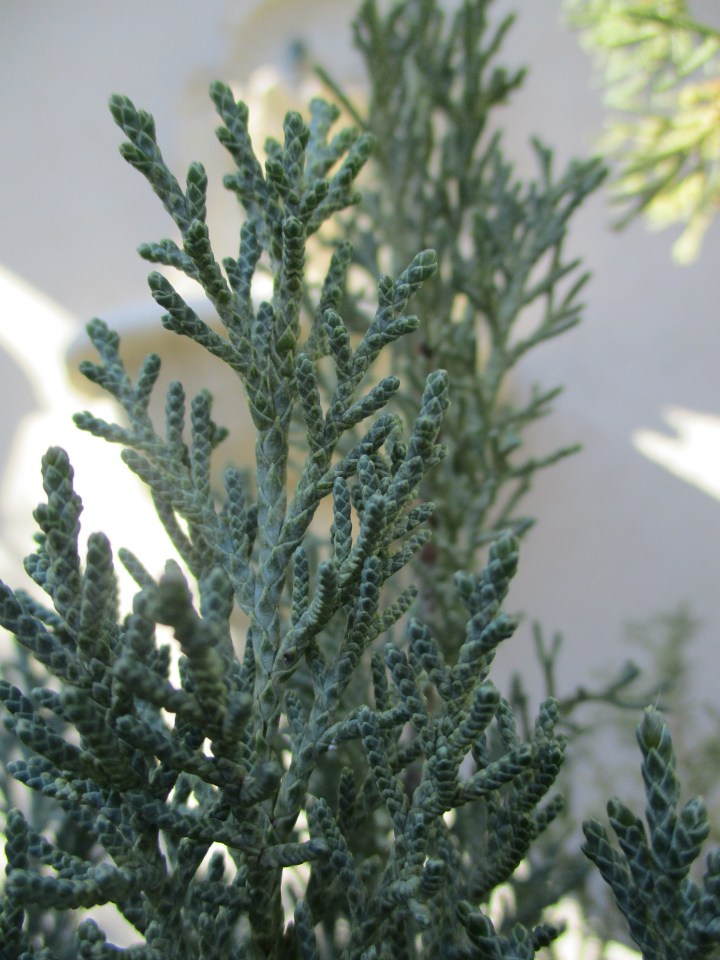 It is no coincidence that many plants with gray foliage are from mountains or deserts. Gray foliage is ‘glaucous’, which, like glaucoma, diffuses light. This helps to protect it from desiccation and scald when sunny weather is also hot, windy or arid. The glaucous foliage of Rocky Mountain juniper, Juniperus scopulorum, is what distinguishes it most from related North American junipers.
 What is it about Australian plants that makes them bloom in winter? Perhaps they think they are still in Australia where it is summer. Whatever the deal is, Geraldton waxflower, Chamaelaucium uncinatum, provides a scattering of small white, pale pink or lavender pink flowers from now until spring. It is no mistake that their bloom resembles that of New Zealand tea tree. They are related.
 Tony Tomeo