Boinkification

Dwarf Alberta spruce needs to know its place.

Many dwarf plants are very practical. The many different dwarf cultivars (cultivated varieties) of false cypress that are grown for their interesting forms, textures and foliar colors are much more proportionate to home gardens than similar specie in the wild, which are big enough to get harvested for timber. Oranges are easier to reach on dwarf trees than on standard trees, which get as big as shade trees.

However, not all plants should be bred to be dwarfs. Dwarf Southern magnolias certainly have their appeal for tight spots, but do not make as much shade as larger trees do. Compact cultivars of crape myrtles (although not actually dwarfs) take too much time to grow above truck traffic to be practical as street trees.

Many classic annuals and perennials are likewise bred to be too compact to be as practical as they were in the past. Annie of Annie’s Annuals in Richmond refers to this all too common practice as ‘boinkification’. It makes many blooming plants more marketable and resilient to shipping and installation, but deprives them of their natural form and elegance.

Short annuals and perennials certainly have their place. Lobelia, sweet alyssum, dwarf marigolds and petunias are fine along walkways and in pots with other larger plants. They also work well as bedding plants for a profusion of color. Yet, there is all too often too much of a good thing. Some flower beds are simply so big and plain, that it would be just as colorful to paint an area orange instead of planting so many marigolds.

Taller flowering annuals like nicotiana (flowering tobacco), cosmos and zinnias add depth behind lower growing annuals. Dahlias are perennials that can accomplish the same thing. Some of the older and less common varieties of familiar bedding plants that have not been so boinkified also work well. There are even petunias that can get two feet tall and wide! These taller plants also provide cut flowers; which is something that boinky plants are not so good at.

Boinkification also compromises fragrance and aroma. Bedding dianthus have almost no fragrance at all; unlike the old fashioned dianthus and carnations that had such distinctive spicy fragrance. Modern zonal geraniums are more colorful than classic varieties, but their foliage is not quite as aromatic.

Not only does increased foliar density of boinky plants promote the proliferation of many diseases and pests; but the genetic violations necessary for boinkification interfere with resistance to diseases and pests!

Dwarf Alberta Spruce

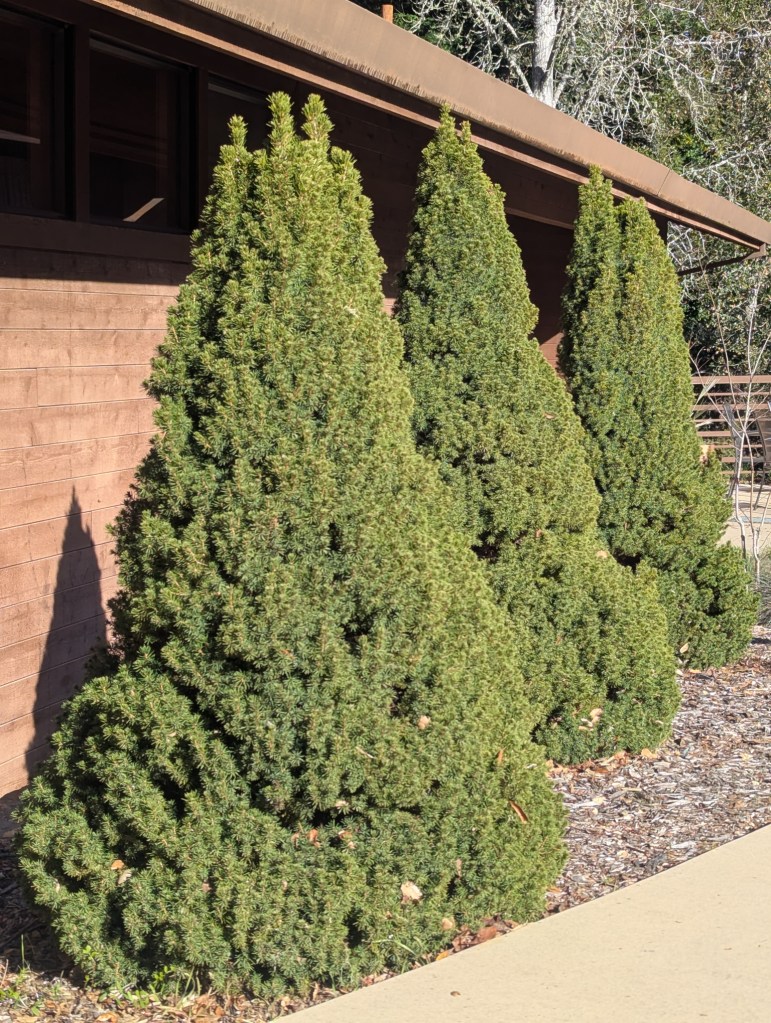
Dwarf Alberta spruce is more like a strictly conical shrub than a small tree.

Unlike other related white spruce, which get more than fifty feet tall, dwarf Alberta spruce, Picea glauca albertiana ‘Conica’, stays smaller than its Latin name, rarely getting more than seven feet tall. It is so dense and conical that it should never need to be pruned. Shearing only damages its short light green to grayish green needles. Dwarf Alberta spruce is compact enough to live in large tubs or urns, as long as its sensitive roots are well insulated. (Concrete or wooden planters are well insulated, so do not transfer too much heat to the roots within. Ivy or ground cover cascading over and shading planters also helps.) Foliage should be sheltered from harsh exposure, since it can be desiccated by warm breezes or reflected glare, like from large windows or light colored south facing walls.

Big Lemons

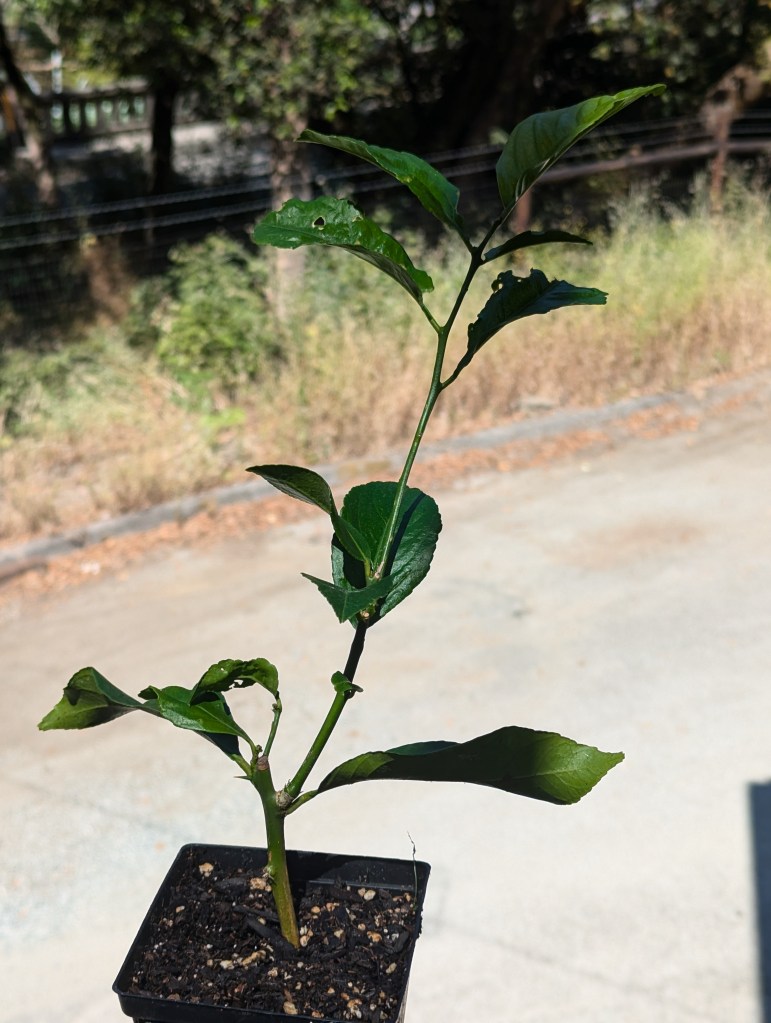
Ungrafted ‘Eureka’ lemon

All but two of the forty or so cultivars of citrus that I grew in the early 1990s were grafted onto the same dwarfing shaddock rootstock. Only ‘Meyer’ lemon and ‘Seville’ sour orange were not grafted, or ‘on their own roots’. ‘Meyer’ lemon naturally stays compact enough to not need a dwarfing rootstock. it was our most popular cultivar. ‘Seville’ sour orange supposedly grows about as large as the various dwarfed sweet orange with or without a dwarfing rootstock, as if the rootstock does nothing to limit its ultimate size. It was our least popular cultivar.

‘Eureka’ lemon, ‘Lisbon’ lemon and ‘Sanguinelli’ blood orange grow larger than any of the other grafted dwarf citrus that we grew. ‘Eureka’ lemon is actually a variant cultivar of ‘Lisbon’ that produces fruit throughout the year, which is a desirable attribute within home gardens. ‘Lisbon’ lemon may seem to be a bit more productive, but only because it produces all of its fruit within a more defined season, which can be a desirable attribute for orchard production. Otherwise, ‘Eureka’ and ‘Lisbon’ lemons are indistinguishable from each other, and grow quite tall. ‘Sanguinelli’ blood orange grows about as large, with a nearly identical upright form, but with a softer foliar texture.

Without dwarfing understock, ungrafted ‘Eureka’ and ‘Lisbon’ lemon trees can grow as big as small shade trees, and produce more fruit than they can support against gravity. Their broken limbs are a horridly thorny mess to clean up. ‘Sanguinelli’ blood orange trees can grow about as large, although they support the weight of their fruit more efficiently, and any debris that they generate, hopefully from pruning rather than breakage, is not so objectionable to handle.

So, I should have known better than to plug a bunch of ‘Eureka’ lemon cuttings. As cuttings, they lack dwarfing understock. I shared more than half with neighbors, who have been warned. About fourteen remain. One is more than enough.

Six on Saturday: Sale

We do not spend much on plant material here. Actually, I purchase nothing. Removal of excessive vegetation is more of a priority than adding more. We purchased quite a bit of plant material this last week only because it was so very inexpensive from a supplier that is closing for business. All of it is new to our landscape. New Zealand tea tree is common locally, but was somehow never installed here. We got a single #15 specimen, although I did not add a picture of it here. We would prefer to install all of the new material early in the rainy season. By local standards, the weather is too cool to do so comfortably.

1. Frost happens here also. Fortunately, it is not too severe. This is the coolest spot in the region. Rhody should not mix randomly capitalized letters like this. ‘E’ should match ‘e’.

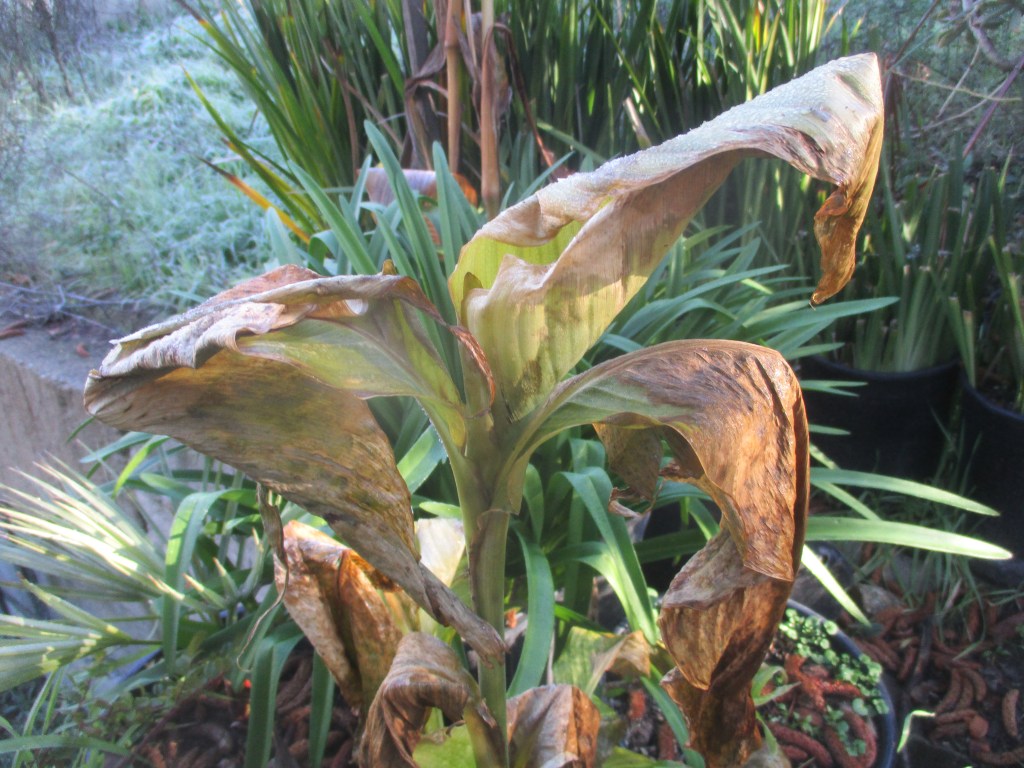
2. Canna ‘Red King Humbert’ melts when the weather gets this cool, even without frost. It is already trying to replace this foliage, so might melt again, but will be fine by spring.

3. Dicksonia antarctica, Tasmanian tree fern could perform better than the rather pekid Australian tree ferns in a cool and riparian landscape. We got only a single #5 specimen.

4. Physocarpus opulifolius, ninebark is the first that I have ever met! It is bronzed, but I do not remember its cultivar. It is too cool to go look now. We got twelve #15 specimens.

5. Pinus mugo, mugo pine looks like a smaller and greener version of mature specimens of dwarf white pine of last week. They eventually get bigger. We got thirty #5 specimens.

6. Picea abies ‘Nidiformis’, bird’s nest spruce will not be combined with mugo pine here. I was warned about their redundancy of form last week. We got forty-two #5 specimens!

This is the link for Six on Saturday, for anyone else who would like to participate: https://thepropagatorblog.wordpress.com/2017/09/18/six-on-saturday-a-participant-guide/

Dwarf Alberta Spruce

Dwarf Alberta spruce is densely conical.

Of all the live Christmas trees available, the dwarf Alberta spruce is perhaps the most practical. It is a shrubby little tree with a big name, Picea glauca ‘Albertiana’ ‘Conica’. (‘Albertiana’ is typically omitted.) It is a dwarf cultivar of white spruce that grows very slowly. It takes many years to potentially get eight feet tall and half as wide at the base. Wild white spruce can grow a hundred feet tall.

The main disadvantage of the dwarf Alberta spruce as a live Christmas tree is the very dense foliage. It almost seems to be artificial. The small needles are only slightly bristly, and finely textured. Otherwise, dwarf Alberta spruce can remain potted as a Christmas tree for several years. It stays sufficiently compact to return to the home annually. It just does not want to be indoors for too long.

The strictly conical form of dwarf Alberta spruce is a distinctive feature in the garden. A pair of trees elegantly flanks a doorway or walkway. A row of evenly spaced trees instills formality to a linear border of bedding plants. Although they do not get too broad, they should have enough room to grow naturally. Pruning for confinement or clearance compromises their naturally symmetrical form.

Sport

P80506Not just any sport; a witch’s broom sport! Remember the quidditch tournament of the first Harry Potter Movie? Well, it has nothing to do with that. You should not be watching such movies anyway.

This sort of ‘sport’ is merely a genetic variant growth. This particular sport happens to be known as a ‘witch’s broom’.

There is quite a variety of other sports.

Sometimes, a plant is going along minding its own business, when all of a sudden, it produces a stem with variegated leaves. Unlike the plain green leaves on the rest of the plant, the leaves on the sport are outfitted with white margins. In the wild, such a sport would probably not last long. Since it has less chlorophyll than the unvariegated foliage, it would grow slower, so would eventually be overwhelmed and shaded out by the more vigorous greener foliage. However, if someone happens to find this variegated sport, and determines that the variegation might be an attribute, it can be propagated as a new variegated cultivar of the species.

Sometimes, a plant is going along minding its own business, when all of a sudden, it produces a stem with bronzed foliage, or gold foliage, or leaves that are shaped differently from those on the rest of the plant. Perhaps new stems are more pendulous than they normally are. Sometimes, growth is more compact. It might even be rather stunted and disfigured, branching into a tuft of densely arranged twiggy stems known as a ‘witch’s broom’.

Such growth does not look like a witch’s broom for very long. As it grows, it develops into a densely shrubby mass that eventually gets too heavy to be supported. If the dense growth is appealing, it can be propagated as a new cultivar, like the dwarf Alberta spruce was reproduced from a witch’s broom sport of the common white spruce, or the pencil point juniper was reproduced from a witch’s broom sport of the common juniper (Juniperus communis ‘Compressa’).

This massive witch’s broom happens to be on a Douglas fir. It has been here for decades. It sure is ugly, but also interesting. It could be interesting enough to be reproduced.