Autumn Planting Of Spring Bulbs

Spring bulbs start now.

Some of the most familiar flowers to bloom in the earliest of spring get planted now as bulbs. They sit and wait in the garden to finish their dormancy, perhaps get a bit of a chill through winter, and get an early start to their bloom cycles as soon as weather permits. Because winters are so mild here in the Santa Clara Valley, some do not even bother to wait for spring, but are instead happy to start bloom before winter ends.

Bulbs become available in nurseries when they can be planted. Those that are not available yet will become available when it is time to plant them for later spring or summer bloom. The first to become available are generally the first to bloom; although bearded iris seem to know when they want to bloom, regardless of when they get planted.

As long as they do not get stored too long or get planted too late, bulbs do not need to be planted immediately, and actually extend their performance if planted in phases. The earliest phases to get planted will bloom earliest. Phases of the same bulbs planted a few or many days later should bloom about the same amount of time later.

With proper planning, later phases bloom as earlier phases finish. For example, because crocus flowers do not last very long, different phases of bulbs can be planted only a few days or a week apart, so that more flowers start to bloom in time for earlier flowers to fade. Freesia flowers last a bit longer, so different phases can be planted two weeks or so apart.

Narcissus and daffodil bulbs are not so discriminating about how deeply they get planted, so various phases can be put in the same spots. As long as they do not get planted too deep, the earliest phases can be planted deep and covered with only a bit of soil, so that later phases can be planted above. If similarly covered with only a shallow bit of soil, later phases of the same bulbs can be stacked, as long as the last and shallowest phase still gets planted deep enough.

Not many bulbs are actually real bulbs. Most are corms, tubers, rhizomes or tuberous roots. They all do the same thing though; store resources through dormancy to sustain quick bloom as weather allows. Although many bloom reliably only once in their first season, some naturalize to bloom at about the same time each year. Tulips are capable of naturalizing, but rarely get enough chill in winter to bloom after their first season.

Anemone (windflower), hyacinth, lily, rananculus, tulip and small colorful callas are the less reliable of spring bulbs after their first year. Crocus, freesia, hymenocallis and harlequin flower can be more reliable if they get what they want. Grape hyacinth, narcissus, daffodil, watsonia, bearded iris and the old fashioned white callas are the most reliable of bulbs that get planted about now.
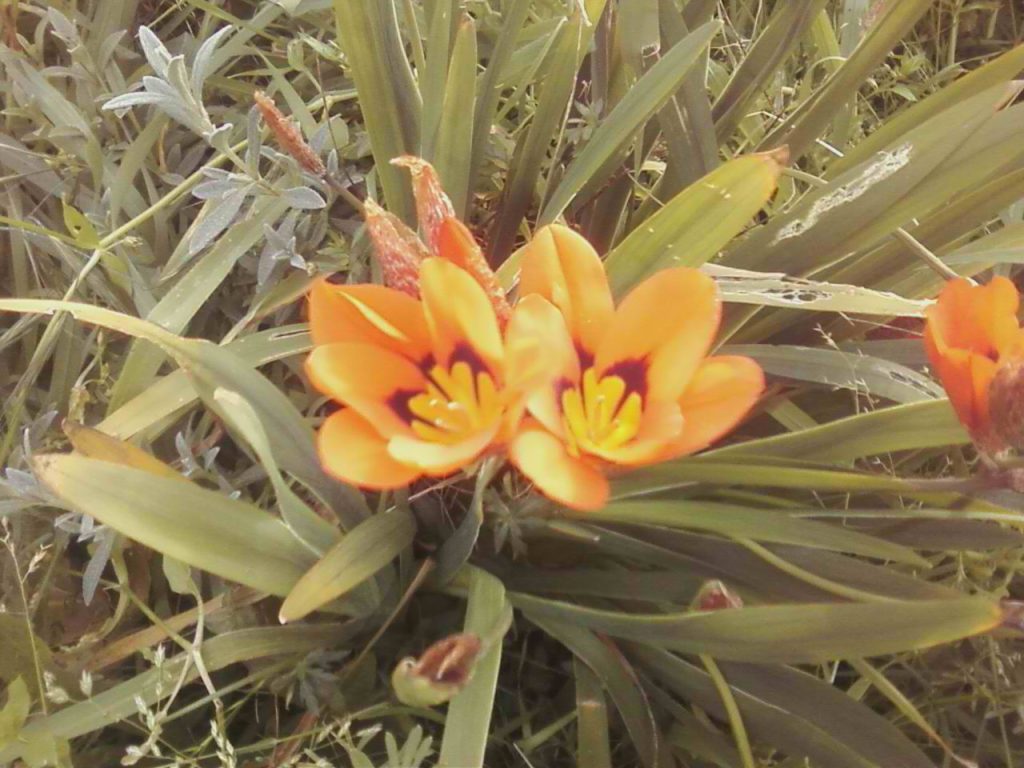
Harlequin Flower

‘Tricolor’ (obviously) means ‘three colors’.

Even though bulbs for harlequin flower, Sparaxis tricolor, are no longer commonly found in nurseries when it is time to plant them in autumn, naturalized bulbs are somewhat common in some older gardens. Where winters are mild and soil does not get too dry and compacted, they are happy to slowly multiply and bloom every spring. They seem to be blooming a bit early this year, since they typically wait until later in spring. The upright narrow leaves resemble those of gladiolus, but get no taller than a foot. Each flower stems rises a bit higher to display a few flowers that are about an inch and a half wide. Each flower has a yellow center surrounded by a narrow rusty brown pattern, which is also surrounded by a third color; which is orange, red, pink or purple.

Narcissus

Daffodil are a type of Narcissus.

If their bulbs were planted when they became available as summer evolved into autumn, Tazetta Narcissus and their hybrids should begin to bloom about now, a bit prior to related daffodil and jonquil Narcissus. In cooler winter climates, bloom must wait until early spring. The most popular variety, ‘Paper White’ blooms with about five or six small clear white flowers clustered on top of foot tall stems surrounded by vertical and somewhat rubbery, narrow leaves. Other varieties have white or yellow outer petals, known as the ‘perianth’, or orange or white centers, known as the ‘cup’. All are good cut flowers that are quite fragrant.

Because it is best to leave narcissus foliage to yellow and abscise (shed) naturally after bloom and as weather gets warmer, ground covers that are deep enough to conceal their deteriorating foliage are practical companions. (For example, deteriorating narcissus foliage can be stuffed under healthy English ivy, where it can be hidden without being removed.) Ground cover also keeps the soil from being bare during summer and autumn dormancy.

Mature clumps of narcissus bulbs only need to be dug and divided if they become so crowded that they do not bloom as much as they should. They are easiest to dig immediately after foliage dies back and lies on the ground, when they are dormant but still easy to find. Dug bulbs should then be stored in a cool dry place until it is time to plant them late in summer. Bulbs should be planted about five inches deep and about five to eight inches apart, with good sun exposure. The largest bulbs with multiple buds (known as ‘noses’) bloom most abundantly.

If they are happy in their location, narcissus easily naturalize, even if they do not get divided occasionally. They get most of the water they need from rain, since they are mostly dormant before dry weather in summer. Gophers and deer do not bother them.

Tulip

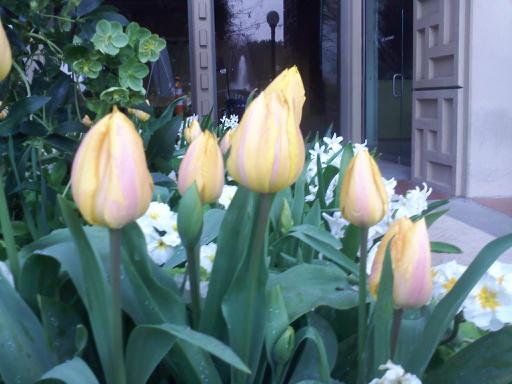
The soft pastel shades of these tulips brighten this somewhat shady landscape.

The mild winters that are so comfortable for us are not so desirable to tulip bulbs, which need to be chilled to perform as perennials. Consequently, they behave as brief season annuals locally. The most popular varieties have simple single flowers in white, yellow, pink, red, purple or pinkish orange. Double tulips are rather ruffled. Parrot tulips are larger and even more ruffled. As the names imply, lily-flowered tulips are shaped like small lilies, with pointy flared petals; and fringed tulips have finely serrate petals. Tulips stand between half a foot to two feet tall. Early types are already finished blooming. Late types, particularly if planted late, may bloom as late as early May.

Flowering bulbs brighten the garden better than incandescent bulbs.

Daffodil bloom from bulbs that were installed last autumn.

The elegant white callas that are just about to bloom in my garden have their origins in the ‘old country’. I obtained them from the garden of my great grandfather Tomeo in my ancestral homeland; Sunnyvale, near San Jose. I am told that my great grandfather planted them decades ago, and had been trying to get rid of them almost as long. I suppose that means that these callas are easy to grow.

My belladonna lilies that got planted two autumns ago are about as old, since they came from the garden of my mother’s mother in Santa Clara, right near Sunnyvale, and were in her mother’s garden prior to that. These bulbs just keep on growing, blooming and multiplying. Although I do not like their bright pink color much, I can not argue with their reliability.  

Bulbs and bulb like plants that can take care of themselves and thrive with minimal or no attention are always welcome in my garden. Bright orange crocosmia is perhaps just as reliable, or should I say ‘persistent’, as callas are, and like callas, should be planted about now. Yellow, red, and orange with red flowering varieties are also available. Pink, red, orange, yellow and salmon cannas are in season too. They are easier to contain, but are likewise prolific.

Some of my other favorites that get planted about now for summer bloom want more attention, but are certainly worth it. Dahlias can naturalize if conditions are right for them, but will more likely do better if dug, divided and replanted in enriched soil at least every few winters. They are remarkably easy to propagate. Asiatic lilies likewise prefer to be dug and replanted as their soil becomes depleted, but are not likely to regenerate year after year if ignored.             

Honestly though, some of the other summer blooming bulbs and bulb like plants that get planted about now are rather risky. I like to grow gladiolus because they happen to be among my favorite flowers. However, unless they get well amended soil and fertilizer, they do not perform very well, if at all, after their first year. Liatris is not much more reliable. Tuberous begonia is still a mystery to me, since I have not been able to prevent them from rotting in their first year!

Of the many bulbs and bulb like plants that get planted in autumn that are now blooming, grape hyacinth, snowdrop, watsonia, bearded iris, daffodil and narcissus are the most reliable and likely to naturalize, particularly with rich soil and regular watering. Daffodil and narcissus do not spread as well as the others, but are probably the most resilient. With a bit more effort, freesia and crocus can be persistent. In some situations, freesias have actually been known to naturalize as effectively as grape hyacinth.

Other early bloomers (that get planted in autumn) are more demanding. The anemones that I planted in about 1990 survived neglected in my garden for nearly a decade, but probably produced more flowers in their first year than in all subsequent years combined. Ranunculus and hyacinth may do the same if conditions are not just right for them. Tulips are perhaps the most profusely colorful of spring bulbs, but are sadly grown mostly as annuals, since they rarely do much more than produce foliage after their first year.

Proof of Seasons

Daffodil bloom here as if they were in the Pacific Northwest.

Narcissus make me wonder. Both paperwhite and common daffodil, as well as a few fancier daffodil, bloom here as if they were in a climate that is more conducive to such performance. The happiest naturalize and slowly multiply. Not many bulbs do so where winter weather is so mild. That is why I do not bother with tulip or hyacinth, although a few hyacinth have also been performing reliably here for many years.

Peony is very marginal here. I know that they perform inexplicably well for some neighbors, but none have ever done well for me. I really do believe that they prefer more chill than they experience here. Realistically, winter weather is relatively mild here.

Yet, I am not convinced that it is as mild as I have always believed it to be. Some who are unfamiliar with California believe that we experience only two seasons, which are summer, and a few days annually that are not summer. I know better. No one argues that the warm and dry summers here last longer than elsewhere. Prior to summer though, spring is likely comparably to spring within other climates. After summer, autumn, although mild, is cool enough to initiate autumn foliar color. Then, winter is cool. Really, it is cool enough for deciduous species to defoliate, and for mild frost. It may not get as cold as it does in other climates, but how cold does it need to be to qualify as winter?

I am satisfied with the winters here. I can grow all of the deciduous fruit trees that I want to grow. This is one of the best climates in the World for roses. These daffodils seem to be quite satisfied as well. In fact, they sometimes stay dormant later here than in climates with cooler winters!

Hyacinth

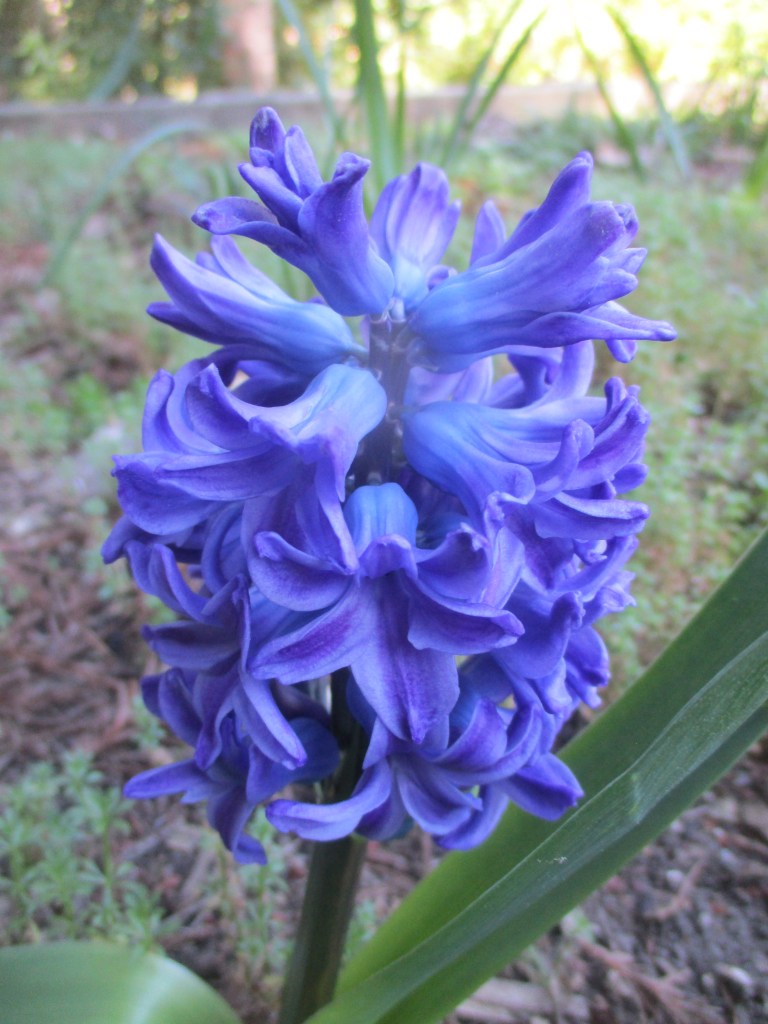
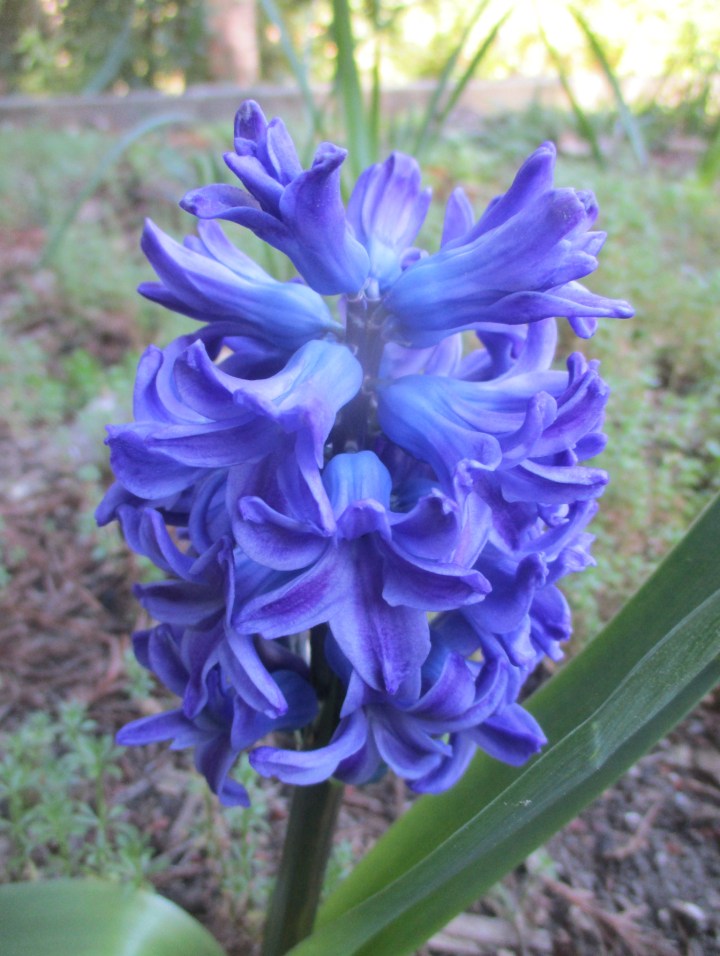
Hyacinth is both colorful and fragrant.

The most fragrant of flowers generally lack color. The most colorful of flowers generally lack fragrance. Most flowers employ either fragrance or color to attract pollinators, but not both. Hyacinth is an exception that is as colorful as it is fragrant. Bloom can be rich hues and tints of most colors except for green. The captivating fragrance is sweet and intense. 

Hyacinth are spring bulbs that are now finishing bloom, but are ready for planting during autumn. They require a bit of chill through winter, so must be dug and refrigerated for two months or so while dormant in milder climates. Dormant bulbs are plump and round, like small but toxic onions. They appreciate rich soil, regular irrigation, and a sunny situation. 

Bulbs generate only a few strap shaped and somewhat rubbery leaves during late winter prior to early spring bloom. These leaves resemble lily of the Nile leaves, but stay rather short, and may not flop. Hyacinth blooms with one or two short, stout and neatly cylindric trusses of several small flowers. Foliage lingers for only two or three months after bloom. Bulbs may not be reliably perennial.

Early Bulbs Start Even Earlier

Daffodils for next spring start now.

Crocus, daffodil and narcissus are among the earliest of the popular early bulbs to bloom at the end of winter. Hyacinth, tulip, freesia, anemone, ranunculus and some types of iris bloom shortly afterward. That process should begin in February or so, about five months from now. Early bulbs are seasonable now though. This is when they go into the garden.

Early bulbs, or spring bulbs, take commitment. While dormant, they are not much to look at. There is less to look at after their internment into shallow graves, where they disperse their roots secretly through winter. They will not make an appearance until they bloom in spring. Fortunately, their performance is more than adequate compensation for the effort.

Early bulbs go into the garden now because they take time to get ready for spring bloom. While dispersing roots, they also begin to develop foliage and floral stems. Such growth remains safe and invisible below the surface of the soil until the weather is warm enough for it to emerge. Until then, chilly and rainy weather helps bulbs adhere to their schedule. 

Whether they are true ‘bulbs’, or they are corms, rhizomes, tubers or tuberous roots, early bulbs are specialized storage structures. They contain what the particular plants need to grow to maturity and bloom within their preferred season. They should resume dormancy afterward, to repeat the process as perennials. However, few modern cultivars will do so. 

Realistically, extensive breeding for the development of the more extravagant of modern early bulbs has compromised their vigor. Consequently, some are not reliably perennial. Some simpler crocus, daffodils and narcissus can naturalize as perennial in comfortable situations. Otherwise, more of the later bulbs, like canna, cala and dahlia, are perennial.

Whether they naturalize or not, most early bulbs bloom just once annually. Planting them in phases prolongs bloom. Ideally, a subsequent phase begins to bloom as its preceding phase finishes. The length of bloom determines the frequency of phases. For example, if tulips bloom for a week, phases can be weekly. Winter annuals cover nicely when done.