The simple species is notably distinct from its several popular modern cultivars. Chinese fringe flower, Loropetalum chinense, grows very slowly to about fifteen feet tall. Its simple evergreen foliage is exclusively light green. Its small and ribbony flowers are exclusively creamy white. Limber and arching stems can eventually overwhelm adjacent vegetation.
However, this simple species is now very rare. Popular modern cultivars are much more compact. Although a few can grow taller, most are no more than five feet tall. Most exhibit delightfully purplish or bronzed foliage. Individual leaves grow about an inch or two long. Floral color ranges through white, creamy white, pink, rosy pink, rich red and garnet red.
Chinese fringe flower has a woodsy style. Shearing or aggressive pruning compromises its naturally relaxed form. It is naturally an understory species, so is somewhat tolerant of partial shade. Bloom is most abundant as winter relinquishes to early spring. It continues sporadically throughout most of the year. Blooming stems can be handsome cut flowers, and tolerate forcing bloom.
Some of the earliest of spring flowers are done blooming. More are just beginning. Then, a few early spring flowers barely qualify as early. Their fresh color is especially pleasing after such an atypically wintry winter. Many are delightful cut flowers. A few that bloom on bare deciduous stems are conducive to forcing. Even the earliest bloom could be earlier.
Bare stems are simpler and less wasteful to force to bloom than bulbs and potted plants. Most bulbs and some potted plants do not survive long after forcing. Dormant deciduous plants easily replace a few forceable stems. Forcing such stems is as simple as bringing cut flowers into a home. The difference is that it is premature, immediately prior to bloom.
Flower buds on dormant deciduous stems begin to swell during warming spring weather. Such stems are ready for forcing when these floral buds are about to pop open. Ideally, a bit of floral color should be visible through some of the bud scales. A few flowers may be blooming. Collective bloom accelerates within the warmth of a home interior after cutting.
Flowering but fruitless counterparts of popular fruit trees are some of the best for forcing. These include but are not limited to flowering cherry, plum, apricot and other stone fruits. Flowering pomme fruit trees, such as quince, crabapple and pear are almost as popular. Related fruiting stone and pome fruit trees are as conducive to forcing, but not as garish.
Of course, there is nothing wrong with simpler bloom. Some fancy flowering cherry trees bloom with single white flowers like fruiting cherries. However, cutting stems from fruiting trees decreases fruit production. With a bit of planning, dormant pruning can allow a few undesirable stems to remain. These stems are then available for cutting and forcing later.
Witch hazel cultivars are exemplary for forcing, but are done blooming. Flowering quince and forsythia are now finishing within most climates. Redbud, lilac, wisteria and perhaps weigela are still conducive to forcing. Dogwood and deciduous magnolia can perform as well if humidity is not too minimal. So should some acacias, although their fragrance and pollen may be distasteful.
According to these maples, spring is right on time.
Seasons in the Santa Clara Valley are not very distinct. They are not much more distinct in the Santa Cruz Mountains above. Hot weather in summer does not last for more than a few days, and usually cools off somewhat at night. Winter is never very cold, with light snow rarely falling only on the tops of the highest peaks.
Some believe that summer is our only season, with a few days of ‘not summer’. I would say that it is more like springtime all the time, with a few warm days, a few cool days, and a few rainy days. In many ways, it is great for gardening. However, it can be limiting for species that prefer more warmth in summer, or a good chill in winter. It can also be rather boring.
The vast orchards that formerly occupied the Santa Clara Valley were fortunately satisfied with the mild climate here, and actually enjoyed it. They got just enough chill and just enough warmth, but just as importantly, they appreciated the aridity. Late rain and humidity can ruin the same sorts of fruits in other climates.
Even without much distinction between seasons, springtime in the Santa Clara Valley was spectacular before the orchards were exterminated. A long time ago, tourists came to see it like the fall color of New England. Many or most tourists witnessed it while the weather where they came from was more like late winter. Natives considered the timing to be right on schedule.
However, the schedule did not coincide with what we learned about seasons in kindergarten. We cut out colored leaves from construction paper in autumn, even though there was not much fall color. We cut out snowflakes from white paper in winter, even though most of us had never seen snow. By the time we started cutting out flowers, most spring bloom was already done.
Norway maples always seemed to know what time of year it was. Schwedler maple, which is a darkly bronzed cultivar of Norway maple, was a common street tree in the Santa Clara Valley back then, particularly in tract neighborhoods that were build in the middle of the 1950s. Some disliked how it stayed bare and seemed to be dead after other trees bloomed and foliated.
To some of us, the reddish new growth of the Schwedler maples was what let us know that it really was springtime. Of course, we were done with all our spring planting by then, as allowed by the local climates. Also, the bloomed out orchards were already foliating. The maples just let us know that winter was completely finished and would not be back for several months.
Five young feral Norway maples at work are doing that splendidly right now. They lack the bolder color of the Schwedler maples, but they make the same statement. The bloom of the flowering cherries is exquisite, but not as convincing as the foliation of the maples.
There is so much blooming or finishing blooming here in the Santa Cruz Mountains above Los Gatos that it is difficult to select only a few pictures. These flowers are not from my home garden, but are from nearby Mount Hermon, which is located on the coastal side of the Santa Cruz Mountains, a few miles north of Santa Cruz. I enjoy the horticulture of the Santa Clara Valley, where San Jose is located, more than anywhere else in the world. However, there are many flowers that perform better in the cooler and moister climate of the Santa Cruz Mountains that separate the Santa Clara Valley from the Pacific Ocean. Mount Hermon is located in USDA Zone 9.
Daffodil are probably all done by now. The last to bloom earlier this week were in somewhat shaded spots. This one was looking a bit tired. Daffodils are one of only a few bulbs that will naturalize in our mild climate.
Forsythia also finished a while ago. This picture was taken at about the same time earlier in the week as the daffodil above. This tired specimen was not actually in the landscape, but was in a small nursery where gardeners stock recycled plants and recently acquired plants that have not yet been installed into the landscape. Forsythia is rare here. There is only one other in the landscaped area that we are aware of.
Dutch iris is a surprise every year. As I mentioned with the daffodil, there are not many bulbs that naturalize here. Dutch iris is one of those bulbs that needs more of a chill than it can get here. However, this colony blooms reliably every spring!
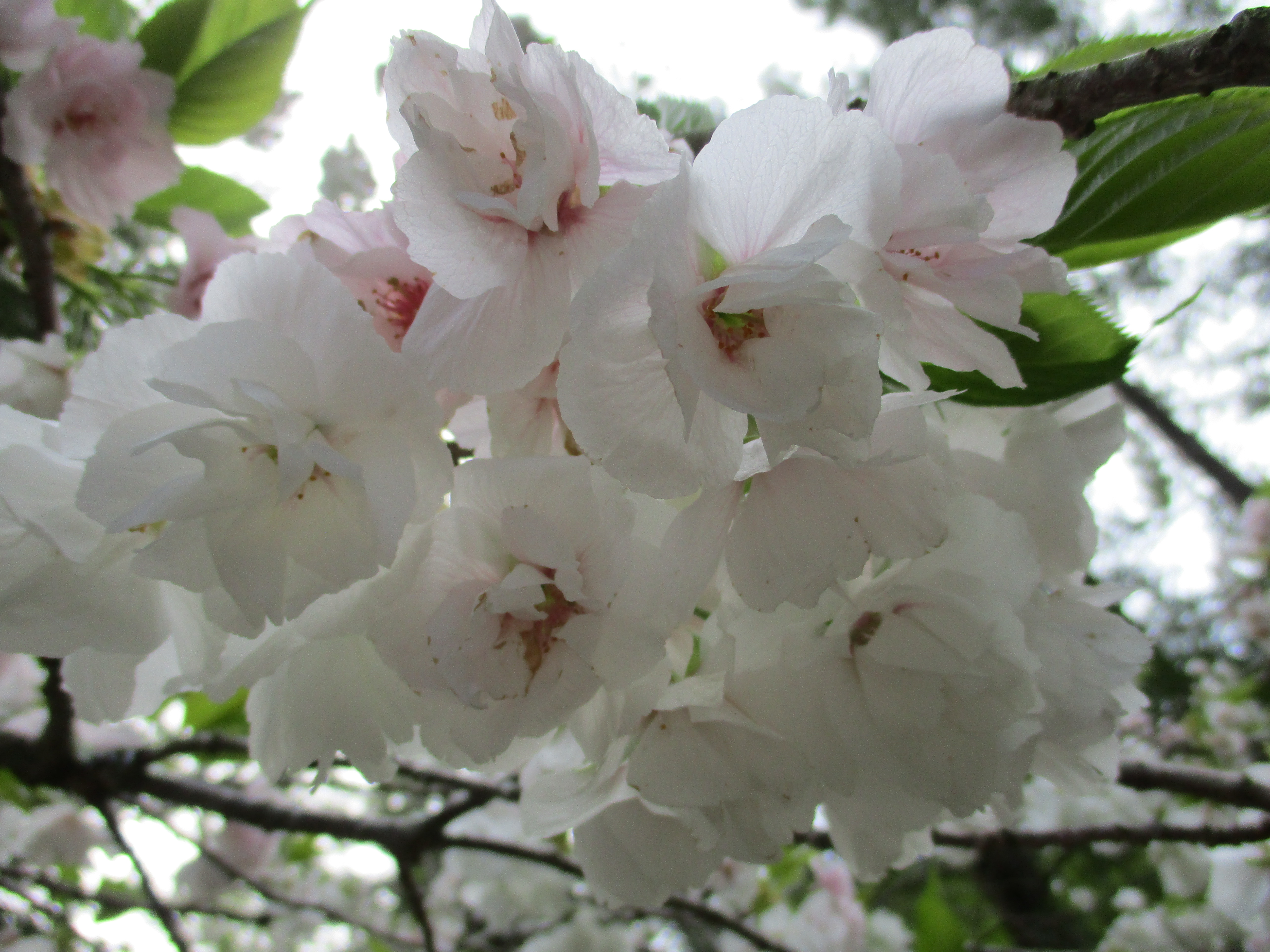
Flowering cherry is spectacular against the dark green backdrop of redwoods. A pair of mature ‘Yoshino’ or ‘Akebono’ flowering cherries in downtown Mount Hermon are the most famous in town. They are very old and sadly, must be removed. A few others have been planted nearby. There are at least three ‘Kwanzan’ flowering cherries in other areas. I do not know what cultivar this one is. It might be my favorite because it is so striking white; my favorite color. This picture was taken at about the same time earlier in the week as the daffodil and forsythia. Only the ‘Kwanzan’ flowering cherries continue to bloom now.
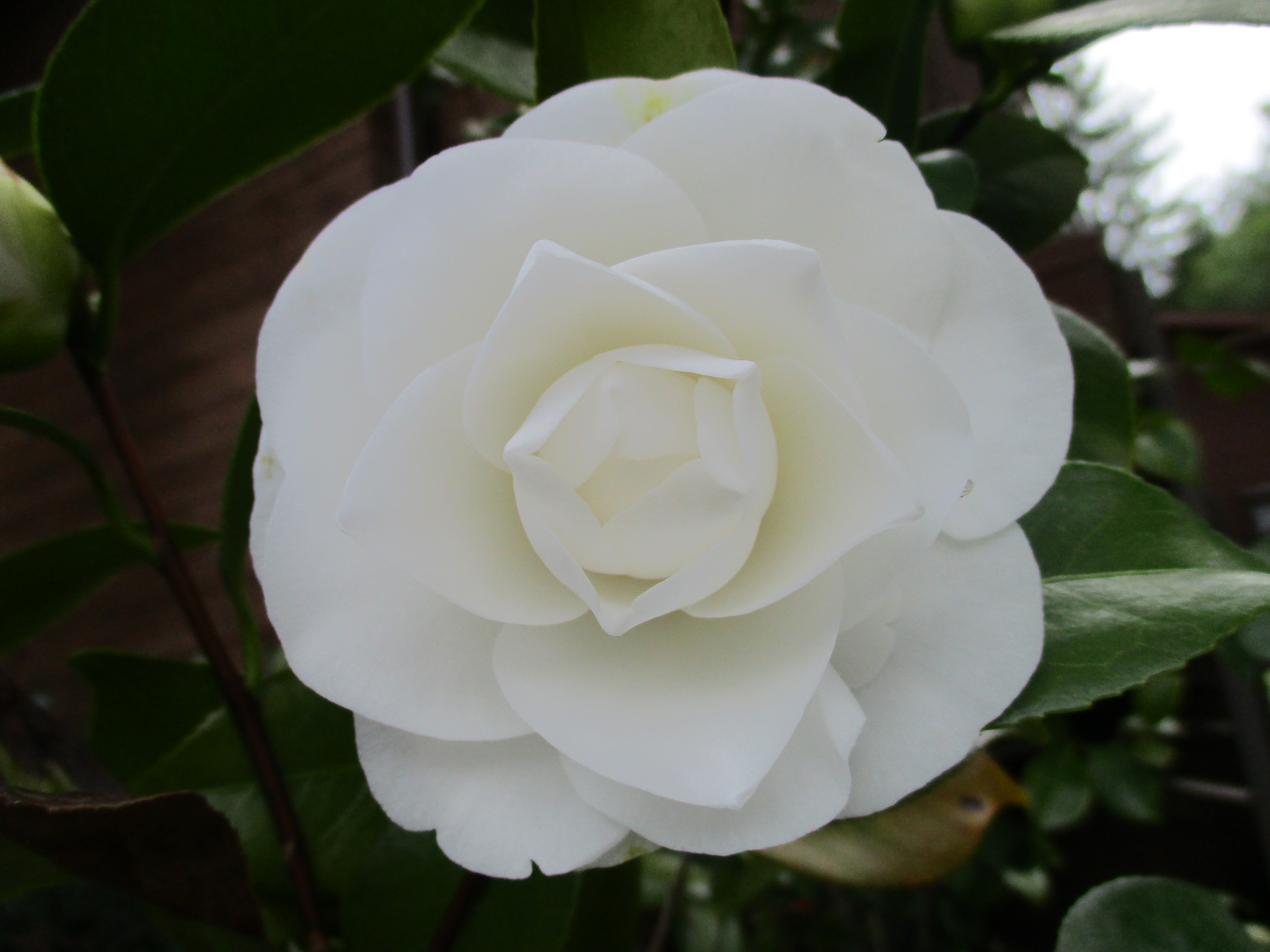
Camellia bloom for quite a while. A few blooms sneak out in midwinter before the main bloom phase, and a few flowers are still blooming now. There are at least a dozen cultivars here. This elegant white camellia might be my favorite.
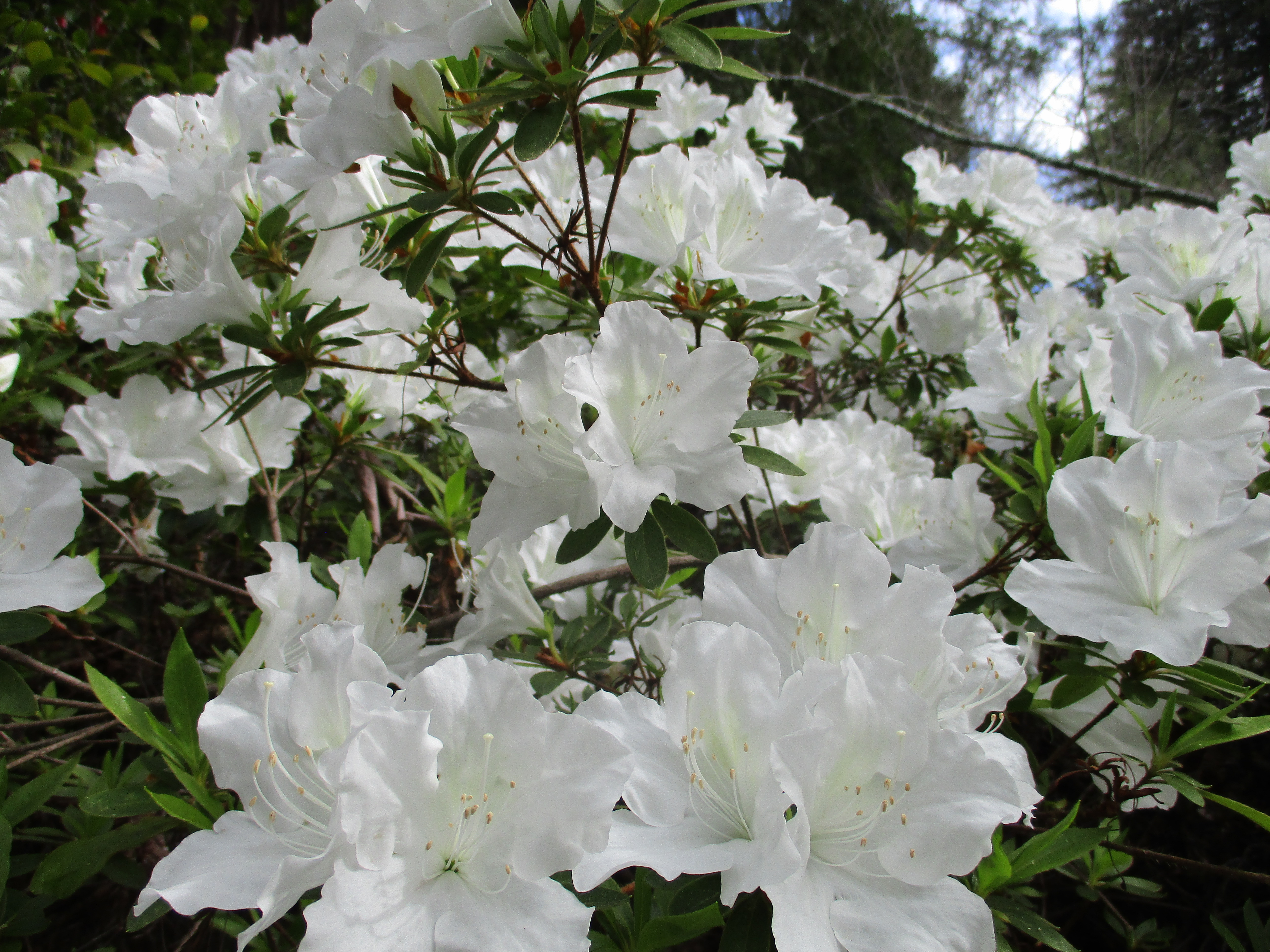
Azalea is even more variable than the camellias. Many are of course finished blooming; but a few still have unopened buds that will bloom this week! This is my favorite, obviously because it is white. I used to grow azaleas in the mid 1990s, as our second major crop. Rhododendrons were our primary major crop. We also grew camellias as our fourth major crop.
Garden Bloggers all over America and in other countries can share what is blooming in their gardens on the fifteenth of each month on “Garden Bloggers’ Bloom Day”, hosted by Carol Michael’s May Dreams Garden at http://www.maydreamsgardens.com


 Tony Tomeo