New View

It may not look like much, but it gets annoying, especially at night.

The industrial shop buildings at work are not exactly visually appealing. Fortunately, they are partially obscured from the roads outside by wild forest trees within the adjacent Zayante Creek and a roadside ditch. One road is on the opposite side of Zayante Creek. The other is on the opposite side of the roadside ditch that is perpendicular to Zayante Creek. Their intersection with associated traffic signals is therefore right outside. I added five Arizona cypress trees to the forested area of the roadside ditch, and three Monterey cypress to the forested area of Zayante Creek, to obscure the buildings more in the future. Unfortunately, though, some of the trees beyond needed to be removed for renovations of a major water main for Santa Cruz. One was a mature Monterey cypress between one of the shop buildings and the intersection of the two roads outside. Not only did this reveal the view of the backside of the building from the roads and intersection, but it revealed the view of the intersection from the few windows of the building. Now, from where I do much of my writing, I can see this traffic signal monotonously change from green to yellow to red.
Horridculture – Bullwinkle

P80808This rant may not go in the direction you expect it to. The pictures suggest that this would be about the bad vegetation management crews who severely disfigure trees that get too close to utility cables. It is not.
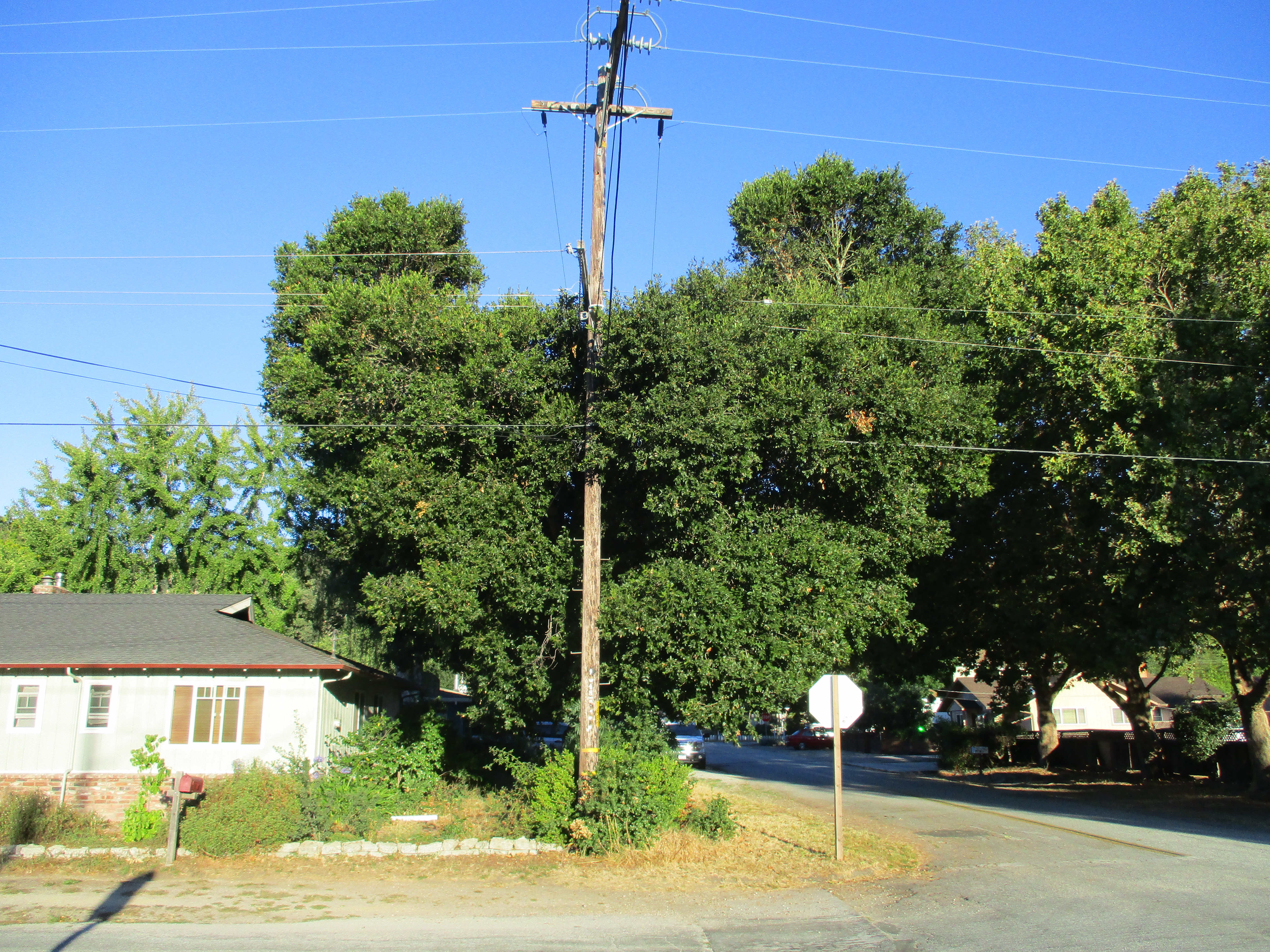
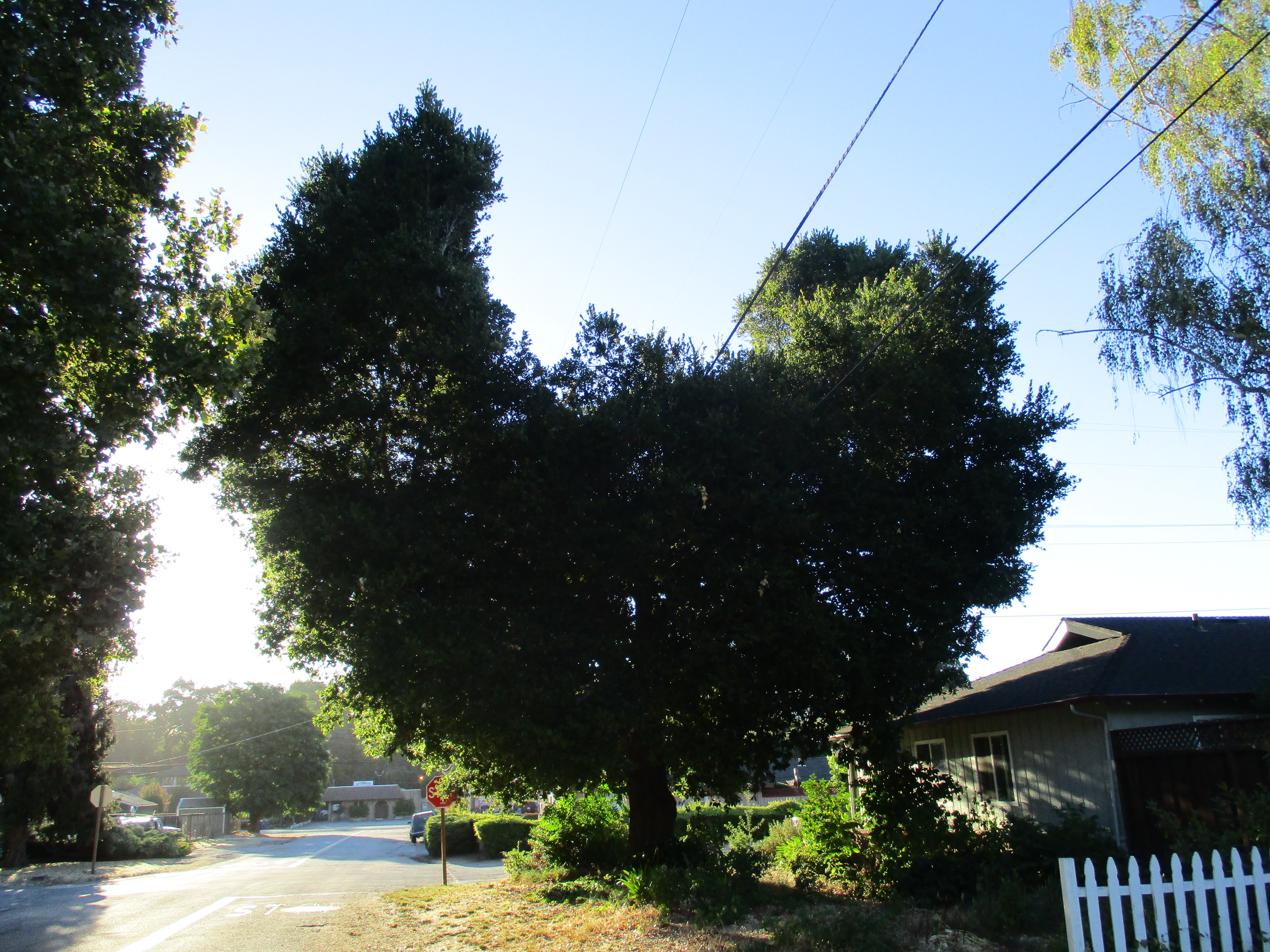
This is about horticultural ‘professionals’ who plant trees where they will encroach into utility cables, with no regard to what might eventually be done to them in order to keep electrical service reliable and safe. The native oak in these pictures likely grew from seed, so unless someone knows the squirrel who buried the acorn, there is no one to blame. Many of us who enjoy home gardening are sometimes not aware of how tall and wide particular trees can get when we plant them. Horticultural ‘professionals’ should know better! That is what they charge so much money for when they design a landscape.
Palm trees are the worst! They grow only upward, with only a single terminal bud. Once that terminal bud encroaches into a utility easement, there is no option to prune back to another branch that might direct growth around the easement. ‘Pruning’ the only terminal bud back kills the entire tree. Yet, some landscape ‘designers’ continue to prescribe the all too trendy queen palm for the backsides of urban landscapes, even if utility cables are back there like they so typically are.
The oak in these pictures got a Bullwinkle cut, with big ‘antlers’ reaching upward and to the left and right of cables that are directly above. The lower picture sort of shows a ‘step back’ cut into the top for clearance from other perpendicular cables that pass over that edge rather than directly above. The tree is in surprisingly good condition, and gets pruned as properly as possible for the difficult circumstances.P80808+This brief article from a few days ago discusses a few more details about easements. https://tonytomeo.com/2018/08/02/easements-really-should-be-easier/

Easements Really Should Be Easier

70802thumbLike Michael Jackson said, “You got an easement on down the road.”. . . or something like that. In older neighborhoods, that is where the utility easements are usually located. These are zones for utility poles that suspend electrical, telephone and television cables. When electricity first became available, that was the easiest place to put the cables, and the practice continued for decades.

Utility easements in middle aged neighborhoods are usually at the rear boundaries of back yards. They were put there to get out of the way of shade trees in front yards, particularly street trees. Where there are alleys in back, easements are on one side of the alley or the other. The same applies to narrow streets with easements. More modern neighborhoods have subterranean utilities.

Those of us who must contend with easements know how difficult they can be. Trees that encroach too closely to the high voltage cables on top of the poles must be pruned for clearance, even if such pruning disfigures or kills them. Lower cables for telephone and cable television sometimes get tangled with vines or big shrubbery because clearance from vegetation is not such a priority.

Utility providers have access to easements to maintain their systems. So do the tree services that have the grim task of pruning encroaching vegetation for clearance from high voltage cables. They do what they must to maintain reliable service; which is unfortunately not always compatible with what we want for our trees. Clearance pruning is too often unsightly, but it is very necessary.

The only way to avoid unsightly and disfiguring clearance pruning to to only plant trees that will not encroach into high voltage cables. Of course, in small gardens with big easements, the choices of trees that stay proportionate to available space are very limited. Except for Mediterranean fan palm or palms that stay very short, palms should never be planted below utility cables. They grow only upward, and can not be pruned around cables, so must be removed when they get too close.