Confluence

There are too many bridges to count here. Several roads and trails, and a historic narrow gauge railroad cross over two creeks and two streams within a relatively confined area. This particular suspension bridge is for a hiking trail that crosses over Zayante Creek at the downstream edge of its confluence with Bean Creek. Bean Creek, which is to the upper right in the picture below, flows through the farm on the outskirts of Scotts Valley. Zayante Creek, which is to the left in the picture below, flows through my neighborhood on the outskirts of Los Gatos. Ferndell Creek, which is just a stream from a nearby spring, also flows into this same confluence, but is not visible to the right of the picture below.

All of these creeks and streams sustain even more diverse ecosystems than those of the redwood forests above, and the chaparral pine forests a bit father above. Redwoods grow like weeds here. The redwood in the picture below is what is known as a ‘virgin’ because it was not harvested for lumber when most others were clear cut harvested to sustain development of the San Francisco Bay Area, and to rebuild San Francisco after the Great Earthquake and Fire in 1906. It was most likely rejected because it was too small to bother with at the time. Only a century later, it is massive! The cables that are now embedded into its bark formerly supported an older suspension that the newer bridge replaced many years ago. Although redwoods are not necessarily a riparian species, and can actually be resilient to drought, they do enjoy this abundance of moisture. The many other trees that inhabit these ecosystems with them grow very tall to compete for sunlight, and in some situations are excluded by their dense growth.

WWF

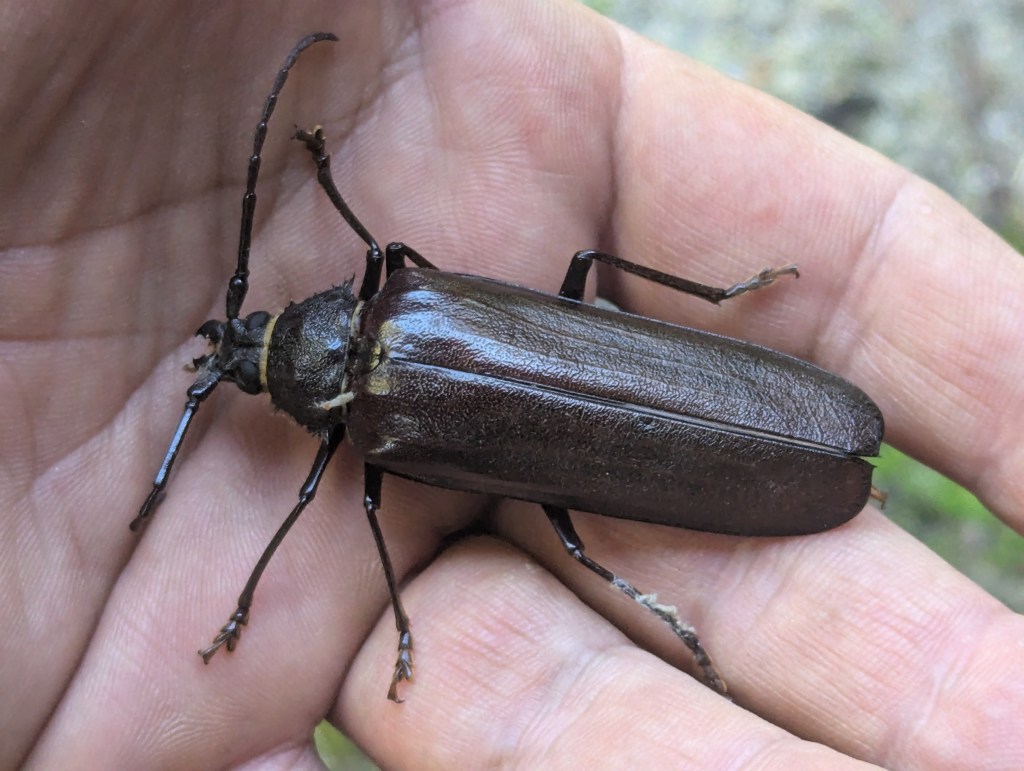
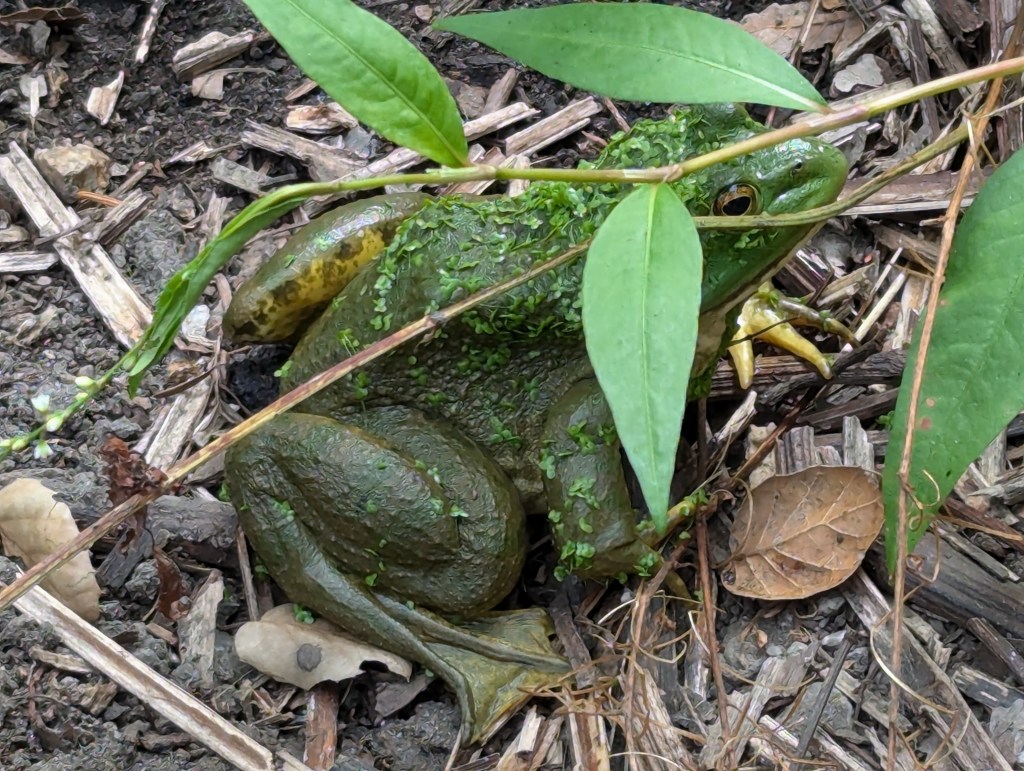
The World Wrestling Federation is now known as World Wrestling Entertainment because the World Wildlife Fund was already known as the WWF. The dude in the picture above could go either way. Apparently, he, or she, is some sort of aggressively invasive exotic bullfrog. Nonetheless, he or she still qualifies as wildlife, and now inhabits the drainage pond that is within a cultivated landscape that is adjacent to natural forest ecosystems. I mentioned his or her presence to a biologist who then informed me of how much damage this particular species can do to any natural ecosystem that it infests. I then realized that the tree frogs that had been so loud through spring had been silent all summer. Although they naturally get quiet by summer, they are not normally so completely silent. I am now concerned that the bullfrog might eat small fish who might inhabit the pond. Duckweed obscures activity below most of the surface of the pond. I would not mind if the bullfrog ate the duckweed. He or she probably does, but there is just too much of it. This species of bullfrog is omnivorous, so will eat anything that it can get its big mouth around, including mollusks and insects. That could be beneficial, but might also include beneficial insects. Actually though, I am more concerned about any baby fish than insects. Besides, when I met the insect in the picture below, I was actually somewhat concerned about the unwelcome bullfrog. I do not want his or her demise to be as violent as the appearance of this insect suggests it could be. I have no idea what this insect is, but it looks like it should have a Volkswagen hood ornament. Getting it together with the bullfrog could be an event for the WWF!

From the Muddy Banks of the Wishkah

Well, . . . it is not exactly on the muddy banks.

Kurt Cobain was here. So was I. That is how I got this picture of this English holly in this awkward situation within Kurt Cobain Memorial Park, on the muddy banks of the Wishkah River. I wrote about other pictures from there at my other presently discontinued blog, ‘Felton League’, a bit more than a year and a half ago. This particular picture was omitted because it was irrelevant to that particular post. It is more relevant to this horticultural blog.

‘From the Muddy Banks of the Wishkah’ is, incidentally, the second album that the band Nirvana recorded without Kurt Cobain.

English holly is more naturalized on the muddy banks of the Wishkah River and throughout coastal regions of the Pacific Northwest than it is here. There are not many ecosystems that it can not migrate into there. Here, it can infest only ecosystems that retain sufficient moisture through summer to sustain it, such as riparian or coastal ecosystems. Even within such ecosystems, it would not likely survive on top of a piling such as this specimen.

Some of the most prominent vegetation of the coastal ecosystems of the Pacific Northwest is surprisingly similar to vegetation here. Douglas fir, which is sporadically native here, is the most prominent species within the forests there. Bigleaf maple is likewise more common there than here. Naturalized Himalayan blackberry is even more common and more wicked there!

However, to me, the entire region seemed to be riparian. Nothing was far from some sort of waterway. I encountered nothing that resembled a familiar chaparral ecosystem. Someone who is more familiar with the region could distinguish between the various local ecosystems. I should be more observant about the diversity of the ecosystems and their associated vegetation, both native and exotic, when I return late next winter.

Nature Is Not Naturally Accommodating

Many trees naturally exhibit irregular form.

Gardening is quite unnatural. It involves unnatural cultivation of mostly unnaturally exotic (nonnative) species of plants. Irrigation delivers more water than seasonal rain provides. Fertilizers contribute more nutrients than endemic soils provide. Pesticides, if necessary, inhibit proliferation of pathogens. Nature simply could not accommodate such demands.

Not only is gardening unnatural, but it also interferes with established ecosystems. Many aggressively invasive plants were formerly desirable exotic plants that naturalized. Many pathogens arrived with exotic plants. Several naturalized plants have potential to distract native pollinators from native plants that rely on their pollination. It is an ecological mess.

Nonetheless, it works. Gardening within the constraints of nature would be unproductive. Most residents of California inhabit chaparral or desert climates that originally sustained limited vegetation. Such limited vegetation sustained a very limited indigenous populace within relatively vast areas. Modern residential parcels would be completely inadequate.

That is the justification for gardening, whether for sustenance, or merely to beautify home environments. Unnatural breeding continues to improve performance of many useful and appealing plants. Unnatural horticultural techniques generate more desirable vegetation within confinement of urban gardens than would naturally inhabit a few acres in the wild.

Nature remains relevant though. All plants originated within nature somewhere. Besides their basic requirements, exotic plants prefer environmental conditions that are similar to those of their natural origin. Some tropical plants crave more warmth and humidity. Some plants prefer more winter chill. Most popular exotic plants rely on supplemental irrigation.

Physical characteristics of many plants necessitate special accommodations also. Roots of plants that naturally compete in dense jungles are likely to damage pavement. Without adequate pruning, native plants that naturally exploit burn cycles can become perilously combustible. Many vines naturally try to overwhelm nearby vegetation and infrastructure.