
Sunday Best – Cicada

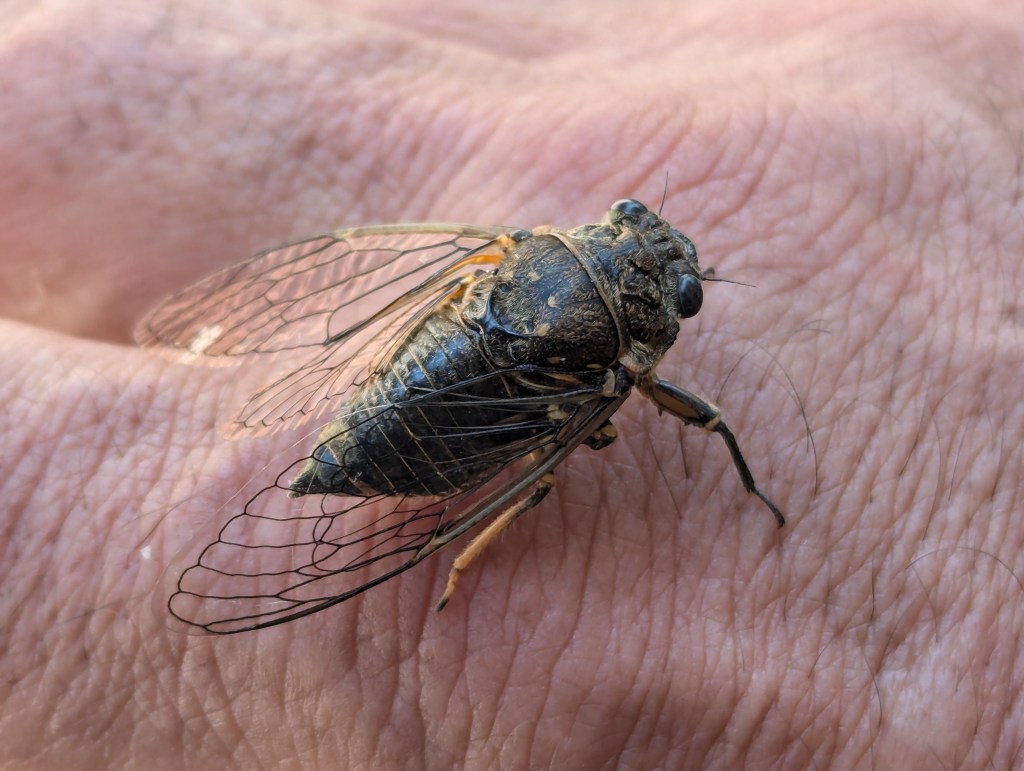
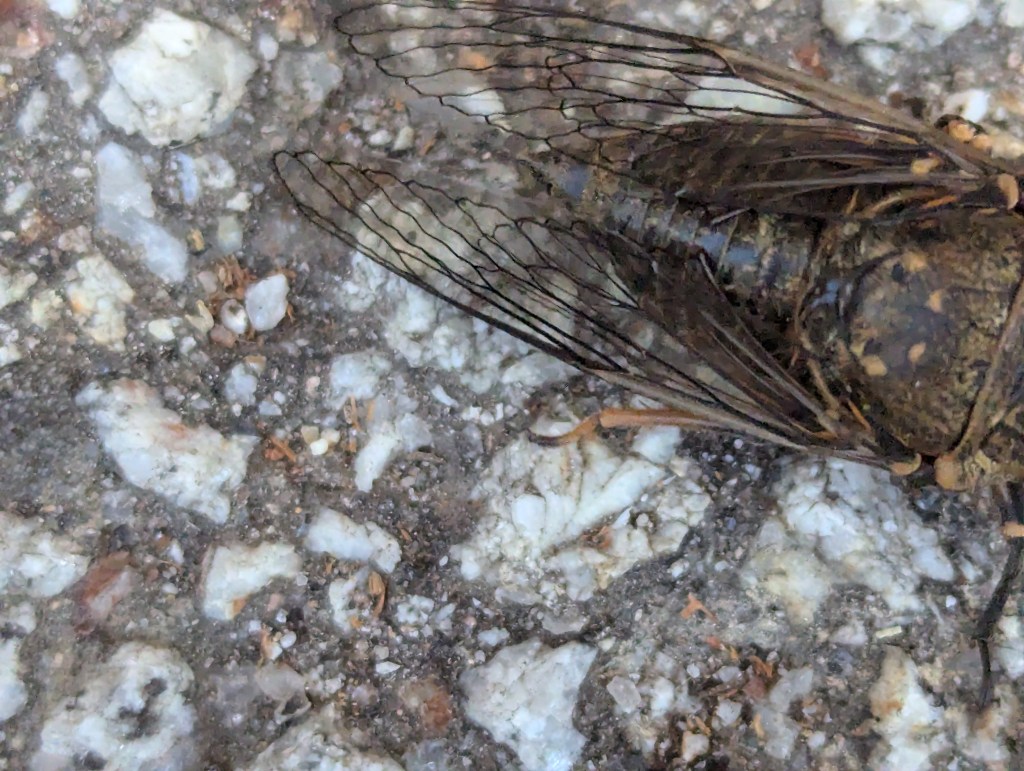
Contrary to common belief, cicadas are native to California. There are actually more native species here than in any other state. Of course, that is partly because California is so big, with so many distinctly diverse ecoregions. Cicadas are merely less prominent here because they are less numerous than they are within dense hardwood forests farther east. Within most regions here, they are somewhat rare. Even where they are most numerous, they do not congregate to form obnoxiously loud populations as they do elsewhere. Some native species are content to share their relatively mixed western forests with relatively few individuals of their own kind, and perhaps a few individuals of other cicada species. They are loud enough to find each other over significant distances. This cicada found its way to where I was enjoying the garden last Thursday. It was quite intimidating when it arrived with loud buzzing of its wings. It flew awkwardly before bashing into a steel building with a loud ‘PING’ that sounded more like a fat acorn falling onto the roof. I should have fled. It circled on the ground briefly before getting airborne again, and coming after me! It landed on my collar. I managed to maintain my composure as I removed it. I could see that one of its wings was impaired, as is evident in the picture above. That did not stop it from trying to fly again. It did not get far before landing on the asphalt driveway. It did not cooperate for the second picture below, which, although not of good quality, demonstrates that the impaired wing is not so impaired. It was likely merely out of whack from crashing into the wall. Before we could get acquainted, this no longer so intimidating cicada flew away as awkwardly as it arrived.

Well, not exactly locusts; although, until they were reclassified within the Order Mantodea, they were of the same Order Orthoptera as locusts. Nor are they affiliated with either honey locust, Gleditsia triacanthos that I wrote about for last Tuesday, or carob, Ceratonia siliqua that I wrote about for the previous Tuesday, and which is the sort of locust that sustained John the Baptist in the desert. These abundant critters are young mantises, which likely hatched shortly before posing for this picture that my niece took on her front porch. My niece had seen a slow moving adult mantis there last autumn, and guessed that it might have deposited eggs, and then later died in privacy. Fortunately, she enjoys all sorts of flora and fauna, and was not too disturbed by this scene, or by the mother last autumn, as even some who work outside might have been. In fact, to the contrary, she was pleased that their mother felt that her porch was safe enough for them to start their lives on. She knows that there are plenty of insects for them to eat within the vegetation that inhabits the landscape there, as well as in nearby landscapes. This many mantises will eventually disperse into the neighborhood to satisfy their voracious appetites as they grow. That is why mantis eggs are available for sale from some nurseries. They are beneficially predatory insects because they consume detrimental insects. Since their arrival, my niece did a bit of research on their sort, and found that some people actually raise certain rare varieties of mantises as pets. As weird as it seems, it is no weirder than pet tarantulas. Anyway, this picture was taken more than a week ago. These baby mantises are likely already growing fast and dispersing elsewhere into Los Angeles.

Mycology was a topic that we horticulture students did not study much in school. We learned about some of the more important fungal diseases of vegetation, but that was about all. We could not take the time to study it any more extensively than mycologists could take the time to study horticulture or even botany.
Yet, horticulturists are often expected to know more about mycology than we should be expected to know. Perhaps it is because fungal organisms seem to grow sort of like botanical organisms grow. In ancient history, mycology actually was more closely related to botany, but needed to become a separate discipline as more was learned about each of the two. Perhaps that was at a time when entomology still included arachnids, myriapods and crustaceans. Heck, there was a time when earth, air, water and fire were considered to be the only four primary elements.
I have no idea what this mushroom is. It got my attention because it is so weird. It is such a weird mix of pastel purple, gray and white, with such a distinctly flat top. It was solitary. Not only did I see no others like it, but I noticed no other terrestrial mushrooms of any sort nearby. It appeared amongst blackberry bramble and naturalized English ivy, on the bank of a creek, under bay trees, with bigleaf maples, white alders, red alders and a deceased Douglas fir nearby. The area was quite damp from all the rainy weather this winter. Large and likely old rusty ruddy brown basidiocarps extend from the rotting bases of some of the bay trees. Smaller and likely younger brown and white basidiocarps extend from the rotting trunk of the deceased Douglas fir. All of this is irrelevant, since I still have no idea what this is.
 They were impossible to miss. They came at a weird time too.
As guests were arriving for a big event, a fire alarm was activated, and compelled everyone to leave the building that they were gathering in. The swarming bees met the guests as they came outside. The bees just happened to show up in the same place and at the same time as the guests were forced outside. Fortunately, no one seemed to mind, and some found the swarming bees to be compelling enough to stop and take pictures.
Initially, all the bees were flying in a big swarm. Those closest to the middle of the swarm were flying fast, sort of like angry wasps. No one saw the queen that the swarm was centered around, but she apparently landed on this redwood limb about forty feet up. The swarming bees slowly collected in this mass around the queen. By the time I took this picture, almost all were attached to the mass, with only a few still flying about.
At least three swarms started to establish new hives in buildings near here last year, and needed to be removed by beekeepers. One hive started to develop where another had just been removed. Another swarm was removed before establishing a new hive.
Bees seem to be attracted here. Perhaps they appreciate all the flowers in the landscapes. It is unfortunate that they can not stay where they typically try to move in. Most of us really like them.
This swarm was still here when I left, so I do not know what happened to it afterward. Hopefully, it either left the area, or at least moved into a place where it will not be problem, such as in a rotten tree trunk out in the forest where bees belong.
 Perhaps I should see this movie. I hear that it is pretty lame. I sort of wanted to see it because it was filmed in Cambria, about thirty miles to the northwest of where Brent and I were in our last year of studying horticulture at Cal Poly in San Luis Obispo at the time. Yet, I never select movies. I always leave that up to whomever I am seeing the particular movie with. None of my friends ever wanted to see Arachnophobia. The one friend who you would think would want to see it because of where and when it was filmed wanted nothing to do with it. You see, Brent, the famous horticulturist and landscape designer who works outside where spiders live, is afflicted with Arachnophobia.
About a year before the filming of Arachnophobia began, in early 1988, Brent lived in Sequoia Hall at Cal Poly to the north of San Luis Obispo, and I lived south of town, about twenty minutes away. Brent called me up early one morning as I was getting ready to leave for school to tell me about a spider in his dorm room. Perhaps “tell” is not the best word to describe his frantic panic. I mean, he was totally freaked out!
I told him to wake up Jerry, his roommate who usually slept in a bit later, and have him remove the spider. He got even more frantic and told me that Jerry was up in the room. Well, . . . if Jerry was up in the room, and Brent was not with Jerry, I just had to ask, “Where are you?!” “I’m calling from the payphone in the lobby!”, Brent explained frantically. (Telephones were hardwired in 1988.) Okay, so this complicated things a bit. He actually ran from the room and down from the third floor before stopping long enough to use a telephone? I told Brent that he should go back up to his room and have Jerry remove the spider. He really freaked out, and exclaimed, “Are you not listening?! THERE IS A SPIDER UP THERE!!”
Somehow, after explaining that Jerry did not answer the telephone when he had tried to call a few time before calling me, Brent convinced me to rush over and stop by before class to remove the spider for him. Brent was in his pajamas without slippers when I met him in the lobby and proceeded up to his room, where Jerry had just woken up to find Brent gone and the door wide open. We both went to the lower left sill of the window where Brent had seen the terrifying spider, and found it, dead. Yes. . . dead. I rushed over there, parked in a red zone, rushed upstairs, all to kill . . . a dead spider.
Well, it was not exactly a dead spider. It was the molted exoskeleton of a spider. In retrospect, I should have told Brent either that it was a dead spider, or that we had found and killed it. You see, Brent and I studied entomology together, so we knew how this molting process worked for certain insects. Arachnids like mites and spiders use a similar technique. As they grow too large for their external skeletal structure, they shed it, and then hide out somewhere while their new exterior hardens into a new exoskeleton. So when I told Brent that we found the molted exoskeleton, he freaked out all over again knowing that the spider was still hiding in his room, and that it was BIGGER!
I do not remember how Jerry and I got Brent to go home the following evening. Perhaps his second best option was to come to my house, where spiders were quite common. We never actually saw the spider.
 Tony Tomeo