
Sunday Best – Epiphyllum

Hippeastrum papilio, butterfly amaryllis is an uncommon and weirdly epiphytic amaryllis. It may not be as pretty as the countless more colorful hybrids of the genus, but it is more reliably perennial. All of the few specimens that I have observed within home gardens are potted or in the ground, either because they are easier to grow that way, or because those who grow them are not aware that they are epiphytic. After all, that is quite weird.
This specimen, from my Six on Saturday post earlier this morning, is blooming in Brent’s garden. As I mentioned earlier, Brent did not know what it was when he acquired it from a neighbor who left it with him when she relocated. I know that it does not look like much in this picture, but that is only because Brent is an idiot, and takes bad pictures. I intend to get a copy of this butterfly amaryllis for my garden, and may try to grow it epiphytically.
I find this species to be more appealing than prettier hybrids, both because it is reliably perennial, and because it is a simple species rather than a hybrid. This is also why I dug a few naturalized Crinum bulbispermum, Orange River lily bulbs for my garden. They are none too pretty, but will last forever. The same applies to Amaryllis belladonna, naked lady, but they are a bit too prolific and common to not potentially qualify as a weed. Their bright pink floral color can be a bit obnoxious anyway. But of course, that is why I was so very pleased to find a bulb that bloomed white, which is my favorite color. It is multiplying nicely here now, just like I know the butterfly amaryllis will once I get a fresh copy of it.

What a weird tree! Fiddle leaf fig, Ficus lyrata, is an uncommon but familiar large scale houseplant that we might not welcome into our homes if we knew how it behaves where it grows wild in the lower rainforests of Western Africa. Although it can grow upward from the ground like almost all other trees do, it often germinates and begins to grow as an epiphyte, within organic debris that accumulates in the branch unions of other trees. While suspended, it extends roots downward. Once these roots reach the forest floor, they develop into multiple trunks that overwhelm and crush the host tree as they grow.
The bold foliage is typically dark drab green, like the shades of green that were so popular for Buicks in 1970, with prominent pale green veins. Individual leaves are about a foot long and potentially nearly as broad at the distal (outward) ends, often with randomly wavy margins. Like fiddles, they are narrower in the middles, or actually more often narrower at the proximal (inward) ends. When pruning becomes necessary, the caustic sap should be soaked from fresh cuts with paper towels so that it does not drip and stain.
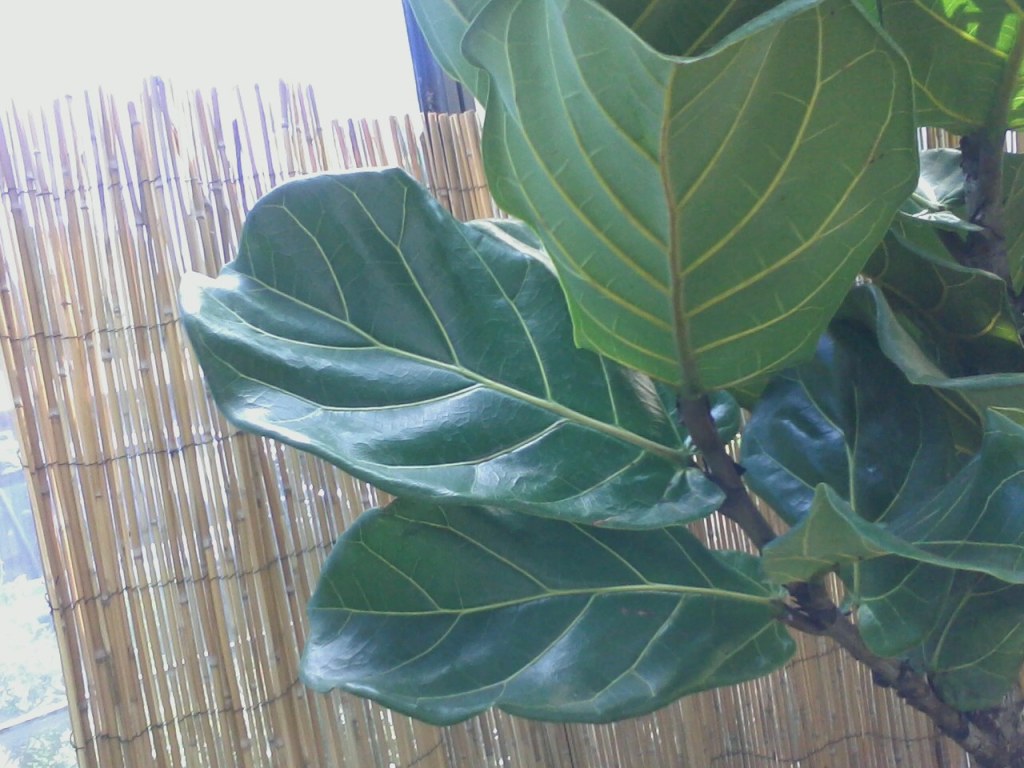
What a weird tree! Fiddle leaf fig, Ficus lyrata, is an uncommon but familiar large scale houseplant that we might not welcome into our homes if we knew how it behaves where it grows wild in the lower rainforests of Western Africa. Although it can grow upward from the ground like almost all other trees do, it often germinates and begins to grow as an epiphyte, within organic debris that accumulates in the branch unions of other trees. While suspended, it extends roots downward. Once these roots reach the forest floor, they develop into multiple trunks that overwhelm and crush the host tree as they grow.
The bold foliage is typically dark drab green, like the shades of green that were so popular for Buicks in 1970, with prominent pale green veins. Individual leaves are about a foot long and potentially nearly as broad at the distal (outward) ends, often with randomly wavy margins. Like fiddles, they are narrower in the middles, or actually more often narrower at the proximal (inward) ends. When pruning becomes necessary, the caustic sap should be soaked from fresh cuts with paper towels so that it does not drip and stain.
I do try. I prefer to submit pictures that conform at least somewhat to a particular theme. It just did not work out that way for this week. The only thing in common with these pictures is that they are from the same garden. It is garden at work, but one that I do not do much in.
1. Grape, which I still think of as dago wisteria, was planted here years ago, by someone who is no longer here to take care of it. The established vine grows like big voracious weed. I pruned it back last winter, and pulled up several stems that rooted where they flopped onto the ground. There are still six copies left at the storage nursery. I would like to plant some of them this winter, but the one original is already too much work. The grapes are somewhat tart when ripe, which makes me suspect that it is not quite warm enough here for them. It gets warm during the day, but cools off at night.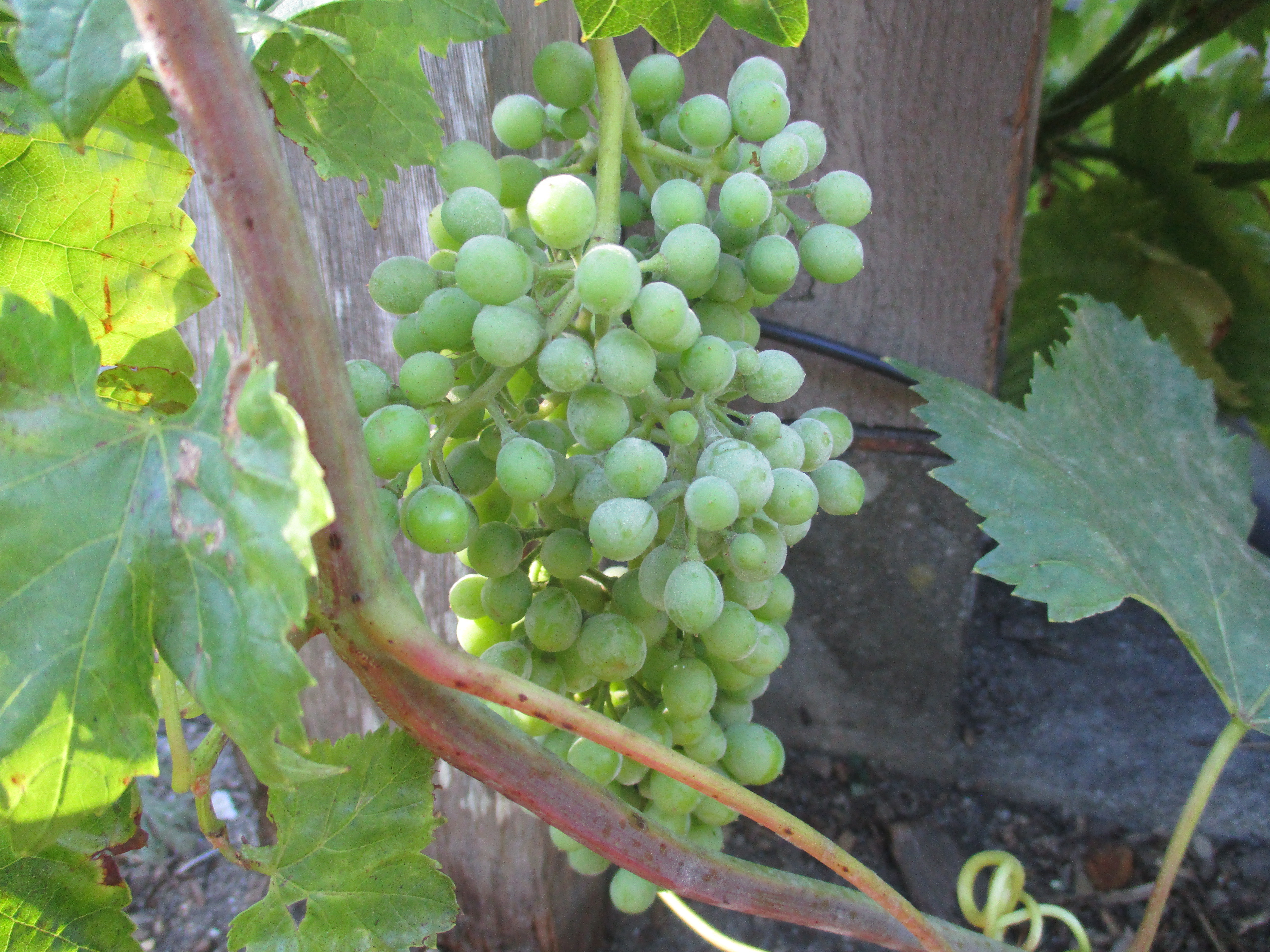
2. Succulent of an unknown species grows so close to the grapevine that it was overwhelmed before I pruned the vine back. This is a common exotic succulent that has been around in the region for a long time. I remember that it grew on the sides of some of the roads in Montara, along with other vegetation that naturalized from the gardens of homes that had been there during the Victorian period. I suppose that it is naturalized also in some spots, but does not seem to be aggressive or invasive about it. This particular specimen was likely put here intentionally. The foliage is always yellowish.
3. Tillandsia, along with a few other epiphytic bromeliads, were added to this garden just this year. They are wired onto this branch from the Eucalyptus cinerea that I mentioned in ‘Silver‘ last week. The branch is a scrap from pruning that was just propped up in the landscape for the ephiphytes. The big gray limbs in the background are of an old ‘Kwanzan’ flowering cherry tree. The epiphyllums that I mentioned two weeks ago on Sunday in ‘Epiphyllum Surprise‘ get hung from the cherry tree while they are in bloom, and then sent back to the storage nursery for recovery when they finish.
4. Spanish moss hangs with the tillandsias on the same branch of the Eucalyptus cinerea. It does not grow here naturally of course. It would probably prefer a significantly more humid situation. It gets watered and misted automatically from above. So far all the epiphytes seem to be happy here, and do not see to mind that the stem that they are clinging to is from a eucalyptus. Mosses that cling to native oaks do not cling to eucalyptus trees until the trees are old. While viable, young eucalyptus bark is toxic to mosses and other epiphytes, and exfoliates too regularly for much to cling to it anyway.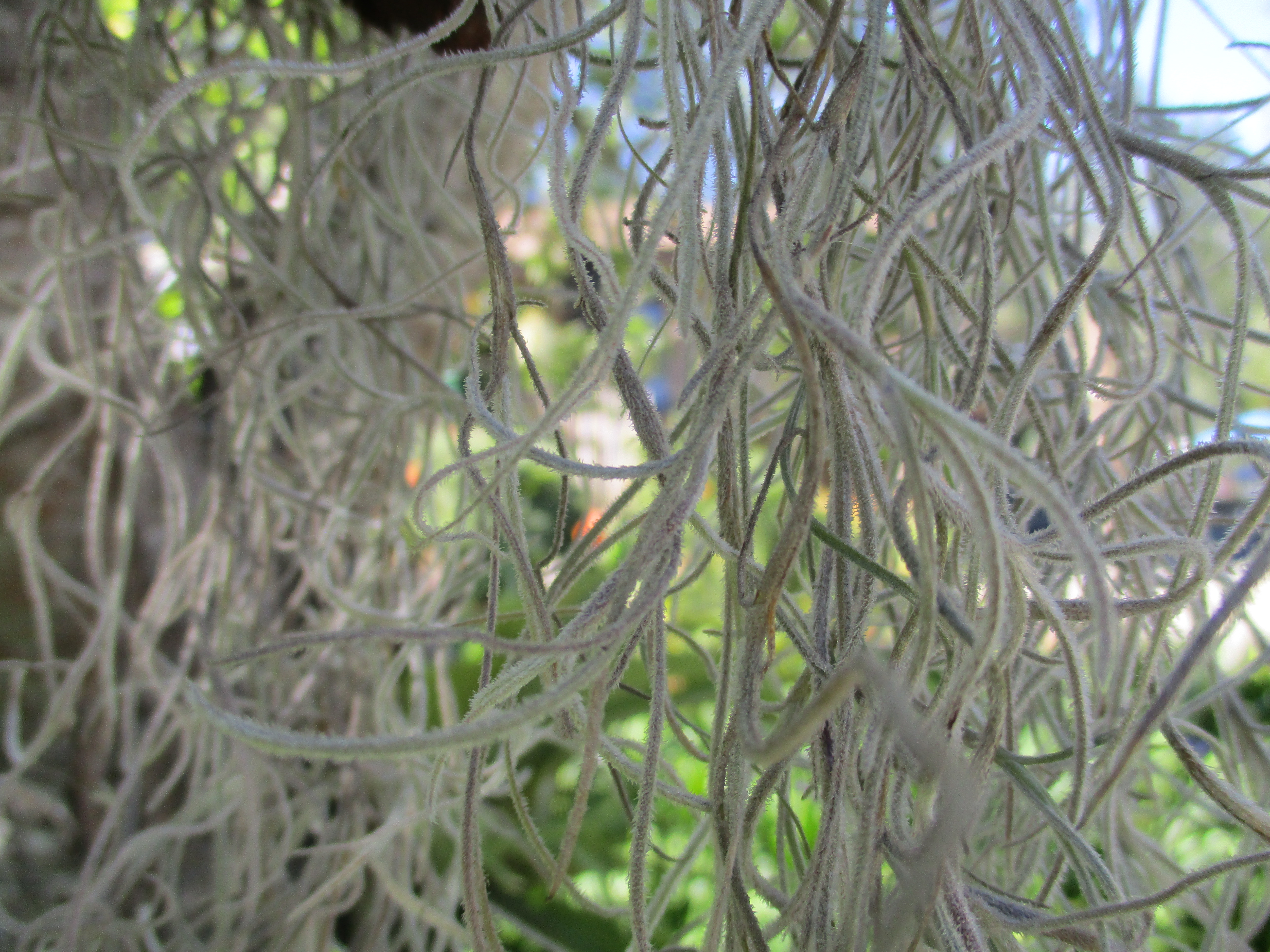
5. Alyssum happens to be one of my favorite wildflowers in this garden. When I was little kid, I found a small envelope of mixed wildflowers seed in a Sunset Magazine in a waiting room in a hospital. It is a long story, but to be brief, I ‘borrowed’ the seed, and put it out in my mother’s garden. The alyssum from that mix naturalized and self sowed quite nicely for decades. The original plants might have bloomed more colorfully, but eventually reverted to basic white, just like these that grow wild here. I still believe that white is the best, but would not mind other colors if I ever grew it intentionally.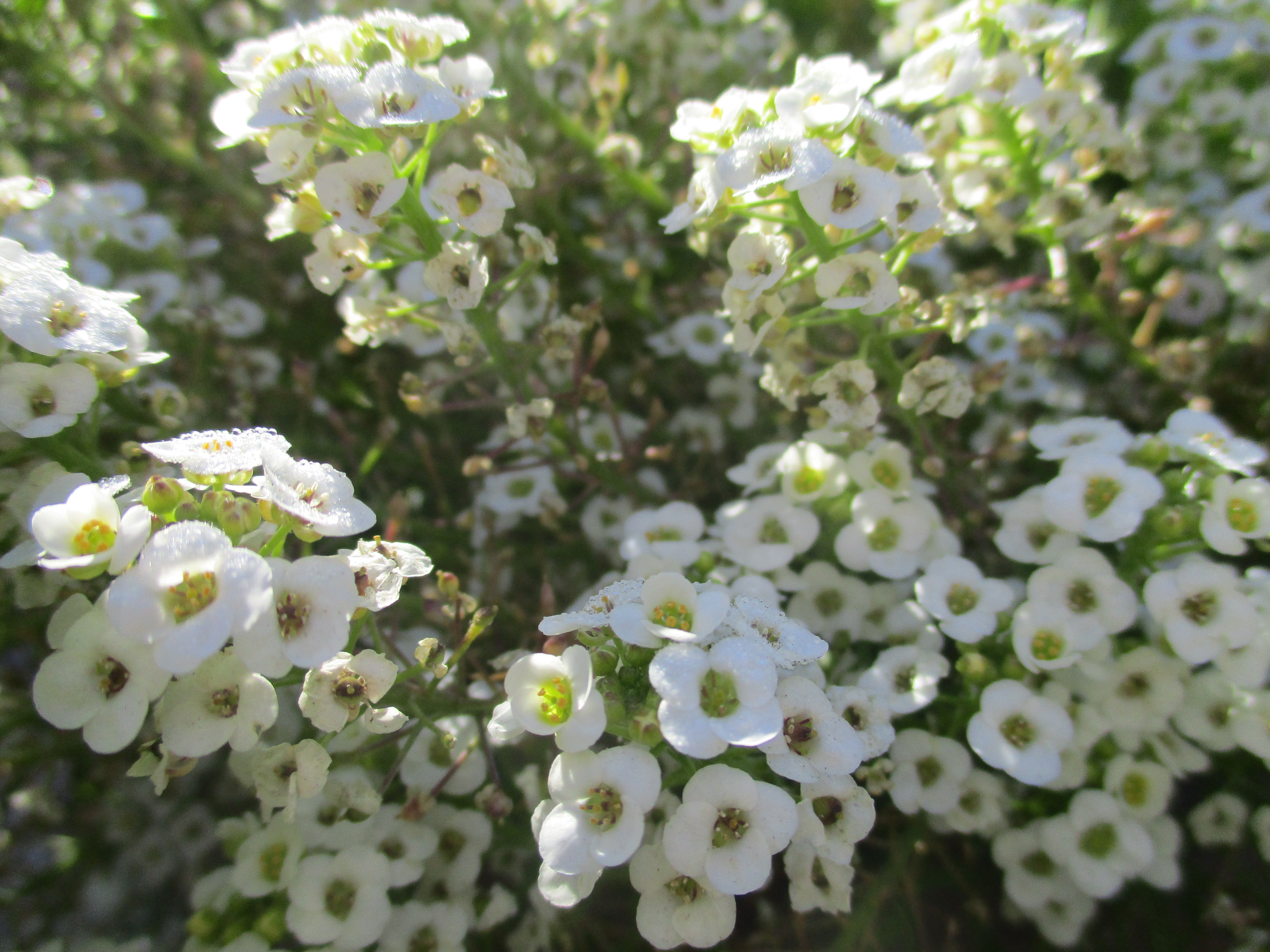
6. Morning Glory is another favorite, but for a different reason. I like it here because it is so much prettier than it ever was in any of my gardens. I sowed the seed, and cared for it, but morning glory was never very happy for me. In this garden, it sows its own seed, and does reasonably well. The vines are not as voracious as they are supposed to be, but the flowers are pretty. That is probably a good thing. These vines happen to be next to the grapevine, so could make quite a mess on top of the mess of the grapevine if they grew as well as they are supposed to. This is a good compromise.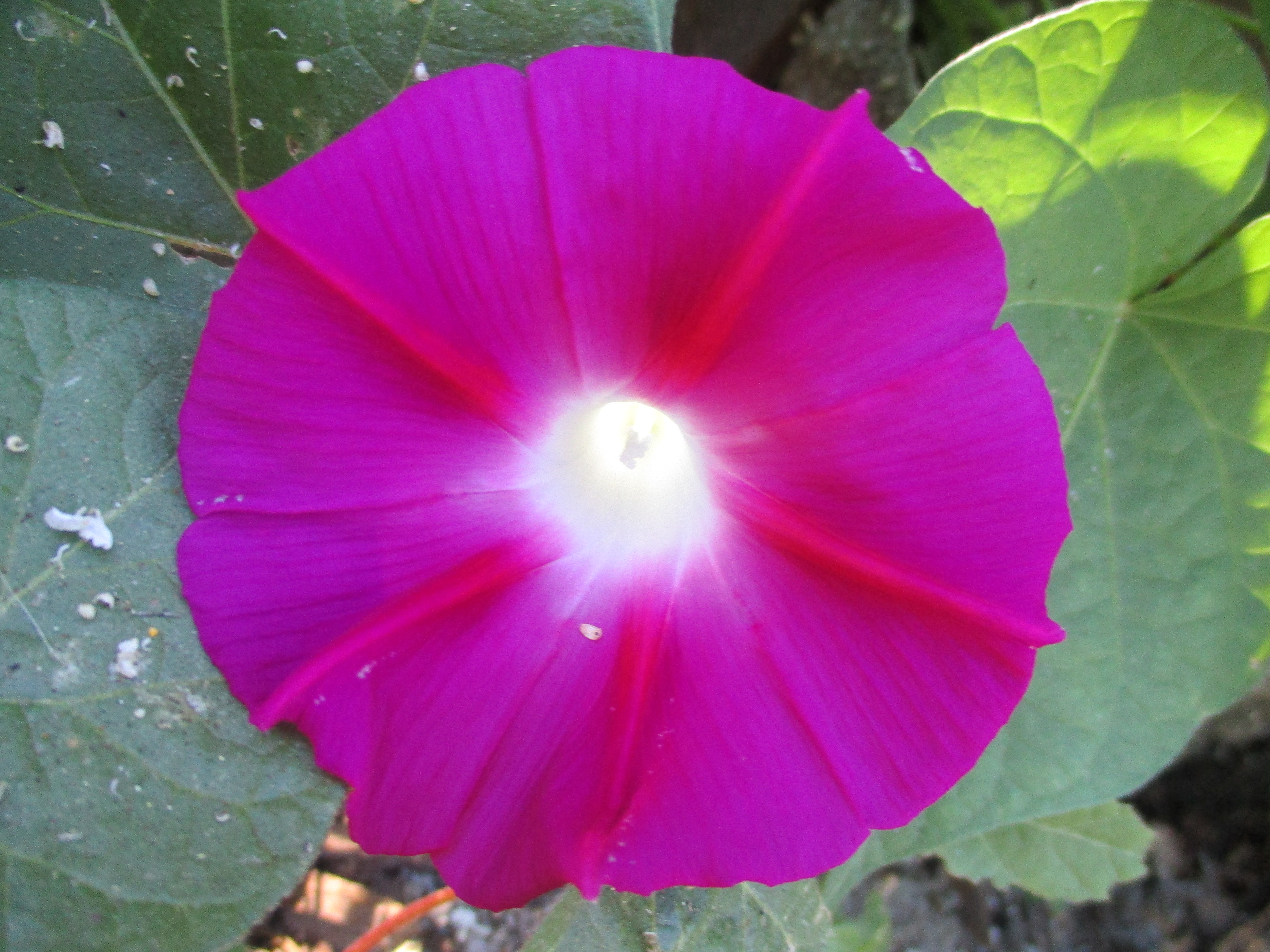
This is the link for Six on Saturday, for anyone else who would like to participate:
https://thepropagatorblog.wordpress.com/2017/09/18/six-on-saturday-a-participant-guide/
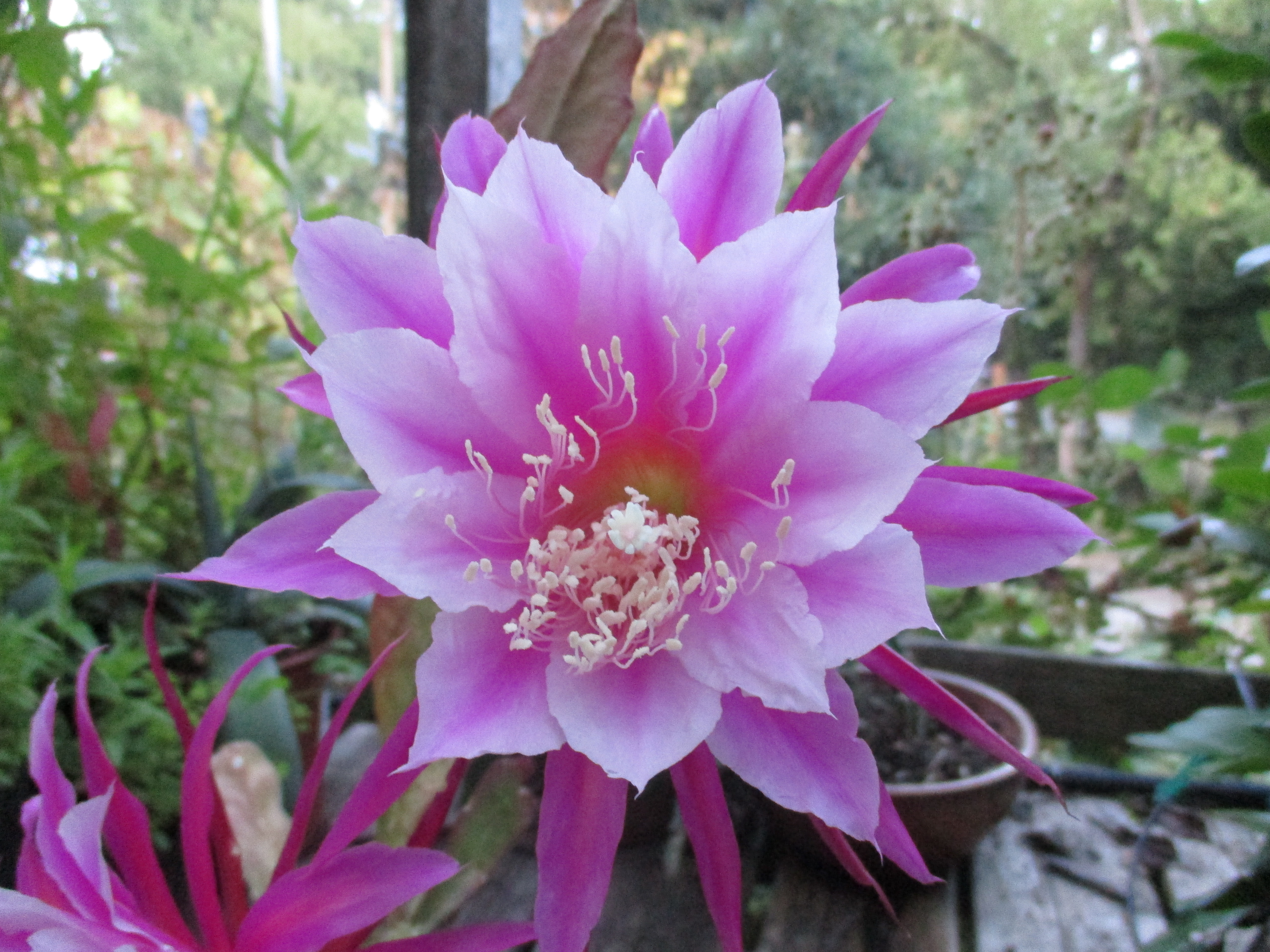
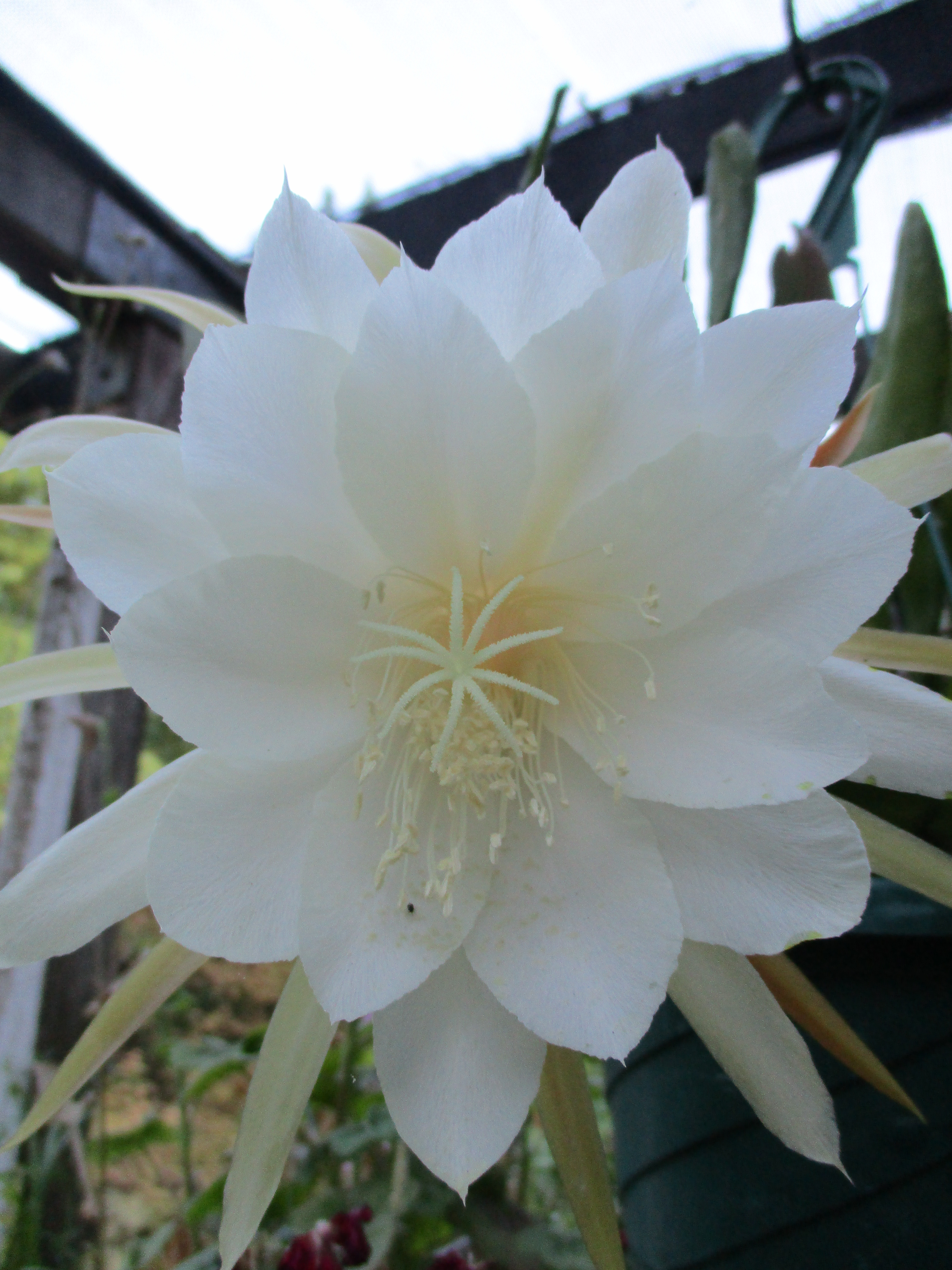 Epiphyllum oxypetalum was my very first epiphyllum. A friend’s mother gave me three long cuttings, which were cut in half to make six cuttings. They grew like weeds, and I was quite pleased with them. At the time, they were the only epiphyllum that I wanted. The wide nocturnal flowers are strikingly pure white and nicely fragrant, and stay open late into the morning if the weather is right. Since white is my favorite color, I craved no more.
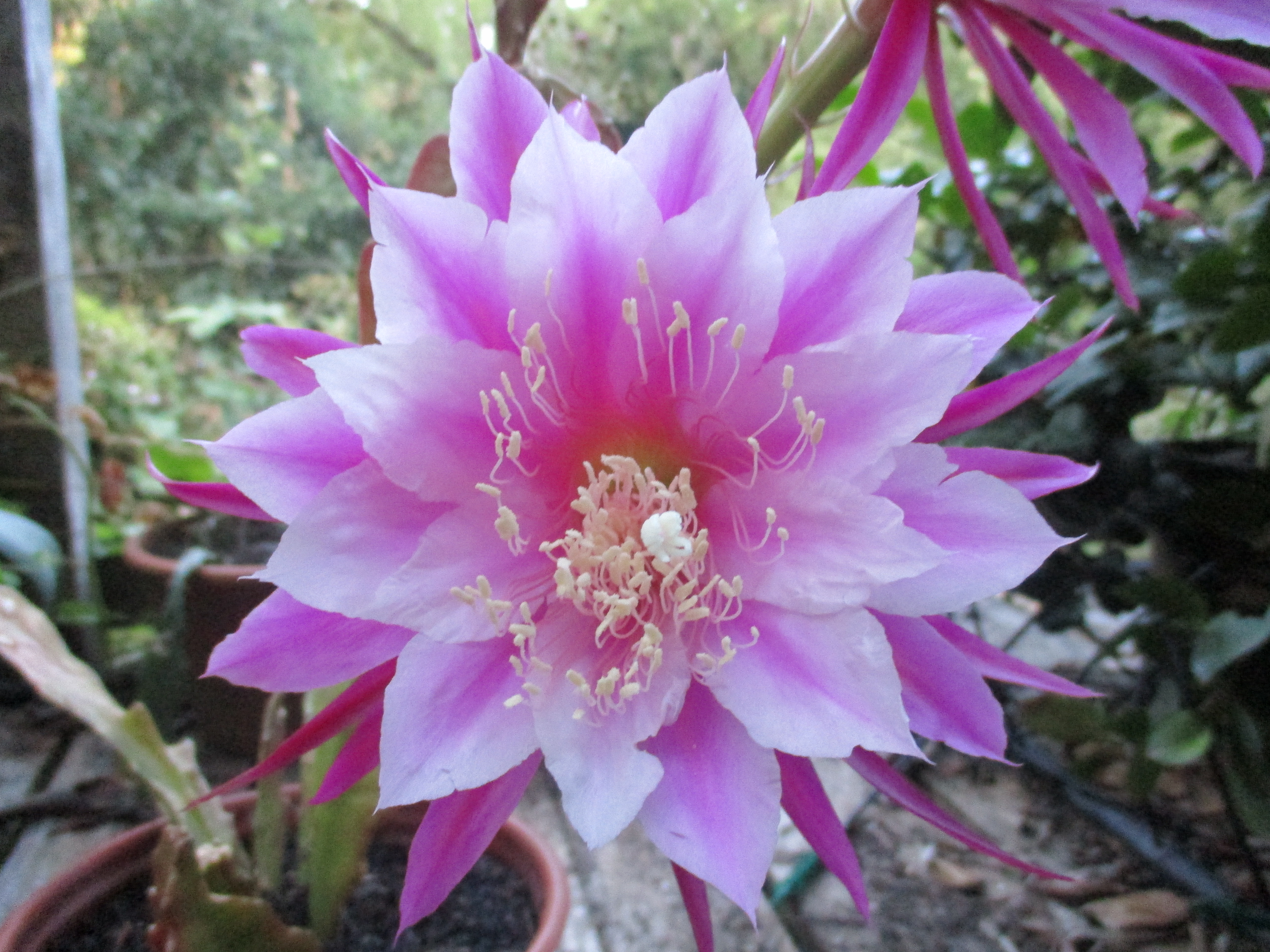
Then I got bits of another epiphyllum from one of my clients. I do not know if it really is a species of epiphyllum, but it grows just like one, with the exception of the bloom. Rather than only a few huge nocturnal flowers, it blooms with many smaller pink flowers that remain open all day. It lacks fragrance. It is not as impressive as Epiphyllum oxypetalum, but it is colorful for a longer time. Besides, now that I got it, I must continue to grow it.
Shortly afterward, I acquired a bit of another epiphyllum from another client. I expected it to bloom with a bright red flower, but it did nothing. In fact, it sat around for a few years without doing anything. Finally, it bloomed for the first time this year. That is the surprise.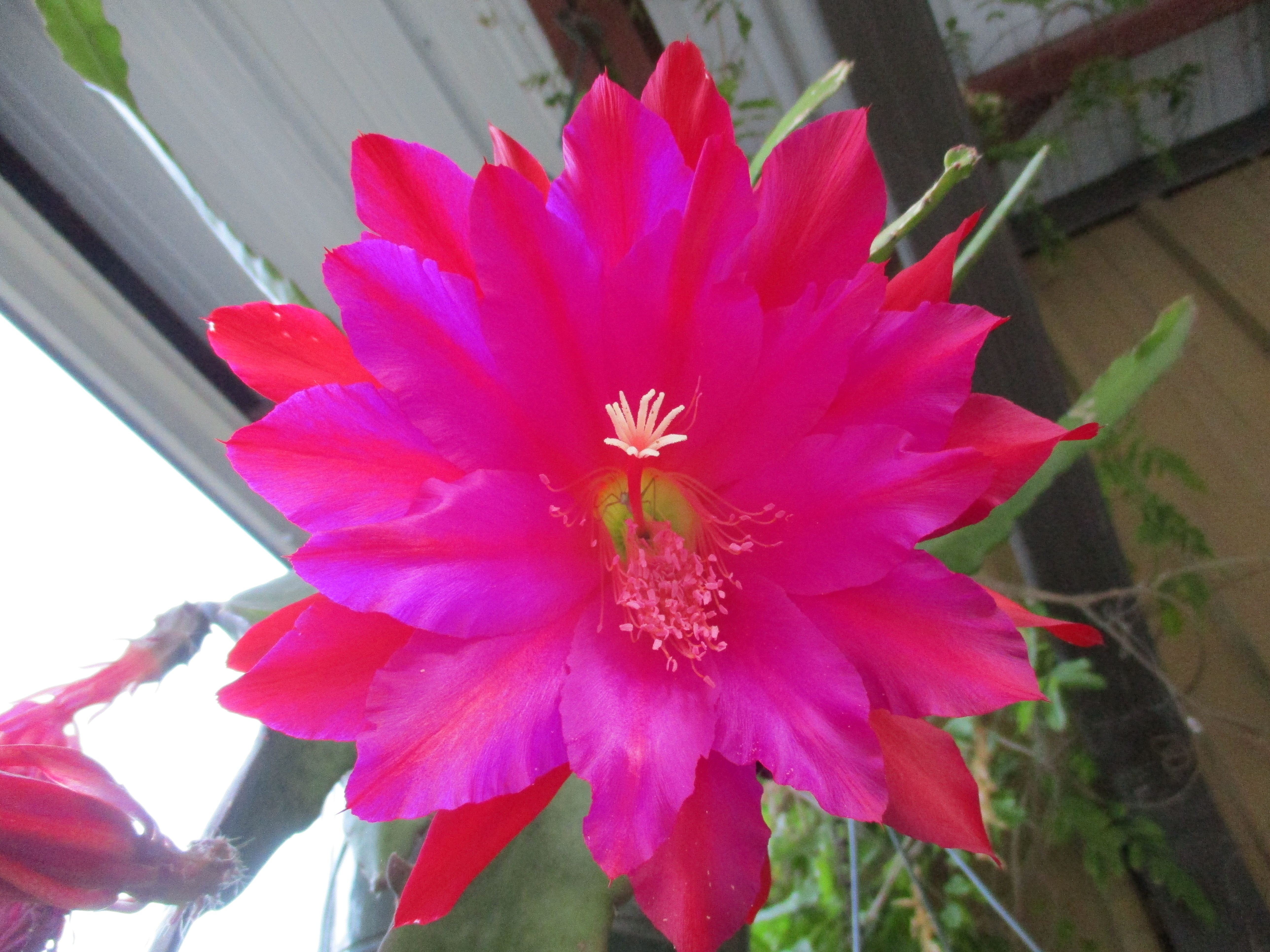
This red epiphyllum that bloomed last year is not mine. It belongs to a colleague who hangs it in public garden at work while it is blooming. This is what I expected mine to look like. I sort of believe that it happens to be one of the more popular cultivars of epiphyllum.
What I got instead was these intriguing pink blooms! I don’t know what to think. The clear whit Epiphyllum oxypetalum is still my favorite, and I really like the rich red, but these pink flowers are totally rad too!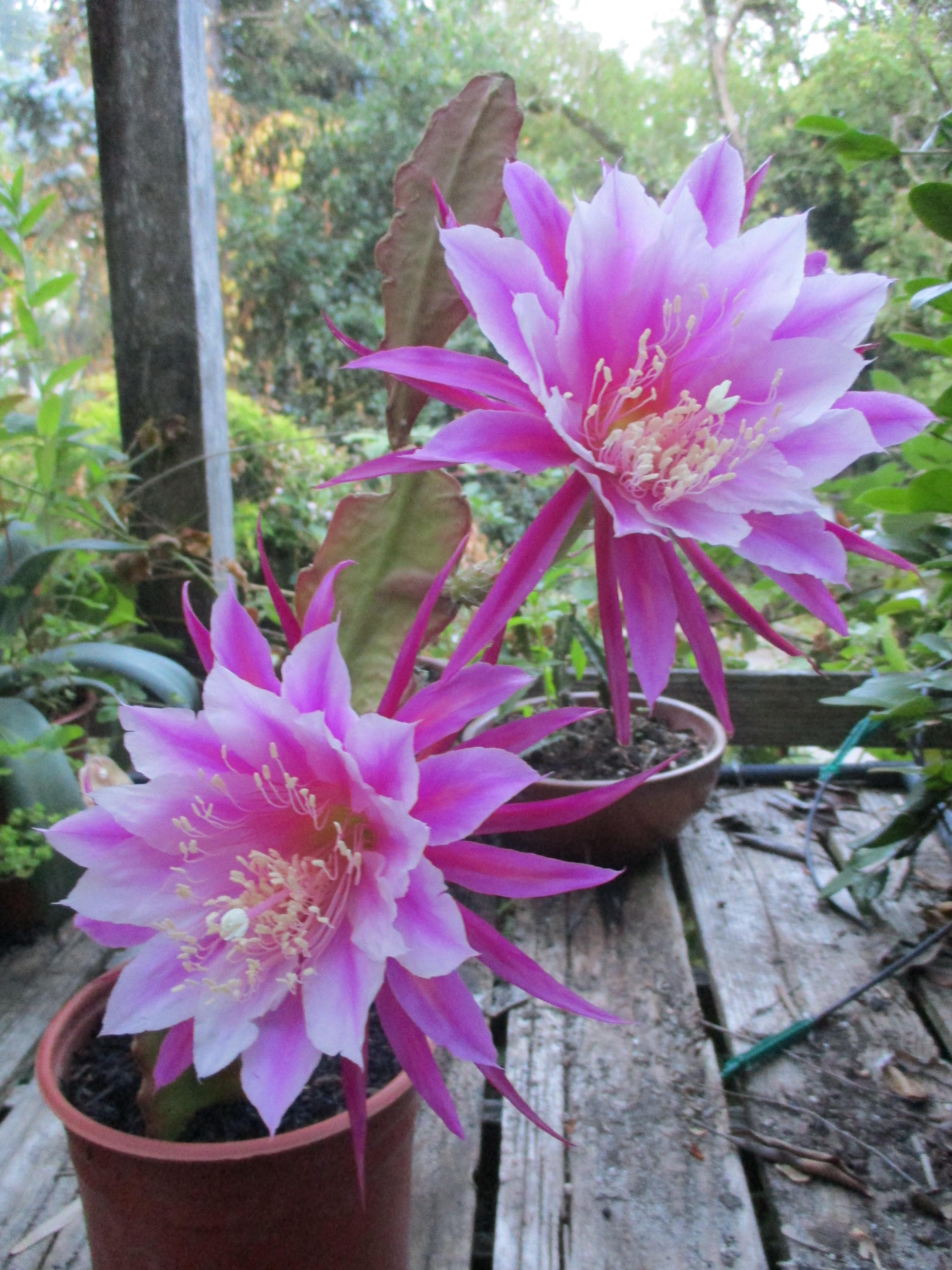
Cacti was the topic for my gardening column less than two weeks ago. ( https://tonytomeo.com/2018/07/30/cacti-are-notorious-for-nonconformity/ ) Both space and illustrations are limited in the column though. Only a picture of a prickly pear was posted with that main article. The other part of that article, which is a brief description and a picture of white epiphyllum, was posted the next day. ( https://tonytomeo.com/2018/07/31/epiphyllum-oxypetalum/ ) Since then, I have been wanting to get a picture of one of the small but delightful orange flowers of a prickly pear in the private collection of one of my colleagues. Now that I got that picture, I really did not know what to do with it. I got two other pictures of the fruit and stems of the same prickly pear, and three more pictures of other cacti in the same collection so that I could post them here. Instead of saving the best picture for last, the prickly pear flower is posted first just because it is that cool.
1. Prickly pear flower should bloom during the day. They should not be nocturnal. I can not be certain because I am not familiar with this particular species. What I do know is that the flowers have been open early in the morning, and then closed shortly after exposed to sunlight, almost like those of a nocturnal epiphyllum. It took me a while to get this picture of this single peachy orange flower.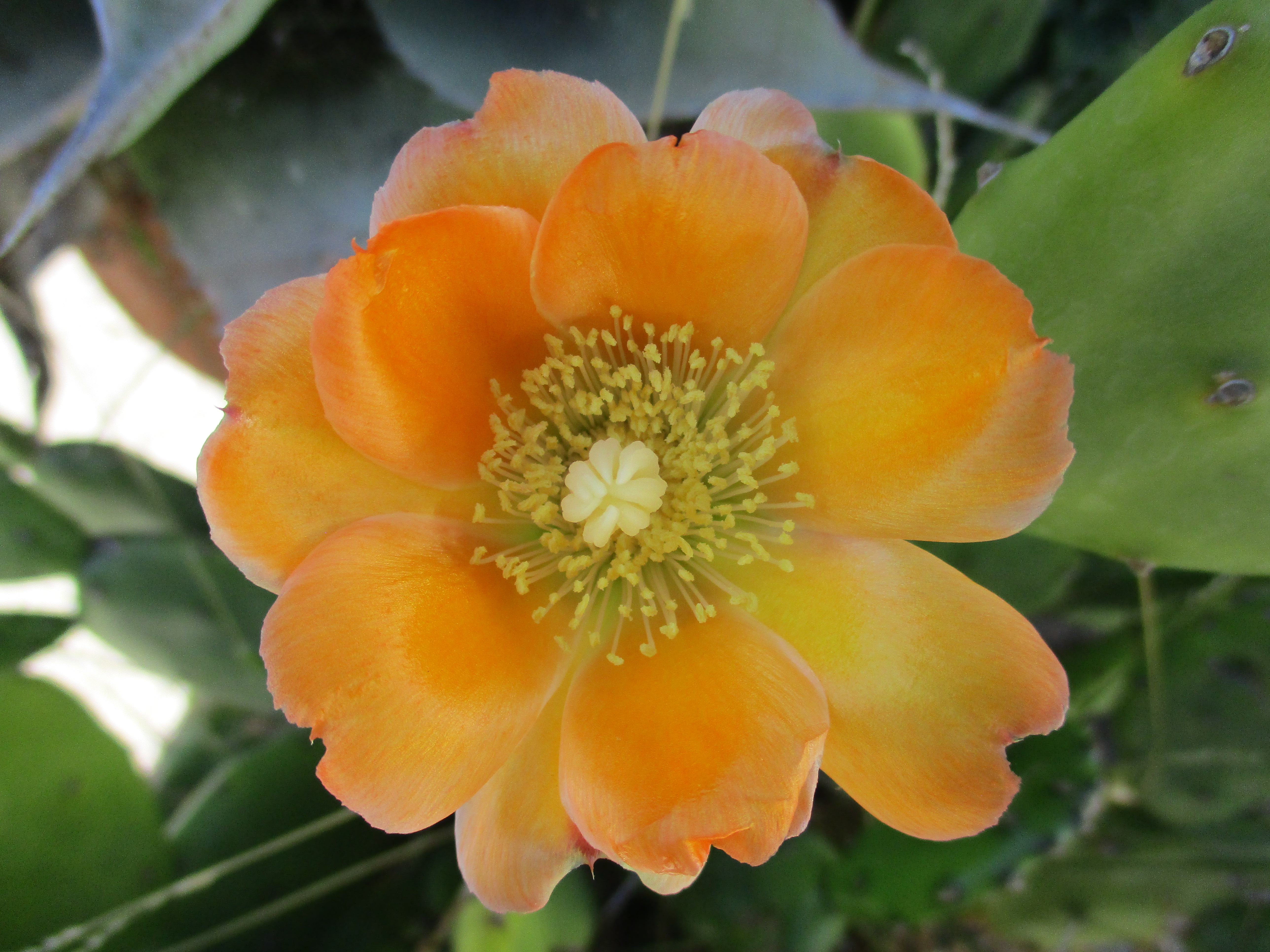
2. Prickly pear fruit should ripen right after bloom, but most fall off of this plant while still green. It might be because the plant is potted and watered regularly. Those that ripen are only about two inches long, and quite pithy without much flavor. They would probably be bigger, more abundant and better flavored if the plant could grow in the ground.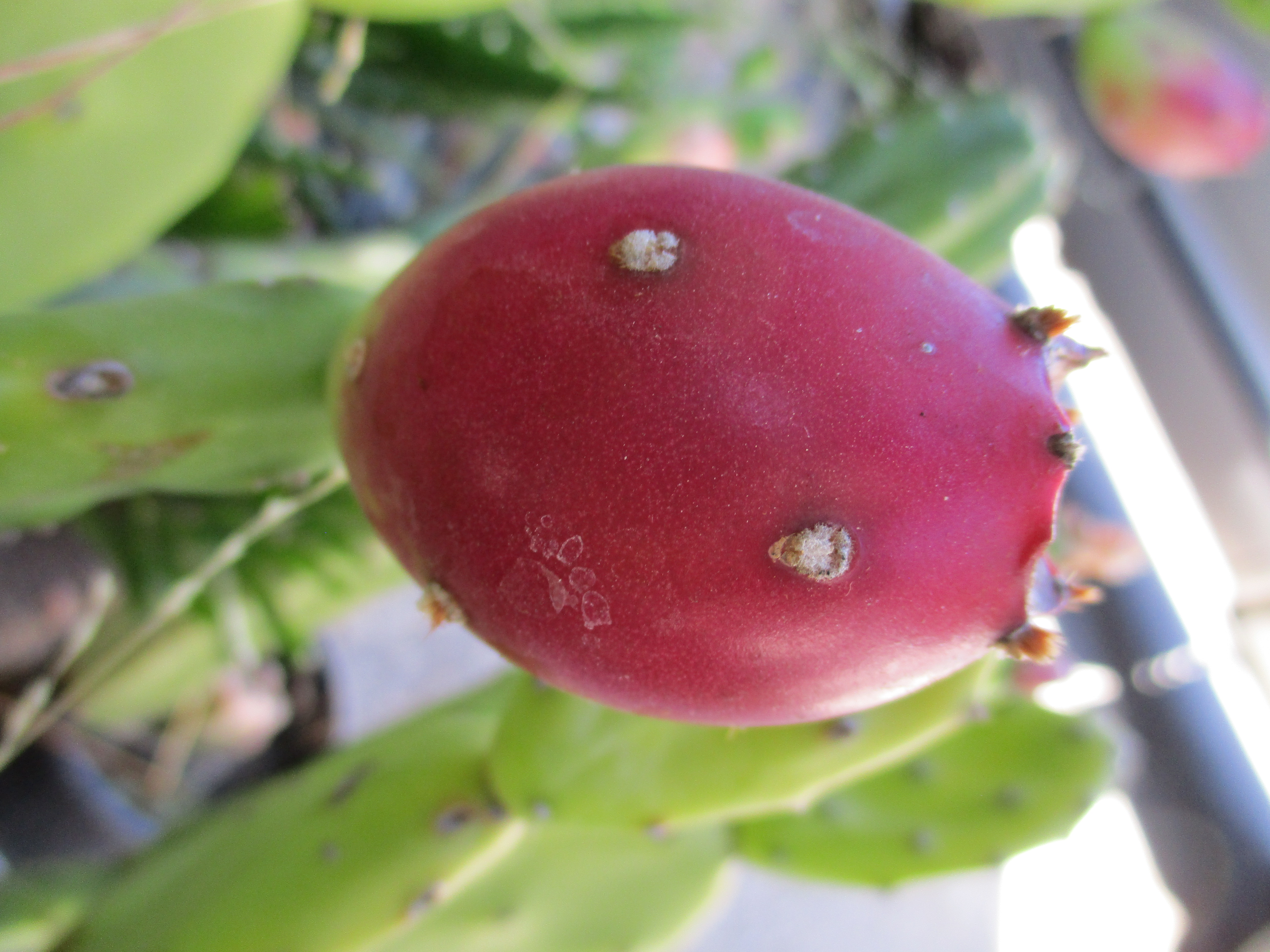
3. Prickly pear pad is not as prickly as those that I got a picture of for the previous article about cacti. I do not know how their flavor is because I have not tried them. This is a small plant that can not spare many pads. Even if there were a few to spare, they are not very big, even when mature. The probably would not taste very goo either, since they take so long to mature in the pot.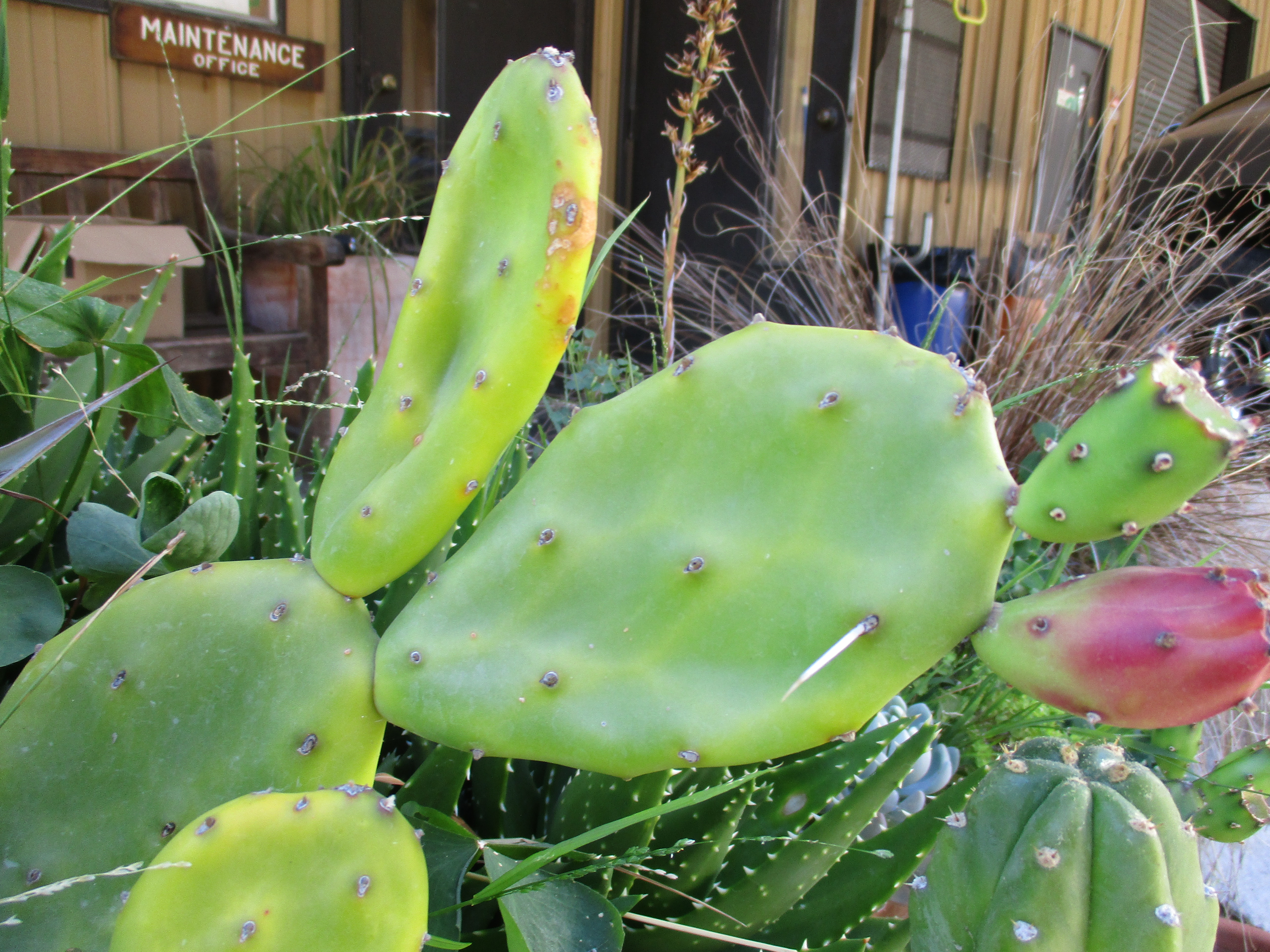
4. Cereus cactus really is nocturnal; cereusly! It produces huge white flowers that are about as big as those of the white epiphyllum that was featured earlier. The flowers do not open until after sundown, and may wait until late at night. While open, they are powerfully fragrant. The fragrance seems to ‘turn on’ immediately when the flower open, and ‘turn off’ as soon as the flowers close before dawn.
5. Rat tail cactus, like epiphyllum, is epiphytic, which means that it grows where debris collects in crotches of limbs in big trees. If they grown on the ground, they just sprawl about and maybe form low mounds. This is not an exemplary specimen, although it bloomed well earlier, with reddish orange flowers that are significantly smaller than those of the epiphyllum, and also a bit smaller than those of the prickly pear.
6. Epiphyllum is a weird epiphytic cactus. This particular cultivar is even weirder than most. Cacti photosynthesize with their green stems, while using what should be leaves as spines. This cultivar does not seem to be satisfied with that technique, so is outfitted with these weird leafy appendages on its flat green stems, as if it really wants leaves like other plant have.
This is the link for Six on Saturday, for anyone else who would like to participate:
https://thepropagatorblog.wordpress.com/2017/09/18/six-on-saturday-a-participant-guide/
The common names of ‘Dutchman’s pipe’ and ‘queen of the night’ are not much less awkward the the Latin name of Epiphyllum oxypetalum, which might be why the Latin name is more common than the common names are. Some know it as ‘white ephiphyllum’ or even more simply as ‘white epi’. It is one of the more popular of the epiphyllums; and it is the most popular with white flowers.
The nocturnal flowers appeal to nocturnal pollinators. What we see simply as luminescent white is actually outfitted with exquisite patterns that are only visible to those who can see ultraviolet light, like nocturnal moths. Bats are as blind as . . . well, bats, but can follow the richly sweet fragrance if they choose to. Sunlight disables fragrance immediately, and causes flowers to close soon after.
In the wild, sprawling primary stems can cascade almost twenty feet. Of course, they are much shorter in home gardens. The more pendulous secondary stems that bloom get about a foot long, and perhaps three inches wide. Flowers bloom in summer, and can be half a foot wide and a foot long. Epiphyllums naturally hang from trees as epiphytes, so will do the same from hanging pots.
 Staghorn ferns are epiphytes. They cling to tree trunks, rocks or whatever they happen to grab onto. They can root into decayed wood if it is porous enough, but they are satisfied to just cling to the exterior. They do not need soil. They sort of make their own soil by collecting debris that falls from the canopies of trees above. In the jungles where they live, they get all the water they need from rain. They often live in the crotches of branches because that is where they happen to land. (The epiphyte I wrote about earlier was just a palm that landed in the wrong place, but is not really an epiphyte. https://tonytomeo.wordpress.com/2017/11/15/epiphyte/ )
In home gardens, staghorn ferns are often grown on wooden plaques so that they can be moved around like potted plants. Because it does not rain much here, they need to be watered occasionally. They do not grow very fast, but eventually need to be attached to larger plaques, or divided into smaller clumps that fit onto new plaques. Alternatively, they can be grown like plants in hanging pots, but without the pots. Even if they start out in pots, they may eventually envelop and obscure their pots, and form a big rounded hanging mass that only wants water and debris from above. A small bit of fertilizer might improve their naturally light color, but too much will roast leaf margins.
My colleague Brent Green acquired this humongous and well rounded specimen from a client who wanted it removed from an olive tree that it had grown too big for. It had been there for decades. Brent gives it a banana every month or so because it likes potassium. It does not get much debris from above in Brent’s well groomed garden.
 The ivy in this sycamore did not just climb up from the ground to hang over this big limb. If you look closely, you will see no vine coming up from the ground. This small patch of ivy as well as a small pyracantha, are growing in a decayed cavity on top of the big limb. The ivy may have climbed up a long time ago, and then rooted into the cavity before the original vine was somehow removed. Alternatively, the ivy might have grown from a seed that was dropped by a bird or ivy vines that are higher up in nearby box elder trees. It is impossible to say now.
 It is also difficult to say why there is such a large cavity on top of the limb. It could have originated as a large scar incurred from the impact of another large limb that fell from above. There are a few cavities higher up that were caused by large limbs breaking away. Although unlikely, the cavity could have developed from sun scald damage, after the upper surface of the big limb suddenly became exposed by the loss of limbs higher up.
 This other aerial patch of ivy hangs from a smaller cavity higher in the same tree. Oddly, among sycamores, such cavities on upper surfaces of large limbs are not uncommon. Sycamores often drop large limbs from high in their canopies, exposing or damaging lower limbs below. Their lightly colored bark is very susceptible to sun scald if suddenly exposed after always being shaded. It is also not very resilient to heavy impact. Of course, more typical cavities develop on trunks where significant limbs broke or were pruned away. Other plants can grow in these as well, as demonstrated by the ‘epiphyte’. https://tonytomeo.wordpress.com/2017/11/15/epiphyte/
 Tony Tomeo